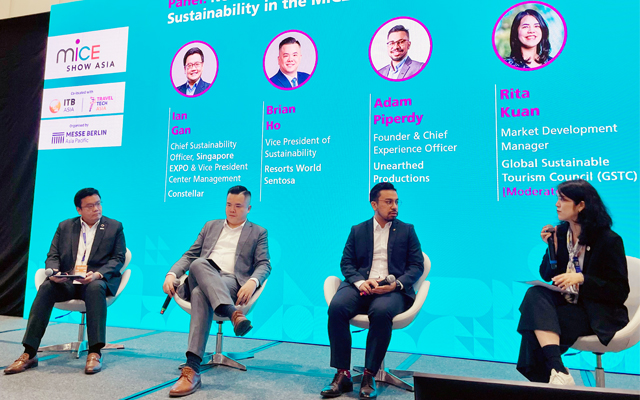
Small actions can lead to big impacts was the key takeaway from the Next Horizons: Future-Proofing Sustainability in the MICE Industry session at ITB Asia last week.
Rita Kuan, market development manager of the Global Sustainable Tourism Council (GSTC), opened with an introduction to GSTC’s MICE Early Adopter Program, a two-year initiative launched in 2024 that involves awareness-raising and implementation of the MICE Standard, and sharing of best practices and solutions.
The programme is designed to result in an increase in three main areas: sustainable practices, the number of GSTC-certified MICE businesses, and consumers’ choice of sustainable businesses.
Kuan then introduced the panelists whose organisations – Singapore Expo, Resorts World Sentosa, and Unearthed Productions – adopted the programme one year ago.
Ian Gan, chief sustainability officer, Singapore Expo, and vice president centre management, Constellar, said sustainability has been embraced as a business strategy.
Constellar is aiming for a 75 per cent reduction in Scope 1 and 2 emissions, and a 30 per cent improvement in energy use intensity from its 2019 baseline by 2025. It also targets a 10 per cent improvement in water efficiency by 2026. Furthermore, the company is scaling up initiatives, such as a nearly 1,400m2 urban rooftop farm that brings the farm-to-table concept to event catering.
Gan added that Constellar has “curated a journey roadmap” to encourage greater sustainability within the business events ecosystem. Steps include a sustainability health check so organisations can assess and improve their green practices.
Adam Piperdy, founder and CEO of Unearthed Productions, then called on the industry to make “smarter choices for better experiences, lower costs and real sustainability”, noting that brands can choose “to embed sustainability into every event” by using his company’s practical, action-based checklist.
Questions to ask include whether it is necessary to lay carpet at exhibitions; if it is possible to introduce QR-code agendas with real-time updates and what type of catering is best, he elaborated, adding that an opt-in or credit model for meals can cut costs and waste while providing attendees with greater “freedom of choice, dietary fit and more time to connect”.
“The future of events is about doing less, but making it count,” he said, adding that the industry can “double down on content, connections and conversations” for improved sustainability.
As the world’s first destination to be certified for both GSTC destination and hotel standards, and host of Singapore’s inaugural GSCT conference in 2024, Resorts World Sentosa (RWS) is focused on increasing sustainability to meet growing industry expectations.
RWS’s vice president of sustainability, Brian Ho, stated: “Focusing on sustainability is no longer optional, but rather a strategic necessity,” he said.
He introduced RWS’ 2030 Sustainability Master Plan, which targets carbon neutrality and positive social-economic impact by 2030. Key elements of the plan include greening 75 per cent of its buildings, halving operational waste-to-landfill, and fostering an environmentally- and socially-conscious workforce.
In closing, the speakers called on business events players to share best practices to boost sustainability adoption in the industry.