Under president Supawan Teerarat’s leadership, the Thailand Convention and Exhibition Bureau (TCEB) is anchoring its future roadmap in the Colour Economy, a strategic framework that maps economic potential across colour-coded pillars such as Silver for wellness and Green for sustainability.
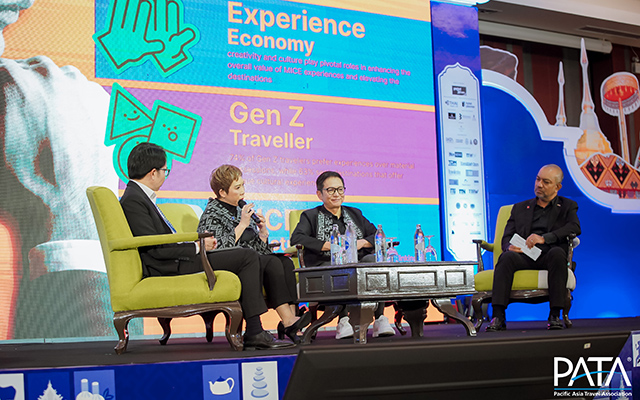
During the From Creative Economy to Future MICE Setting session at the PATA Destination Marketing Forum (PDMF) 2025 in Chiang Rai, industry leaders discussed how to tap the overlap between a city’s business events capabilities and its Orange Economy – the creative and cultural sectors – through collaboration with the UNESCO Creative Cities Network (UCCN).
Peeradorn Kaewlai, project advisor for the model, emphasised that the UCCN Co-Creative City Model is to help such cities move beyond holding the designation, and to amplify their creative capital within the business events and festival economy.
“The Co-Creative City Model is designed for UCCN network cities as a tool to assess their existing creative assets and plan how to activate them more effectively. It helps cities understand where value can be created across the upstream, midstream and downstream segments of the creative value chain, so they can better support local creative entrepreneurs and strengthen their destination appeal,” he said.
The model also supports UCCN cities in fulfilling the network’s expectations, particularly around the commitments they must uphold.
“UNESCO requires every UCCN city to demonstrate how it contributes to the network locally, nationally and internationally.
“By mapping their events and assets against the creative value chain, cities can pinpoint what kinds of programs or large-scale festivals are still missing, and what needs to be developed to create meaningful impact through a MICE and festival lens,” Peeradorn noted.
Working with business events data from cities including Chiang Mai and Phetchaburi, TCEB developed a canvas that overlays festivals, congresses, and other related activities onto their creative ecosystems.
“We input MICE events and festivals into the canvas, and look at the target audience, type of activities, and where they sit within the creative industries,” explained Peeradorn.
Through this exercise, the team was able to assess whether the city is upstream, midstream and downstream of the creative value chain.
In the case of Chiang Rai, which was designated as a UCCN City of Design in 2023, the analysis revealed opportunities to strengthen the upstream segment, in areas such as knowledge creation, professional development, and industry-level exchange.
“This is the model TCEB aims to use in collaboration with every UCCN city, ensuring they can fully leverage their creative assets and strategically address value-chain gaps,” Peeradorn summarised.
Running alongside the creative agenda is the sustainability focus of the Designated Areas for Sustainable Tourism Administration (DASTA), which oversees the overlap between Thailand’s designated sustainable tourism areas – several of which overlap with TCEB’s MICE Cities and UCCN cities.
For example, Chiang Rai and Songkhla (City of Gastronomy, 2025) currently sit at the intersection of all three categories, while Pattaya already qualifies for the first two categories and is applying for UCCN recognition as a City of Film.
DASTA’s director-general Siripakorn Cheawsamoot noted that this alignment is critical to future-ready destinations.
He proposed that the “M” in MICE should evolve toward “L factors”: Low carbon, Longevity and Livability, stating that achieving UCCN status is only the beginning.
He cautioned that long-term management, cross-sector collaboration, and community alignment will determine whether cities can sustain the standards expected of them.