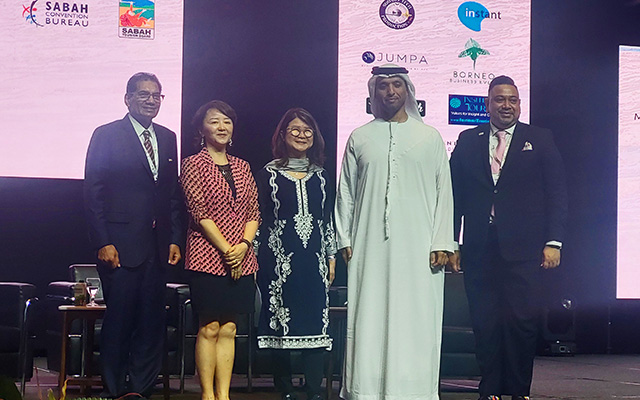
Strategic collaboration across destinations, governments and industry players are critical to sustaining long-term growth in the global business events sector, as rising costs squeeze margins and force a rethink of how events are planned and delivered.
This was highlighted by speakers at the plenary session entitled The Global Growth Engine: Powering Trade, Investment and Confidence through Business Events at the 3rd International Business Events Forum – BE in Sabah 2026.
One of the panellists, Margaret Ma Connolly, president and CEO of Informa Markets Asia, said: “From an organiser’s perspective, partnerships must be built around customer value rather than rivalry. For successful B2B events to really thrive, we need to strategically collaborate. Collaboration is not only between organiser and venue, but also with city governments and the entire value chain.”
Another panellist, M Gandhi, president, Malaysian Association of Convention and Exhibition Organisers & Suppliers (MACEOS), emphasised the importance of associations as platforms for collective advocacy.
He stated: “Competitors come together and become members of an association because when we operate individually, we compete for market share, but together we protect and grow the market.”
Using South-east Asia as a primary example, Gandhi stressed that collaboration among small and mid-sized economies is a necessity rather than an option. He noted that while individual markets may lack the standalone scale to attract major global business events, regional cooperation can amplify their collective appeal and competitive edge.
He likened South-east Asia to “many 7-Elevens coming together to form a viable market”, explaining that while a single outlet may be too small to generate meaningful impact, the combined network creates scale, reach and relevance.
Meanwhile, Mubarak Hamad Al Shamsi, director of Abu Dhabi Convention and Exhibition Bureau, said destinations must focus on long-term strategic and legacy impact rather than short-term gains.
He said: “It’s really important for us as destinations to see the real impact and real value of business events, and this can only be delivered through collaboration between government and the private sector.”
Mubarak cited Abu Dhabi Finance Week as an example of how business events can drive long-term economic impact beyond delegate numbers.
Launched in 2022 with around 2,000 participants, the event has since grown to attract approximately 25,000 delegates, evolving into a key platform for global financial services institutions, fintech players and international investors.
This event helped to create channels for engagement between international companies, government bodies and regulators, encouraging several organisations to establish or relocate regional headquarters to Abu Dhabi, said Al Shamsi.
Ashwin Gunasekeran, CEO of Penang Convention & Exhibition Bureau, indicated that true collaboration requires destinations to engage industries as long-term partners rather than passive beneficiaries of support.
“When we move beyond simply supporting industries to collaborating with them, it becomes investment-driven”, Gunasekeran said, noting that this approach allows business events to play a more direct role in strengthening priority sectors in the destination, while delivering broader economic returns for the destination.