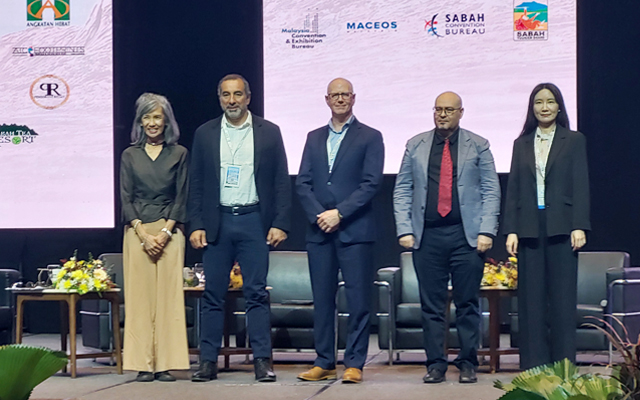
Strategic partnerships are the primary driver for destination competitiveness and event scalability. However, industry experts warn that these alliances must be structured with formal frameworks and clear KPIs, rather than relying on informal goodwill.
That was the message from panellists speaking at the Limitless Horizon: How strategic partnerships define the future of business events session, held during the 3rd International Business Events Forum – BE in Sabah 2026.
Mahir Abdulkarim Julfar, executive vice president of Dubai World Trade Centre (DWTC), stressed that partnerships must be anchored in long-term intent, not short-term wins.
He shared: “It’s not about the outcome of this year or next year only, but about how we are going to grow together.”
Mahir highlighted how DWTC works with organisers on three-year business plans that map out projected growth by industry, sub-sector and geography. These plans are reviewed annually, allowing both parties to assess whether assumptions made earlier still hold true in a fast-changing market, and to recalibrate resources, capacity and strategy accordingly.
“Every year, we review where we said we would be and where we are actually heading,” Mahir explained, positioning partnership planning as an ongoing performance exercise rather than a static agreement.
Martin Balmer, account director at Northstar Meetings Group, pointed to the need for clarity and alignment. Effective partnerships, he said, begin with shared objectives, clearly defined roles and agreed KPIs.
Meanwhile, Reza Soltani, president, Institute of Tourism in Belgium, noted that collaborations rarely fail because of misaligned goals. Instead, they break down due to unspoken expectations and an absence of shared understanding when conditions deteriorate.
Soltani stressed that while organisations often focus on credentials, scale and capability during partner selection, these factors offer limited insight into how a partnership will hold up under pressure.
He said: “Understanding how a partner reacts in difficult situations is just as important as assessing technical expertise or market reach.”
Bona Nahyun Lee, CEO of BornTiger, and a seasoned business events strategist, emphasised that differences between partners are not the problem, but ambiguity is. She argued that partnerships break down not because organisations have different goals or philosophies, but because those differences are never made explicit at the outset.
Lee indicated that when partners are clear about where they align and where they diverge, including how each defines success, differences can become a source of complementary value rather than tension.