Business events must move away from being performative and overcrowded, as the industry enters a critical era of recalibration.
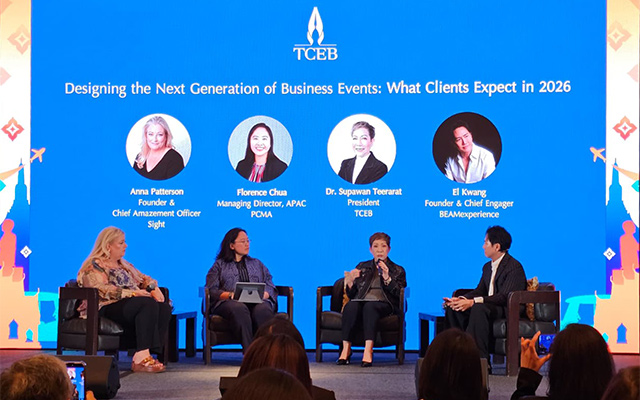
This was the consensus at the Thailand MICE Roadshow in Singapore 2026 last Thursday, where the panel discussion, Designing the Next Generation of Business Events: What Clients Expect in 2026, explored the evolving demands of the market.
“Success is not only defined by attendance or numbers anymore, but more on impact, experiences, and meaningful outcomes,” stated Supawan Teerarat, president of the Thailand Convention and Exhibition Bureau (TCEB).
During the session, Supawan also spoke about Return on Experience (ROX) and Return on Relationship as the new benchmarks for Thai business events.
“We are moving from the counting of numbers to diving deep into the experiences that matter. When you have your event in Thailand, you can explore more on ROX for yourself and your clients,” she elaborated.
While digital transformation remains a priority, the panel noted a growing paradox. As AI further integrates into the industry, delegates increasingly crave physical connection.
Anna Patterson, founder & chief amazement officer, Sight Agency, opined that technology alone is not a cure-all. “New and shiny technology needs new and shiny experiences… It’s the user touchpoints and the value of their time that matters,” she said.
Florence Chua, managing director APAC at Professional Convention Management Association (PCMA), supported this with a preview of PCMA’s global outlook study, which revealed an infrastructure gap.
“While we are saying we are working harder and planning better, less than 20 per cent (of event organisations) have actual infrastructure frameworks to help in planning,” Chua noted, adding that “real-life scrambling” remains the industry norm.
The discussion also sparked a debate over the industry’s talent gap. Chua emphasised the need for digital literacy and data science to alleviate low-value tasks, allowing humans to focus on higher-level strategy. However, Patterson countered that the industry faces a “mindset gap” rather than a pure talent shortage.
“Everyone wants (tasks to be done) quicker, but we’ve lost sight of what’s important to us as individual humans. We need to spend more time mentoring our people and being human – because an overwhelmed attendee does not remember the brand,” Patterson observed.