Asia/Singapore Wednesday, 8th April 2026
Page 1008

Snap! The event’s a game

0

Event planners are increasingly recognising the benefits of bringing out the element of fun in meetings and corporate activities through gamification. By S Puvaneswary

Gamification is the latest buzz-word in the business events industry and event organisers are paying attention to ways to best leverage this concept to keep their audiences engaged.

Gartner, Inc, a global information technology research and advisory company, describes gamification as “the use of game design and game mechanics to engage a target audience to change behaviors, learn new skills or engage in innovation”.
In an article published in November 2012, Gartner, Inc predicted that by 2014, 80 per cent of current gamified applications would fail to meet business objectives primarily because of poor design.

“The challenge facing project managers and sponsors responsible for gamification initiatives is the lack of game design talent… Poor game design is one of the key failings of many gamified applications today.” said Brian Burke, research vice president at the firm.

“The focus is on the obvious game mechanics, such as points, badges and leader boards, rather than the more subtle and important design elements, such as balancing competition and collaboration, or defining a meaningful game economy. As a result, in many cases, organisations are simply counting points, slapping meaningless badges on activities and creating gamified applications that are simply not engaging for the target audience,” he added.

“Gamification must be relevant to the clients’ business,” urged Nigel Gaunt, vice president global business at the headquarters of BI Worldwide. “For instance, I would use a game involving cars for clients in the automobile industry.”
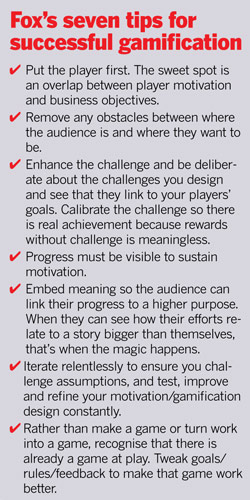
Introducing the concept of gamification to Malaysian business event specialists at the Malaysia Convention and Exhibition Bureau’s Malaysia Business Events Week in August, Jason Fox, the author of The Game Changer and a motivation design expert, said meetings could be as engaging as online games if designed well and delegates would pay for good meeting experiences.

Mike van der Vijver, meeting designer of MindMeeting, which specialises in the design of effective programmes for international meetings, and co-author of Into the Heart of Meetings, suggested that debate – regarded as a form of gamification – can be used in events to engage the audience and develop solutions, especially for resolving conflicts.
Familiar with the use of debates in meetings, Eric Chuo, deputy general manager at AOS Conventions & Events, said such activities work well with young professionals and ROI can be measured when the audience votes for the winner through conference mobile apps.

According to Andrea Lee, area director – Kuala Lumpur at Destination Asia, the adoption of gamification in meetings is on the rise among her pharmaceutical clients. She said: “Many clients want us to design more than just a mundane meeting. They want inexpensive solutions to keep the audience attentive as pharmaceutical events tend to be very dry. We use games, especially after lunch as energy levels tend to be low, and the objectives are to entertain and educate the audience. We have used games to help the audience master the spelling of new drugs. Prizes are dangled to encourage participation.”
Gamification can also be used to motivate people towards aspirational goals.

Leon Qiu, client service director at BI Worldwide China, said online gamification is still very new in Asia, with countries receptive to this being China, South Korea and Singapore. He added that mobile and web based gamification is hot because it is fun and engaging for the player, and allows programme owners to easily track user generated data and behaviour.

Gaunt pointed out that gamification need not be a one-off activity. The qualifying period for some game-driven incentives can stretch up to a year, allowing participants to fulfil tasks and earn points towards their final score at the end of the period.

Kuala Lumpur Convention Centre has for some time now incorporated games into its internal meetings and training sessions to motivate and incentivise team members and to keep everyone attentive. An example of what the venue has done is The I-Maze, a hands-on game that challenges teams to discover a secret path to their goals through a series of mazes.

Rohizat Baharum, director of human resource at the venue, told TTGmice: “This problem-solving activity is great as it requires participants to work together and share specific information made available to them, in order to complete a task. It’s also excellent for team bonding as participants almost always begin in a state of confusion, followed by a major learning curve in effective planning, action and decision-making when they are forced to think out-of-the-box to complete the challenge. They also discover the value of common objectives and communication because the activity requires the full participation of all members.”

Sarawak Convention Bureau is also using games to motivate staff to win more  event bids and meet more clients.

However, general manager Chew Chang Guan, warned that competition through gamification could make “players selfish and unwilling to share”.

“Thus we always emphasize on collaboration when we embark on such games,” said Chew.
MICE groups unfazed by protests in Hong Kong

0

HONG Kong’s MICE sector has not been significantly affected by the on-going pro-democracy protests that have paralysed parts of the city over the past week, travel specialists and hoteliers at IT&CMA say.

The Occupy Central demonstrations, which include the occupation of key commercial districts such as Tsim Sha Tsui, Wan Chai and Mong Kok by protestors, spurred a surge in enquires about safety and security but have so far resulted in only a few cancellations, trade sources said.

Anvy Wang, marketing executive at Silvermine Beach Resort, said the property had “one or two cancellations,” adding that the demonstrations had not yet led to properties discounting their room rates.

“We are receiving enquiries, some groups are worried about the situation but they’re generally not cancelling,” said Wang.

One hotelier, speaking on condition of anonymity, said she did not think the demonstrations would last too long. “I don’t think they will have much of an impact on trade. We have had some cancellations on both the MICE and leisure front, but we’re just coming into peak exhibition season, so I don’t think those groups will cancel,” she opined.

Agents bringing groups into the destination said the protests had raised concerns about safety and security.

“Corporate clients want safe destinations,” said Robert Szulc, managing director of Boomerang in Poland. “When they see problems they tend to move. That said we haven’t had any cancellations (for Hong Kong) yet.

“Some clients are calling us wanting to know more about what’s happening. We collect information from official sources, such as the government and the police, and report back to them, so that helps,” he added.

Mario Corrado, associate partner of Offbeat Venues in Belgium which focuses on the Benelux market, said he is still planning to bring a group to Hong Kong in the near future. “I don’t think it will get to the level of serious cancellations,” he said. “My clients haven’t even asked about the situation.”

Quicker immigration clearance, access to unique venues among Japan’s new lures for MICE visitors

0

JAPAN Convention Bureau (JCB) is rolling out a number of measures to boost MICE footfalls as part of the country’s efforts to become a tourism-oriented destination with a targeted arrival of 20 million visitors by 2020.

Among the initiatives is the introduction of fast lanes for VIPs and international travellers attending business events in Japan next year, with Narita International Airport and Kansai International Airport being the first gateways to offer this perk.

The country will also allow “trusted” travellers – frequent visitors to Japan who have been identified by the immigration authorities as posing “low risk” – to use automated gates at the immigration checkpoints.

Akira Ninagawa, executive director of JCB, who spoke to TTGmice e-Weekly during Visit Japan Travel Mart 2014 last week, also revealed that the bureau would identify unique venues and cultural programmes to attract more MICE groups.

Ninagawa said: “Places such as Tokyo National Museum, where we conducted the Japan Night (the opening dinner of Visit Japan Travel Mart 2014), Nijo Castle in Kyoto and Atakemaru (a Samurai ship) cruise round Tokyo Bay are unique venues we would like to introduce to international MICE visitors.”

Meanwhile, traditional art and craft sessions, tea ceremonies and geisha performances are some of the programmes proposed for incentive itineraries.

According to the Japan National Tourism Organisation, Asia contributed 90 per cent of incentive business to Japan last year. Ninagawa shared that Taiwan, South Korea and China are main markets.

Japan has also witnessed an immediate boost in incentive arrivals from Malaysia and Thailand after visa-free facility was granted to citizens of both countries last year. This has encouraged Ninagawa to expect similar growth in MICE arrivals from Indonesia and India which were offered simplified visa procedures at the start of this year.

Incentive footfalls are, however, not tracked in official data and are included as part of business travel arrivals. According to Ninagawa, 79,228 business travellers received support from JNTO in 2013, a 34 per cent rise over 2012.

Visitors for meetings and conventions totalled 250,000 last year.

“Moving forward, we are focusing on conferences and congresses that rotate in Asia-Pacific. We are also introducing new destinations such as Hokkaido and Kyushu,” he added.

South Korea gains popularity

0

SOUTH Korea is emerging as a preferred destination for international MICE buyers as they go in search for “newer” destinations for their clients, who are already familiar with South-east Asian countries like Singapore, Malaysia and Thailand.

Dubbing South Korea a “young destination” for MICE groups from the UAE, Anwar Abu Monassar, director of operations at Abu Dhabi-based The Vision Destination Management, said: “We have already seen some movement from the leisure and business markets to South Korea, but it’s still missing from the MICE side.

“The traditional destinations in Asia are Malaysia, Indonesia, Singapore and Hong Kong, so we see potential in South Korea. It’s coming without a base but we are confident it will grow,” he added.

Having recorded strong leisure demand for South Korea, Asian travel companies, on the other hand, are now keen to grow outbound meeting and incentive interest to the destination too.

Sophiya Travel & Tours Cambodia’s director of tour development, Leng Pagna, said: “We are getting a lot of enquiries for South Korea from our MICE and corporate clients in Cambodia; they have already been to nearby countries like Singapore, Malaysia and Thailand, so South Korea is viewed as a newer destination, just like Taiwan and the US.”

Most of Sophiya’s outbound MICE groups to South Korea are incentives from the Cambodian agriculture and association sectors, averaging around 30 to 35 pax who spend six days in Seoul, Jeju, Nami Island and Sorak Mountain, added Leng.

Sharing similar sentiments, Christina Pakpahan, director of Medan-based Okdo Tour & Travel Service, said: “Malaysia, Singapore and Thailand are close (to Indonesia) and already done, so we are looking for further options in Asia-Pacific like South Korea and Australia. While the Indonesian leisure outbound market is established, MICE traffic to South Korea is growing at about eight to 10 per cent.”

According to Pakpahan, her MICE groups average around 50 to 60 pax from the insurance and government sectors, spending five days to a week combining meetings and incentives in Jeju, Seoul and Busan.

Urging the South Korean authorities to build on the rising wave of interest from Indonesian MICE market, Pakpahan remarked: “We would like to see more roadshows by Korea Tourism Organization and direct (air links with) Indonesia, especially as Medan now has a new airport. Without direct flights to South Korea, we have to transit in Singapore and Kuala Lumpur.”

Sanjeev Tandon

0

Dusit Thani Laguna Phuket has made Sanjeev Tandon its director of sales and marketing. Tandon brings 25 years of international experience in several senior sales and marketing management positions to his new role, and joins the Thai resort from Mövenpick Hotel Al Khobar and Mövenpick Beach Resort Al Khobar.

Jeff Ross

0

SwissĂ´tel Hotels & Resorts has picked Jeff Ross to lead SwissĂ´tel Resort Phuket as general manager. Ross joined the company in 2010 and was last hotel manager at SwissĂ´tel The Stamford, Singapore.

Vincent Lelay

0

Vincent Lelay has taken on the role of cluster general manager of Sofitel So Singapore and The Singapore Resort & Spa Sentosa Singapore. Lelay brings to both properties a wealth of international hotel management experiences which include his role as vice president of hotel operations for Greater China.

Cheryl Ong

0

Cheryl Ong is now director of sales & marketing with Raffles Singapore. She was most recently director of sales & marketing for The St. Regis Singapore.

Arnaud Girodon

0

Arnaud Girodon is now general manager of The Datai Langkawi. He brings a wealth of hospitality experience to this role, having led at some of the region’s luxury hotels and resorts.

Lucia Franziska

0

Sunway International Hotels & Resorts has appointed Lucia Franziska as general manager of Banjaran Hotsprings Retreat Ipoh. Franziska brings with her over 30 years of experience in a range of positions and institutions within the hospitality industry.

Reviews

The Ritz-Carlton, Bangkok

The newly-opened Ritz-Carlton, Bangkok anchors the One Bangkok development with cosmopolitan elegance. Featuring the city's largest ballroom and a spectacular new penthouse suite, it delivers exceptional hardware and deeply authentic, soulful service for business and leisure travellers alike

Mama Shelter Zurich

Behind the imposing, Brutalist concrete that defines Zurich’s Oerlikon district lies a surprising secret. While its exterior honours the neighbourhood’s industrial roots, stepping inside Mama Shelter reveals a vibrant, neon-soaked world that is a far cry from its rigid shell

Hyatt Regency Kuala Lumpur at KL Midtown

A polished urban retreat designed for business travellers, Hyatt Regency Kuala Lumpur at KL Midtown combines thoughtful design, seamless service, and exceptional facilities.