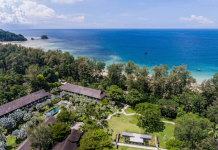
506 rooms and suites
3-2-1 Nishi, Naha City, Okinawa 900-0036
www.loisir-naha.com
www.loisir-spatower.com
This hotel boasts Naha city’s highest bed capacity and one of the few natural hot springs in Okinawa. It comprises two buildings, with the main Loisir Hotel building constructed in 1993 and the Loisir Spa Tower added in 2009 in response to increased numbers of visitors to the city.
Naha Airport, a duty-free mall and four golf courses are about seven, 14 and 40 minutes away by car respectively.
Rooms The hotel offers two- to four-star categories of rooms to suit different budgets. The Loisir Hotel building offers 417 rooms while the high-end Spa Tower has 89.
I was checked into a room with a balcony in the 12-storey Spa Tower. Designed with cheerful colours as well as motifs reflecting Okinawa’s ocean, flowers and sun, my spacious City View Superior Twin room provided the usual amenities business travellers will appreciate, such as a comfortable bed, work desk, flat-screen TV, mini bar, safe and hair dryer. Trouser press or an iron can be requested for free.
With the free Wi-Fi (for all guests), I was able to check some emails but not for long, as the desk and bedside reading lamps somehow did not offer bright-enough lighting.
Spa Tower guests are entitled to complimentary use of the hot spring at its Churaspa on the second floor, which opens from 14.00 to as late as 23.00 (there is also a Loisir Spa at the Loisir Hotel building). Pity I could not make it in time for this luxury offer during my hasty one-night stay, but a relaxing soak in the bathtub, which was separate from the toilet and wash basin, sufficed.
Meeting facilities The hotel is regarded as one of Naha’s MICE-friendly accommodation providers.
While the Spa Tower offers a medium-size banquet hall on the third floor for up to 250 pax in theatre setting, the Loisir Hotel building offers lots more across its first, second, third and 12th floors. It houses 10 banquet halls, the largest of which accommodates up to 900 pax (theatre), the smallest, up to 20 (round-table); one event hall for 300 (theatre); three private rooms for 12 to 40 (depending on the set-up), and one Japanese-style room for up to 40 (round-table). Five of these spaces have built-in audiovisual equipment, while the rest can easily have the equipment set up on demand.
F&B Five F&B outlets are gathered inside the Loisir Hotel building: Fontaine offers buffet meals for up to 150 pax; Izumitei, Japanese and Chinese cuisines for 106 pax; Papillon, BBQ at the poolside and garden for 125; Sirene, French cuisine for 71; and Planete, light food, drinks and piano music for 64.
Breakfast at the spacious Fontaine restaurant on the first floor is exclusive for Spa Tower guests. It offers a good spread of the usual Western fare such as toast, bacon and eggs, and salad, as well as Okinawan dishes.
Sirene only operates for private parties, which require reservation at least three days in advance.
FACT FILE
Maximum number of pax for meetings 1,000 Maximum number of pax for banquets 600
Recent events held
• 13th International Symposium on Solid Oxide Fuel Cells welcome party for 100 pax and reception for 477 pax, October 2013
• Joint Annual Symposium of the Vacuum Society of Japan and the Surface Science Society of Japan welcome party, reception and dinner for 100 pax, November 2013
• Worldwide Japanese Automobile Group awards ceremony for 30 pax, January 2014
• International pharmaceutical firm, catering for 1,200 pax (along with other hotels at the Southeast Botanical Gardens), March 2014
Okinawa is enhancing MICE capabilities, air access and destination awareness to draw events from beyond its key markets. By Kathy Neo
Although weathered all at once by the global economic downturn, H1N1 pandemic and strong Japanese yen in 2009, Okinawa’s tourism has since proven resilient. According to the Okinawa prefectural government, the island registers an annual average of six million tourists per year, with 80 per cent being repeat tourists. Last year, the industry even reached a record high of about 6.4 million visitors in total.
While domestic tourists from mainland Japan still form the bulk of yearly arrivals, the numbers are shrinking as a result of the country’s ageing population, according to the Okinawa Convention & Visitors Bureau (OCVB).
Conversely, international arrivals have seen a steady increase over the years, from 109,000 in 2003 to 382,000 in 2012, followed by a sharp rise to 550,800 in 2013.
Thus encouraged, the island is targeting to receive 750,000 international tourists this year. Taiwan, Hong Kong and South Korea are currently the major foreign source markets, due largely to their proximity as well as the availability of regular direct flights.
On the MICE front, OCVB supervisor for MICE marketing, Koji Niimoto, told TTGmice that apart from the main source markets, the bureau is also seeking to lure more traffic from Singapore, Thailand, Malaysia and Europe, adding that at the moment, the convention business is contributed mainly by mainland Japan, while incentive groups hail from overseas.
Taiwan has been the biggest incentive market due to its close proximity to Okinawa – only about an hour’s convenient flight away. Indeed, the number of overseas applications for OCVB’s incentive support for the financial year ending March 2014 saw the highest number from Taiwan (43), followed by Thailand (18), South Korea (14), China (five) and Malaysia (one).
To accommodate an expanding MICE demand and attract more international events, OCVB is looking to construction a major convention venue with capacity for as many as 20,000 people at once. Niimoto revealed that discussions and research are ongoing for a suitable location to build the venue, with a final decision expected in the next year or so.
Currently the largest convention space in the prefecture is the Okinawa Convention Center (OCC), which offers a maximum seating capacity of 5,000 people in its biggest event space. There are three other convention venues, namely the Bankokushinryokan, Okinawa Institute of Science and Technology Graduate University, and Okinawa Jichikaikan.
The 27-year-old OCC most recently carried out a massive repair work to its theatre hall following a typhoon that shattered the space’s glass wall, a spectacular stage backdrop that brings in panoramic views of the ocean. Also subject to nature’s mercy are several of the centre’s conference spaces, which also boast a feature glass wall with an ocean or garden view, a unique offering that has been drawing event organisers from the region and the wedding market from mainland Japan.
Nevertheless, to lure more business, OCC MICE coordinator, Naomi Nakaza, told TTGmice the centre has been offering special rates to event organisers, such as 20-70 per cent less for international events with more than 10 attendees, and 10 per cent less for the rental of all OCC facilities for large-scale events. The discount policy will continue, Nakaza added, albeit the higher consumption tax implemented since the country’s new financial year in April, but minor adjustments to the qualifying criteria can be expected. She is upbeat that the adjustments will not impact OCC’s business.
Meanwhile, OCVB is also hosting familiarisation trips for the international trade to raise awareness for the island’s offerings. In March this year, it hosted international media representatives for site inspections of Naha Airport’s brand new international terminal, convention centres, wedding venues etc, as well as for experiencing pre-/post-meeting options including whale watching, fishing, diving and spa, among others.
Come September, OCVB will hold a seminar in Singapore to connect some 60 local buyers with Japanese travel agencies, hotels and incentive houses. The bureau has yet to confirm the venue and exact date of the event at press time.
Greater connectivity is being planned as well, specifically to enable direct flights from regional markets such as Singapore, Thailand, Malaysia and Indonesia. Most recently, an MoU was signed on March 25 between Singapore Changi Airport and Okinawa Prefecture for the commencement of direct flights from Singapore in the near future. Through the MoU, the prefectural government will this year focus on promoting tourism traffic from South-east Asia, Australia, India and other regions via Singapore.
When asked how Okinawa intends to stand out as an incentive destination, Niimoto said: “We have our own unique culture that is different from that of mainland Japan (due to historical influences). We offer a different type of Japanese culture to the world. To top this off, we are known for our people’s hospitality, which transcends the language barrier.”
Indeed, the results of a satisfaction survey for foreign tourists conducted by OCVB in 2013 showed the lowest percentage (5.8) of respondents who felt Okinawa’s hospitality was unremarkable, against other indicators. But when compared against the highest percentage (20.6) indicating guidance signs/markings as unremarkable, it does leave room for wonder if hospitality truly “transcends the language barrier”.
Sen Tamaki, manager for overseas marketing at Okinawa Convention & Visitors Bureau, admits that the island continues to face inadequacies in multi-lingual skills, land transportation and Wi-Fi access.
“Language is a key problem,” acknowledged Tamaki. “OCVB currently subsidises up to 50 per cent of the cost of language courses for staff of private companies. A list of qualified language teachers and service training instructors is planned for release this year for the companies’ choice. We also need more English-Japanese signs on the roads, and we will propose this to the prefectural government.”
As for land transportation, Tamaki said taxis in Okinawa are expensive, while the public bus network is complicated even to the locals.
“We hope to have a subway system in the future, but this will be a major project that takes time, the quickest being 10 to 15 years for the commencement of construction,” he explained.
In response to a rising number of complaints about the lack of free Wi-Fi service in public areas, he said OCVB provides financial support to hotels and small enterprises to install the necessary equipment.
Additionally, research is ongoing for star-rating Okinawa’s hotels to bring them in line with international practice, he revealed.
Meanwhile, two major hotel projects are expected to complete this year, namely the 238-key Hotel Orion Motobu Resort & Spa and 346-room Hilton Okinawa Chatan, in July and September respectively.
Need to know
In pursuit of Moby-Dick
konart/123RF.com
Okinawa may not be renowned for whale watching, but it is possible to obtain this experience here if one gets the season right, which is the period from December to March. Groups can depart from Naha city or Onna Village and engage in this breathtaking activity for three hours in a boat that takes 17 to 60 people at one time. Cost is 3,800 yen (US$37) to 4,500 yen per person; reservation is necessary with Okinawa Tour Island (http://option.okitour.net/special/whalewatching/).
Brand new terminals greet air, cruise passengers
Naha Airport
Naha Airport opened a brand new international terminal in February this year in response to increasing international traffic. The new four-storey terminal spanning 23,700m² is almost four times bigger than the previous one, featuring 20 check-in counters, two F&B outlets, two souvenir shops and an observation deck on the top floor.
Meanwhile, the new Naha Cruise Terminal, opened in April, can accommodate larger vessels with its longer 340m berth and water depth of 10m. It spans about 4,500m² over two floors, including a rooftop observation deck. About 130,000 cruise arrivals are targeted for the new financial year, according to OCVB.
Angling fun
Fishing is hardly a boring activity, especially if done in groups. Divide into teams to compete for the most number of fish caught, chat and crack some jokes while waiting for the target to be hooked, and cheer in unison when someone has finally made a catch. Available all year round, Marine Palette (http://brc.marinepalette.com/) offers three- and six-hour trips out to sea for small groups of up to eight people in each boat, complete with a fisherman who teaches how to attach the bait and reel in the catch. Charges are from 5,000 yen and reservation is necessary. Choose from three departure venues: Naha city, Yomitan Village or Onna Village.
Dine, cruise and enjoy the sunset
Enjoy a ‘rocking’ good company dinner post-meeting on board a small ship that can accommodate up to 180 people each time in its restaurant. Local cruise company Westmarine (hwww.westmarine.co.jp) offers a cruise dinner as well as one at sunset, both lasting about one hour 45 minutes. Western fare is served, including salad, main course, dessert and beverage. Charges are from 3,900 yen per person. From April to September, departure times from Naha Port are 17.45 and 20.15 for sunset cruise and dinner cruise respectively; from October to March, departure times are 17.00 and 19.45 respectively.
A home to stay
Yomitan Village (www.ti-da33.com) offers the Mimpaku homestay programme for a maximum of 350 people, each house accommodating four. Participants get to experience the local folklife through farming, cooking and handicraft-making activities as well as sanshin guitar and ryuku traditional dance performances. Charges are from 12,000 yen per person per day, inclusive of Okinawan breakfast and dinner. For more information or reservation, contact Chiharu Tamaki of Sky Tourists Service at sky1194@churamura.com and (098) 958-1193.
Ideas
Two-night meet-and-bond programme
Southeast Botanical Gardens
Day 1
Arrive at Naha Airport’s new international terminal, which opened in February this year.
Check into the MICE-friendly Loisir Hotel & Spa Tower Naha, and have a short rest before heading out to the Southeast Botanical Gardens for some rejuvenating greenery. Find over 1,300 plant types here, as well as fruit and herb gardens. There is also a large pond, the surroundings of which are dotted by colourful flowers and palm trees. Electric trams are available for a guided tour of the spacious grounds, as are guided walking tours which offer a closer look at the flora.
At 17.00, depart from Naha Port for a sunset cruise dinner on board a small ship owned by local company Westmarine. Eat, drink and be merry from the Western fare offered, while waiting to take in the beautiful changing colours of nature outside the window as the sun slowly sets.
Day 2
After breakfast at the hotel and a half day of meetings, head out to Onna Village for departure out to sea in a whale-watching boat. Bring along a poncho or windbreaker though, or risk getting wet and catching a cold as the open-deck boat speeds through the waters. Although much depends on your luck as well, the best months to sight the lovely sea creatures are from December to March.
After the three-hour trip out at sea, head back on land for some retail therapy at the Okinawa Outlet Mall Ashibinaa, a beautiful architecture of eclectic ancient Greek, contemporary and native Okinawan elements. Find discontinued or sample products from more than 100 popular brands here – especially European brands – which are reasonably priced and of good quality.
If you are not too keen to shop, remove your shoes and stroll along the beach, which is just a minute’s walk from the mall, feeling its soft-as-talc sand and the Okinawan sea breeze.
After dinner, enjoy a session of Loisir Hotel’s renowned in-house onsen at the spa to chase away the fatigue of the day.
Day 3
Before departing from Naha Airport, check out its two souvenir shops featuring Okinawan glassware and jewellery, among other things.
THE annual gathering of feng shui practitioners and enthusiasts from around the world will head to Melbourne this year, making it the first International Feng Shui Convention (IFSC) to be held in Australia since the event’s inception in 2004.
To be held on November 15 and 16 at Novotel Melbourne St Kilda, IFSC is organised by the team at the International Feng Shui Association (IFSA) Australia Chapter.
“However, we had valuable support from the Melbourne Convention Bureau (MCB). It scouted potential venues and made a shortlist for us. It helped me put together a formal proposal which I submitted to the executive committee just to reassure them that we were able to commit fully to an event of such scope. A representative of MCB also came with me to help inspect the venue. The bureau also printed marketing materials for us and referred us to suppliers. MCB basically helped us lay the groundwork for the convention,” said Janene Laird, president of the chapter, in an interview with TTGmice e-Weekly.
Laird added that various leaders at the association headquarters had also chipped in to take up various responsibilities in the planning and execution of the event.
IFSC is expected to draw more than 200 attendees from countries such as Holland, Romania, Canada, Japan, China and Brunei.
Highlights at the event include two-track lectures that will see seminars running concurrently in two rooms, allowing a more diverse range of topics of be presented and discussed. Some 25 globally recognised speakers will lead the lectures, with topics touching on feng shui’s influence on certain business sectors such as architecture, interior design and real estate, for instance.
“We want to create a robust programme that isn’t just all academic presentations that appeal only to my colleagues and I, but one that encourages the public to come and learn more about feng shui, and how it can help their business and support their clients,” Laird explained.
The programme also includes an annual general meeting for association members, workshops and networking opportunities.
INTEGRATED resort The Venetian Macao has rolled out a limited time offer for meeting planners who contract their events at the venue by August 31 this year.
The Meetings More Rewarded package, valid for bookings of at least 25 rooms combined with a meeting package for one night, offers a five per cent off the master bill, complimentary in-room Wi-Fi, complimentary breakfast on selected dates, as well as two benefits from the following list:
– One-way Cotai Water Jet ticket (Hong Kong to Macau)
– Dedicated coach transfer on arrival or departure
– Welcome entertainment performance
– One complimentary room for every 25 rooms booked
– One complimentary upgrade for every 25 rooms booked
Promotion ends December 31, 2015. Terms and conditions apply.
THE upcoming Singapore MICE Forum (SMF) will give attendees an Asian perspective to the industry as it begins Gearing Up for the Next Wave of Change.
Unveiling the theme for the forum last week, SACEOS president Janet Tan-Collis said: “It is time for Asian leadership to take charge and take the lead in the way we do business.
“We see that Asia is taking full control as we move along and we need to gear up for the change. It is like the rising of the phoenix – when we are up there, it is going to be hard to go down,” she said.
For the first time, Kishore Mahbubani, the dean and professor for the Practice of Public Policy at the Lee Kuan Yew School of Public Policy at the National University of Singapore, will deliver the keynote address on the Asian Paradigm at the SMF.
Said Tan-Collis: “Mahbubani is someone who really knows the pulse of Asia and we will be able to see from his perspective how MICE in Asia will transform the world.”
Another first for SMF is the Asia Meeting & Incentive Travel Exchange (AMITE), which brings together 30 pre-qualified, hosted buyers from Europe and North America and Asian suppliers of meeting and incentive travel for one day of pre-arranged and one-to-one meetings.
According to Tan-Collis, AMITE is a new regular programme that is part of SACEOS’ strategy to direct greater attention towards the meetings and incentives component.
While SACEOS has 124 members today, Tan-Collis said 80 per cent of this membership comprises PCOs, PEOs and suppliers to exhibitions and she is striving for “greater balance”.
Nevertheless, she emphasised that this does not signal a dilution to the members from the exhibitions industry.
She said the greater integration between all MICE compenents today drives the dynamics of the full meetings industry.
Emphasising that education, accreditation and professionalising the MICE industry underline the core of SACEOS’ mission, Tan-Collis added that SACEOS will be conducting two certification workshops: Certified in Exhibition Management and Certified Meeting Professional during that week as well.
SMF 2014 will kick off on July 13 and run through until July 18. Registration is open at www.regonline.sg/singaporemiceforum2014
“We no longer want to freely distribute our brochures to any trade visitors because it is expensive and wasteful if they are not serious buyers. So we actually keep these booklets at the back of our booth and only if they are serious and really need them then we will pass the booklets to them. Since the past two years, I no longer bring copies in bulk to tradeshows. For example (at the recent IT&CM China in Shanghai), I only brought up 20 copies of our Anantara Hotels, Resorts & Spas booklet. Normally if buyers request for a copy, I will send them the e-version but of course if they want a hard copy, I will give them one. This not only translates to cost savings but helps save our environment.
Our wall panels are also entirely reusable so we will recycle them for subsequent tradeshows. We no longer throw them away after every exhibition.” Tommy Lai
Area director of sales & marketing (China)
Minor Hotel Group, Thailand
“We used to print a worldwide directory of hotels for our sales staff as part of the marketing kit for the clients but we realised that it is not practical for most of the buyers because they are normally interested in only a particular region or country, and not necessarily the whole world.
So over the last few years we decided to do away with the directory. Instead we print brochures and leaflets according to countries which makes it lighter for our staff to carry around and give to buyers too. Also our sales kits are moving towards the e-version because many people are comfortable with using iPads.” Scarlett Sun
Assistant marketing director (international)
Millennium & Copthorne Hotels, Singapore
Eric Ricaute, founder & CEO, Greenview, Singapore, and his director of sustainable events, Cara Unterkofler, tell Raini Hamdi how exhibitors can be green yet remain engaging and attractive
If there is one thing you want to get off your chest about how ‘un-green’ meetings are, what would you say? Eric Most of the impact of meetings, specifically trade shows, conventions and exhibitions, is the amount of material used and the resulting waste generated from the exhibit hall floor.
You can put in a great recycling programme to have attendees recycle and help minimise waste in F&B, but that is usually only a fraction of the total waste generated from the show. The largest contributor to waste is generally the set-up and breakdown of exhibits and exhibitor materials. This is especially ‘un-green’ when exhibitors are accustomed to building an exhibit for a show, then just leaving it there to be disposed, and doing this for every show.
But why are exhibitors not thinking about this? Cara The “waste” from meetings and events is a result of extremely tight timelines and turnaround times, a lack of planning and a lack of awareness of what is actually happening.
It only takes watching what is being dumped into the landfill compactor at the end of a large expo show to realise there is a massive inefficiency occurring in the name of being “efficient” (i.e. quick) – tons of wasted materials from carpet to furniture to food.
Like every other industry and sustainability challenge, it takes creative problem-solving, leadership, analysis and creating new partnerships to change the way things are done, but we’re all already spread so thin by our daily responsibilities that it seems impossible to do so. So we just push on down the road of inefficiency. The biggest waste in meetings and events is that people aren’t more curious and dedicated to breaking this unrewarding cycle.
Have you ever measured the amount of waste from a trade show or exhibition? Eric Yes, we do measure this for most of our clients’ shows. The amount varies depending on the type of show – lots of waste from samples given out to attendees at food shows, for example, while scientific shows only have high-priced chemical lab equipment to display and reuse their booths/showcases each year so the show floor has very little waste.
So if I’m an exhibitor and I really need to attract people to my stand, how can I balance the need to be attractive and the need to be sustainable? Eric This will depend on what specifically you are promoting. I would say the most important first step is to make sure your giveaway swag is consistent with the message or impression you’d like to give. We’ve seen companies promoting their green or sustainable services, yet give away those little foam squeeze balls which just end up in the trash and are likely to use chemicals and materials of concern. Also, how many people really take all those brochures and keep them forever? Most of them don’t even get taken home; they get left in the hotel room. I’m guilty of this myself. So why not have a QR code or link where people can just go online and get information, than printing?
Other than that, just make sure you can turn off your lights and equipment at your booth at night.
But aren’t giveaways what attract people? Cara More and more, people are looking for experiences, not stuff. Instead of giveaways, offer experiences – analyse their handwriting, let them play ping pong, let them experience being halogrammed into a meeting. They will learn from the experience and associate it with your brand more than the swag they leave behind.
There is no rule that says a sustainable booth can’t be an engaging one – we’re just back to the status quo and efficiency challenge we were at before. It takes thoughtfulness and mindfulness, but is completely possible and likely rewarding in the end, as the ideal is to have a booth that generates business and supports your tradeshow objectives, but one that hopefully you can reuse, get your money’s worth and be proud of as a brand.
When it comes to sustainability, companies are competing to be clever. May the best companies win. And they will.
Have you seen any best practices from a really smart exhibitor somewhere? Eric The smart ones are the simple ones – they avoid the overuse of promotional collateral and cheap giveaways, turn off their lights and figure out how to divert the waste generated from the exhibit set-up and breakdown. Cara I’ve seen really large booths being constructed more like modular homes that come together again and again, instead of being constructed like a house and then left behind or trashed. These booths don’t need to be painted, instead employ magnetic panels or fabrics that can be used over and over.
I recall last year Marina Bay Sands at ITB Asia built a stand that could be dismantled and re-used. But I don’t see this as a trend. Do you think it will come? Eric It depends on where the incentive lies. Right now if it’s cheaper to build a booth and just leave it at the show for someone else to dispose of, then the exhibitors have no incentive.
The venue can incentivise by making exhibitors – or indirectly through their decorators – take financial responsibility for the disposing of materials appropriately. The organiser can also incentivise or influence the case by highlighting those exhibitors that have taken some type of green commitment that the organiser has established.
There are trade-offs obviously. Shipping large exhibits across the world all the time can have a larger environmental impact potentially, and making exhibitors take back all materials just so they can throw them away in another country isn’t really going to solve the problem. But it’s more important right now that we get everyone in the industry just thinking about these things, as more solutions and even business opportunities to address them will emerge. Cara Yes, also, corporate responsibility is a trend that is here to stay – it just hasn’t fully trickled down to events yet. Increasingly companies are going to be casting their sustainability net wider and eventually, events will become a point of distinction like the other facets, i.e., supply chain, community-giving, where their coffee comes from, etc.
Do we need tradeshows and exhibitions at all in today’s Internet world? Eric Yes definitely. The value of face-to-face meetings has been studied and proven. People want to see the products themselves, because you can’t touch, smell or really see with your own eyes products through the Internet.
More importantly, trade shows are actually the most efficient way of doing business. Imagine all the flights, hotels, travel, etc, that would have to occur for you to meet up with dozens or hundreds of people individually otherwise. By getting everyone together, you also get a scale of streamlining the impacts, with the potential to address them all at once. Plus, tradeshows and exhibitions are more fun than video chats.
Ten years from now, tradeshows will look like... Eric They will look the same at the core, but have different bells and whistles. Much more will be done with mobile devices, gamification, virtual attendance, 3D holograms and hopefully a lot less wasteful registration booths and tradeshow floors, and they will be much more global in attendance and location. But at the heart, it’s still a bunch of people getting together.
Most interesting will be an increase in types of shows. Already we’re seeing exhibitions and conferences for so many types of products and services that either didn’t exist a decade ago or were really small. This is true of the technology sector, but also all the products and services pertaining to sustainability. Cara Technology is going to play a huge part in meetings and events in (a) allowing people to participate that otherwise would not be able to and (b) connecting people before, during and after the event. Before you get there you will know through an app exactly who will be there and your Linked In profile will suggest and match meetings with others in your business. During the event, instead of needing to see name badges and the colours that indicate suppliers, wholesalers, retailers, etc, perhaps a google glass will show exactly who you are already connected with via social media and something about that person – he loves the Red Sox and just won a big game last night – so you can start a conversation with him. Presentations will all be available digitally so you can create notes, share and keep them for later. It’s all about conversations and the technology will keep you connected after the event. But the technology only fosters the human connections that are the magic and power of face-to-face meetings.
Unrest in Egypt has taken the shine out of the mighty land of the pharaohs, but local tourism authorities and sellers are not giving up. By Greg Lowe
It is indisputable that Egypt’s rich culture and history provide an exceptional setting for incentive planners who can choose from an impressive range of products and activities such as visiting the Great Pyramid of Giza, cruising down the Nile or opting for some beachside relaxation at the Red Sea resort of Sharm el-Sheikh.
The country has clear aspirations for tapping these resources and putting its meetings industry well and truly on the global map. It is unfortunate, then, that political turmoil and a fragile security situation has rendered Egypt a no-go destination for many corporate travellers, especially in the light of a bomb attack on a tourist bus which killed three South Koreans in February and a suicide bombing near Sharm el-Sheikh in early May.
“It is really sad to say that outbound to Egypt has come to a stand-still,” said Alicia Seah, marketing communications director at Dynasty Travel, an outbound specialist in Singapore.
“Prior to these current political and security issues, Dynasty Travel was taking at least 1,200 to 1,500 travellers to Egypt annually. (The problem is) especially (true) for MICE. No company will send their employees to any part of world deemed a high risk – Egypt is already considered a ‘write-off’,” Seah added.
The downturns in both business and leisure travel have hit Egypt hard, especially given the number of people who rely on tourism to make their living. However, the fallout is not only dampening revenue and costing jobs, it is also hampering the local industry’s capacity to service MICE groups effectively, said Karim ElMinabawy, president of Emeco Travel, one of the country’s leading DMCs.
“This is a major problem,” he said. “The lack of business and specifically the lower MICE traffic means labour is losing its talent and experience.”
There is an upside to this part of the story, however. Egypt’s Ministry of Tourism is transforming the current quiet time into an opportunity for the destination to up its game. A few months ago it sponsored and organised training programmes to develop MICE-related skills for all staff at hotels, which could ill-afford to foot the bill themselves given the low revenue they have faced for the past few years.
“The plan is to ensure Egypt’s standard of service is back to normal when business is expected to return after the election which should take place this coming fall,” said ElMinabawy.
Currently there are no official statistics on MICE arrivals and spending. Overall international visitor numbers are, however, tracked and the decline has been severe. Arrivals fell 28.9 per cent year-on-year to 642,197 in January 2014, according to data from the Central Agency for Public Mobilization and Statistics.
Again, authorities and the private sector are taking measures to address these issues. Egypt Tourism Authority formed its first ever MICE department in 2012. The country won the Event category in the ITB-Cinema Award 2014 at ITB Berlin for its Incentives made by where it all begins video. Egypt is also planning to make Sharm el-Sheikh its first-ever green city.
The destination has also had some success in encouraging major associations to hold at least one key event in the country, with SITE Executive Summit 2013 and Euromic Annual General 2014 as two recent examples.
Other initiatives to lure back travellers include subsidising charter flights to resorts on the Red Sea, such as Sharm el-Sheikh, Hurghada and Marsa Alam, as well as El Alamein on the Mediterranean coast. Direct flights from Paris, London and Istanbul to Luxor, Hurghada and Sharm el-Sheik started on March 1, enabling groups to bypass Cairo and head straight to key destinations.
Marwa Al Ashkar, director of marketing for Accor in Egypt, said combining these and other collaborative efforts, including social media campaigns and live video streams from Sharm el-Sheikh and Hurghada, are helping to restore the country’s reputation.
“Business groups are the main MICE contributor for Accor hotels in Egypt,” she said. “This year, with the political scene gradually stabilising, we’re expecting promising developments from other markets, in particular Asia.”
Need to know
In Agatha’s footsteps
Fans of Agatha Christie will clamour for the opportunity to meet and stay at The Old Cataract Aswan Egypt, where the grande dame of whodunits penned her classic Death on the Nile, which was also filmed at the property. Ideal for executive groups, the luxury hotel, built by Thomas Cook in 1899, features five small meeting rooms suitable for groups of 40 to 55. High tea on the terrace overlooking the Nile and the ancient ruins of Elephantine Island is another option and a suitable shore activity for river cruise groups.
Visit www.sofitel-legend.com/aswan for details.
Go on an adventure
Energetic and adventurous incentive and teambuilding programmes can be planned around Ras Abo Gallum National Park, a protected area and safe haven for Bedouin culture.
A jeep safari can be arranged, as well as a Bedouin lunch, camel rides, snorkelling at the Blue Hole – a 130m deep submarine sinkhole – and a walk around Dahab bazaar to round off the day. These activities are suitable for most people but group members need to be prepared for some exertion.
Visit www.whitesharkegypt.com for more information.
Cruise down the Nile
Nile cruises are one of the most popular was of exploring Egypt’s ancient past. Dahabiyas, traditional sailing boats and also the name of King Farouk’s own vessel which he used to travel between Luxor and Aswan, provide a more luxurious and relaxing way to soak up the surroundings of the Nile Valley than the larger diesel-powered cruisers.
The eight-berth luxury boat tours are an ideal post-conference option or incentive for smaller groups who have already visited Cairo.
Approach Emeco Travel arrangements. Visit www.emeco.com for details.
Dynastic dining
Groups wanting an impressive backdrop to their event can hold their gala dinner at the temples of Luxor or Karnak in Luxor, the ancient city of Thebes, or other nearby locations such as the Mortuary Temple of Hatshepsut, near the Valley of the Kings. Factors such as group size and weather conditions will determine the choice of temple and events can only be held in the external areas, but the experience will doubtlessly be unforgettable given the history of these structures.
Regal meetings
Mena House Hotel, a former royal hunting lodge built in 1869 that was developed into an opulent palace-like property, affords staggering views of the pyramids at Giza which are located just 700m away. The hotel features 40 acres of gardens and plenty of locations for gala dinners and events. The terrace provides an exceptional view of the pyramids, making it ideal for a sunset reception with cocktails and canapes. Mena House Hotel also offers 1,890m2 of events space, including six private banquet rooms with a maximum capacity of 520 pax, and three boardrooms.
Visit www.menahousehotel.com for more information.
Abhijit Ghosh has made a comeback at Six Senses Hotels Resorts Spas with his appointment as resort manager of Six Senses Ninh Van Bay, Nha Trang. Most recently Hilton Hotels & Resorts’ director of operations in India, Ghosh served seven years with Six Senses at Six Senses Samui, Thailand, Evason Ma’in, Jordan and the former Soneva Gili in the Maldives.
InterContinental Hotels Group (IHG) has made Michael Martin general manager of InterContinental Dubai Marina (opening 4Q2014) and regional general manager of the United Arab Emirates. Martin has more than 30 years’ experience in the hospitality industry, 22 of which were spent with IHG.
The newly-opened Ritz-Carlton, Bangkok anchors the One Bangkok development with cosmopolitan elegance. Featuring the city's largest ballroom and a spectacular new penthouse suite, it delivers exceptional hardware and deeply authentic, soulful service for business and leisure travellers alike
Behind the imposing, Brutalist concrete that defines Zurich’s Oerlikon district lies a surprising secret. While its exterior honours the neighbourhood’s industrial roots, stepping inside Mama Shelter reveals a vibrant, neon-soaked world that is a far cry from its rigid shell
A polished urban retreat designed for business travellers, Hyatt Regency Kuala Lumpur at KL Midtown combines thoughtful design, seamless service, and exceptional facilities.