

Asia/Singapore Thursday, 9th April 2026
Page 1073

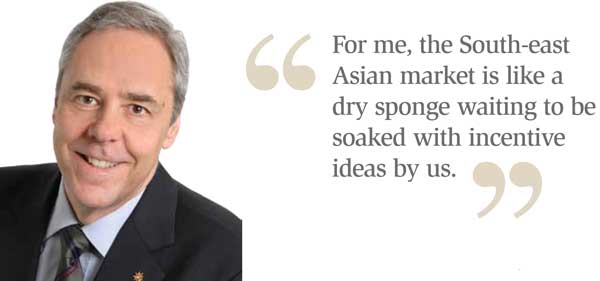
Urs Eberhard

0

The South-east Asian MICE market is making Urs Eberhard smile. The executive vice president-markets & meetings of Switzerland Tourism tells Raini Hamdi why


How strong is Switzerland as a MICE destination overall?
Nineteen per cent of our business is pure MICE, 30 per cent is business travel and 50 per cent is leisure.

Are you seeing as much growth in Asian MICE business as you are with Asian leisure business?
We are seeing a surge of more than 50 per cent in incentive enquiries from South-east Asia, particularly from Thailand and Indonesia, so far this year.
MICE already constitutes around 10 to 15 per cent of the business from South-east Asia. Companies, national or international, in markets such as Singapore, Malaysia, Indonesia and Thailand, are looking for skilled employees and want to incentivise these employees. These are life insurance, pharmaceutical, IT companies, etc, that have highly-skilled employees; they see Switzerland as a premium and desirable destination that they can use as a reward for employees.

I thought they saw Switzerland as expensive. Has that perception changed, or is there simply a bigger budget?
I think, as with everything, it’s a progression. In the first year, you reward with a DVD player perhaps, second year a watch, third year a trip to a neighbouring destination, then farther afield,  especially if your competitors are doing it.
I was in Indonesia in May, talking to some of the biggest MICE organisers there, like Panorama, and it was so encouraging – for me, the South-east Asian market is like a dry sponge waiting to be soaked with incentive ideas and suggestions by us. I was the happiest guy in the room because people were really interested about what they could do or what was available for them in Switzerland and we have a good product for MICE.

How is it good for Asian MICE groups?
Well, English is spoken widely and the infrastructure works. Asians seem to like to do a lot in a short time and in our country, you can enjoy vineyards and glaciers on the same day – taste the wine and enjoy lunch in the vineyard and ski in the late afternoon in the mountain. It is compact and this is appealing for Asian MICE groups. I get requests from corporates which want to visit two mountains in a day. That kind of diversity and possibility translates to giving something to the employee that has real value.
We are investing a lot more than before on the MICE segment in South-east Asia because we do believe in its potential. As it is, Ivan Breiter (Switzerland Tourism’s director, South-east Asia based in Singapore; the regional office was established in June 2012 due to increased prospects from the region) is getting so many requests for big incentive groups, incentive training seminars and media fam trips.

What’s a typical incentive from South-east Asia to Switzerland like today?
The group size is normally 80 to 120 pax, but we also get larger ones of around 400 pax and sometimes, even up to 3,000 pax coming in phases over several weeks.
Usually, they stay four nights in good hotels and do a lot of excursions. Their preference is the Lake Geneva area and Lucerne, as they want to go up to the Titlis. Many of them are first-timers to Switzerland so, even though we would like to bring new ideas and new areas, we must be mindful not to take away the icons. If you go for the first time to Paris, and the company says you’re not going to see the Eiffel Tower, that would not work.

What sort of investment are you putting into South-East Asian MICE business?
We shifted the focus of the central team in Europe to support enquiries from the South-east Asian incentive market. In the past, we had a person in Zurich supporting MICE enquiries from the traditional markets (eg, Germany, Italy, France, the US, etc), but with the traditional markets (lagging) due to  the economy, it made sense to shift resources to support Asia, which is booming.
We’ve also increased by about 30 per cent the spending to tap MICE and leisure business in South-east Asia. We’re doing more MICE fam trips for buyers and media. We never really had a dedicated, organised MICE fam trip for Asian buyers before, but we did one with six outbound agencies last May, where they had a special programme and workshop with Swiss suppliers. We’re doing another MICE fam for around 10 agencies in September.
We are considering now to include a South-east Asia team in our Meeting Trophy event or to have a dedicated Asian Meeting Trophy. Meeting Trophy is when we invite incentive buyers from various markets in Europe and the US to discover the product in a fun way. Buyers from Germany compete with those from France, the UK, and so on, solving puzzles and challenges along the way – it is really like a teambuilding incentive. The programme is 2.5 days and they travel in trains, boats, buses, convertibles…it’s really a memorable experience for them. This year’s event (this month, July), is the ninth Meeting Trophy. We’re thinking, next year, we could have an Asian team join the event, or have an Asian Meeting Trophy where buyers from Singapore ‘compete’ with buyers from China, India, etc.

Did the keen interest from Asian MICE groups for Switzerland surprise you?
When I think back, no, as every growing economy that has a need for skilled labour will have that effect on incentive travel. What surprised me was the speed – how fast and strong the demand has grown. It’s the same as in the early days in Europe when Thomas Cook started taking leisure groups on touring holidays and decades later we saw the rise of FITs from Europe. In Asia, this is happening but everything is at a much faster pace!

Are Swiss suppliers ready for Asian incentives?
With incentives, it’s not a problem, as the group stays four nights, have a nice programme, gala dinner, etc. The problem is with the Asian leisure group series, which we understand is price-orientated. Also, they arrive at 9pm and leave at 7am the next day, so it’s a customer that does not sit at the bar, enjoy dinner – the lifestyle aspects – which comes as a kind of cultural difference for a lot of the traditional Swiss hotels.
This is mostly the China market, however. Our studies show that the average spending by visitors from, say, Thailand, is 30 to 50 per cent more than the spending of Chinese visitors. In the meantime, China has overtaken Belgium as a source market for Switzerland, and will overtake Holland this year, probably Italy too, so there is quite a volume in it. So our strategy in China is also to try and find the second or third-time traveller to Switzerland who appreciates the nature, fresh air, quality of food and accommodation. By appreciating all this, they will spend more time exploring Switzerland and also start to appreciate the nice things in life – perhaps order a bottle of wine to enjoy in the country, instead of rushing to sleep as they have to catch the 8am to Paris.
India strives towards national MICE policy

0

INDIA is expected to unveil a national policy for MICE by end-September this year, the absence of which has crippled the country’s endeavour to position itself as an international MICE destination.

India Convention Promotion Bureau (ICPB) vice chairman, Chander Mansharamani, said: “Deliberations for the policy are underway. We recently had a meeting with the additional secretary of the Ministry of Commerce with regards to the finances necessary for aggressive marketing. The ministry is positive about the policy.

“We are working to announce the MICE policy by end of September at the celebrations of ICPB’s silver jubilee…. We have plans to get some top 50 buyers from the world at the function so that we can interact with them and provide a peek into what all we can offer.”

According to ICPB, the new MICE policy will include a system to record MICE-related statistics in the country, a guidebook providing information on India’s various MICE facilities for foreign buyers, and education programmes for state governments on the economic benefits of MICE events.

“We at ICPB feel that we need the support of a city if we are looking to attract international events. In countries like Singapore or Australia, the city goes and bids for a conference, not an individual. So, we need to convince our governments to get international conferences to our cities. We will try to engage local governments and all the stakeholders of the city,” said Mansharamani.

Anup Nair, managing director, Incentive Destinations, said: “(Having a) MICE policy will help the segment. However, it is important that through the policy, the government is proactive in finding solutions to various issues hampering the growth of the MICE market in the country.”

Meanwhile, the Ministry of Tourism has begun talks with the state government of Maharashtra for the introduction of a single-window clearance system for MICE, and is likely to seek discussions with other state governments once the system is up and running in Maharashtra.

Seoul shifts focus to incentives

0

HAVING established a forte in hosting international conventions, Seoul now wants to build up its incentive muscle and will do so by forging close links with DMCs and event planners.

Maureen O’Crowley, vice president of the Seoul Tourism Organization (STO), said: “Seoul has done well with the conventions and exhibitions business, having maintained its fifth position on the UIA’s charts (of top international meetings cities for the third year running) and yet with a 10 per cent growth in qualified events.

“Conventions and exhibitions will continue to hold strong for Seoul, so now it is time for us to shift our focus to incentives. The great thing about incentives is that such events materialise much faster than conventions and exhibitions, which take years to prepare and happen.”

O’Crowley said STO would “work closely with DMCs and event organisers” to attract more incentive groups.

“China is also on our radar now, and we plan on getting more incentive business from that market, which is why we participated in IT&CM China this April,” she added.

When asked if the convention city would have to develop new and fun products to appeal to incentive clients, O’Crowley said it was more important to work creatively with what the city already offered.

“It is very interesting how groups are coming up with great activity ideas themselves. In April we had a group from a pharmaceutical company in China and an activity the participants had to do was to take photos that captured determination, confidence and passion – the three key traits of Korean businessmen that the company’s CEO liked. A 150-pax group from McDonald’s in Singapore created their own version of Running Man (a popular Korean TV game show) in Lotte World amusement park.”

MCI, Console Communications merge to form MCI Malaysia

0

GLOBAL association, communications and event management company MCI recently merged with Malaysian professional congress organiser, Console Communications, for a stronger hold on the growing Malaysian MICE market.

Commenting on the creation of MCI Malaysia, Yap Shook Fung, director of Console Communications, said: “It is a natural step for Console to join a big global leader like MCI. We believe it will help in bringing more international events to Malaysia and my team and I are excited to be part of the MCI global network.”

Robin Lokerman, president – MCI Asia-Pacific, said MCI wanted to expand to Malaysia and build its corporate business in the country.

“Malaysia is a growing MICE destination and many of our clients are expressing an interest in Kuala Lumpur and other cities. With Console, we have found a very experienced team to build our business and support our clients.”

Malaysia Convention & Exhibition Bureau CEO, Zulkefli Sharif, called the merger a “timely” one, given the “rapid development of the business events industry and the increase in awareness of Malaysia as one of the major players in the industry”.

“With Console’s strong foothold in the local business events industry and MCI’s global networking and expertise, we believe this merger will be a catalyst to the industry, bringing more prestigious events to Malaysia’s emerging and dynamic business events industry,” he added.

Console, established in 2004, has been managing large-scale conferences in Malaysia and abroad, including Water Malaysia 2013, the 10th Asia-Pacific Conference on Human Genetics 2012, and Borneo Water & Wastewater Exhibition 2012.

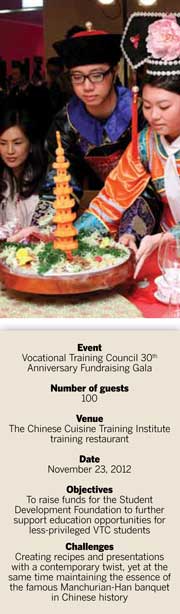
VTC 30th Anniversary Fundraising Gala

0

Hong Kong’s Vocational Training Council overcomes modern limitations to spirit guests back to ancient China for an imperial fundraising feast of a lifetime, writes Prudence Lui


The Vocational Training Council (VTC) recently celebrated its 30th anniversary with a Manchurian-Han imperial feast-themed fundraising dinner. In ancient China, this feast was only hosted by the Chinese emperors, spanning three whole days with six banquets of over 300 dishes. A diverse range of culinary skills would be gathered from all over imperial China to put together the best of both Manchurian and ‘Han’ (Chinese) cuisines into one lavish event.

Lawrence Wong, director of Chinese Cuisine Training Institute (CCTI), VTC’s member institution, said: “The last royal feast held in Hong Kong was more than three decades ago (November 1977) when the crew from a Japanese TV station hosted the two-day event for a documentary film.

“This unique event took us almost a year to research, concentrating on the banquet menu and rituals, sourcing of ingredients and modernising of the presentation and cooking methods.”

Menu development proved a challenging aspect because original ingredients such as bear paws and elephant trunks from the Manchurian-Han feast are unavailable now due to the protection of endangered animals and the environment.

Hence, the institute’s trainees, instructors and guest chefs chose to re-engineer recipes with a contemporary twist and new presentation. For instance, a molecular gastronomy technique was employed for desserts such as the pearl-like white chocolate mousse with apricot puree. The menu included luxurious dishes such as sautéed sturgeon fillet with chrysanthemum, braised sliced abalone with skin of giant garoupa, and double-boiled chicken and bird’s nest soup.

Wong added: “Veterans from the catering industry, including chefs, service staff, restaurant owners and food writers, were consulted to ensure the essence of the banquet was genuinely reflected in this 2012 version. Guest chefs, who are graduates of CCTI’s master and advanced courses, were invited to take part in this once-in-a-lifetime opportunity and to showcase different provincial culinary arts.”

Additionally, mountains carved from ginger and lotus roots were showcased as one of the key decorations of a typical Manchurian-Han feast in ancient China.

Elementary Chinese Cuisine Diploma trainees picked up carving skills to make carrot pagoda decorations for the dishes. They were also exposed to rarely seen ingredients, such as giant garoupa skins, pigeon eggs and sturgeons. F&B trainees also went through stringent training on serving the heavy dishes.

“According to history, as the Emperor could not spare time to accompany his guests, he instructed for the food decorations to represent his royal gardens to show hospitality. At VTC’s banquet, the masterpiece, hand-crafted by CCTI trainees and instructors, showed miniature streams, trees and cliffs. Carrots and yams were carved into pagoda and bridges, while cinnamon sticks represented logs.”

To reflect the Qing Dynasty ambience, the event floor was transformed into an ancient Chinese imperial palace. Upon arrival, guests were welcomed by greeters dressed as imperial guards and ladies, before going through a ‘time machine’ via the elevators to the eighth floor.
Apart from performances of ancient imperial dance, music and magic shows during the dinner, there were also pre-dinner activities, such as Chinese fan calligraphy and silhouette paper cutting. There was also a photo corner comprising a dragon chair and pillars with dragon carvings. During the cocktail, guests could dress up as an emperor or empress and have a picture taken while seated on the dragon chair.

Throughout the gastronomic journey, ancient Chinese imperial serving rituals were followed. Front-of-house trainees and instructors were dressed from a wardrobe of over 100 traditional costumes to enhance the imperial ambience.

VTC wowed its VIPs well through this innovative dinner. Its in-house team took full charge of planning and execution. More than 150 instructors and trainees from CCTI and the Hospitality Industry Training and Development Centre participated in this memorable event.

Suntec Singapore reopens with a bang

0

SUNTEC Singapore Convention and Exhibition Centre has thrown open its doors to MICE once again after year-long renovation works.

The rejuvenated convention centre now boasts a modernised façade including a three-storey interactive digital wall, and amenities such as free Wi-Fi throughout its premises.

Suntec Singapore hosted the closing of the 8th Special Olympics Singapore National Games on June 3, and has since also hosted the Liver Symposium, APASL for 3,500 delegates; and a consumer show, the Singapore Book Fair.

Looking ahead, the convention centre has a calendar packed with events for the rest of 2013, including Spikes Asia 2013 and the Singapore Chinese Chamber of Commerce and Industry’s SME events.

The individual is key in teambuilding: Asia Ability

0

TEAMBUILDING specialist Asia Ability strives to develop the skills and performance of participants and corporations through teambuilding activities that focus on the individual’s abilities.

Each of Asia Ability’s team programmes fall under one of eight abilities – Activeability, Businessability, Createability, Exploreability, Innovateability, Interactability, Responsability and Rhythmability.

For example, under Rhythmability, teambuilding is forged on a grand musical scale. Using the infectious rhythms of samba, Asia Ability transforms a group of individuals into a giant percussion band with each person playing their part, in time and on cue.

Under Exploreability, teams have to literally explore the city to research, script, rehearse and film a five-minute long travel documentary.

As for Innovateability, Asia Ability highlighted its latest programme, Rat Trap. Inspired by the board game Mousetrap, participants are transported into an atmosphere similar to a giant toyshop. The objective is to build a series of large contraptions which, when placed in the right sequence, perform a chain reaction of events.

Asia Ability managing director, David Powell, said: “Our programmes are very popular given that they require no travel and minimal preparation from the clients which is a highly efficient use of the delegates’ time.”

Time was a challenge the company faced in organising teambuilding sessions. “It is especially so if the client wishes to transport the group to an offsite venue,” he added.

“We have to then convince clients that teambuilding does not require a beach or even an outdoor venue – but can be totally integrated within a conference or meeting agenda.”

Asia Ability, established in 1996, currently has offices in Malaysia, Thailand, Singapore and Vietnam, and also holds regular events in Australia, Hong Kong, China, Philippines and Indonesia.

World Expo 2020 dreams fizzle out for Thailand

0

THAILAND’S MICE and tourism industries were left bruised after the country’s bid to host World Expo 2020 was rejected due to a lack of government support.

No one has accepted responsibility for the failure, with the opposition Democrat party blaming the government, which in turn has pointed the finger at the Thailand Convention and Exhibition Bureau (TCEB) for dropping the ball.

The Paris-based Bureau of International Expositions (BIE), which oversees the world fair, told TTG Asia the reason why it rejected Ayutthaya as a potential host for the 2020 event was clear.

“The government did not reiterate its support for the bid,” said a BIE spokesman. “Without support for the bid there is no point in going ahead.”

TCEB declined several opportunities to comment on the matter. However, Sumate Sudasna, president of the Thailand Incentives and Conventions Association, who also sits on TCEB’s board, said the rejection would damage the country’s international standing.

“It’s a loss of credibility, of confidence (in Thailand),” he said, adding the decision could weaken Thailand’s chances of hosting other world-class events of a similar scale. “If we have the chance to do things (bid for major international events) in the future, whoever is putting the bid together will have to be more committed.”

Thailand’s foreign minister and deputy prime minister, Surapong Tovichakchaikul, was quoted in the Bangkok Post as saying that TCEB was to blame for BIE’s decision, as the bureau had been unprepared and lacked information about proper bidding procedures.

Shangri-La’s Rasa Sentosa Resort enhances MICE product

0

A STANDALONE event venue by the beach will join Shangri-La’s Rasa Sentosa Resort’s collection of function spaces by the end of July, along with the introduction of CSR activities themed around a new nature sanctuary.

The yet-to-be-named beachfront venue, once the site of the resort’s popular Barnacles Restaurant which has since been shifted to level three, will be able to accommodate 200 guests indoors and outdoors.

General manager Ben Bousnina told TTGmice e-Weekly that the restaurant’s move was necessary to allow the resort to accommodate the strong demand for beachfront event venues and also to provide greater convenience for guests during breakfast hours by centralising all restaurants on the dedicated dining floor, Dine on 3.

Bousnina said: “We also plan to build a sanctuary next to the new event centre, with plants and fruit trees to attract birds that were displaced by the construction on this island or even an orchid garden. We are also meeting with the team from the Butterfly Park (also located on Sentosa island) to see what we could do here.

“With this sanctuary, we will offer activities to resort guests and corporate groups that will satisfy their corporate social responsibility objectives.”

The sanctuary will complement the resort’s ongoing on-site garden tours that are conducted by the resident gardener, according to the resort’s spokesperson Tina Chia.

Iconic Majestic Hotel wins hearts of event planners

0

THE Majestic Hotel Kuala Lumpur has seen healthy interest from event planners since its opening last December.

Built in 1932 as Majestic Hotel and shut down in 1983, the iconic building celebrated a grand reopening last December following a refurbishment by YTL Hotels (TTG Asia e-Daily, December 10, 2012).

According to the luxury property’s director of sales & marketing, Anna Olsson, The Majestic Hotel Kuala Lumpur has been the venue of choice for several events such as F1 Gala Dinner 2013, The BrandLaureate Awards 2013 and other functions organised by the private banking sector and high-end brands. It has also hosted local wedding dinners with 800 to 1,200 people.

Olsson noted that the bulk of business for residential meetings had come from Singapore and Hong Kong, with China showing growing interest, while Australia and New Zealand produced incentive bookings.

Meetings and incentives from the Middle East are also rising.

The property will work closely with The Leading Hotels of the World – it is the only hotel in the Malaysian capital to be included in the collection of properties under the luxury hospitality consortium – to attract more corporate interest and attend tradeshows such as IMEX to build further awareness of the hotel.

Reviews

The Ritz-Carlton, Bangkok

The newly-opened Ritz-Carlton, Bangkok anchors the One Bangkok development with cosmopolitan elegance. Featuring the city's largest ballroom and a spectacular new penthouse suite, it delivers exceptional hardware and deeply authentic, soulful service for business and leisure travellers alike

Mama Shelter Zurich

Behind the imposing, Brutalist concrete that defines Zurich’s Oerlikon district lies a surprising secret. While its exterior honours the neighbourhood’s industrial roots, stepping inside Mama Shelter reveals a vibrant, neon-soaked world that is a far cry from its rigid shell

Hyatt Regency Kuala Lumpur at KL Midtown

A polished urban retreat designed for business travellers, Hyatt Regency Kuala Lumpur at KL Midtown combines thoughtful design, seamless service, and exceptional facilities.