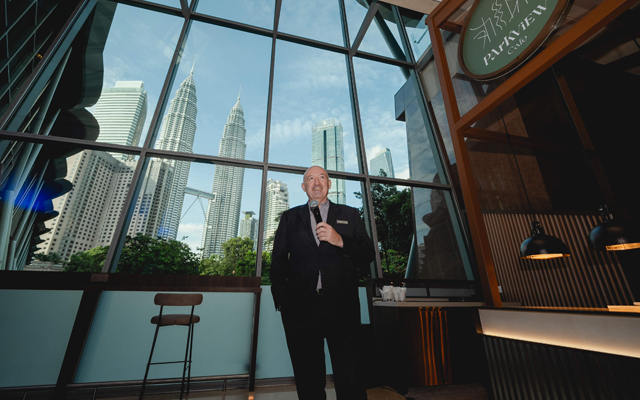
John Burke, general manager of the Kuala Lumpur Convention Centre, at the Parkview Café
The Kuala Lumpur Convention Centre (KLCC) has unveiled its newest dining and event space – the Parkview Café, on level one.
Parkview Café showcases the best of Malaysia’s diverse culinary heritage with its menu featuring fresh, locally-sourced ingredients. This commitment to sustainability ensures that each meal is delicious and a celebration of local farmers and suppliers.
John Burke, general manager of the Kuala Lumpur Convention Centre, at the Parkview Café
Diners at Parkview Café can also expect panoramic views of the lush greenery of KLCC Park and the Petronas Twin Towers.
The cafe accommodates 120 guests for casual dining and 70 for events.
TTGmice e-news bulletin will be taking a break from December 13, 2024.
We will be back on January 7, 2025, when we will continue to deliver the latest headlines straight to your inbox. The site will continue to be updated with articles during the month, so check back regularly.
In the meantime, TTG Asia Media wishes all readers Happy Holidays and a Happy New Year!
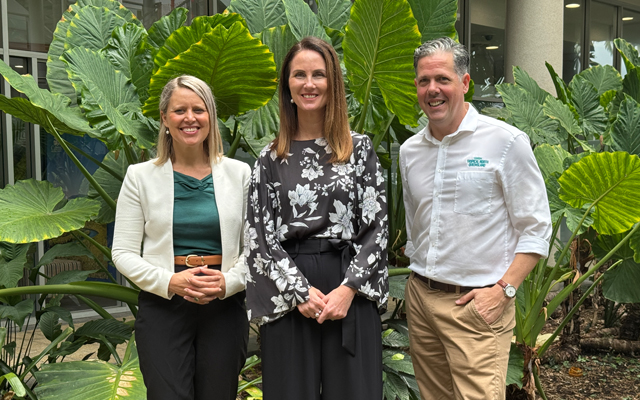
Queensland’s assistant tourism minister Bree James; Cairns’ mayor Amy Eden; and Tourism Tropical North Queensland CEO Mark Olsen announce that Cairns will host the 2025 Amway Korea incentive
Tourism Tropical North Queensland (TTNQ) has secured a major win for the region, securing an international business event that will inject over A$11.6 million (US$7.5 million) into the local economy.
Amway Korea will bring approximately 2,700 delegates to Cairns in 2025, arriving in six waves between November 17 and December 9.
Queensland’s assistant tourism minister Bree James; Cairns’ mayor Amy Eden; and TTNQ’s CEO Mark Olsen announce that Cairns will host the 2025 Amway Korea incentive
“This event is an incentive rewarding Amway’s top performers with each wave of delegates doing three full days of touring and at least two offsite events as well as opportunities to explore Cairns at leisure,” said TTNQ’s CEO Mark Olsen.
He pointed out that international incentive groups are the “highest-yielding market in tourism” with an average spend of A$1,000 per delegate per day compared to A$735 for other international business events.
He added: “Announcing this so soon after hosting Australia Next in Cairns in September will really resonate with the international incentive organisers who were wowed by our destination and are now planning where to hold their next event.”
The successful bid for the Amway Korea event highlights the collaborative efforts of various stakeholders, including TTNQ, Business Events Cairns & Great Barrier Reef, Cairns Regional Council, Queensland Government (through Tourism and Events Queensland), and Tourism Australia.
Previously in 2018, Cairns hosted the 6,000-strong Amway China incentive.
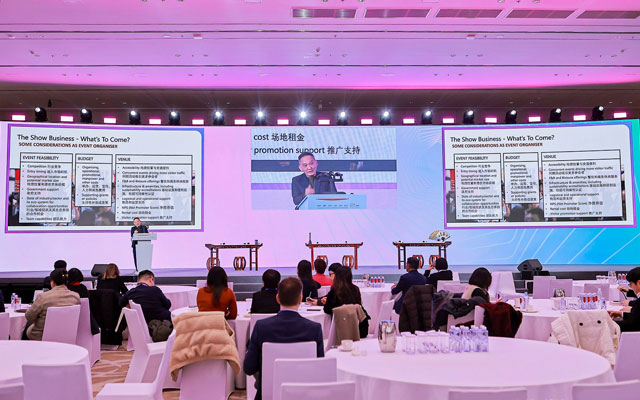
Chua Wee Phong, group CEO of Constellar, shared how the Singapore Expo is navigating the evolving event landscape
Venue operators from around the world gathered at the inaugural Global Venue Experts Forum in Beijing – held at the China National Convention Center Phase II (CNCC2) – to discuss strategies for navigating the evolving landscape of the events industry.
Michael Kruppe, general manager of the Shanghai New International Expo Centre (SNIEC), shared insights on how the venue has adapted to changing market dynamics.
Chua Wee Phong, group CEO of Constellar, shared how the Singapore Expo is navigating the evolving event landscape; photo by JIMAGE
He highlighted the 300,000m2 venue’s shift away from just B2B tradeshows towards hybrid events, B2C conferences, and non-traditional events like sports and science shows.
Kruppe further emphasised the importance of customer satisfaction and safety, urging venues to continually seek feedback and invest in infrastructure. He also underscored the growing significance of Environmental, Social, and Governance (ESG) factors, noting the increasing pressure on venues to adopt sustainable practices.
Meanwhile, Chua Wee Phong, group CEO of Singapore-headquartered Constellar, which manages the Singapore Expo, discussed the challenges of rising costs and evolving event needs. He advocated for dynamic rental pricing to support emerging events, investing in sustainable infrastructure, and offering value-added services like festivalisation and customised experiences.
“These experiences are not just for exhibitors and delegates, but they also target the B2C market like families. Apart from our major tradeshows, we change our content every six months.
“To maximise space utilisation and revenue, we have transformed our multipurpose halls into versatile venues. Our dedicated festivalisation team then assists event organisers in creating unique experiences, attracting larger audiences, and boosting overall event success,” Chua elaborated.
Meanwhile, Nicholas Aaron Khoo, chairman, Digital Media Investment Committee of N PrimePartners Capital, shared about Esports and Egaming-related events, inspiring venue providers to diversify their business.
Other venue chiefs, such as Shelley Tang, general manager of the Hangzhou International Expo Center, and Dong-Ki Lee, president and CEO of Coex Convention & Exhibition Center in Seoul, also highlighted the importance of diversifying revenue streams. This includes exploring new business opportunities like F&B services, digital signage, and sustainable event solutions.
The report highlights opportunities and challenges for business travel
BCD Travel’s recently-released Travel Market Report: 2025 Outlook provides an in-depth analysis of global economic trends, air travel forecasts, hotel rates, car rental insights, and sustainability initiatives.
The report by BCD’s Research & Intelligence team forecasts the global economy to experience modest growth of 2.9% in 2025, with the US leading the pack among developed economies.
The report highlights opportunities and challenges for business travel
However, high prices, geopolitical instability, and an ageing population will influence economic dynamics. Businesses should remain aware of potential challenges such as supply chain disruptions, climate-related events, and volatile fiscal policies.
Next, international air travel is projected to experience a significant rebound, with Asia spearheading growth at 30% above pre-pandemic levels. Domestic travel is expected to stabilize. Global airfare is anticipated to remain relatively flat overall, although regional variations exist.
Business class fares may see a slight increase of one per cent, while intercontinental economy fares are predicted to decrease by 0.6%. Interestingly, the report highlights the potential for increased leverage in corporate travel negotiations as airlines revise their discount strategies.
Meanwhile, average daily room rates (ADRs) are forecasted to rise by 2.9% globally, with the strongest growth anticipated in the Southwest Pacific (+4.6%) and the Middle East (+4.1%). The report offers detailed regional insights, highlighting key growth areas like Saudi Arabia (+6.5% ADR increase), Spain (+6.0% ADR rise), Japan (+8.0% ADR increase), and Tanzania (+11.0% ADR increase).
Leisure demand for car rentals is expected to soften, while corporate rates are likely to increase, especially for contracts not renegotiated recently. While Europe may see relative pricing stability, the Americas and Asia-Pacific regions are likely to experience more dynamic fluctuations.
The report also underscores the rising importance of sustainability in business travel. Increased adoption of Sustainable Aviation Fuel (SAF) is anticipated, potentially leading to higher travel costs, particularly in regions like the EU with upcoming mandates.
Corporations will also need to take into account the EU’s Corporate Sustainability Reporting Directive (CSRD), which emphasises accountability in business travel emissions. The report also highlights the need for companies to develop “meaningful travel” strategies that balance environmental impact, traveller wellness, and business objectives.
The business travel landscape in 2025 will be characterised by moderate economic growth, regional travel recoveries, and a strong focus on sustainability. Corporate travel managers will need to adapt to this evolving environment by actively renegotiating contracts, integrating sustainability practices, and staying vigilant of geopolitical and climate risks.
With increased cyber threats and rising travel costs, SAP Concur offers insights on how businesses can navigate the complex T&E landscape in 2025
Artificial Intelligence (AI) is poised to streamline business travel and expense management, and SAP Concur’s 2025 travel and expense (T&E) predictions outline how this technology will impact businesses in the coming year.
With increased cyber threats and rising travel costs, SAP Concur offers insights on how businesses can navigate the complex T&E landscape in 2025
Continued investment in digital systems and security infrastructure
Companies in 2025 will invest in innovative new solutions such as process automation and generative AI to support growth. However, as digital estates grow and businesses incorporate new systems to streamline T&E processes, the risks associated with data and system breaches rise.
Pressure to compete will leave businesses and customers vulnerable. Today, more organisations than ever experience cybersecurity breaches, putting personal information at risk.
It is a delicate balancing act to respond quickly to the demands of internal and external stakeholders without disregarding security concerns. Investment in tech innovation and security infrastructure will be top priorities in 2025, as firms compete to provide greater customer value while minimising risk.
Nearly 85% of businesses in Asia-Pacific (APAC) have reported an increase in their cyber budgets and regulations are gaining momentum. For example, in Singapore, companies can face fines of up to 10% of their local annual turnover.
A return to the office puts pressure on budgets to go further
As employees return to the office in droves, we expect business travel volume to increase. And with inflation slowing, businesses have an opportunity to extract more value from travel investments.
But leaders are cautious. In 2025, pressure will mount for financial controllers to get more out of T&E budgets, ensuring minimal risk to the overall business posture.
The result is a bolstered mandate for compliance and visibility. For example, T&E may be increasingly managed by one platform, ensuring policies are consistently applied as more travellers book trips and submit expenses –protecting against costly mistakes, fraud, and policy breaches.
“From 2020-2023, circumstances led to dramatically reduced travel activity and companies experienced benefits to their bottom line. Corporate travel is now recovering strongly – according to GBTA, the global business travel industry spending is expected to hit a record US$1.5 trillion this year, with China and US the two fastest-growing markets. APAC was the fastest growing region for corporate travel in 2023, expanding 36% over the year before,” said Brett Wheeldon, vice president of solutions consulting, APAC, SAP Concur.
“With this comes a scramble for visibility and the ability to rapidly adapt and then apply company spend policies. Many organisations, however, are ill-equipped to deliver this change.”
Expense reports become exception reports
As the hype settles, individual job roles are defining their most valuable practical applications for AI. Repeatable tasks such as validating transactions for compliance will become increasingly automated in 2025, reducing the time managers spend reviewing individual expense reports.
Instead, ‘trusted’ transactions may never even land in an expense report. They will be replaced with exception reports, which only highlight deviations from the business’ standard T&E policies.
Automation will handle mundane tasks and help travel managers deliver in-depth audits with ease. In turn, this will give reviewers greater capacity to inspect expenses, identify fraud, and ensure no error goes unchecked.
Employees show a healthy scepticism in AI
While 2024 promised AI-literate businesses a host of transformative benefits, 2025 will see the tech treated with a sensible level of scepticism and thoughtfulness.
For now, however, AI will be seen as an assistant helping to source recommendations and identify expense anomalies, rather than a one-stop solution for booking travel or submitting expense reports.
Use cases such as pre-trip approvals and itinerary building are bringing benefits. But rather than going all in on AI, business travellers and travel managers will be tentatively exploring the workflows with the largest returns in 2025.
One area that’s often overlooked is travel research, or the time spent by employees searching geographies, identifying the best ground transport, and finding out local payment methods. AI can assist with these tasks, and truly give staff back their time for daily duties.
“Travel booking is the perfect use case to move away from static cumbersome input forms to a natural language conversation that has the datasets to access information such as corporate travel policies, specific event dates and even travellers’ record of travel that may alter policy rules based on the frequency of travel,” said Wheeldon.
Demand grows for improved user experiences
With business travel on the rise, traveller expectations will continue to increase.
In 2025, we anticipate greater demand for real-time updates on disruptions. This can help address the effects of extreme weather events and geopolitical conflicts, which are increasingly influencing business travel decisions. With employer duty of care under a magnifying lens, travellers expect greater levels of support through T&E systems.
Following years of buzz around AI and digital innovation, 2025 will be the year of practical implementation. Organisations will plan how to stay competitive with their new T&E investments, all while making provisions to protect data, security, and their bottom line.
The critical piece here is to take the initial step, for example, by engaging SaaS solutions for their horizontal scalability, as many APAC organisations have done. For such firms, integrated T&E is critical. This means the ability to add things like duty of care providers beyond basic expense, as the company scales.
“Of course, that aggregated T&E data also provides insight into other areas APAC businesses are becoming more and more focused on, for example, what is the organisation’s travel program’s carbon footprint, and does the organisation have the tools to reduce that footprint?” remarked Wheeldon.
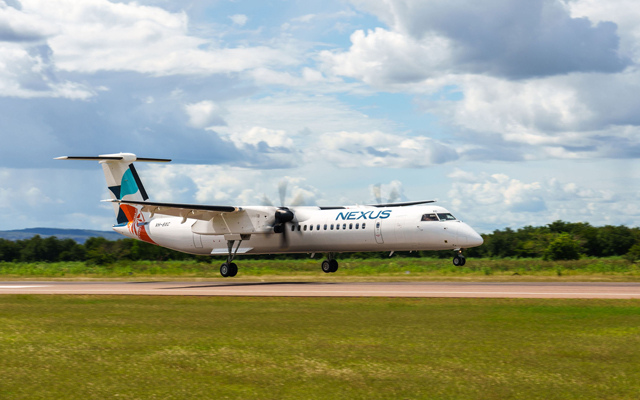
Nexus Airlines uses larger aircraft with more seats
Nexus Airlines, a regional carrier which was launched in July 2023, is expanding its operations to improve connectivity within Western Australia to better cater to corporate and leisure travellers.
The airlines’ group external relations manager, Kym Francesconi, told TTGmice on the sidelines of the BE reWArded Mega Famil that Nexus is an evolution of Aviair.
Nexus Airlines uses larger aircraft with more seats
“Aviair is our smaller, fixed-wing aircraft that’s been operating for 40 years. Nexus is where we introduce larger aircraft which has 76 seats. With bases located regionally in Broome and Geraldton, Nexus Airlines provides a range of passenger and charter air services for corporate groups,” she explained.
Francesconi shared that the owner of the company, who lives in Kununurra, in far northern Western Australia, initially set up the airline to “improve connectivity” and “connect the dots” throughout the massive state. For instance, corporates that needed to get to Kununurra for work from Geraldton, no longer had to fly down to Perth, and back up north.
In response to how the airline’s connectivity would benefit the corporate sector, aside from fly-in fly-out workers – employees who are flown to remote work sites for a period of time, then flown back home for a break – Francesconi opined: “There is a big opportunity in the incentive market. For example, there’s the Perth to Geraldton route for the Pink Lake, which is extremely popular with the Singaporean, Malaysian, and Chinese markets.”
The airline is currently exploring new routes within Western Australia, such as Broome to Exmouth, as part of its expansion plans.
“Thanks to the Jetstar flight which connects Singapore and Broome, I think a connection onward to Exmouth (from Broome) will appeal to the Singapore, Malaysia, and European markets. We’ve engaged a consultant to look at the viability of such routes,” she said.
Francesconi pointed out that stakeholders are currently in talks with the government to build conference facilities in Broome, to “establish Broome as the Northern Gateway into Western Australia”.
“Look at how big our state is. At the moment, the main entry point is Perth, so I think it would make sense to have a Northern Gateway, which would open up a lot more opportunities for business events and tourism,” she opined.
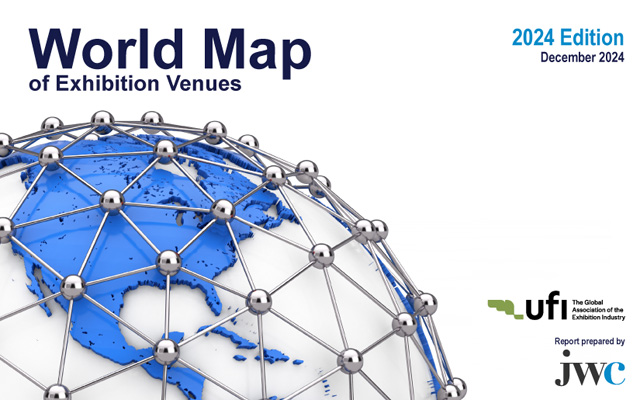
UFI, The Global Association of the Exhibition Industry, has released the latest edition of its World Map of Exhibition Venues to provide stakeholders with the latest insights into venue capacity worldwide. This report was prepared in collaboration with jwc.
In addition to global and regional venue capacity data, the report details 22 global markets with over 300,000m2 of gross indoor exhibition space.
Cover page of the World Map of Exhibition Venues
This global census covers all exhibition venues with a minimum of 5,000m2 of gross indoor exhibition space at the end of the year 2023.
On a regional level, the Asia-Pacific region now accounts for 38.5 per cent of global venue capacity, surpassing Europe (36.7 per cent) for the first time. North America ranks third at 17.1 per cent.
On a country level, China continues to dominate globally, representing 31.3 per cent of total venue capacity, followed by the US (14.2 per cent) and Germany (7.3 per cent). Collectively, the top five markets (China, the US, Germany, Italy, and France) have grown by 1.1 percentage points to a new total of 63.5 per cent of total space globally.
Mega venues – facilities with over 100,000m2 of indoor exhibition space –continue to grow in number, with 83 tracked globally. Europe retains a small lead here with 39 such venues, ahead of Asia-Pacific with 38. The remaining ones are North America (5) and the Middle East and Africa (1).
For the first time, venues from Ethiopia and the Ivory Coast have been included in the report.
The 2024 UFI World Map of Exhibition Venues covers the following markets: Austria, Belgium, Brazil, Canada, China, France, Germany, India, Italy, Japan, Mexico, Poland, Russia, Saudi Arabia, South Korea, Spain, Switzerland, the Netherlands, Turkey, UAE, United Kingdom, and the USA. These dedicated country profiles provide a deep dive into venue capacity and trends, offering valuable benchmarks for industry stakeholders.
The full World Map of Exhibition Venues report is available free of charge on the UFI website at www.ufi.org/research. It is also available at www.jwc.eu.com.
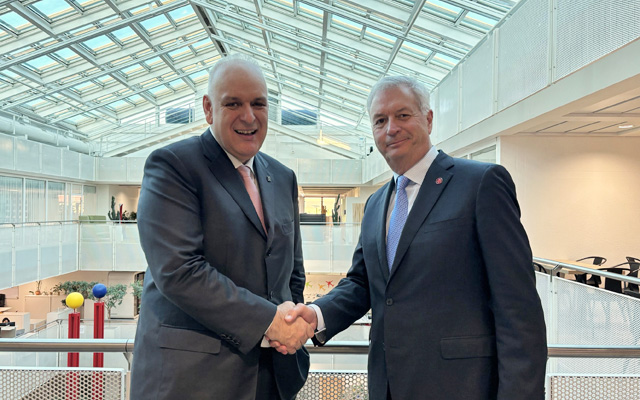
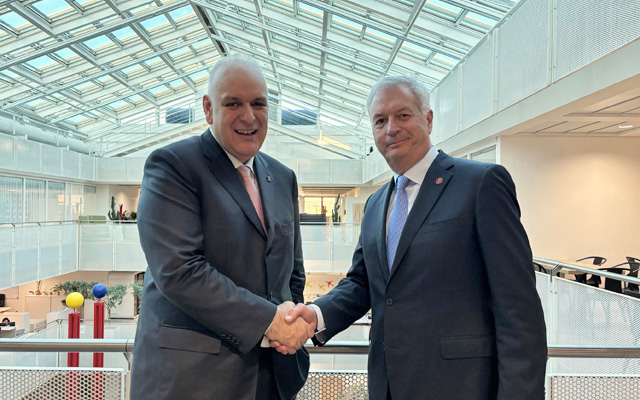
Michael Rousseau, president and CEO of Air Canada, has been named the new chairperson of the Star Alliance Chief Executive Board. He succeeds Scott Kirby, CEO of United, who held the post since December 2020.
From left: Theo Panagiotoulias and Michael Rousseau
In his new role, Rousseau will lead the two annual board meetings and serve as the spokesperson for the board, guiding the strategic direction of 25 global member airlines.
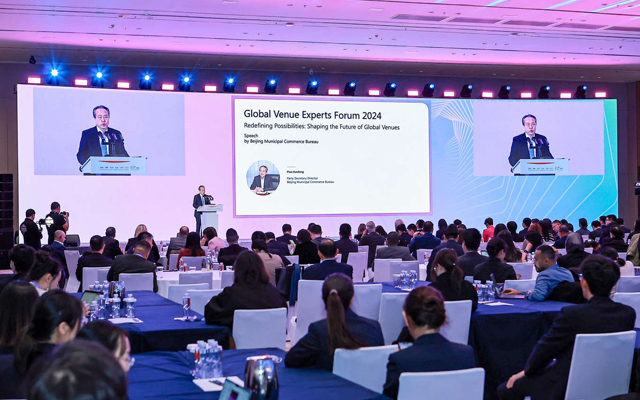
Beijing Municipal Commerce Bureau Party’s secretary director Piao Xuedong emphasised the capital city's commitment to the business events industry during the opening speech
The inaugural Global Venue Experts Forum, jointly organised by the International Congress and Convention Association (ICCA) and Beijing North Star Group, concluded successfully in Beijing on December 7, 2024.
The two-day event brought together approximately 300 industry professionals and large-scale venue operators from 50 countries to the newly-built China National Convention Center Phase II (CNCC2). This forum served as a pilot event for the CNCC2 ahead of its official opening next year.
Beijing Municipal Commerce Bureau Party’s secretary director Piao Xuedong emphasised the capital city’s commitment to the business events industry during the opening speech; photo by JIMAGE
Themed Redefining Possibilities: Shaping the Future of Global Venues, the forum delved into four key topics: the strategic role of convention centres, global venue market dynamics, revenue diversification, and next-generation venue architecture and design. Industry leaders shared insights, case studies, and best practices to address the evolving needs of the global venue industry.
The forum also underscored the evolving role of convention centres. No longer mere meeting spaces, they are now seen as catalysts for urban development and cultural exchange.
In support of this, Li Xiaolin, deputy general manager of Beijing North Star Convention and Exhibition Investment Co., emphasised the two-way promotion between conference activities and destination development. The CNCC2, for instance, is expected to revitalise Beijing’s northern region and serve as a global communications hub.
Patrick Chen, director of the Intangible Culture Heritage Department at Shanghai Municipal Administration of Culture and Tourism, highlighted the importance of community engagement. Venues should cater to conference attendees and local residents, fostering a sense of pride and belonging.
Ross Steele, general manager of Te Pae Christchurch Convention Centre, also highlighted the importance of incorporating local culture into the venue experience, even when clients prioritise enhanced technology and versatile, multifunctional spaces.
He explained that in New Zealand, the Māori culture is deeply embedded in the venue’s identity, where visitors seek authentic experiences through local cuisine and architectural storytelling to connect with the destination on a deeper level.
The Global Venue Experts Forum marked a significant milestone for ICCA’s expansion into China, where the partnership with Beijing North Star Group aims to elevate industry standards and attract more international events to the country.
The newly-opened Ritz-Carlton, Bangkok anchors the One Bangkok development with cosmopolitan elegance. Featuring the city's largest ballroom and a spectacular new penthouse suite, it delivers exceptional hardware and deeply authentic, soulful service for business and leisure travellers alike
Behind the imposing, Brutalist concrete that defines Zurich’s Oerlikon district lies a surprising secret. While its exterior honours the neighbourhood’s industrial roots, stepping inside Mama Shelter reveals a vibrant, neon-soaked world that is a far cry from its rigid shell
A polished urban retreat designed for business travellers, Hyatt Regency Kuala Lumpur at KL Midtown combines thoughtful design, seamless service, and exceptional facilities.