Crowne Plaza Hotels & Resorts, a part of IHG Hotels & Resorts (IHG), has unveiled Meetings Without Boundaries, a concept for the Greater China market which capitalises on the rising demand for domestic cultural tourism and bleisure travel.
The Meetings Without Boundaries concept features China’s business hubs like the Crowne Plaza Xiamen Jimei Seaview, which offers office environments along the Xiamen seaside. Next, the Crowne Plaza Hangzhou Riverside, strategically located near the Hangzhou International Expo Center and Qiantang River, has over 2,500m2 of versatile meeting space.
Crowne Plaza Shennongjia 640
Meanwhile, the Crowne Plaza Tianjin Meijiangnan enjoys a unique advantage in resources and location, as it sits near Tianjin Meijiang Convention and Exhibition Centre, Tianjin Municipal People’s Government, and the Xiqing Economic Development Zone. This year, the hotel hosted the World Economic Forum’s 14th Annual Meeting of the New Champions 2023, where its event team ensured a seamless conference experience for the over 1,500 attendees, catering to the personal needs of delegates from nearly 100 countries.
Crowne Plaza Hotels & Resorts also offers meeting guests an opportunity to enhance their connection to the destination. At Crowne Plaza Shennongjia, nestled deep in mountainous forests, a hike in the wilderness allows for a new way to engage in both teams building and the natural environment. Alternatively, at the picturesque Crowne Plaza Chongli Resort in Zhangjiakou, the snowy vistas will allow guests to ski or savour the landscape, creating unforgettable memories.
Crowne Plaza Hotels & Resorts also has a footprint in urban high-tech zones.
For instance, Crowne Plaza Wuzhen is located near the World Internet Conference Center and high-speed railway station, and offers 800m2 of flexible meeting space. In the coastal hub of Qingdao, the Crowne Plaza Qingdao Jinshui features 2,000m2 of flexible event space and 11 meeting rooms, including a 1,000m2 ballroom that can accommodate over 650 people.
Crowne Plaza Hotels & Resorts currently operates 115 hotels and has 72 in the pipeline in Greater China. Newly-opened properties include Crowne Plaza Ganzhou, Crowne Plaza Jiangmen Binjiang in the Greater Bay Area, and Crowne Plaza Jinan Runhua, located next to the Shandong International Convention and Exhibition Center and commercial business district.
Rosewood is running a time-limited Meet With Purpose group offer, which includes a 15 per cent allowable attrition on group stays.
The offer also includes one complimentary suite upgrade based on 25 rooms per night, and one complimentary meeting room with a catered function. Planners can also opt to share the benefits by directing Rosewood to donate three per cent of room revenue to a local charity.
This package can be booked from now until December 20, 2023, for travel until December 19, 2024.
South Korea’s MICE industry has seen business return in full swing post-pandemic, with no sign of slowing down. Robust government support for overseas organisers and planners was instrumental for the thriving sector when it played host to numerous large-scale corporate events and international conferences in 2023.
One stood out with a massive turnout of a record 25,000 participants – the 12th World Choir Games (WCG) Gangneung 2023.
This year’s edition has returned to South Korea after 20 years. The city of Gangneung, located in the Gangwon province, is the second South Korean city after Busan in 2002 to host the international event.
Founded in 2000, the WCG is the world’s largest choir competition, taking place once every two years on different continents and organised by Interkultur, a German-based foundation.
President of Interkultur and founder of WCG, Günter Titsch, had expressed confidence that their South Korean counterparts would “deliver a highly successful, flawlessly organised, and truly unforgettable event for all attendees”.
“From our perspective, the collaboration with the local team has been nothing short of exceptional.”
Experienced in hosting major international events, Gangwon-do was the venue of the 2018 Winter Olympics in Pyeongchang previously, which went down in history as the “Peace Games” due to the joint appearance of North and South Korean athletes.
The 12th WCG Gangneung 2023 welcomed 25,000 participants from choirs worldwide coming together to celebrate their love of song – with 324 teams, including 95 teams from 33 foreign countries, partaking in competitions and other activities in six venues citywide over 11 days.
Host city, Gangneung, is known for its breathtaking location by the sea in front of awe-inspiring mountainous scenery.
To allow the overseas delegates to explore the surroundings with ease, Gangneung Cultural Heritage Night Tours were provided at the Gangneung Local Government Office and Yeongwol Seobu Market.
Besides, daily street performances were also staged at Wolhwa Street, Gyeongpo Beach, Jumunjin Market, Jeongdongjin Station and Gangneung Church, to add to the enjoyment of the participants.
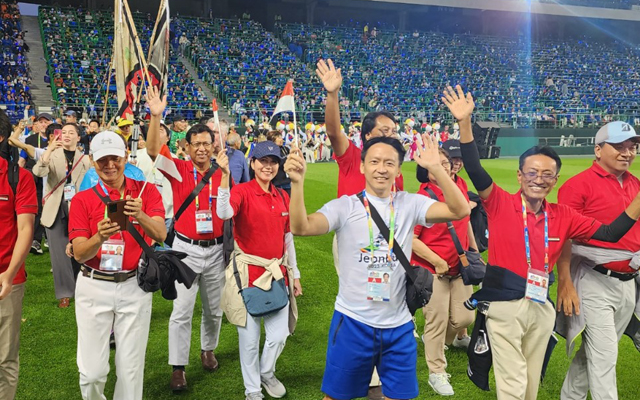
On the sporting front, the East Asian nation also hosted the Asia-Pacific Masters Games 2023 Jeonbuk Korea for the first time in May. The nine-day event was staged across 14 cities and counties in Jeollabuk-do.
An international sports event held every four years, this year’s edition saw about 3,000 delegates participating in 25 sporting events including archery, badminton, baseball, bowling, cycling, golf, swimming, triathlon, and wushu.
Korea Tourism Organization (KTO) assisted organisers by operating welcome desks at Incheon and Gimpo Airports to receive overseas participants.
During the Games period, a Jeonbuk shuttle bus was deployed to provide connectivity from the stadium to the province’s major tourist attractions. Various tours were also provided for delegates to explore neighbouring places of interest easily during their stay.
Major international events staged in South Korea
1 of 4
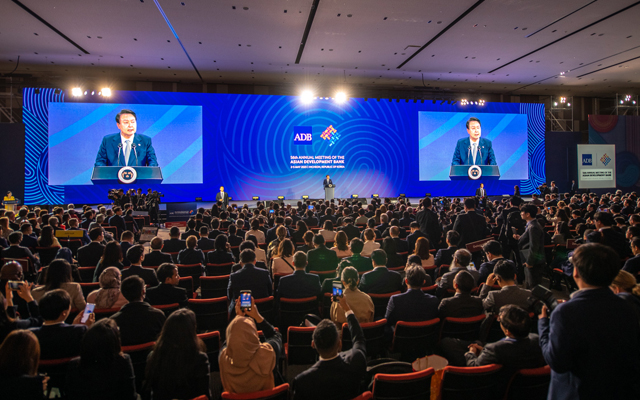
The 56th Asian Development Bank Annual Meeting welcomed 5,000 delegates
South Korea hosted the Asia-Pacific Masters Games 2023 Jeonbuk Korea for the first time in May
The 10th International Electric Vehicle Expo in May attracted 7,380 attendees
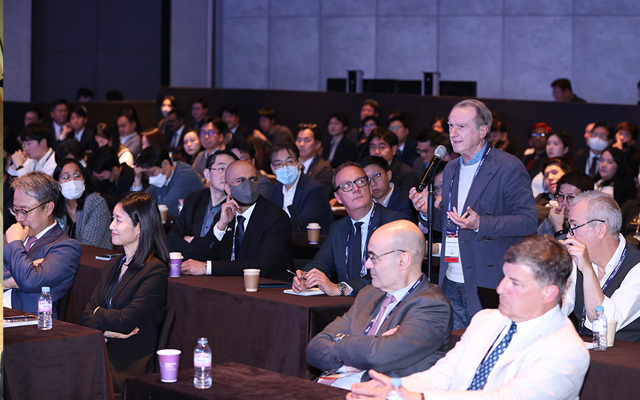
The 28th TCTAP, recognised as the best international academic conference in the field of interventional cardiovascular medicine in the Asia-Pacific region, chose South Korea as its host country
Other major events in 2023 include the 10th International Electric Vehicle Expo in May which attracted 7,380 attendees; and the 56th Asian Development Bank Annual Meeting in the same month welcomed 5,000 delegates.
Thousands more took part in the 2023 Global Marketing Conference and 28th TCTAP, recognised as the best international academic conference in the field of interventional cardiovascular medicine in the Asia-Pacific region.
This November, Seoul will host the 2023 Annual Global Meeting of the International Gynecologic Cancer Society, as well as one of the mega events in eSports, the League of Legends World Championship. Both events are set to welcome about 2,000 and 12,000 respectively.
This year’s stellar showing can be attributed to KTO’s MICE Bureau’s various attractive initiatives directed at inbound business events.
Among others, business events organisers and planners can obtain financial assistance, as well as marketing and liaison support, with the actual amount of financial support dependent on the event size and scope.
Assistance ranges from complimentary accommodation (subject to conditions); cost defrayment on items payable to local contractors; subsidies for cultural entertainment and bidding expenses; to customisable souvenirs.
The bureau will also ensure overseas prospects are updated on the latest happenings in the business events sector, help with coordination with local suppliers, as well as organise site tours and orientation trips.
KTO’s spokesperson added: “With the end of the pandemic, competition to attract MICE events has fully resumed. With the resumption of offline events, demand for special experiences has increased, and with it, the need for event planning that is unique in terms of location and content.”
Interested in organising your next event in South Korea?
Find out more about the support and assistance available here.
Incentive planners have noticed an increase in demand among corporates asking for unique local experiences to be added to their itineraries post-lockdown.
Moreover, these local activities also need to allow corporates to positively contribute to and uplift the lives of local communities.
The Seedbed Project in Kobe, Japan
Ricky Chen, project manager of Taiwan Tour, told TTGmice: “Local experiences are a must these days in most incentive itineraries. This actually started before the pandemic, but (I noticed that) more and more (corporates are requesting).”
One example of a local experience that Taiwan Tour offers includes a tribal culture and hunter school in Taitung, Hualien.
Chen shared that corporates will have the chance to learn to track animals through their footprints and their dung.
Over in Japan, the Kobe Convention Bureau uses unique local experiences as a major selling point to attract incentive groups.
Lance Ferguson, the bureau’s assistant manager meetings & events, said: “Being a city located between two popular destinations Osaka and Kyoto, Kobe needs to come develop unique local experiences in order to stand out from the crowd.”
He suggested experiencing the “mountain life” in Kobe, where corporate groups can hike Mt. Maya, and experience zazen, a form of meditation practised by the Buddhist monks of the Tenjoji Temple.
Another interesting local experience Kobe offers is the Seedbed Project based on Awaji Island. The project, run by the Tane no Chikara organisation, aims to create a sustainable community by managing an abandoned three-hectare farm.
There, workshop participants will get to work together to build and create parts of a village called Seedbed. The experience is designed to inspire through co-creation, and leave a lasting positive impact on the group and local community.
Such experiences usually would appeal to mature travel markets that are well-travelled and are on the lookout for new experiences and destinations, noted Ferguson.
Meanwhile, although Richard Woss, managing director of ATI Travel, also indicated that demand for local experiences is being increasingly part of incentive itineraries, the “level”, or how in-depth local experiences go, depends on the group. For ATI Travel, a common CSR programme would be just a regular beach cleaning session.
Ferguson agreed, and stated that the depth of local experiences and the value of giving back to society varied among corporates.
Some groups aim to create memorable experiences for participants while leaving a lasting impact on the local community (such as the Seedbed Project), while others may opt to visit a sake brewery; one of the more popular requests.
“Kobe is the biggest producer of Sake in Japan and travellers can learn about sustainability at the breweries. Rice and water are a big part in the brewing of sake, so how the water is treated, and how the rice is grown, is something that corporates can also learn about,” he said.
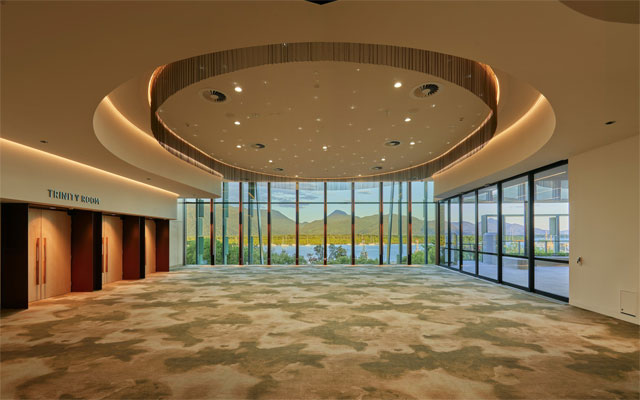
Views of the Trinity Inlet can be seen from the Trinity Room
The A$176 million (US$112.5 million) Cairns Convention Centre, operated by ASM Global since it opened in 1996, will now be able to host multiple events, as well as larger conferences requiring multiple break-out spaces.
The state-of-the-art expansion delivers an extra 10,500m2 of space comprising an exhibition area with space for 30 booths; 450-seat theatre-style plenary lecture space that can be divided into two; three large meeting rooms that can be configured into multiple sizes; and a 500-capacity Trinity Room banquet space.
Views of the Trinity Inlet can be seen from the Trinity Room
The outdoor terrace, and lobby for pre-event functions, can also be utilised by meeting planners.
A key part of the expansion is the Trinity Room and Terrace level, offering unparalleled views over Trinity Inlet. The significant expansion project also includes a large undercover Porte Cochere planted with native, tropical flora that can also be used as a function space.
ASM Global (Asia Pacific) chairman and chief executive, Harvey Lister, said the Centre’s expansion and refurbishment would deliver significant economic benefits to the Cairns economy over the next decade and beyond.
“Cairns Convention Centre is on track to host 160 events this financial year, including 60 conferences bringing more than 35,000 delegates to Cairns, delivering a visitor spend of over A$100 million into the region,” noted Lister.
Cairns Convention Centre, general manager, Janet Hamilton, said the refurbished and expanded centre was poised to welcome event organisers and delegates from across Australia and the world.
“We are already receiving positive reactions to the new spaces, with clients impressed with the contemporary design and light filled areas that feature our lush, tropical rainforest in the background,” Hamilton said.
“We sit at the heart of one of the world’s most beautiful destinations and great care and consideration was taken to bringing the natural environment into the Centre’s spaces. From our open spaces with floor-to-ceiling windows, to our stunning Trinity Room and Terrace with views across the inlet, the Centre showcases Cairns’ natural assets.”
Despite importance of sustainable travel, companies lack sustainable travel goals during corporate travel
While 82% of companies have sustainability goals in place, only 45% have targets for sustainable business travel, with only 20% of business travellers are aware of their company’s sustainable travel goals.
This is according to a BCD Travel survey of more than 100 travel buyers and almost 1,800 business travellers to gauge the importance of environmental sustainability in business travel.
Despite the importance of sustainable travel, companies lack sustainable travel goals during corporate travel
Sustainability priorities
Among the top three sustainability priorities, travel buyers name supporting general company sustainability goals, tracking and reporting travel sustainability, and reducing the environmental impact of business travel. Over two-thirds rate these priorities as extremely or very important. Meanwhile, offsetting carbon emissions and satisfying traveller interests are the least important.
Benefits and challenges
In addition to reduced environmental impact (88%), travel buyers see enhanced company reputation (65%), and talent recruitment and retention (46%) among the main benefits of adopting a sustainable travel programme. However, more than half mention the extra cost of sustainable travel options as their biggest pain point. Other challenges include traveller education, a lack of standard measurement approaches and definitions, and having the right tools, e.g., online booking tools supporting carbon budgets.
Selecting suppliers
Only one-third of travel buyers require suppliers to have sustainability goals and commitments in place. A quarter looks for suppliers with similar sustainability values and environmental certifications such as EcoVadis.
One sixth requires the availability of a carbon emissions calculator, science-based targets and other sustainability metrics. Although most buyers don’t mandate sustainability criteria, around half view them as “nice-to-have”.
Sustainable travel options
While half of companies encourage sustainable travel, only a third promote sustainable options at the point of booking. Reducing travel volumes and travelling by train instead of plane are the top two options promoted by travel buyers. They often also promote taking direct flights instead of connecting flights, combining several trips in one, and limiting the number of employees on the same trip. Additionally, travellers mentioned sharing ground transportation and choosing economy class over business class as frequent recommendations by their companies.
Traveller behaviour During a trip, the most popular traveller sustainability practices relate to hotel stays. Seven in 10 travellers avoid frequent towel changes, and six in 10 refrain from using daily housekeeping. Recycling, going paperless with travel documents, supporting local vendors or walking where possible are similarly popular. Some four in 10 also mention travelling with only hand luggage and bringing their own reusable water bottle.
While over half of travellers are willing to take fewer but longer business trips, or try new, more sustainable ways of travelling, only 30% are willing to pay more for travel to include carbon offsets or purchasing sustainable aviation fuel (SAF).
Regional differences The surveys reveal regional differences in sustainable practices for both travellers and travel buyers. Companies in EMEA focus on reducing travel volumes and travelling by train instead of plane, while flying economy class instead of business and sharing ground transportation are more common in North American companies. Employers in APAC often promote direct flights and eco-friendly hotels.
IMPACT continues to push the sustainability envelope
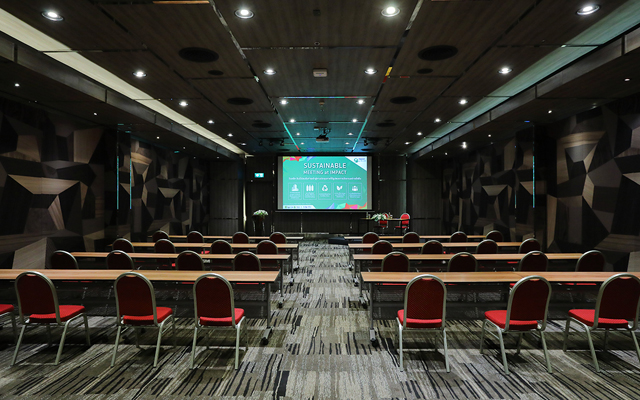
IMPACT Exhibition Management in Bangkok, Thailand, has introduced a new Green Meeting Package that provides event planners with a structured mechanism to run more sustainable events.
This includes discouraging the use of tablecloths, chair covers, straws, and plastic bottled water at meetings; using green air conditioners for all exhibition halls; separating waste; and using environmentally friendly paper bags, hand soap, and dishwashing liquid.
IMPACT continues to push the sustainability envelope
Event planners will also be offered plant-based protein menu options and an option to donate excess food from the events to various foundations.
A carbon footprint report – which measures energy, water, gas consumption and food waste – will also be provided to help organisers keep track of the entire event process from set up to tear down. The numbers in the carbon footprint report are calculated based on the guidelines formulated by the Thailand Convention and Exhibition Bureau and Thailand Greenhouse Gas Management Organization.
Come 2025, visitors will also be able to take the Pink Line monorail when it is fully operational. Free shuttle services from Sri Rat station to Muang Thong Thani are currently being provided while construction is still ongoing.
“The green meeting package has been designed to mitigate climate change that requires urgent attention. We hope that customers are willing to be a part of our sustainability efforts and will pay more attention to considering hosting events sustainably,” said Paul Kanjanapas, CEO of Bangkok Land.
Paul shared that currently, IMPACT’s exhibition halls are “full every week”, and a 100 per cent recovery is expected this year. In 1H2023, IMPACT successfully held 421 events, with another 200 more events on the calendar until the end of 2023.
Global business aviation company VistaJet, celebrating 15 years in Asia, wants to deepen its roots in “emerging markets” like India and has opened an office in Singapore to tap the growth in the inflow of investment and demand for professional services.
The Singapore opening complements its marketing and sales offices in Hong Kong, Dubai, London, New York and Los Angeles.
VistaJet Global 7500’s cabin
Ian Moore, chief commercial officer, said private aviation did not see a downturn during the pandemic with big corporations adopting a “no asset, no hazard” business model – not owning, operating and maintaining its own fleet – and “commercial solutions” not being able to deliver the “value of time”.
Asia, he continued, was a big buyer of its flagship Bombardier VistaJet Global 7500 product and tailored flight-hour subscription plan offering guaranteed access and availability to the entire fleet at a fixed hourly rate anytime and anywhere around the world.
This comes as corporates, Moore commented, were looking for “certainty” and “anonymity, combined with luxury and efficiency”.
The Global 7500 can fly non-stop from Singapore to London, Vancouver, San Francisco and Cape Town with its range. Hourly rates start from US$15,000 and between 20 and 30 per cent more for short hops and during peak hours.
The aircraft seats 14, sleeps eight, and is designed with four living spaces comprising a living area, a dining area for up to six passengers, a cinema and a stateroom.
“Asia is growing significantly, and private aviation is taking off,” he said, citing the example of India creating a bigger footprint on world trade.
According to a statement, intra-Asia and flights to and from Asia in 1H2023 increased 80 per cent year-on-year.
VistaJet has committed to being fully carbon neutral by 2025 and since introducing offsets in 2020, more than 85 per cent of members have opted in to compensate for their fuel emissions by investing in certified carbon credits.
Moore said an announcement on the use of sustainable aviation fuel will be made soon.
Simone Seiler has been appointed global general manager
FCM Meetings & Events (FCM M&E), a division of the Flight Centre Travel Group, has announced a global expansion of its business that will bring about a consolidation of all global offices under the purview of global general manager Simone Seiler.
Seiler is a seasoned travel industry executive with over two decades of experience in the business events sector.
Simone Seiler has been appointed global general manager
“We believe the meetings, events, and event travel markets are ripe for disruption worldwide. With this investment, we’re well-positioned to capitalise on the growing demand for high-quality and personalised event experiences that has seen an exponential bounceback,” Seiler said.
“It’s clear the demand for in-person connection continues to increase, with recent data showing conferences and events being one of the top two reasons for travel among both SME owners and decision-makers. The passion and engagement we’re seeing is very encouraging, and this is something that has and continues to be felt globally,”she continued.
She added that FCM M&E is experiencing and anticipating a steady annual growth rate of demand at 12 per cent year on year for in-person meetings.
Events, event travel and meetings are leading the business travel bounce back globally with a recent whitepaper by FCM M&E revealing that business events market size, in terms of revenue, is expected to grow at a compound annual growth rate of 6.6 per cent from 2022 to 2030 to reach US$1563.3 billion by 2030.
Asia Ability ran the Say Hi To Everyone teambuilding event at IT&CM Asia
Mega-sized teambuilding events are back for team-bonding specialist, Asia Ability Creative Teambuilding, with its staff handling several gatherings with 700 to 1,000 participants this year.
David Fotheringham, director, Asia Ability Creative Teambuilding, told TTGmice that companies are “back to flying people in from everywhere to attend a face-to-face event, like in the good old days”.
Asia Ability ran the Say Hi To Everyone teambuilding event at IT&CM Asia
“It was still restrictive last year, but not anymore in 2023,” he cheered.
While Fotheringham did not immediately have the number of events conducted so far this year, he said the “volume and scale of events now certainly exceed what we did during the lockdown period”. Not only are events bigger in size, they are also “bolder and more intense”.
He believes that mega teambuilding activations are back because ease of travel has returned, companies have resumed full-scale operations, and “travel costs are getting a little bit closer to normal”.
“Sure, the cost of travel is still inflated compared to pre-Covid but much better than a year ago when rates were crazy, up to three times the price we saw pre-pandemic. Furthermore, there is still strong pent-up demand for face-to-face global meetings,” he added.
While companies sought activities to onboard new hires during the height of remote work, they are now focused on building people culture and strengthening communications. Classic teambuilding games are a big hit now, observed Fotheringham.
“Next month, a global accounting firm event for 700 new partners from around the world will utilise our Go Team city adventure game using iPads. This was the same game the company ordered from us 10 years ago,” he shared.
“In fact, our Go Team city adventure game has been our biggest sell since coming back from Covid, because it encourages interaction and is conducted outdoors, plus participants get to see the destination as they play,” he added.
Drone-related games, introduced during Covid, remain popular.
With a need to be more sustainable with its operations, Asia Ability is now working on moving tools and processes of some of its existing games onto proprietary apps so that reliance on paper instructions and writing materials can be removed.
Just 10 minutes from Phuket International Airport on the serene northern coast, this 178-key, Bill Bensley-designed resort offers delegates a quiet, tropical paradise steeped in Phuket’s tin-mining heritage
The newly-opened Ritz-Carlton, Bangkok anchors the One Bangkok development with cosmopolitan elegance. Featuring the city's largest ballroom and a spectacular new penthouse suite, it delivers exceptional hardware and deeply authentic, soulful service for business and leisure travellers alike
Behind the imposing, Brutalist concrete that defines Zurich’s Oerlikon district lies a surprising secret. While its exterior honours the neighbourhood’s industrial roots, stepping inside Mama Shelter reveals a vibrant, neon-soaked world that is a far cry from its rigid shell