Asia/Singapore Friday, 2nd January 2026
Page 386

Malaysia’s April 1 reopening marks proper tourism restart

0

Malaysia will finally reopen to international tourists on April 1, with no quarantine on arrival for fully vaccinated travellers.

In making the announcement on March 8, prime minister Ismail Sabri Yaakob detailed that these travellers must still undergo an RT-PCR test two days prior to travel and an RTK antigen test within 24 hours upon arrival in Malaysia.

Fully vaccinated travellers can enter Malaysia without quarantine from April 1

Entry requirements for travellers who are not fully vaccinated will be announced today by the Health Ministry, while Standard Operating Procedures for land and sea entry points will be updated soon.

The move to reopen international borders were in line with the country’s Transitioning to Endemicity phase on April 1.

Malaysia’s travel players welcome the decision.

KL Tan, president, Malaysian Association of Tour and Travel Agents (MATTA), said it was a crucial step for the tourism industry.

He said: “We can finally start rebuilding the tourism sector and contribute to the country’s economic recovery. With a firm date, the industry can now begin its marketing and promotion activities.”

He said it made sense to reopen the country’s borders while maintaining updated Standard Operating Procedures to ensure public health and safety.

Sri Ganesh Michiel, deputy president, Malaysia Budget & Business Hotel Association, said the reopening would not immediately revive the hospitality and tourism industry; it would take a long time to rebuild the confidence of travellers to vacation in Malaysia.

And as overseas travel will soon be more accessible to Malaysian residents, Yap Lip Seng, CEO of Malaysian Association of Hotels, said domestic travel promotions must be intensified while activities targeting overseas markets are reignited.

Yap hopes that airlines would be incentivised to mount more services into Malaysia in support of inbound traffic recovery.

FCM Travel, the business travel division Flight Centre Travel Group, welcomed Malaysia’s call of easing restrictions and quarantine in an effort to shift to an endemic Covid-19 strategy.

Bertrand Saillet, managing director, Asia, FCM Travel, said: “Only two months into 2022, FCM already saw inbound and domestic sales within Malaysia reach 30 per cent of its 2021 figures. With these changes, our industry has been given a much-needed boost that is expected to drive continued growth for the entire corporate travel industry, particularly Malaysia’s large and small businesses. This decision will enable clients to travel more easily and ultimately aid their business performance in the months ahead.

“We are optimistic that the restoration of vital connections between Malaysia and its neighbours will contribute to a much-needed impetus for travel to and from Singapore, Indonesia, Thailand and Brunei which accounted for over 60 per cent of its pre-pandemic arrivals.”

International Women’s Day: established commitment to gender parity

0

Marriott International’s Women’s Leadership Development Initiative goes back 20 years, earning it bragging rights as the first hospitality company to have such a programme in place to help women ascend to senior leadership roles in the company.

Regan Taikitsadaporn, chief human resources officer of APAC with Marriott International, said: “Diversity, equity, and inclusion have always been a cornerstone of our culture, and our continued success is the direct result of our efforts to cultivate an inclusive workforce.”

Taikitsadaporn: success in gender parity in leadership is never final

The company has since accelerated its goal to achieve gender representation parity for the entire global leadership team by 2023, two years earlier than originally planned. According to Taikitsadaporn, women now occupy 44 per cent of Marriott’s global executive positions.

“While we are on track to reaching our goal, success is never final. We are unwavering in our commitment to advance women in leadership, and will continue to find ways to develop the next generation of women leaders at Marriott,” he told TTG Asia.

As the Women’s Leadership Development Initiative is global, Asia-Pacific talents are beneficiaries too. Today, around 40 per cent of management positions in the region are represented by women, and there are nearly 100 female general managers here, with many more top talents in the pipeline.

Gender parity efforts in the region are supported by the Women Ambassador Network (WAN), a community of Marriott leaders in Asia-Pacific who are passionate about raising awareness and taking actions to promote, advance and inspire women in leadership.

After putting WAN on pause in 2020 due to the pandemic, Taikitsadaporn said Marriott employees were excited to revive the programme last year.

“We were thrilled by our associates’ enthusiasm to get involved. There are currently more than 70 women and men in the programme, representing various roles and seniorities, from hotel general managers to property-level associates in sales, marketing, operations, finance and HR. Each WAN member is an ambassador for their respective markets, and is responsible for coming up with a customised activation plan as each market’s progress and needs can be different,” elaborated Taikitsadaporn.

“As one of the senior sponsors of the programme, my role is to inspire and help our ambassadors shape their vision and objectives, making sure they have access to the right tools and resources to promote women in leadership locally.

“One of our most recent initiatives was training our WAN ambassadors to set up mentorship programmes for women associates in their markets. Our markets have already started recruiting mentees and mentors, and we are very excited by the potential of building a strong pipeline of future Marriott woman leaders, and promoting a culture of women lifting each other up for growth and success,” he shared.

Aloft Perth hosted an International Women’s Day event, featuring director of sales of marketing Danielle Garrigan as speaker, who shared her career experience with fellow associates and how Marriott International empowers women at the workplace

Taikitsadaporn believes that a diverse leadership team brings enriched experiences, which ultimately leads to the best possible business outcomes. Furthermore, empowering female leadership “nourishes a culture that inspires and promotes career opportunities for all”.

He detailed: “When there are more women leaders in an organisation, it empowers young women to realise that they too have the full potential to be the leaders of tomorrow. It also sends a message to other employees that the contributions and perspectives of everyone are valued and supported.

“Embracing differences and diversity is critical to the success of any good organisation. A company that advocates for diversity and inclusion will be better at decision-making and retention of top talent.”

When asked if the pandemic and evolved work and personal pressures have altered the future of female leadership opportunities, Taikitsadaporn referenced a McKinsey survey that found that mothers in heterosexual dual-career couples with children have reported larger increases in their time spent on household responsibilities since the pandemic began.

To ease the pandemic’s disruption to work/life balance for working mothers, Marriott International activated its TakeCare programmes regionally and locally. Team leaders offer flexible work arrangements, while confidential helpline and counselling services via the Employee Assistance Program are available in some markets.

“Taking care of our associates’ well-being is at the core of our values and culture. We will continue to explore more opportunities to ensure our support to working mothers stays relevant during this challenging time,” he concluded.

Business Events Australia Asia Showcase kicks off

0
Australia is now officially open to international visitors

Taking place from March 8-11, 2022, this year’s Business Events Australia Asia Showcase will provide 110 qualified incentive planners and corporate decision-makers from Greater China, India, Malaysia, Indonesia and Singapore with the opportunity to virtually meet and do businesses with Australia’s top industry sellers.

The hybrid event will include one-on-one virtual appointments and group briefings where customers can learn about new developments and infrastructure updates, while broadening their network of Australian industry contacts.

Australia is now officially open to international visitors

More than 50 industry sellers will be present, and include a range of destinations, hotels and venues, unique products and experiences.

“The event will provide a platform for industry to connect, forge new relationships and build on existing ones,” said Robin Mack, executive general manager commercial & business events, Tourism Australia.

“Each Australian region has exciting new developments to share with customers. Our infrastructure boom has continued during the past two years and we have welcomed a wealth of new accommodation, venues and experiences that will inspire a world-class incentive programme.”

Pre Covid-19, business events was one of the highest yielding sectors of Australia’s visitor economy, with Asia being one of Australia’s most important markets for incentive travel.

“For the year ending December 2019, Australia attracted 314,000 delegates from Asia who contributed A$1.5 billion (US$1.1 billion) in direct expenditure. The showcase event forms part of our broader recovery strategy which is focused on supporting conversion-driving activity and welcoming business events visitors back to Australia as quickly as possible,” he added.

Japan eases entry requirements for business travellers

0
The welcome sign at Narita International Airport

Japan has begun admitting overseas business travellers, providing a much-needed boost to the country’s business travel market.

Prime minister Fumio Kishida said the move, which came into effect on March 1, is part of the country’s “exit of the sixth wave” of coronavirus.

The welcome sign at Narita International Airport

The opening up follows pressure from business leaders and universities to remove the entry ban, which was first implemented on November 30, 2021, in response to the emergence of the Omicron variant, mere weeks after Japan had eased border controls.

Under the new rules, quarantine in government facilities can be as few as three days, depending on the visitor’s vaccination status and country of departure. The daily cap on the number of people who can enter Japan has also been increased to 5,000, up from 3,500.

Japan’s business travel sector welcomed the easing of measures, but remain certain of the immediate impact.

Hwang Cheng Meng, vice president global market management Asia-Pacific, CWT, stated: “There is a lot of pent-up demand, particularly among employees of Japanese companies who are based overseas and want to travel to Japan to meet their colleagues.”

He pointed out that the need to meet face-to-face is especially high among staff of Japanese firms that have bought or merged with other companies since the start of the pandemic.

However, Hwang noted that “testing and quarantine requirements remain among the biggest barriers to resuming travel”. This is evident from countries such as UK and India which have eliminated testing and quarantine for fully-vaccinated travellers, bringing about “a significant increase in bookings and enquiries for both inbound and outbound travel”, he elaborated.

Miki Ogikubo, the spokesperson of Toyoko Inn, which has 269 business hotels across Japan, said they are stepping up their overseas promotion in light of the news, such as advertising on travel and accommodation booking websites.

Pre-pandemic, the Tokyo-based hotel chain saw an increase in guests from abroad, with a high of 15 per cent annually, but the majority of their business still comes from the large domestic business market.

Virtual events drive profitability: event owners

0
Speakers on PCMA’s How to Monetise Virtual and Hybrid Event Content webinar discuss how their organisation has benefitted from taking their events online

Media organisations that survived two fraught years caused by the Covid-19 pandemic are seeing light at the end of the tunnel after embracing digital transformation, investing in event technology, and committing to talent training.

Panellists on PCMA’s How to Monetise Virtual and Hybrid Event Content webinar, declared they were reaping “profits”, and that the “virtual” component of their events would be expanded this year to boost the bottomline.

Speakers on PCMA’s How to Monetise Virtual and Hybrid Event Content webinar discuss how their organisation has benefitted from taking their events online

Atifa Silk, Haymarket Asia (HA) managing director, based in Hong Kong, said its marketing communications and finance live events used to contribute 70 per cent of revenue. Now, digital events contribute more than 50 per cent of revenue.

Despite having no live events in 2020/2021, HA saw its “best financial performance in 10 years” and profitability was up “significantly”, with Silk noting the company was planning for “a year of full-virtual events”.

Razlan Manjaji, head of global events, South China Morning Post (SCMP), also based in Hong Kong, had planned a mix of virtual and in-person events in 2022, but had to shift to strictly virtual events “for different categories of clients and monetised differently” due to changing circumstances.

SCMP’s seven-year-old events arm, which used to organise 12 to 18 live events a year, held more than 56 virtual events in 2020 with the same team, Manjaji said, adding that the virtual event cost basis was much lower.

“While revenue is lower, the absolute profit margin is much bigger,” Manjaji noted when asked by moderator Deanna Varga, managing director, Mayvin Global, on changes in measuring ROI.

Manjaji said: “When you organise a virtual event enough times, it becomes a very profitable business.”

He explained that a virtual event could garner up to 7,000 registrations from more than 60 countries, with 3,000-plus participants tuning in. Compared to 300 for a live event, virtual events could create a win-win outcome for the organiser and sponsors.

“Every data point you collect can be analysed and a value put to it,” he said.

“And because of the flexibility of virtual events, organisers are able to secure good speakers on short notice,” he added, giving the example of SCMP’s relaunch of its flagship event – Women of Our Time virtual conference in 2021, in celebration of International Women’s Day. It featured Singapore president Halimah Yacob as a keynote speaker.

However, Silk acknowledged that while the “margins have been great”, costs have been going up, and the event technology investment had to continue to meet audience expectations and deliver a successful event.

With virtual event attendance fatigue setting in, registrations today, in particular for free events, have dropped compared to a year ago, Silk observed.

However, there were still opportunities, she noted, with the biggest ROI centred on the data generated by virtual events and being able to leverage the layers of data to give valuable feedback to sponsors and partners.

On what existing or new team members needed to develop a “monetising” mindset to deliver successful virtual or hybrid events, Manjaji said it was important to train staff rather than educate sponsors and partners, “learn on the job”, experiment and “try different things”.

He shared that for the first virtual event SCMP organised, the team did not realise there were eight minutes of video and audio silence, and described it as a “horrific experience”.

The “sponsor was furious”, Manjaji recalled, and management realised staff needed to attend “proper certification courses” to be exposed to different types of events and their operation, and to possess more “rounded knowledge” to properly execute a virtual event strategy.

Manjaji opined: “Virtual events are here to stay and will be a permanent part of our business.”

On the other hand, Bjoern Kempe, CEO and founder, Expos Global (formerly Expos Asia) – with offices in Singapore, Shanghai, commented that hybrid and virtual events worked better for conferences and corporate events, but are “not the cure for the absence of tradeshows”.

“Exhibitors and visitors are eagerly waiting to network again and to conduct business live and in person,” he pointed out.

SICC makes preparations for business pick up in 4Q2022

0
The Sabah International Business and Economic Summit 2022 welcomed some 700 participants from 21 countries

The Sabah International Convention Centre (SICC) in Kota Kinabalu, expects that business events will pick up in 4Q2022, once Malaysia’s borders reopen.

SICC has kept busy hosting meetings, conferences and events for the state government, since business events were allowed to resume in October 2021, albeit with strict standard operating procedures in place, shared SICC’s CEO, Rosmawati Lasuki.

The Sabah International Business and Economic Summit 2022 welcomed some 700 participants from 21 countries

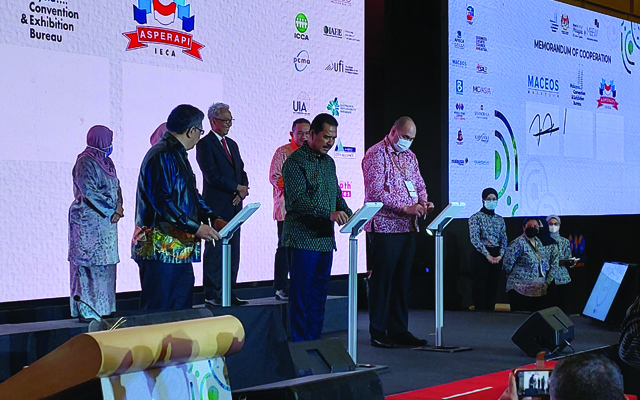
For example, earlier in January, SICC hosted the inaugural Sabah International Business and Economic Summit 2022. Organised by the state government and the KSI Strategic Institute for Asia-Pacific, the two-day hybrid event attracted more than 700 participants from 21 countries. The state also received investments worth RM4.3 billion (US$1 billion) via three Memorandum of Understandings signed at the event.

But SICC has not lost its sight of the global market, and has been actively communicating with prospective clients through virtual site inspections and virtual meetings.

It is also collaborating with stakeholders such as the Malaysian Association of Convention and Exhibition Organisers and Suppliers, Malaysian Association of Tour & Travel Agents, Sabah Association of Tour & Travel Agents, Malaysian Association of Hotels, and Sabah Tourism Board, to drive domestic and international business events to the venue.

Adam Kamal, head of contracting and domestic market, ICE Holidays, opined: “In the post-pandemic era, I foresee business events organisers looking for destinations in second-tier cities because it is less crowded, and also because many have already been to Kuala Lumpur.

“Thanks to SICC, Sabah will emerge as a frontrunner for business events in Malaysia because it is the only convention centre located both by the sea and in town, with many international hotel chains of different categories in the vicinity.”

He added that Sabah would also appeal to event organisers, due to the possibility of pre- and post-tours as there are many attractions and nature-based activities for corporate groups, such as paying a visit to the UNESCO-listed Kinabalu Park.

Opened in February 2020, SICC is the largest waterfront purpose-built conference, exhibition and entertainment facility in Borneo.

Rosmawati shared: “We offer more than 40 event spaces, meeting rooms and VVIP lounges. The centre maximises utilisation of function spaces, allowing simultaneous events without any interference.

“Our exhibition hall with direct access to the loading dock can accommodate up to 280 exhibition booths, and the hall can be subdivided into three smaller spaces.”

She added SICC also features an “in-house team of internationally trained culinary experts” which will elevate the dining experience with both new and traditional menus.

On track to open next year is SICC’s Performing Arts Hall, a two-tier amphitheatre with a seating capacity of 1,250, good for performances and concerts.

Cosmoprof Asia 2022 relocates to Singapore from HK

0
organisers moved the event current entry restrictions for travellers to Hong Kong has meant a potential disruption to both exhibitors and visitors for Cosmoprof Asia in November

Organisers of Cosmoprof Asia 2022, BolognaFiere Group and Informa Markets, have revealed that this year’s edition will be relocated from Hong Kong to Singapore.

Cosmoprof Asia will be held from November 16-18, 2022, at the Singapore Expo, keeping the same show dates. Organisers shared in a press release that current entry restrictions for travellers to Hong Kong would most likely bring about a disruption to both exhibitions and visitors, as inbound travel to Hong Kong would likely be subject to quarantine restrictions.

Organisers moved the event to Singapore, citing current entry restrictions to Hong Kong as a problem

“The APAC region remains a crucial reference for global economics, and Cosmoprof Asia is continuing its growth in the area,” said Antonio Bruzzone, general manager of BolognaFiere Group and director of Cosmoprof Asia. “In 2022, Singapore is the best location to welcome stakeholders and professionals again, offering a not-to-be-missed experience to do business in person”.

From the cosmetic supply chain to finished products and brands, all sectors of the beauty industry will be able to gather under one roof, and buyers can easily source from more than 10 product sectors in one venue.

David Bondi, senior vice president – Asia of Informa Markets and director of Cosmoprof Asia, added: “Our proactive decision to relocate the fair from Hong Kong to Singapore shows our determination to help the industry to reconnect in 2022. We are confident in Singapore’s strong reputation as a preferred destination for business events, and look forward to welcoming our delegates from around the world in the Lion City this November.”

When TTGmice asked if this “special edition” could result in a permanent move to Singapore, organisers replied that the team is currently fully invested in the 2022 edition, and will keep the industry posted on updates and plans for 2023.

While waiting to meet face-to-face come November 2022, Cosmoprof Asia’s beauty community will have the opportunity to participate in Cosmoprof Asia Digital Week, a virtual event happening from June 27 to July 5, 2022.

There are five Cosmoprof events in total – Cosmoprof Worldwide Bologna, Cosmoprof North America, Cosmoprof India, Cosmoprof Asia, and Cosmoprof CBE ASEAN. Cosmoprof CBE ASEAN was the fifth exhibition of the network that has been announced, and will be held in Bangkok, Thailand this September, and focus on the cosmetic industry in South-east Asia.

Congress Rental gains new ground in virtual events arena

0
From left: Congress Rental’s Oliver Langbein, Lucas Flood, Luke Hamilton, and Michael Cousins unloading equipment for an event at Macquarie University

Rather than shutting their doors during the pandemic, Congress Rental – a specialist provider of simultaneous interpretation equipment – invested the time to expand their repertoire by thoroughly developing skills required for virtual and hybrid integration, and is well poised to capture the virtual and hybrid events market as events around the world restart.

“When everything changed in March 2020, our core on-site interpretation equipment rental business wasn’t viable anymore. We had to pivot our business and become totally virtual, so that we could integrate interpretation into them and offer these solutions to our clients,” managing director Jeremy Ducklin told TTGmice.

From left: Congress Rental’s Oliver Langbein, Lucas Flood, Luke Hamilton, and Michael Cousins unloading equipment for an event at Macquarie University

Pre-pandemic, he indicated, convincing organisations that virtual events could be just as impactful as in-person ones was a huge challenge. Fast forward to today, Congress Rental managed to build an entirely new client base and grown its remote interpretation business “massively”, where more than 90 per cent of their customers are new compared to pre-2020, shared Ducklin.

But even as the world gingerly emerges post-lockdown, challenges for the events industry still abound.

Aside from obvious challenges such as border restrictions and a never-ending list of health protocols to be followed, Ducklin pointed to several other issues – labour and the rising costs of equipment and freight – the company is currently facing.

“Many have exited the events industry, and freelance labour is more difficult and expensive to procure. We need to have more staff to manage our online events, and returning in-person events. While we are willing to hire and train individuals, finding the right people is a challenge,” he lamented.

Covid-19 has also resulted in chip shortages, which is disrupting the availability of equipment, while sea freight now costs four times more than pre-Covid, which Ducklin said had a “big impact on budgets set many years ago”.

Despite the challenges, Congress Rental is pushing forward with its expansion projects outside of headquarters Australia. In 2017 and 2019, Congress Rental started up in Indonesia and New Zealand respectively.

“Congress Rental Indonesia is still our investment baby. We will continue to establish ourselves there and are quietly confident about how the business will develop in 2022. (As for Congress Rental New Zealand), although we have had some good wins, the tight lockdown and exclusion of international visitors has had a negative impact on the business. But now that visitors are allowed back in again, we are confident of strong growth through the relationships we have developed.”

Ducklin revealed plans to head to the Philippines. The company already has “a website and partners in place”, but the project was put on the backburner when the pandemic hit.

Ducklin: virtual and hybrid events will have so many options that each client needs a curated solution to fit their needs

Besides expansion, the company has also been implementing a raft of new event technology, such as cloud-based solutions. Calling this a “powerful” tool in the company’s arsenal, Ducklin explained that this cloud-based solution would help to save on “capital expenses, cross hire charges and add contingency, scalability, backup, cloud recording and security”.

Yet another product Congress Rental is working on is Hub Connect, where multiple meeting rooms around the globe can be joined together. This means that all delegates are co-located with their interpreters, and “everyone’s audio, video and languages are connected, where everyone can see and hear what is going on irrespective of their location”, he explained.

When asked for his thoughts on the viability of hybrid and virtual events as in-person events return, Ducklin believes the former will continue to play a key role in the events business.

He elaborated: “I think event planners will now have to include a virtual component in most of the meetings that they undertake. While this change happened partly because of Covid-19, in the future it may be due to delegates being concerned about their carbon footprint and climate change. People now have an expectation that they can still obtain key learning points from a meeting without having to travel to a distant location.”

He expects demand for remote interpretation to grow as multilingual virtual and hybrid events carry on.

“Historically, organisers dismissed remote interpretation as an unreliable alternative to on-site interpretation. Now that they’ve seen it in action, it’s likely that doubts about the reliability of remote interpretation have lessened.

“With the cost savings on interpreter travel and accommodation, it’s clear that most organisations will seriously consider remote interpretation for future events virtual and hybrid events moving forward,” he added.

International Women’s Day: wise step forward in addressing gender equality

0

Established in 2015, Womenwise is Flight Centre Travel Group’s (FCTG) effort to inspire women across the company to develop their leadership potential, and it comes with numerous women-led events that are committed to the agenda.

In 2018, FCTG became a signatory to the United Nations Global Compact (UNGC). Its own Sustainable Development Goals (SDGs) addresses 12 of the 17 SDGs set out by the United Nations, including Gender Equality.

Wong: FCM Asia has made good progress in creating gender parity and ensuring there is representation of women in leadership teams over the last two years

“Initiatives such as Womenwise play a critical role in ensuring we remain accountable to achieving this,” remarked Anna Wong, HR director for Asia with FCM, the flagship business travel division of FCTG.

“Key to the momentum our Womenwise movement is gaining has been the creation of an accessible platform for all of our women across brands or support roles to engage with,” Wong told TTGmice.

Prior to the pandemic, FCTG organised annual events that enabled thousands of women to take their place on the leadership pathway. One highlight was the Womenwise annual incentive, an internal one-day all-expenses paid programme that saw the company fly in and accommodate attendees in the host city. It was a coveted event that drew more than 1,000 applicants every year.

The Womenwise Leadership Summit was another valued event, where FCTG’s senior female leaders shared tried and tested methods harnessed to develop the company’s own leaders.

Womenwise expanded into Asia in 2019, and today there are Womenwise chapters in Australia, Asia, India, the Americas and Africa. These chapters ran customer events, blending business networking with opportunities for attendees to share vulnerable stories and form authentic connections.

Wong said: “Just as Womenwise has played a big role in leadership development at FCTG, Womenwise customer events enable us to take all we have learnt and gathered over the years, and start to rally behind the women we work with across organisations.”

Initiatives differ across region. In Asia, Singapore, Hong Kong, Malaysia and China have their own chapter that drives local initiatives and activities.

“Despite the ongoing pandemic, in 2021, the local chapters organised fundraising activities and were able to raise A$13,157 (US$9,646) for Solar Buddy, a FCTG-supported charity dedicated to illuminating the future of those living in energy poverty,” shared Wong, adding that the usual quarterly regional workshops were able to continue online.

“During these workshops, our people were able to hear and learn from inspirational women leaders within the FCTG family. Senior female leaders such as Melanie Waters-Ryan, CEO for leisure at FCTG and Suyin Lee, managing director of Discova shared their stories – how they have raised a family, navigated major businesses changes, and defined their own unique leadership styles within multiple roles at FCTG.

“Our FCM Asia staff have greatly benefitted from the opportunity to ask questions, interact and learn,” she said.

When asked to detail successes FCM has achieved through Womenwise Asia’s goals, Wong said: “Asia has made good progress in creating gender parity and ensuring there is representation of women in leadership teams over the last two years. Thirty per cent of our regional senior management team are women and within the local markets, females make up 40 per cent or more of the local management team.

“Under the company’s Brightness of Future philosophy, we have proactively discussed career development with all staff. In the last two years, 70 per cent of role changes were female staff, with 20 per cent going into leadership roles. Female staff on maternity leave have all returned to work after their leave, and retention is high (90 per cent and up) in this group as their leaders proactively support them to balance their commitments at work and at home.”

The Brightness of Future philosophy states that people have the right to belong to a team that will provide them with a supportive working community, and the right to a clear career pathway. Promotion and transfers from within reign as the first choice.

According to Wong, Womenwise Asia’s goals for FCM are: Celebrating the success and contributions of our female staff; Introducing flexibility to FCM Asia offices; and Providing initiatives to encourage women in leadership.

“We are constantly making conscious efforts to drive this transformation in female leadership parity. It is important to recognise the influence and contribution of FCM’s women who are passionately contributing to the workplace and ensure they have equal and fair opportunities in leadership development,” she added.

Following the launch of FCTG’s renewed Diversity & Inclusion programme Come As You Are in mid-2021, Womenwise now comes under the Gender Equality pillar, one of six pillars to the programme. The other pillars are LGBTQI+, Mental Health, Accessibility, Age, and Heritage/Race/Religion.

This story is part of an International Women’s Day series published by TTG Asia, TTGmice and TTGassociations, where we highlight organisations in our industry that are committed to supporting gender parity in the workplace and beyond as well as uplifting the quality of life for womenfolk in the communities they interact with through their operations.

The Standard, Bangkok Mahanakhon set to be Asia’s new MICE darling

0
Meet in style at The Standard, Bangkok Mahanakhon

Brought to you by The Standard, Bangkok Mahanakhon

The pulsating city of Bangkok welcomes The Standard, Bangkok Mahanakhon, which adds swanky, new accommodation and venue options for business event planners and attendees.

Set to open on May 11, with room reservations available since February, the 155-key property, The Standard, Bangkok Mahanakhon, will be the brand’s flagship hotel in Asia.

The latest exciting addition to Standard International’s growing global portfolio showcases The Standard’s signature unconventional and playful sensibilities, combined with a meticulous consideration of design, detail and service for its taste-making clientele.

The Standard, Bangkok Mahanakhon boasts a prime address

For a start, the new hotel boasts a prime location in the vibrant central business district between the Sathorn and Silom corridors, and housed within the landmark King Power Mahanakhon, a 78-story mixed-use building that is one of the tallest in Thailand.

Amar Lalvani, executive chairman for Standard International, said: “We love the energy, style and culture Bangkok offers and couldn’t be more proud to partner with King Power to open our flagship for the region in this awe-inspiring building, in this incredible city. When we open our doors in May, visitors and locals will be treated to the world of immersive hospitality that only The Standard can create.”

Armed with guestrooms ranging from 40m2 to a sprawling 144m2 penthouse, a spacious terrace pool overlooking the city, 24-hour fitness centre, and an eclectic mix of food, drink and nightlife venues under one roof, The Standard, Bangkok Mahanakhon is perfect for corporate travellers to stay, work and play, at any time of day and night.

Event planners are offered four flexible meeting spaces and function venues as a canvas on which to craft memorable gatherings for their guests. Good for up to 140 guests, these spaces are outfitted with state-of-the-art teleconferencing systems as well as integrated Apple and Windows operating system. Event planners are supported by tailor-made services and full tech assistance. Event attendees will appreciate the natural daylight that flood the space as well as opportunities to socialise at the pre-function foyer and take in city views from an outdoor balcony.

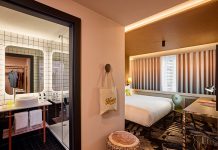
Guestrooms and suites come complete with various luxurious amenities

Rich in style and comfort, the guestrooms and suites are a dream come true for business travellers and event attendees looking to recharge in between hectic schedules. Every room is furnished with cosy beds, rain showers and/or soaking tubs, Nespresso machines, Bang & Olufsen Bluetooth speakers, large flat screen TVs, and plush seating areas. Creature comforts continue with custom robes and Davines bath amenities. Wi-Fi also comes free.

Health-conscious corporate travellers never have to break from their fitness routine, as the hotel offers an outdoor pool and a 24-hour fitness centre – touted the most advanced gym in Bangkok, no less. One can also enjoy light dishes, craft cocktails and plant-based delights, juices and smoothies at the pool terrace.

Whether for a feast with valued business partners or a quiet meal alone, the hotel offers guests two exquisite dining options – the first international outpost of the renown The Standard Grill and Thailand’s first outstation of the acclaimed Mott 32. Guests can savour American steakhouse classics at The Standard Grill, and award-winning Oriental cuisine, sparkling ambience and an impeccable wine list at Mott 32.

For a bit more fun, The Parlor is the place to be for cocktails and live music. Alternatively, saunter over to the fantasy-décor accented Tease for exquisite tea and unique treats.

Event planners and attendees looking for dining experiences that please all senses, the hotel satisfies with two spectacular sky-high dining venues. Dine and dance at retro-glam, space-age-inspired restaurant, Ojo Bangkok, which serves up creative twists on authentic Mexican fare. In the mood for a quieter evening? Enjoy a tipple while appreciating stunning city views from the highest rooftop bar in Bangkok, at the al fresco Sky Beach.

Retro-glam, space-age-inspired restaurant, Ojo Bangkok, serves up creative twists on authentic Mexican fare

The Standard, Bangkok Mahanakhon currently offers a 25 per cent pre-opening discount on Best Available Rate. Bookings can only be made directly here.

Find out how The Standard, Bangkok Mahanakhon is the perfect choice for business travellers to stay, work and play.

Reviews

Hyatt Regency Kuala Lumpur at KL Midtown

A polished urban retreat designed for business travellers, Hyatt Regency Kuala Lumpur at KL Midtown combines thoughtful design, seamless service, and exceptional facilities.

A versatile powerhouse

Arena @ Expo, a multipurpose concert hall at the Singapore Expo is a flexible space for high octane concerts and lifestyle events.

Amari Bangkok

The five-star property excels in backing its expansive facilities with seamless service and personalised attention, setting the benchmark for luxury in Bangkok.