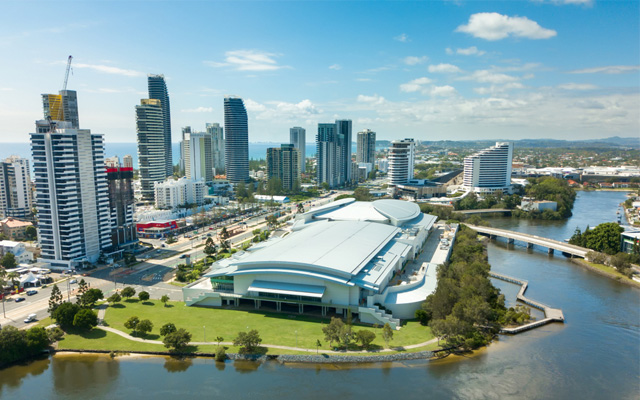
An aerial view of the Gold Coast Convention and Exhibition Centre (GCCEC) and Broadbeach skyline
Some 7,000 delegates will make their way to the Gold Coast over the next few weeks, injecting A$11 million (US$8.5 million) into the destination’s visitor economy.
This month will see the return of the Australasian Real Estate Convention from May 30-31 with 3,000 delegates expected to attend, in addition to the Australian Pharmacy Professional Conference from May 20-23 with up to 4,000 delegates. Gold Coast Convention and Exhibition Centre will host the two large-scale business events.
An aerial view of the Gold Coast Convention and Exhibition Centre and Broadbeach skyline
The Gold Coast has seen a welcome return of domestic business events since capacity and social distancing restrictions were eased for venues. A pipeline of more than 160 meetings and conferences has also been secured – worth A$184 million – in partnership with the local industry despite the challenging Covid-19 environment.
Destination Gold Coast’s CEO Patricia O’Callaghan said the Gold Coast was looking forward to the return of these events after a challenging year, and opined that the industry was headed for a “strong recovery”.
O’Callaghan shared that the Gold Coast has continued to engage with international and domestic conference organisers throughout the global pandemic to lock in these high yielding events for the city. She added that there is a “compelling desire to meet face-to-face”, hence the “pent-up demand for business events will be very strong”.
“We are also actively working with event organisers to confirm an additional A$143 million of conferences and meetings through strategic marketing activities and bid opportunities,” she added.
The Gold Coast attracted almost half of all business events hosted in Queensland in 2019, injecting A$570 million into the economy.
Exhibitions its ability to expand marketplaces by bringing buyers and sellers together and offering a platform for launching innovation and new product
How exhibitions drive economic recovery by enabling growth and recovery is the key theme for this year’s Global Exhibitions Day (#GED21; June 2, 2021), which will be marked by a hybrid seminar organised by the Exhibition and Event Association of Australasia (EEAA).
After the success of #GED2020 in which an online webinar attracted over 800 people from Australia and internationally, this year’s event will be hybrid, with a welcomed return to in-person element for those who can attend, at International Convention Centre Sydney.
Exhibitions bring buyers and sellers together and offer a platform for launching new products
The seminar will feature leading thinkers in the sector and offer a local and international perspective and experiences. Delegates will hear from the likes of individuals such as ASM Global’s (Asia Pacific) chairman and chief executive Harvey Lister; Adelaide Convention Centre’s general manager Simon Burgess; and Chris Kilbee, executive director, ASEAN, at Informa Markets.
Claudia Sagripanti, EEAA’s chief executive said in a statement: “Exhibitions and business events are key to rebuilding economies, and we will be aiming to highlight the sector’s capability to propel the economy forward particularly at this time.
“We will be showcasing the power of exhibitions and why a focus the work of the sector should be a top priority for business and governments in the current climate.”
Just before Covid-19 happened, the business events sector contributed more than A$35 billion (US$27 billion) to Australia’s GDP, derived from over 430,000 events annually, and employed more than 229,000 people.
Global Exhibitions Day is an annual world-wide campaign that was established by UFI, the Global Association for the Exhibition Industry and is supported by more than 40 partner associations and industry bodies from 90 countries and regions.
Optimism and momentum for business travel is growing
The Global Business Travel Association’s (GBTA) latest poll has revealed that three in four GBTA buyer and procurement respondents feel their employees are ‘willing’ or ‘very willing’ to travel for business in the current environment, continuing the month-on-month positive trend for a return to travel.
The results from the 19th poll in the series are the most positive yet, with increasing optimism, growing momentum for a return to business travel and an increase in bookings – largely due to the success of the vaccine roll-out and introduction of vaccine passports.
Optimism and momentum for business travel is growing
“It’s reassuring to see so much momentum for a return to business travel, with more optimism, willingness to travel and an increase in bookings. Government policies remain the greatest obstacle to opening travel, particularly in the UK, Europe and Canada. Our advocacy teams continue to lobby on behalf of members, in London, Brussels, Ottawa, Washington and around the world for the responsive and safe re-opening of international travel,” said Suzanne Neufang, CEO of GBTA.
Optimism and momentum for a return to travel
Three in four (74%) GBTA buyer and procurement respondents feel their employees are ‘willing’ or ‘very willing’ to travel for business in the current environment. The remaining buyer and/or procurement respondents feel their employees are ‘not willing’ (10%) or ‘neutral’ (11%) in terms of their employee’s willingness to travel for business. In addition, one in 10 (6%) are ‘unsure’.
Three in four (78%) GBTA member and stakeholder respondents think issuing government-issued digital health verification (or digital green certificates and/or vaccination passports) is either ‘very effective’ or ‘effective’ in terms of resuming business travel. Only one in 10 think it is ‘ineffective’ (8%), ‘very ineffective’(8%) or are ‘unsure’ (8%).
Respondents from Europe (86%), the UK (90%) and Canada (89%) are a bit more likely than respondents from the United States (73%) to say issuing digital health verification or vaccination passports is effective in terms of resuming business travel.
When asked to describe the single greatest barrier to business travel in the current environment, over half (55%) cite government policies that restrict travel or make it difficult (e.g. entry restrictions or mandatory quarantines), followed by company policies restricting employees from travelling (23%) and travel budget freeze/cost savings (11%). Few cite employee unwillingness to travel (7%), other reasons (4%) or are unsure (1%).
Respondents based in the UK (80%), Europe (70%) and Canada (77%) are much more likely to cite government policies as a key barrier to the resumption of business travel compared to those based in the US (44%).
Optimism among suppliers and travel management respondents concerning the financial prospects of companies in the business travel sector continues on a positive trajectory, as half report they are ‘very optimistic’ (3%) or ‘optimistic’ (47%) about the industry’s financial prospects.
One in four (26%) report they are ‘pessimistic’ or ‘more pessimistic,’ and one in four (23%) are ‘neither pessimistic nor optimistic.’ Only 4% report they are ‘unsure’ about the financial prospects of companies in the business travel sector.
Among those who say their employees are ‘unwilling’ to travel for business in the current environment (or are ‘unsure’ or ‘neutral’), safety concerns (79%) and the lack of vaccinations (74%) are the primary reasons for their hesitancy. Other reasons include lack of interest (16%) and hesitancy to travel to unfamiliar locations (9%).
Over half (54%) of supplier respondents report an increase in bookings from corporate customers within the past week compared to just 40% in the April poll. Two in five (36%) report their bookings have increased from the previous week. Only one in 10 report their bookings have decreased (10%).
Over half (52%) of supplier and travel management company respondents report that they feel more optimistic about the industry’s path to recovery compared to a month ago. Two in five (41%) say they feel the same and only 7% say they feel more pessimistic about the industry’s path to recovery compared to a month ago.
Managing the return to non-essential business travel
Almost half (46%) of GBTA members and stakeholder respondents expect their company will resume non-essential travel for all employees equally, regardless of their vaccination status.
However, one in four (38%) are unsure as to what their company’s policy will allow concerning vaccination status and the resumption of non-essential business travel. Only one in six (16%) say their company will allow fully vaccinated employees to resume non-essential trips while continuing to limit travel for those who have not been vaccinated.
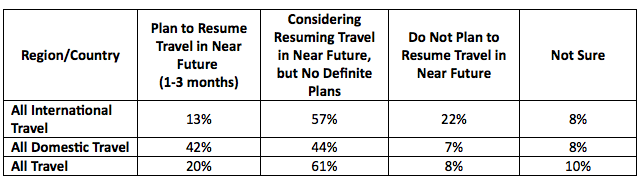
Eight in 10 (81%) GBTA member company respondents who reported cancelling or suspending most or all trips to a specific region/country are considering resuming travel in the near future or are considering resuming travel but do not have definite plans. Less than one in ten do not have plans to resume business travel in the near future.
Staffing up to meet demand
Three in four (77%) suppliers and travel management respondents say their staff size is ‘much less’ or ‘less’ today compared to before the pandemic. Less than one in 10 (6%) say their staff size is larger today and one in seven (15%) say their company is the same size today.
Almost half of supplier and travel management employee respondents agree their company will likely face difficulties hiring staff due to a shortage of qualified candidates (47%) or hesitancy among prospective employees to work in the travel industry (46%). Other anticipated obstacles of note include candidates wanting to work remotely (35%) or vaccination verification (15%).
Thinking ahead to the next six months, the majority of supplier and travel management respondents (62%) expect staffing at their company to increase moderately or significantly. One in four (27%) expect staffing to remain the same, while only 8% expect staffing to decrease.
Among suppliers and travel management respondents who expect their staff will increase in the next six months, approximately half (48%) are concerned it will be difficult to find qualified candidates as many have left the travel industry. In addition, more than half (54%) feel it will be difficult to hire qualified candidates due to competition with other companies who are also re-staffing.
Trend for ‘bleisure’ or ‘workcations’ – not a priority
Only one in five (19%) GBTA member and stakeholder respondents are ‘much more likely’ or ‘more likely’ to combine leisure travel in combination with business travel; equally, about one in six (17%) say they are either ‘less likely’ or ‘much less likely’ to do so.
Almost three in five (56%) say that that the pandemic has not changed their plans to extend business trips to incorporate some leisure time. Only 8% are ‘unsure’ whether they will combine business travel with leisure travel.
View the entire poll results here and key highlights here.
ASM Global APAC has promoted Mark Jan Kar to the new role of General Manager of Coca-Cola Arena, following the recent resignation of current CEO Guy Ngata.
Jan Kar is currently the Arena’s director – commercial & live, and brings a wealth of experience in the sports and events industries. He has lived in Dubai since 2008, and is familiar with the characteristics of the destination.
His vision for the Coca-Cola Arena is to consolidate its position as the region’s premier entertainment and sports venue, and will be working closely with key stakeholders including the Dubai Government and commercial partners to expedite the return of live events.
Bruce Ryde has been appointed as the general manager and brand strategist at Kamalaya Wellness Sanctuary and Holistic Spa in Thailand.
Among his new responsibilities, Ryde will work with the hotel’s founders to grow the brand through an online platform, Kamalaya Connect, and a retail arm, Kamalaya Essentials.
Ryde has a long hotel history both operating hotels and leading global brands in Asia-Pacific. The Australian was most recently managing the luxury brand strategy for Marriott International’s brands, as vice-president Asia Pacific.
Prior to that, Ryde held the same position with IHG, overseeing the InterContinental brand as well as the launch of the Hotel Indigo and Kimpton brands in Asia-Pacific.
TFE Hotels has appointed Amanda Cottome as hotel general manager and brand experience manager at A by Adina Sydney.
Prior to this, Cottome spent more than five years working with Ovolo Hotels Australia as general manager of Ovolo 1888 Darling Harbour; and most recently, as group director of brand experience & culture for Ovolo nationally, where she drove and managed the strategic operational brand experience for the Ovolo group.
An experienced hospitality professional, Cottome has worked in many operational and management roles for major hotel groups in Australia, including Accor’s Mercure Sydney, the Wynyard Travelodge (SPHC), Urban Hotel Sydney St Leonards and Mirvac Hotels & Resorts.
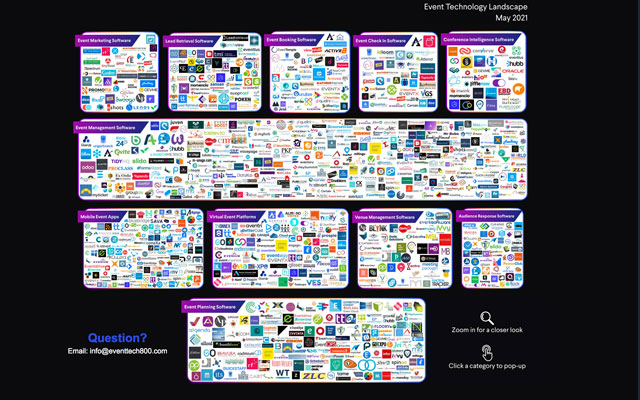
The number of event technology vendors across the world has expanded by 400 per cent in the past year, according to a global mapping study conducted by marketing specialist, Hoosh.
The inaugural study, titled EventTech 800, identifies 832 companies operating in the event technology space across 11 categories, such as Event Marketing Software, Conference Intelligence Software, Event Management Software, Virtual Event Platform, and Audience Response Software.
The number of event technology vendors worldwide has grown by 400 per cent in just 2020 alone
EventTech 800 creator and CEO of Hoosh, Fab Capodicasa, attributed the rapid growth in event technology to the disruption of in-person events throughout the Covid-19 pandemic and the resulting need to engage audiences virtually.
“I’ve been following this space closely during Covid-19 but was still shocked by the sheer number of vendors that have emerged”, remarked Capodicasa, who added event software startups are booming, far outpacing consolidation of larger, established players.
EventTech 800 features startups such as Hopin, Airmeet and Swapcard as well as established heavyweights such as Cvent, Aventri, ON24 and Bizzabo.
Capodicasa told TTGmice that both the growing presence of new vendors and the consolidation of established players would ultimately benefit event planners and event attendees.
He explained: “In SaaS (Software as a service), as platforms eat up others and get bigger, more apps are created to take advantage of the ecosystems those platforms create. Big platforms like this, and even push for it, because the platform with the biggest ecosystem of apps wins.
“What this means for event planners is fewer choices in platforms but more specialised apps. The selection of specialised apps can be overwhelming, but it expands the range of the planner’s capabilities and range of creative possibilities. And that results in variety and flavour of experiences for the user; otherwise, the user would experience the same (at events) too often.”
Hoosh will continue to track the event technology landscape and publish EventTech 800 quarterly for now. The study may be produced bi-biannual or yearly when the sector stabilises.
The Shangri-La Dialogue was supposed to have been attended in-person by a wide range of top military officials and diplomats from Asia, North America, the Middle East and Europe.
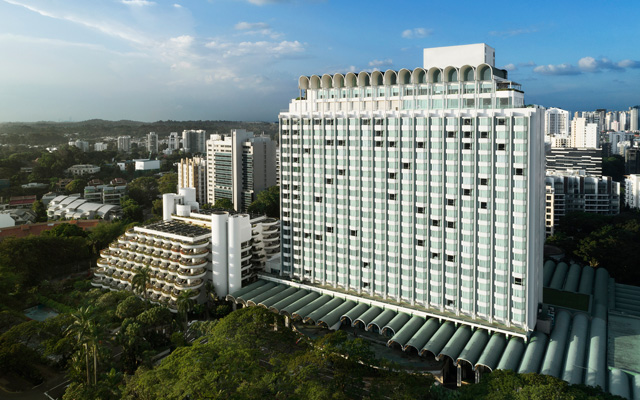
The Shangri-La dialogue joins the list of event cancellations; Shangri-La Singapore pictured
Organiser International Institute for Strategic Studies (ISS) indicated in a statement that the cancellation was due to the rise of new Covid variants globally.
The ISS Shangri-La Dialogue is expected to make a return in the middle of next year.
RMIT students from varying disciplines will work with MCEC on cracking down on single-use plastics
Melbourne Convention Exhibition Centre (MCEC) is partnering with six RMIT University students participating in the RMIT Activator’s Impact Academy programme to mentor them in a multidisciplinary sustainability project.
The project aims to eliminate problematic and unnecessary single-use plastic from MCEC’s events and on-site cafes by 2025. A key aspect of the project is to apply a circular economy approach to developing a solution, where students had to rethink the system to design out waste and keep materials and products in use.
RMIT students from varying disciplines will work with MCEC on cracking down on single-use plastics
MCEC’s sustainability manager, Samantha Ferrier, is the project coordinator and an example of the future career opportunities available in the sustainability field.
“It’s a unique opportunity for the industry to solve real challenges by collaborating with university students. The students are highly self-motivated and passionate and are taught to apply a design and systems thinking approach.
“Our team at MCEC is really excited to see the solutions that the students come up with because eliminating unnecessary single-use plastic is something we’ve been working towards for some time. It’s important that the events industry is doing all we can to prevent waste by redesigning the system,” she said.
The six students are studying degrees in marketing, economics and finance or information systems.
The RMIT Impact Academy is designed to deliver solutions for a sustainable future by connecting students with industry projects within a simulated modern work environment.
It runs each university semester and is currently recruiting students and industry delivery partners aligned to emerging tech for good, social impact and education futures.
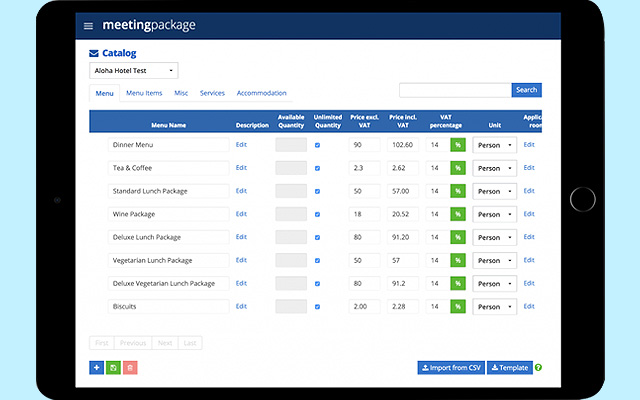
Hotels and venues do not need to pay an annual licensing fee until they have received an equivalent amount of confirmed sales through MeetingPackage
Finland-headquartered MeetingPackage, a software company that offers a self-service, cloud-based, no-code platform which automates all meetings and events sales and operations, has made its software free for hotels, conference spaces, and event venues.
There is no time limit on this offer, and this means that if MeetingPackage does not provide enough new business, the venue can use the platform for free for a lifetime. The only caveat is that once that when the sales target is hit, MeetingPackage asks that the venue continue to use the software for one year, at an equivalent fee (a nett-zero cost).
Hotels and venues do not need to pay an annual licensing fee until they have received an equivalent amount of confirmed sales through MeetingPackage
MeetingPackage can be set up in minutes by venue staff. The software allows venues to handle their own space inventory, offline sales, reporting, and, if required, offers two-way integrations to major Sales & Catering and Property Management Solutions. Venues can also reach new customers via over 300 distribution channels, like CWT, which are directly connected to MeetingPackage.
Traditionally, the hospitality industry has managed sales and operations manually, relying on lengthy email exchanges and RFPs.
“It hasn’t been an easy time for anyone in the industry,” said Joonas Ahola, the CEO & founder of MeetingPackage.
“But even before the pandemic, our hotel partners were showing us that the lead times for booking an event were reduced to days, and the average number of attendees was down. The need for automation in this space is pressing: there’s no other way to serve the customer while retaining margins and efficiencies.”
The newly-opened Ritz-Carlton, Bangkok anchors the One Bangkok development with cosmopolitan elegance. Featuring the city's largest ballroom and a spectacular new penthouse suite, it delivers exceptional hardware and deeply authentic, soulful service for business and leisure travellers alike
Behind the imposing, Brutalist concrete that defines Zurich’s Oerlikon district lies a surprising secret. While its exterior honours the neighbourhood’s industrial roots, stepping inside Mama Shelter reveals a vibrant, neon-soaked world that is a far cry from its rigid shell
A polished urban retreat designed for business travellers, Hyatt Regency Kuala Lumpur at KL Midtown combines thoughtful design, seamless service, and exceptional facilities.