The Melbourne Convention and Exhibition Centre (MCEC) has opened corporate bookings for Australia’s Digital Art Gallery THE LUME Melbourne from September 2021.
With exclusive access to the immersive space (part of MCEC), guests will be treated to a 45-minute feature show and 15 minutes of featurette shows, woven around the event running order.
A rendering of Starry Night, part of the Van Gogh show
THE LUME Melbourne’s inaugural show, Van Gogh, will take guests on a journey into the world of Vincent van Gogh, as his most famous artworks burst to life and the sights, sounds and aromas of 19th century France fill the room.
Exclusive events within the gallery can range from gala dinners to cocktail parties good for 200 to 1,200 pax (Covid-19 capacity limits permitting) and include F&B. Here, the menu was created to celebrate the uniqueness of Vincent van Gogh’s paintings, paying homage to his Dutch heritage and to France, his adopted creative home, and uses fresh Victorian produce paired with an extensive Australian and French wine list.
MCEC and THE LUME Melbourne can also tailor the event with the help of custom projections, such as beaming a company’s branding across 3,000m2 of event space with the help of 150 projectors.
Non-exclusive events are also a possibility thanks to the mezzanine level. The space can be booked during gallery hours for smaller events up to 100 guests.
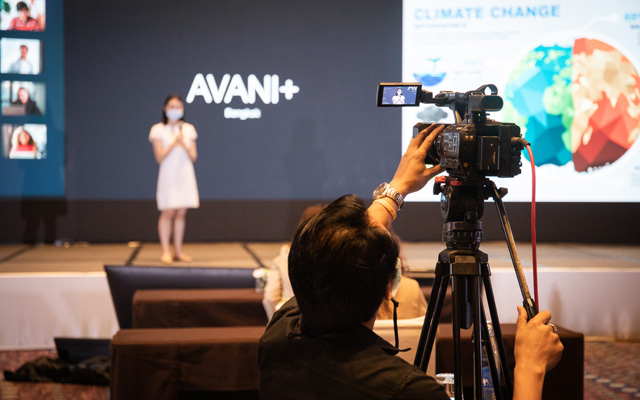
An event being held at the Avani+ Riverside Bangkok Hotel
With remote and hybrid work now the new normal, Avani Hotels & Resorts in Thailand has expanded its portfolio of technology-based meetings and events products.
In addition to being able to host various video calling apps such as ZOOM and Microsoft Teams, the hospitality brand’s digital services now include a range of event planning solutions such as online attendee management, interactive polling, rental of live streaming equipment and services of a dedicated on-site technical team.
An event being held at the Avani+ Riverside Bangkok Hotel
Hybrid packages range from “Mini Meet” with up to 10 on-site attendees and 100 online participants to “Conference Pro” with 50 on-site and 500 online participants, six guest speakers and multiple 4K cameras.
Creative production services such as digital backdrop design and waiting room visuals are also available, allowing event organisers to plan their inter-connected events efficiently. Meanwhile, on-site participants will enjoy traditional hospitality in the form of theme coffee breaks and meeting spaces.
For a peace of mind, all Avani Hotels have adopted a range of heightened hygiene and sanitising standards, collectively known as the brand’s safety and hygiene programme the AvaniSHIELD. All Avani properties in Thailand have also been certified by The Ministry of Public Health and obtained the Tourism Authority of Thailand’s certification for Thailand Safety and Health Administration.
Hilton has opened its seventh hotel in Indonesia, the 168-room Hilton Garden Inn Jakarta Taman Palem.
Launched as the first hotel under the Hilton Garden Inn brand, the hotel offers eight multipurpose function rooms – good for up to 700 attendees – with natural light and state-of-the-art technology to help deliver meetings and events.
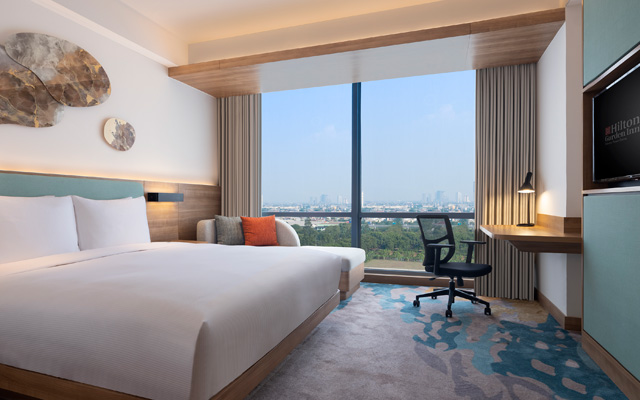
King Guestroom
Accommodation meanwhile, can be found in one of the 168 guestrooms and suites, all of which are furnished with a 43-inch HD TV, mini-fridge, USB charging ports, a dedicated work desk, and bath amenities from CrabTree and Evelyn. Business travellers with their families in tow will be able to book the King Family Suite, which offers a kid-friendly bedroom and play furniture.
Amenities on-site include a 24-hour fitness centre, an outdoor swimming pool, business centre, guest laundry, as well as an all-day diner, and a 24-hour convenience store offering a variety of snacks and beverages.
Hilton Garden Inn Jakarta Taman Palem is located in the heart of West Jakarta’s central business district and a 20-minute drive from Soekarno-Hatta International Airport. It is also connected to Green Sedayu Mall which features a range of retail outlets, restaurants and bars and entertainment options.
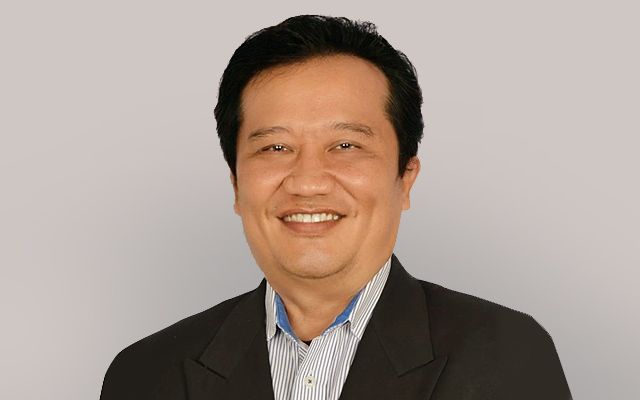
Wyndham Hotels & Resorts has appointed Pamudji Slamet as director of development, Indonesia and the Philippines.
Pamudji joins Wyndham Hotels & Resorts’ Asia Pacific division, which has a portfolio of over 1,500 hotels across 20 markets and territories. He reports directly to Matt Holmes, head of development, South-east Asia & Pacific Rim.
In his new role, Pamudji will be responsible for growing the company’s portfolio through new development and conversion opportunities across franchise and management agreements in Indonesia and the Philippines. Pamudji will focus on establishing new relationships and partnering with key owners and property developers to drive the continued growth of Wyndham Hotels & Resorts presence in both markets.
The Indonesian possesses than 30 years’ experience in the hospitality sector, which includes both operational and development roles where he managed conversions, mergers, acquisitions, rebranding of hotels through franchise, management, hotel lease, as well as manchise agreements. He is also adept at property development across a wide range of segments from luxury to economy hotels to condotels and branded residences.
Prior to joining Wyndham Hotels & Resorts, he was director of development, Indonesia, with Accor. His decades-long experience also included stints at GHM Hotels, Fairmont Raffles Hotels International, Discovery Hotels & Resorts, Horwath Asia Pacific, and JLL.
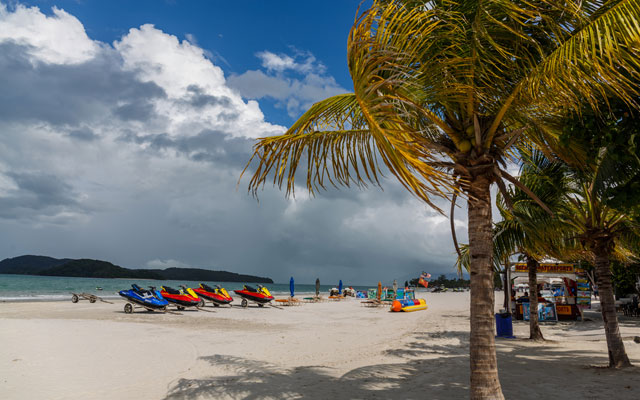
Langkawi may soon welcome foreign visitors under a pilot project; an unusually quiet Chenang beach in Langkawi during Covid-19 pictured
Langkawi is planning to reopen its doors to foreign travellers soon and be promoted as a Covid-free destination, under a pilot project by the Ministry of Tourism, Arts and Culture Malaysia (MOTAC) to kickstart the country’s tourism recovery.
Once successful, the pilot project will be extended to other localities and islands across the country, Noor Zari Hamat, MOTAC secretary-general, said at the Islamic Tourism Centre Corporate forum held last week.
Langkawi may soon welcome foreign visitors under a pilot project; an unusually quiet Chenang beach in Langkawi during Covid-19 pictured
While Noor Zari did not specify a start date for the pilot project, he stated that 80 per cent of the population had to be vaccinated to achieve herd immunity before the pilot project could take off.
In a report by Bernama last month, Kedah chief minister, Muhammad Sanusi Md Nor, said he was hoping the project could take off in September or October, with Langkawi welcoming fully vaccinated foreign tourists.
Anthony Wong, president of Langkawi Business Association, opined that to date, between 35 to 45 per cent of the population in Langkawi had received at least one dose of a Covid-19 vaccine and that at least 20 per cent of the population had received both doses.
Wong added that he has been talking with senior officers at Tourism Malaysia who told him they were trying to get international and regional airlines to resume their services to Langkawi.
He said some stakeholders in Langkawi, such as boat operators, hotels and tour operators, are preparing for the reopening of the island by “getting their house in order”, while others are taking a wait-and-see approach.
Uzaidi Udanis, president, Malaysian Inbound Tourism Association (MITA), pointed out that tourism activities in Langkawi have been at a standstill since March, when inter-district and interstate travel was banned by the government to contain the spread of Covid-19. However, even before March, Langkawi had seen a drop in the number of domestic tourists.
He shared that the main task of MITA currently is to prepare members for the reopening and to ensure stakeholders are ready to receive international tourists.
Uzaidi said that following discussions with stakeholders, three key issues have been identified: first, the lack of human resources as many locals who had been working in Langkawi have since returned to their hometowns; two, the maintenance of tourism products which have been neglected due to the temporary ban on domestic tourism; and three, product readiness.
“We need to ensure we have very good products and local storytellers to ensure international guests have a very good experience when they visit. We are competing with the likes of the Maldives, Bali and Phuket,” he said.
Adam Kamal, head of contracting & domestic market at Ice Holidays, shared that authorities in Langkawi should also ensure that the health facilities are adequate to handle international travellers, who might be infected with Covid-19.
“We should take heed of what had happened in Phuket”, he said, referring to the incident where Phuket reported its first Covid-19 case from overseas on July 7 after reopening to international tourists.
Singapore tightens entry approvals for travellers and transfers from Indonesia
Singapore has reduced entry approvals for travellers from Indonesia who are non-Singapore citizens or permanent residents.
The announcement was made on Saturday (July 10) by the Ministry of Health (MOH), who said that the tightened border measure for travellers from Indonesia will take place “with immediate effect” and comes amid the “worsening” Covid-19 situation there.
Singapore tightens entry approvals for travellers and transfers from Indonesia
Entry approvals may be considered where additional safe management measures are taken, it added.
All travellers with travel history to Indonesia within the last 21 days will also not be allowed to transit through Singapore, starting July 12, 11.59.
With effect from July 12, 23.59, all travellers entering Singapore with recent travel history to Indonesia within the last 21 days will be required to present a valid negative Covid-19 polymerase chain reaction (PCR) test result taken within 48 hours before departure for Singapore.
Currently, such travellers will need to present a valid negative Covid-19 PCR test result taken within 72 hours before departure for Singapore.
Travellers who arrive in Singapore without a valid negative PCR test result may be denied entry into Singapore, said MOH. Permanent residents and long-term pass holders who fail to comply with the new requirements may have their permit or pass cancelled, it added.
All travellers will continue to be subjected to a 14-day stay-home notice at dedicated facilities; an on-arrival PCR test and another test on day 14 of arrival; and an on-arrival antigen rapid test (ART) and self-administered ART test on day 3, 7 and 11 of arrival.
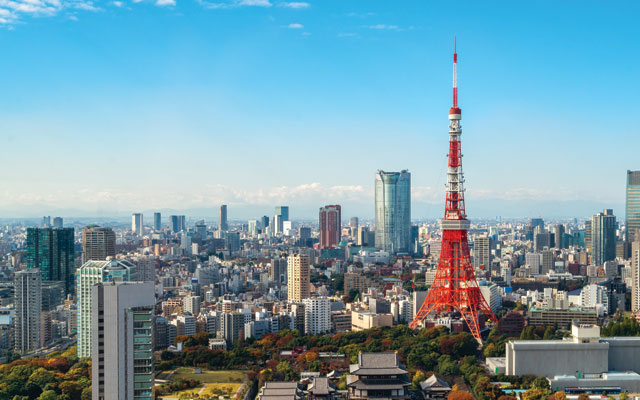
The Japanese business travel market offers vast opportunities to grow; Tokyo pictured
The Tokyo Convention & Visitors Bureau (TCVB) has released sustainable offerings to enable business event organisers to hold conferences in the Japanese capital in a more socially and environmentally responsible way.
Entitled Sustainability Experience in Tokyo, the initiative aims to introduce the city’s rich culture and history in a unique, thought-provoking way via 11 programmes designed to contribute to the United Nations’ Sustainable Development Goals. Programmes have a focus on nature, food, crafts and physical activities.
Tokyo is pushing the sustainable envelope and is keen to show its guests how they do it
According to the TCVB, the idea is to allow business visitors to “enjoy Tokyo charms and at the same time contribute to the future of the city”.
Kazuko Toda, senior director of the business events team, said the TCVB is “confident that the programmes will make the guests’ stay in Tokyo most satisfying. We also hope the meeting organisers will make good use of the programmes”.
One experience explores how bees travel from the Imperial Palace and Hamariku Gardens to a sustainable hive two kilometres away on a rooftop in Ginza where their honey is harvested. Here, participants can learn about the vital role that bees play in ecosystems and enjoy a honey tasting.
Staying with the theme of sustainable food, another experience allows participants to learn and use traditional methods to make nori, dried Japanese seaweed, which was first produced in Tokyo in the 17th century.
Also included are several programmes related to the reuse and recycling of kimonos and other traditional or natural materials to make Japanese souvenirs. Participants can also join a clean-up of Tokyo’s waterways or a walking tour of key sites.
As an add-on, the information pack features tips on how events can be organised more consciously, such as by using local vegetables. It also notes that the Tokyo Metropolitan Government has created more than 800 drinking stations across the capital, offering free tap water to reduce consumption of bottled water.
The second Virtual IT&CM China and CTW China, held from June 22-24 this year, has reported a successful conclusion, with a high percentage of fulfilled scheduled appointments and strong buying intention for the next two years.
Post-show statistics revealed that over 500 Chinese and international delegates had participated in the three-day event, with 200 exhibitors from 22 territories/countries meeting with 247 buyers from 32 territories/countries.
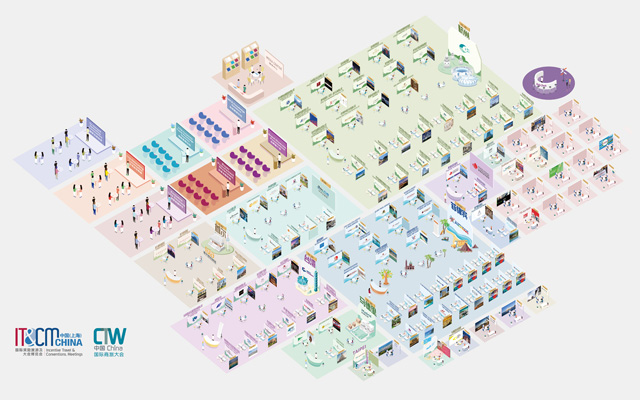
The virtual floorplan at ITCM China
The event organiser, TTG Asia Media, has also found strong business and lead generation throughout the MICE and corporate travel event.
Close to 3,000 pre-scheduled appointments and walk-in meetings were conducted over three days, with 86 per cent of pre-scheduled appointments being fulfilled.
Noteworthy during the ongoing travel and tourism crisis is that 92 per cent of exhibitors and buyers expect to receive or place MICE and corporate travel orders over the next 12 to 24 months.
Eighty-six per cent of delegates said they have achieved their objectives of attending Virtual IT&CM China and CTW China 2021, while 74 per cent of exhibitors rated buyers’ quality were above average.
The post-show study has also found that delegates were most impressed by the live networking conversations, exclusive live sessions, as well as the various MICE and corporate travel knowledge sessions. Ninety-three per cent have also registered their interest in attending the next virtual event.
G Murali Krishna, CEO of India-based Happy Vacations, said that the networking sessions were “excellent and well-organised”, and he was delighted to discover new business ventures.
Similarly, Cheng Xiangfeng, assistant manager of China Women Travel Service, appreciated the opportunity to stay connected with suppliers and the industry to continue with her business planning for when borders reopen.
What first sparked the idea for Delegate back in 2015 and how was business before the pandemic?
Lou: We started Delegate in 2015 as we saw a gap in the market for a self-serve event planning platform. My co-founder Jacqueline and I were both planning events for work and saw the opportunity to solve this pain point. We were also conscious that we wanted to be a tech-first company with our vision being to build tech products to serve the events industry.
Our core business Delegate is an online marketplace that connects anyone planning an event to a network of over 4,000 event vendors. We also launched a backend client management tool called Delegate PRO, targeted at event businesses to manage their sales leads, communications and engagement with end-users. Those two business lines existed pre-pandemic years and were focused exclusively on offline, physical events.
In 2019, we closed the year on a record high and had expansion plans to bring our marketplace and Delegate PRO to Indonesia. A majority of our users ( approximately 60 per cent) pre-pandemic came from the corporate space – we had a lot of users who planned their internal meetings and smaller-scale events on Delegate; the events that they didn’t have the budget to hire a PEO for. We spent the years from 2015 building up our community of users and vendors but alas, 2020 hit and we found ourselves having to start from scratch again.
How did you change your business to survive the pandemic?
Ye: In early 2020, we started receiving cancellations and postponement of events from our corporate clients. In turn, these same clients were also looking to us to help convert their physical events into digital ones. Even as early as March 2020 at the start of the pandemic, they were already looking at tools that could bring about more engagement and interactivity beyond the usual video and meeting tools around.
As a company centred around events and technology, we’ve been driven to innovate to cater to the demand for virtual and increasingly, hybrid events. With this in mind, we launched Delegate PLAY in September 2020, a 3D immersive virtual conference platform to host virtual events.
We have also made a concerted effort to shift our marketplace focus to weddings. Throughout the pandemic, we saw that users were still using us to plan their upcoming nuptials. This also led to the birth of the Delegate Virtual Wedding Festival, Singapore’s largest wedding expo that’s hosted on our own Delegate PLAY platform.
How useful is PLAY for corporate events planners?
Ye: Think of Delegate PLAY as a virtual convention centre that corporate event planners are able to hire for their exhibitions, tradeshows and conferences. It comes complete with a virtual lobby entrance, exhibition halls, exhibitor booths and an information desk. The platform’s exhibition halls allow the set up of customisable virtual exhibitor booths, with live presentations and real-time networking opportunities with attendees.
We also try our best to offer the best-in-class in virtual event experiences by offering attendees multiple touchpoints to interact with such as live chat, virtual meeting rooms, one-to-one attendee networking, parallel stages to view content and much more. It is also 100 per cent mobile-responsive, with a robust suite of branding and sponsorship opportunities.
What’s next after PLAY?
Ye: The appetite we see among our corporate clients is a desire for physical events to return but they are also cautious to do too much, too fast. Having been locked up for almost two years now has meant that a lot of event organisers and attendees are keen to return to networking and engaging with others at in-person events.
For the near term, it seems that our clients are still keen on virtual and hybrid event formats for their larger-scale conferences and events. The features that we have lined up in our product pipeline for Delegate PLAY are catered to the requirements of the event organiser to transition to hybrid formats, where they’re able to offer attendees a unified event experience.
We also have plans to expand the Delegate PLAY brand through the regionalisation of our Virtual Wedding Festival brand. Before the end of 2020, we will bring the show to Malaysia, Hong Kong and the Philippines.
As an SME yourself, how badly impacted do you observe other SME event companies to be at the moment?
Lou: We’re deeply saddened by the number of event companies we’ve seen shuttered among our vendor community in the last year. However, we are also really impressed by the number of creative business pivots we’ve witnessed.
So many SME event business owners we know, ourselves included, have had to make some of the most difficult business decisions in the name of survivability in the last year. And we are proud to be in an industry that’s proven to be so resilient with lots of businesses now upskilling to improve themselves and exploring digital tools and channels as a means to gain more business and to stay relevant.
Do you see enough support both at the private and government levels?
Lou: There’s so much private funding in the events sector globally and we’ve seen companies raising millions of dollars based on sky-high valuations which are truly unprecedented. I don’t think there’s been a more attractive and also, more challenging time to be in the events industry as there is so much more interest and competition in our space now.
In terms of private funding, there’s a lot of interest in this space but investors are pickier with the companies they choose to invest in. They are looking at companies with proven track records, traction and product-market-fit with a clear route to profitability.
On the government front, we both feel incredibly lucky to be based in Singapore as we’ve had a lot of support as a Singapore-owned SME so we’ve been able to enjoy the support of job support schemes, rental rebates etc. We also know of the amazing opportunities that grant such as the Special Situation Fund for Startups which incentivises private sector institutions to co-invest in startups along with EDBI (a Singapore-based global investor) and Seeds Capital of Enterprise Singapore.
What advice would you give young female entrepreneurs, especially those hoping to foray into events technology?
Ye: I think the best advice we could give is to just start. If you find yourself interested in this space, it’s actually a really exciting time to be in events tech as there’s been such a seismic shift in how events are being planned, delivered and experienced. If 2020 has proven anything, it’s that events are here to stay and that they will happen. The future of events is looking hybrid and we’re excited to see what new products will be launched in the years to come.
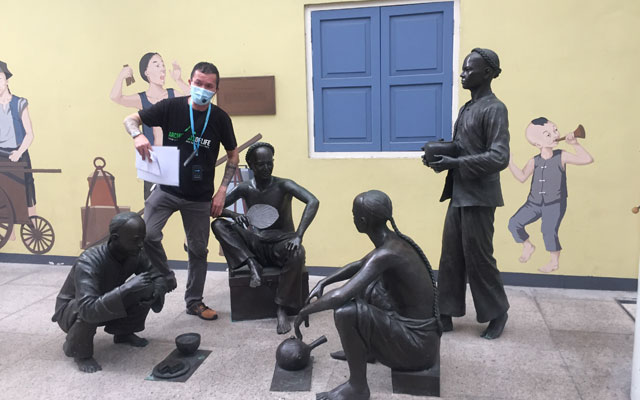
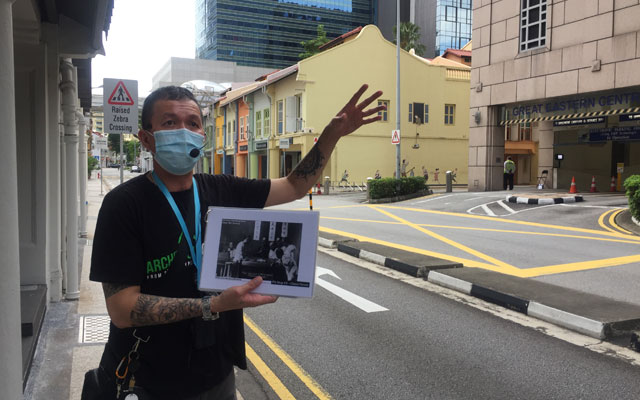
Chiong sharing about the hard life of Chinese coolies during Singapore's colonial era
Triad Trails
1 of 4
Chiong sharing about the hard life of Chinese coolies during Singapore's colonial era
Boat Quay is the first of five pit stops during the tour
China Street was once dubbed the “mouth of gambling houses”
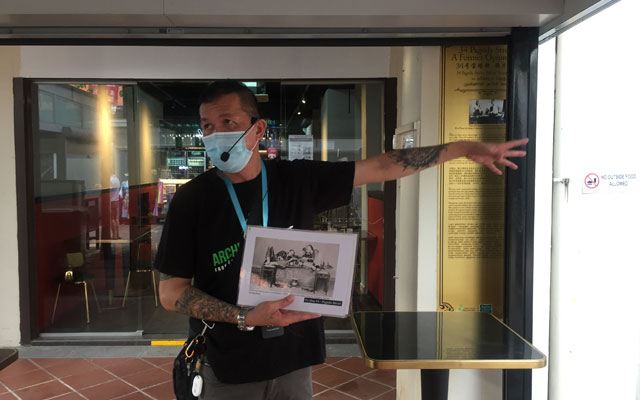
34 Pagoda Street was a former opium den
Concept
With team bonding a challenge during this time of remote working, an inventive and interactive walking tour allows corporate groups to bond over a different kind of outing around the Chinatown district in Singapore.
Led by ex-offenders, the Triad Trails tour peels back the squeaky-clean image of Singapore to reveal the city-state’s dark underbelly past.
The tour is organised by Singapore tour agency Actxplorer, in collaboration with Architects of Life (AOL), a social enterprise that aims to develop the potential of ex-offenders and youth-at-risks.
“The aim of Triad Trails is to challenge the stereotypes that many have about ex-offenders. Through this tour, the public gets a first-hand experience listening to the stories of these ex-offenders. Not only will this give the public an insight into the life of a previous gang member, it also makes the public understand the struggles they (ex-offenders) have,” said Nurfilzah Hanis Razali, a project executive at AOL.
“Additionally, the purpose of this tour is to empower and provide employment opportunities for the ex-offenders by allowing them to take charge of the tour.”
What
The tour kicks off with our tour guide Alvin Chiong, a former gang member, giving us a brief history of how Singapore’s gangland past had its roots in union groups formed by Chinese immigrants who came to Singapore to work in the 1800s. These union groups, which gave the migrants “a sense of security” and brotherhood, eventually evolved into secret societies.
From the gambling joints that once lined China Street to 34 Pagoda Street that was once home to an opium den, Chinatown’s sordid past as a hotbed of vices is brought to life during this tour.
Over two hours, Chiong brings participants on an eye-opening journey to discover the seedy side of old Chinatown characterised by secret societies, opium dens and gambling joints. Chiong’s narrative blends the enclave’s history with related events from his own life, making for a tour that is equal parts informative and revelatory.
MICE application
The tour comprises five pit stops around the Chinatown district. Each tour takes up to 16 participants, split into two groups, with no intermingling between groups during the tour, as part of Covid-safe measures.
One of the tour’s highlights is a dining experience with these tour guides at the end of the day. It’s a fun and novel way for teams to bond over a hearty meal, while learning more about these ex-convicts’ past involvement with drugs and gangs.
At the time of our participation in this tour, dining-in at F&B venues were capped at groups of two under the Phase 3 (Heightened Alert) regulations, so participants were given takeaways instead.
However, at the end of the tour, we still got the chance to sit down for a no-holds-barred small group conversation with Chiong’s mentee – also an ex-offender – who is under training to one day lead these tours on his own. Our chat gave us a rare behind-the-scenes glimpse into gang life and the secret goings-on behind prison bars.
According to an AOL representative, response for the tour has been “very good”, with slots fully booked for this month. Notably, the tour has drawn a mixed bag of participants, from both expats and locals, couples and families, and even church groups. Interest from corporate groups has also been forthcoming.
Service
Participants were given several opportunities to pose questions to the affable Chiong, who fielded all queries with ease. He also kept participants engaged in between pit stops during the tour, with commentary about the landmarks en route.
Chiong’s mentee was equally forthcoming and engaging during our small group conversation with him, with no questions off-limits.
Acting as a conduit for ex-inmates to find meaningful employment and integrate back into society aside, these tours go a long way in subverting stereotypes about reformed convicts through up-close and personal conversations. Guided by ex-convicts who have been there, done that, it’s a refreshing take on the city-state’s gritty colonial past.
Rate: S$70 (US$52) per person Dates: Every Saturday Contact
Email: contact@actxplorer.com
Website: https://actxplorer.com/tour2?id=154
Just 10 minutes from Phuket International Airport on the serene northern coast, this 178-key, Bill Bensley-designed resort offers delegates a quiet, tropical paradise steeped in Phuket’s tin-mining heritage
The newly-opened Ritz-Carlton, Bangkok anchors the One Bangkok development with cosmopolitan elegance. Featuring the city's largest ballroom and a spectacular new penthouse suite, it delivers exceptional hardware and deeply authentic, soulful service for business and leisure travellers alike
Behind the imposing, Brutalist concrete that defines Zurich’s Oerlikon district lies a surprising secret. While its exterior honours the neighbourhood’s industrial roots, stepping inside Mama Shelter reveals a vibrant, neon-soaked world that is a far cry from its rigid shell