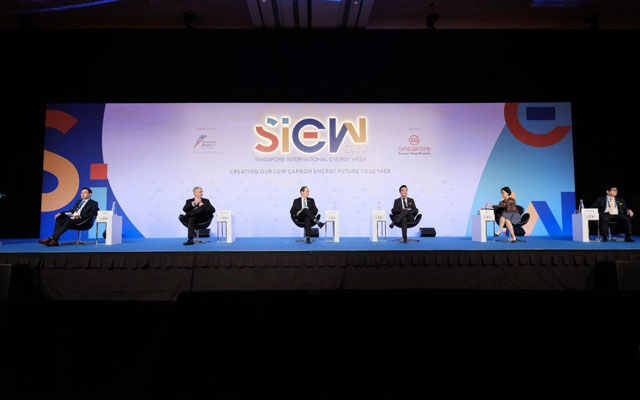
Safe-distancing measures were still enforced at SIEW 2020, in addition to rapid Covid-19 tests being conducted. Photo: Singapore International Energy Week's Facebook
On October 26, the first pre-event Covid-19 swabbing took place at the Singapore International Energy Week (SIEW) 2020, held at the Sands Expo and Convention Centre.
These antigen rapid tests were first announced last week by the Republic’s multi-ministry task force dealing with the Covid-19 pandemic.
Safe-distancing measures were still enforced at SIEW 2020, in addition to rapid Covid-19 tests being conducted. Photo: Singapore International Energy Week’s Facebook
After checking in with SafeEntry and having their temperature taken, participants entered a main area where they were separated into different zones for swabbing.
Each zone had its own set of swabbing stations and registration counter, where attendees received a confirmation SMS from the Ministry of Health and a set of labels for their tests.
They were then seated, where a swabber explained the testing process and carried out the procedure. Participants had a swab stick inserted about 2.5cm up their nostrils and twirled several times, and were then sent the results via SMS.
The seats for testing were wiped down and sanitised after each test.
Delegates were not stopped from mingling with one another while waiting for their results in the main area, but had to present their results at a check-in counter before they were given their badges and allowed to enter the ballroom where the speeches were taking place.
Around 215 tests were carried out, and no one tested positive.
This successful run might mean a loosening of group size limits for social gatherings, but the tests are less sensitive than the polymerase chain reaction tests used conventionally. Hence, safe distancing measures such as the wearing of masks would still need to be observed.
Organised by the Energy Market Authority, SIEW 2020 is a week-long event for energy professionals and policymakers to discuss and share strategic perspectives on issues in the industry and their impact.
This is its 13th edition, but the first time it has been transformed into a hybrid event with both virtual and on-site participants.
Conversations with the Experts sessions have been designed to provide practical and key insights into managing and innovating business events in the Covid era.
The conference will provide attendees with practical knowledge, strategies and solutions needed for recovery
Digital attendees will nominate a topic before the event and interact live with the presenters in these 25-minute breakout sessions.
Topics and speakers include:
Customer Deep Dive: Incentive Travel and Events with Bert Li, associate director of event production, Amway China
Customer Deep Dive: Corporate Meetings and Events with Deborah Caldwell, senior vice president Asia Pacific head of event marketing, Bank of America
Customer Deep Dive: Association Meetings and Events with Paula Rowntree, head of events & experience, The Royal Australian College of General Practitioners; and Kirsty Grimwade, senior manager, events, The Australasian Institute of Mining and Metallurgy
China Focus: Are We Back in Business? with Frankie Gao, managing director, China, MCI Group; and Stephen Zhang, president & chief distribution officer, Manulife Sinochem
Engaging Your Audience with Digital Events: Up Close and Personal with Sourabh Kothari, co-Founder and CEO, Mindcurrent; and Jennifer Kingen Kush, founder and strategist, Kingen Kush Solutions
Karen Bolinger, managing director of PCMA APAC, said: “We want to make sure our digital attendees get a lot of value from the content and what better way than by giving them a chance to engage with the experts and their peers around the region in a personal way.
“Through our APAC research, surveys and community chats with planners, what we’re hearing is that you want to ask your peers and customers what they are doing, how they’ve made decisions and what the next 12 months looks like. Now is your opportunity to ask them directly, as well as share some best practices and tips on rebuilding the business events sector in APAC,” said Bolinger.
Separately, PCMA has engaged Interprefy to deliver live and simultaneous translations of the presentations from English into Japanese, Korean and Mandarin, for the entirety of the event.
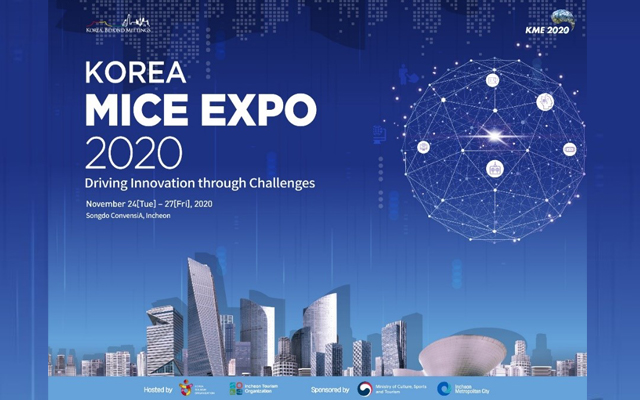
after several postponements, the date has finally been set for this year's Korea MICE Expo (KME)
The Korea MICE Expo (KME), Korea’s largest trade show for meeting professionals and incentive planners, will take place from November 24-27.
The hybrid event will be held offline at Songdo ConvensiA, Incheon, alongside a corresponding virtual event. It is expected to draw over 3,000 MICE industry professionals to meet with 300 exhibiting local service providers such as convention bureaus and unique venues.
After several postponements, the date has finally been set for this year’s Korea MICE Expo
Participants can expect to engage in 1:1 video business consultation with global buyers and gain access to exclusive virtual content available through a new online platform.
Themed Driving Innovation through Challenges, this year’s KME will take a look at challenges presented by the Covid-19 pandemic and suggest creative solutions for implementing the latest IT and meeting technology to welcome a new digital era of the MICE industry.
New features this year include live demonstrations of Korea’s latest MICE industry technology at the Meeting Technology Showcase, and discover MICE-related start-ups at the Smart Tech Exhibition Zone.
KME will kick-off November 24 with an Opening Ceremony streamed live for online participants. The opening keynote will be presented by the vice president of Consumer Electronics Show (CES), which will be followed by three days of B2B meetings, speaker presentations, exhibitions
A business traveller at Haneda International airport
The Japanese government is planning to ease entry restrictions for short-term business travellers from 30 countries and regions starting in November, as part of plans to help the economy recover.
Under the plan, business travellers arriving in Japan would be required to submit a negative Covid-19 test before arrival, and an itinerary of their activities during their stay. Though they will not be required to quarantine in their hotels, they would have to avoid public transportation, according to reports in the Japanese press.
A business traveller at Haneda Airport
China and Japan are expected to conclude an agreement on the mutual reopening of their borders for business travel within this month. This deal will exclude expats and long-term residents, who are still required to undergo 14 days of self-isolation upon arrival in Japan.
The resumption of business travel from China is expected to provide a much-needed boost to the economy. China is the largest source of business travellers to Japan, totalling 370,000 arrivals in 2019, according to the Japan National Tourism Organisation.
The South Korea deal is considered another vital step for Japan as the country is the second-largest source of business travellers to Japan, accounting for 310,000 arrivals in 2019.
Talks continue to set up similar plans with other Asia-Pacific countries whose Covid-19 transmission rate is seen as under control.
Singapore and Germany have agreed on a reciprocal green lane for essential travel, the first European country to have such an arrangement.
This will enable essential travel for business or official purposes via direct flights between both countries, the Ministry of Foreign Affairs and the German Federal Foreign Office said in a joint statement.
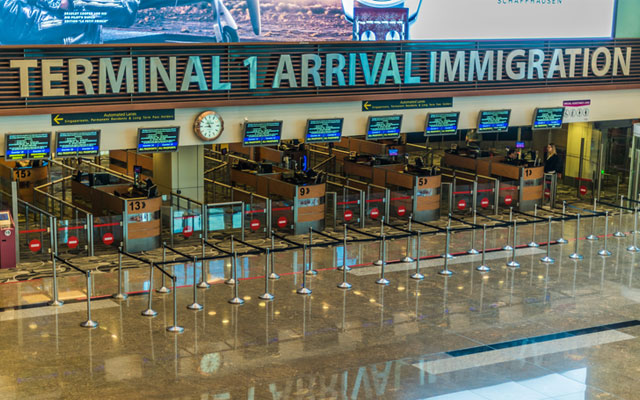
Changi Airport’s Terminal 1 immigration area
Operational details of the green lane, including the procedural requirements, health protocols and application process, will be announced at a later date.
Germany also announced yesterday that Singapore residents will be able to enter Germany again for short-term stays, without having to be quarantined on arrival.
This follows the European Council’s recommendation this week that member countries of the European Union gradually lift entry restrictions for Singapore residents.
Singapore also has travel arrangements with 10 other countries such as Malaysia and Australia, with varied restrictions.
From leftMr Chatupol Sittichai - CEO of The Pixel One Production Co., Ltd. and Future One The Virtual Center
Ms Suphajee Suthumpun - Group CEO, Dusit International
Mr Puripan Bunnag - Director, Executive and Legal Affairs, TCEB
Thailand-headquartered hospitality company Dusit International has teamed up with Bangkok-based event management company Pixel One Production to better its audio-visual offerings for virtual and hybrid meetings.
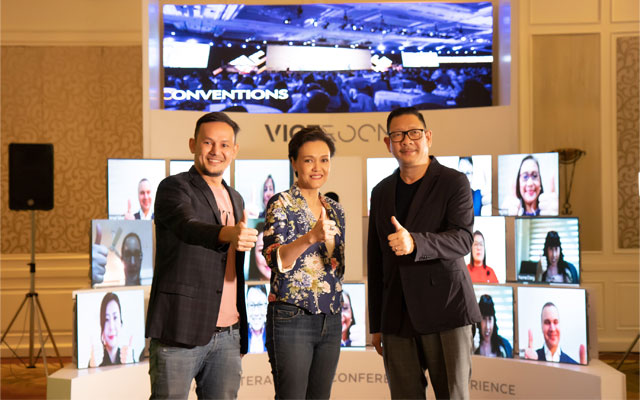
The new services, collectively dubbed VICE ROOM (Virtual Interactive Conference Experience), will transform meeting rooms on demand into high-end recording, live-streaming and presentation studios for worldwide broadcasting.
From left: Pixel One Production’s Chatupol Sittichai; Dusit International’s Suphajee Suthumpun; and TCEB’s Puripan Bunnag demonstrating how future hybrid meetings in Dusit’s meeting rooms will look like
A multi-screen video wall allows for real-time interactions with up to 100 remote event participants, while a green screen backdrop can be incorporated for high-definition virtual backgrounds.
Meanwhile, Pixel One Production’s Future One The Virtual Center can also enrich the meeting experience with virtual Q&As, live polls, and animated presentations.
Dedicated professional event specialists are also on hand to ensure swift and seamless connectivity.
This will be available at all Dusit Hotels and Resorts in Thailand, and also for offsite events catered for by the company.
Hybrid meeting packages at Dusit Hotels and Resorts in Thailand, including a VICE ROOM set up for up to 100 remote participants, start from 90,000 baht (US$2,889) for a one-day setup.
IHG Hotels & Resorts’ has opened its first airport hotel in Australia, the 247-key Holiday Inn Express Sydney Airport.
The eight-storey, new-build hotel is located on the doorstep of Sydney’s domestic airport terminal and minutes away from the international terminal.
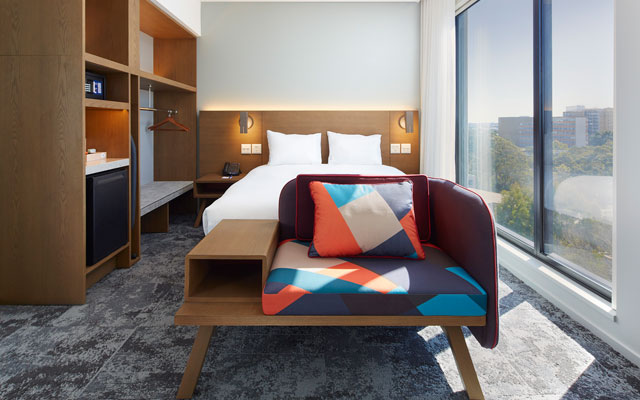
Guestroom
Each room at Holiday Inn Express Sydney Airport features everything a business traveller might need – including power showerheads, a choice of pillows, black-out blinds, high-quality bedding, and free uncapped Wi-Fi
The hotel also features two meeting rooms, flexible workspaces, a business centre, gym, self-service laundry and on-site carpark.
Early departures and late arrivals will also appreciate the hotel’s Grab & Go breakfast options and snacks, beverages, and barista-made coffee available 24/7.
Pre-Covid, China was Thailand's largest inbound tourism markets; travellers at Suvarnabhumi Airport pictured
While China’s outbound situation remains fluid, Asia-Pacific’s aviation industry and observers say governments must not waste any time in ramping up a risk-assessment strategy to welcome back the region’s largest source market.
On the rebooting of China outbound, Wolfgang Georg Arlt, CEO, COTRI (China Outbound Tourism Research Institute) commented: “It is urgent that all countries in the region come to an agreement with China to accept a procedure which does not include quarantine, but accepted standard testing before and after each flight or border crossing as well as agreed protocols for safety and sanitation standards for hotels, sights, transportation, etc in each destination.
Pre-Covid, China was Thailand’s largest inbound tourism market; travellers at Suvarnabhumi Airport pictured
“If a country cannot guarantee such standards for the whole country, parts – especially islands – can be opened first, like Bali, Phuket, Hawaii, etc.”
Arlt added: “COTRI is leading a group of experts offering national and regional governments and companies in the Asia-Pacific region a new strategy paradigm – Advantage: Tourism for the Successful Recovery and Resilience of the Tourism Industry – with regard to the Chinese source market, minimising the problems of overtourism, seasonality, strained relations between guests and hosts in time for the coming post-Covid-19 wave of Chinese visitors.”
The Association of Asia Pacific Airlines (AAPA) said that Beijing can take the lead to stimulate travel back to the region.
AAPA director-general, Subhas Menon, commented: “China can take the lead as it has enough experience and has done a very good job in suppression and containing the spread of Covid-19.”
With low infection rates in most countries in Asia, Menon urged governments to adopt a risk-assessment model, opining “there is no need to be so risk-averse”.
“If this can happen by the end of the year that would be great. But realistically, it is not going to be in place until 1Q2021.”
Governments need to “pay more heed to international travel”, Menon added, and if this is expected to happen only in 2024/25, some 115 million jobs are at stake.
Meanwhile, Japan Airlines has resumed outbound bookings for its Dalian-Narita and Guangzhou-Narita services, with reports stating that Japan would ease inbound business travel restrictions from November.
Shirley Yuen, Japan Airlines’ regional director – global and strategic sales Asia Oceania Sales Office, pointed out: “Currently, only Japanese nationals, foreign permanent residents and long-term business visa holders can enter Japan.”
Business-purpose visas have opened, but quarantine is still in place, while student visas are for those who are already studying in Japan but not those newly-enrolled.
Compared to Hong Kong, Taiwan and Korea, Yuen shared that the search volume from China to Japan has been comparatively higher.
When Cebu Pacific Air operated charters from Shanghai to Boracay last year, Ong Kee Keat, adviser, network strategy and development, said the China inbound market overtook South Korea.
The budget airline is currently “being careful with network resumption”, with Ong adding that “charters are a development investment”, as operators would have to block hotels for a year and build a sustainable structure.
The LCC’s network in China includes Beijing, Shanghai, Guangzhou, Xiamen and Shenzhen, and Ong said there were hints from the Bureau of Immigration that the Philippines may open in January 2021.
Ong continued: “The Philippines is the closest tropical country (with long stretches of beaches) in South-east Asia to China, compared to Vietnam which has a long but rocky coastline. Boracay is well known to the Chinese compared to beach resorts in Palawan or Bohol and we are depending on the tourism board to do more.”
The pandemic has made it more urgent for event venues to evolve their existence, by playing a direct role in supporting the transaction of business and knowledge through events, as well as be regarded by clients as more than just a passive real estate supplier.
In this new episode of TTG Conversations: Five Questions, we speak to Ong Wee Min, vice president of MICE, Marina Bay Sands on the future of event venue suppliers when face-to-face meetings are limited, innovations in venues, the balance between contractual flexibility and business sense, and more.
A lack of trust in people, the payment system or the overall payment process has hampered corporate adoption of virtual and tokenised payment solutions, opined Kurt Knackstedt, CEO, Troovo who spoke at an ITB Asia 2020 Virtual conference session.
While companies have primarily used corporate cards for supplier purchases for nearly three decades, Knackstedt believes that the time is up for these static card products. The current lull in business will enable companies to take the leap into virtual payments.
Once centralised, virtual payments will open up a new world of efficiency
“People are no longer in the same office, so the ability to run physical-proximity type processes – a wet signature on a document, or a rubber stamp that many Asian countries still require for purchases – will not work now. Virtual payments can help out,” Knackstedt pointed out.
He encouraged companies to make use of robotic software, managed by a team of people, to centralise these payments, which will in turn take away work that is repetitive and prone to human error.
Doing so would also help to build trust in both the process and employees.
“It has to be as people-free as possible. No one likes to fill expense reports, do paperwork, or wait two days to get three people to authorise the payment (for an airline ticket for a business trip),” he said.
Instead, an employee would get a virtual card generated, pushed to their phone, tap it at point-of-sale and know that the airline has received the card digitally and issued the ticket confirmation.
“The future of payment is any payment, anywhere in the world, anytime, run through any system, any scheme, any device, but all centrally-managed and all driven from a technology perspective,” Knackstedt concluded.
Just 10 minutes from Phuket International Airport on the serene northern coast, this 178-key, Bill Bensley-designed resort offers delegates a quiet, tropical paradise steeped in Phuket’s tin-mining heritage
The newly-opened Ritz-Carlton, Bangkok anchors the One Bangkok development with cosmopolitan elegance. Featuring the city's largest ballroom and a spectacular new penthouse suite, it delivers exceptional hardware and deeply authentic, soulful service for business and leisure travellers alike
Behind the imposing, Brutalist concrete that defines Zurich’s Oerlikon district lies a surprising secret. While its exterior honours the neighbourhood’s industrial roots, stepping inside Mama Shelter reveals a vibrant, neon-soaked world that is a far cry from its rigid shell