Hilton has launched its EventReady Flexible Offer for all its properties located globally, which aims to give event planners peace of mind when organising future events.
Events in the new normal
From now through December 31, 2020, for meetings or events taking place through to May 31, 2021, customers who take up this offer receive:
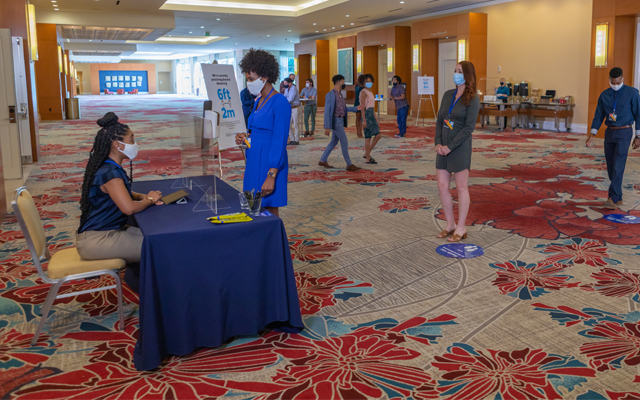
The Hilton EventReady with CleanStay elevated cleanliness and customer service standards for meetings and events, including meeting room seals, the EventReady Room Checklist and socially responsible meeting room sets.
Flexible Cancellation with the Hilton Express Meeting Agreement, allowing short term meetings and events, with up to US$50,000 budget, to cancel without penalty up eight days in advance of arrival.
Double Hilton Honors Event Planner Points, enabling planners to earn two Points per US$1 spent on guest rooms, meeting rooms and more on qualifying events at participating hotels within the Hilton Honors Planner programme.
Planners are struggling to budget for hybrid events as they try to find the balance between taking an event online and managing face-to-face attendee’s expectations, and 61% of planners and 47% of suppliers are only willing to travel within their country for a business event according to research conducted by the Professional Convention Management Association (PCMA).
Forty-one per cent of planners believe smaller and regional events will come back sooner than larger international events, while 27% believe small in-person events will need to go hybrid, and large events wholly digital.
The survey discovered that many event organisers would prefer to travel domestically for now, while China will probably recover the fastest in APAC
The survey revealed most business event planners have no intention of travelling any time soon with almost two-thirds (60%) of planners saying they would only travel within their own country for a business event in 2020, while 10% would travel to another country in Asia Pacific.
The suppliers reported being more willing to travel; with 48% saying they would only travel in their own country, 17% would travel within Asia Pacific and 22% would go anywhere, “if it was worth it”.
Karen Bolinger, managing director of PCMA Asia Pacific, said this survey provides insights from the region, from which planners and suppliers can start devising their plans.
“Some of the results were as predicted, but the real impact Covid-19 has had on business revenue for 2020 was distressing. The suppliers have taken a bigger financial hit, with 66% of suppliers noting a decline greater than 75% in revenue, compared to 52% of planners. This is a massive impact and shows the vulnerability of many of the companies that deliver events.
“The recovery in China is a major indicator for business events post-Covid. The research reveals that the Chinese are expecting a ‘pent-up demand’ for face-to-face events, hence predicting a stronger recovery in 2021 compared to the rest of Asia Pacific.
“Not surprisingly, both planners and suppliers need new skills to survive in a post-Covid economy. The survey revealed the educational and skills-based training needed right now, and these results are helping to shape the educational program PCMA is rolling out across APAC.
“It is clear that the hybrid delivery of events, both large and small, will be with us for a long time however, we need to ensure the entire event ecosystem is taken along for the journey,” said Bolinger.
The research, a regional first, is the largest multicountry business event research conducted since the onset of Covid-19 and included 531 event industry professional participants – 342 planners and 189 suppliers. PCMA conducted its Covid-19 Recovery Dashboard survey in the Asia Pacific between July 7-15, 2020, across Australia, New Zealand, South-east Asia, China, Korea and Japan.
PCMA will conduct further research in the Asia-Pacific region over the coming months.
Hybrid or virtual events are the new normal, but experts caution that organising an online event is very different from a virtual one, with more to consider
Event technology, and the rise of hybrid and virtual events these past several months, has given the industry a lifeline by ensuring business still goes on in the pandemic.
According to GlobalSign.in CEO Veemal Gungadin, most clients are fairly new to virtual and hybrid events.
Hybrid or virtual events are the new normal, but experts caution that organising an online event is very different from a physical one, with more to consider
He said a recent survey the company conducted showed more than 90 per cent of event professionals have never organised such events before, but what was encouraging is that more than 93 per cent were prepared to organise one and are at the learning stage.
He commented GlobalSign.in was confident many clients will see the value in such events, even those who never believed in virtual and hybrid events but had to make the switch out of necessity.
Gungadin observed: “What surprises clients the most is that (moving events online) requires a whole new way of thinking. They have to think digital first and need a whole new set of skills.”
The organiser of the September 24 APACMed Virtual Forum, one of the first hybrid meetings to take place in Singapore where 50 on-site delegates will be joined by a larger number online, is sold on the concept.
Maryline Marquet, vice president, APACMed, which is working with Chab Events to produce the hybrid event, said she is able to expand her reach with five global CEOs speaking, compared to only one for its previous editions.
Marquet also noted costs will be reduced and she is optimistic of reaching at least the same attendance in 2019 with about 1,000 delegates from 31 countries, the event’s best showing to date.
She explained that as the Asia Pacific Medical Technology Association’s flagship event, all-out effort and high costs were involved in the past. With the 2020 cost being lower and the global reach better, future hybrid editions will more sustainable.
While seamless, powerful and flexible event technology is necessary, Oscar Cerezales, chief operating officer Asia Pacific and global executive president corporate division, MCI Group, pointed out that it is only an enabler and part of the whole equation.
He said: “We help our clients design the event without a full focus in technology as all platforms work. By design we mean applying our design methodology, applying neuroscience, defining new metrics, co-developing the business model, increasing engagement, and adding coding to connect the client’s technology with other technology.”
Prudential Corporation Asia, which formulated an all-digital engagement strategy to enable its agents to continue to learn and connect with customers during lockdown and social distancing in place, picked MCI Singapore to deliver broadcast digital experiences to more than 100,000 agents in markets it operates in.
As part of the preparations, MCI helped to set up a broadcast centre, conducted online speaker training and developed easy-to-use broadcast kits for speakers.
Cerezales said: “If you ask me what the main problem is for some online events, is the lack of engagement due to a lack of digital design.
“Digital event design and face-to-face event design are two different animals, where the content for the former has to be more interactive and engaging to overcome the lower attention span in the virtual space,” he added.
And while event organisers may have adapted to the disruption, as Kitty Wong, president, K&A International opined that virtual meetings are two-dimensional and cannot replace the five senses used in face-to-face communication.
Wong said: “Technology can support, but it cannot replace social interaction”, adding that online events can be costly with production, scripting, directing and rehearsals to create audience engagement, otherwise efficiency is low.
“In general, people do not know how to be on camera,” she observed.
Some components of corporate travel still require a human touchcompletely entrusting the travel management process to AI
As AI, chatbots and other smart customer service solutions flood the market, business travel proponents warn against the trap of leaning on automated tools, which cannot fulfil the complexities required of travel policies.
More than 50 per cent of consumers use automated chatbots to facilitate their queries, with the millennial segment of users shunning phone calls as an “outdated service”, shared Jonathan Kao, managing director, Greater China, BCD Travel.
Some components of corporate travel still require a human touch and cannot be completely entrusted to AI
“As a TMC, we receive trip requests for Shanghai to Beijing more than 500 times daily. Chatbots can help us with such low-value services so that we can focus on bringing higher value in our other areas of service,” he said.
AI solutions are useful for solving such “core problems that are simple to handle”, described Kelvin Hu, finance director, Shanghai Chicmax Cosmetics. The FMCG company has a partnership with Ctrip, under which it has customised a standardised travel policy, as well as a middle-tier system that allows travel managers to execute price comparison and expense management.
However, such technology “has not matured enough yet” to be employed across the entire travel management process, opined Hu.
He explained: “Right now, AI’s standing is like Taobao in 2003, when people were not comfortable with online shopping and saw a level of risk. We have to wait for further development that will force the industry to grow.”
Even high-end hotels in China do not have a complete grasp on adept chatbots that can process requests such adding an extra bed to a room, shared Li Lei, founder & director, Youli Hospitality Consulting Co.
He elaborated: “After wrestling with the torturous chatbot that didn’t understand our request, we eventually called the concierge and the matter was easily settled. Even with chatbots, a lot of guests still do not derive the same sense of security (as with human service).”
Frequent business travellers have also grown accustomed to having a secretary who knows their travel needs and preferences for flights and hotels, and such a “perfect solution” is the standard that AI has to meet in order to be fully accepted by the industry, said Leo Pan, GC travel counsellor, Greater China, Boston Consulting Group (BCG).
“Even though BCG has an online adoption rate of close to 80 per cent, we still have some hesitation in completely entrusting the travel management process to AI. It may not be able to handle some problems, such as a shortage of flight seats or hotel rooms, and those boil down to personal service. We still want to take a closer look at how the market develops before investing in a solution,” shared Pan.
From top left: Shanghai New International Expo Centre’s Michael Krupp; JCIM’s Jessica Chang; ICCA’s Noor Ahmad Hamid; and MadTech Event Service’s David Sun
In addition to abiding by guidelines and SOPs, an individual’s discipline, continuous education, and businesses putting people first are three other key requirements for business events to take place safely today.
As compared to some other countries where mask-wearing has not become the norm, Michael Kruppe, general manager, Shanghai New International Expo Centre, shared that a high majority of Chinese visitors to the venue kept their masks on.
From top left: Shanghai New International Expo Centre’s Michael Krupp; JCIM’s Jessica Chang; ICCA’s Noor Ahmad Hamid; and MadTech Event Service’s David Sun
Kruppe shared his views at IT&CM China’s online panel discussion, Reopening Business Events: What Can We Do Better? on August 5.
To reassure visitors that time spent on the showfloor is safe and secure, Shanghai New International Expo Centre has many measures in place, such as temperature taking, disinfection booths and ID checks.
Kruppe shared: “Our first show on June 27 saw 20,000 visitors, a 50 per cent decrease from last year. Our China Beauty show last week welcomed 160,000 people, 10 per cent less than last year. But people are gaining confidence and getting used to the current situation. If they trust us (to keep them safe), they will want to visit.”
David Sun, managing director, MadTech Event Service, said there are good examples set by the Australian government and venues in communicating the need for public consciousness in terms of health and hygiene.
For instance, the country has constant reminders on billboards regarding mask-wearing and personal hygiene, while ICC Sydney communicates the same throughout its venue.
However, industry leaders say the onus is still on the individual to be as hygienic as possible.
“We need to get people to understand that Covid-19 could possibly be around for years. Think about 9-11. Before that, security checks at airports were more relaxed. Now, (through education and reinforcement) we know that we have to reach the airport at least two hours before flying to go through the processes,” Sun pointed out.
Jessica Chang, managing director, JCIM, added: “We (stakeholders) also need to think about putting people’s safety first, before our own interests.”
Chang related how before Covid-19 became a full-blown pandemic, she advised her clients back in February – CVBs and travel agents – to pause their China campaigns, and change it to expressions of support instead.
When asked if a global set of SOPs would help, all three panellists said it would be a near-impossible task, as the guidelines are dependent on the transmission rate in an individual destination.
Sun brought up Australia as an example, where Covid-19 transmissions have remained relatively low in certain states but high in Victoria, which resulted in state borders remaining shut.
He also pointed to China, where places like Shanghai have reopened but not Tianjin.
Kruppe agreed: “I think this has to be micro-managed at local levels, and would not work country-wide.”
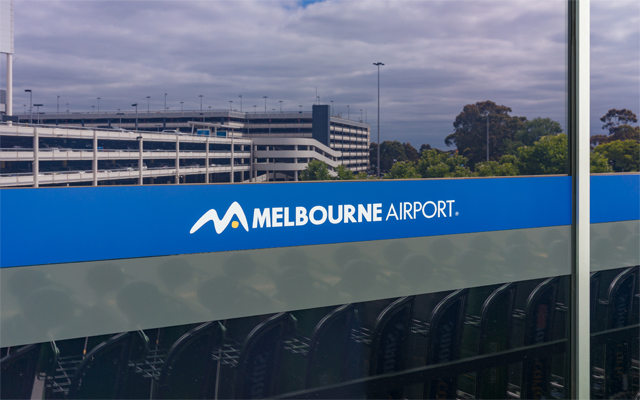
A new solar farm at Melbourne Airport will produce enough renewable energy to power all four terminals
Melbourne Airport is set to open Australia’s largest behind-the-meter solar installation that will produce enough renewable energy to power all four passenger terminals.
Construction of the solar farm is expected to be completed by end-September, and be operational in January 2021.
A new solar farm at Melbourne Airport will produce enough renewable energy to power all four terminals
The solar installation will generate 17GWh of electricity per annum, equal to nearly 15 per cent of the airport’s annual electricity consumption.
Melbourne Airport chief of landside access, utilities and facilities group, Lorie Argus, said the investment in renewable energy will reduce the airport’s carbon footprint.
She added: “With the airport’s electricity demand expected to grow, the construction of our solar farm makes sense for several reasons. The project is expected to deliver significant annualised energy cost savings, a timely benefit with the impacts of Covid-19 wreaking havoc on the aviation industry.”
Glen Thomson, general manager of Beon Energy Solutions, which is working with Melbourne Airport on the project, said: “The airport location brings with it some unique complexities and challenges, which utilises our collective strengths.”
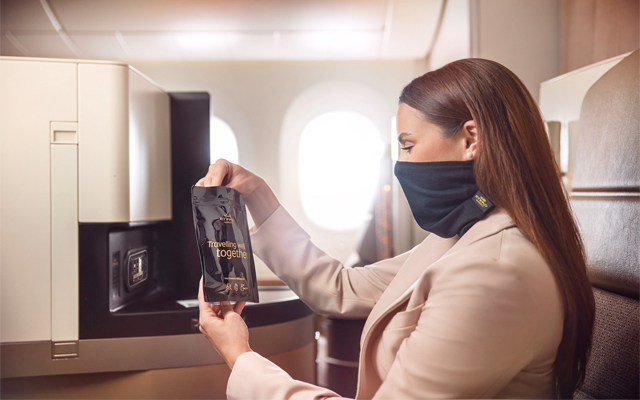
Premium passengers flying with Etihad Airways will receive antimicrobial-treated face masks
Etihad Airways has introduced a snood style face mask for its first and business class guests, as part of its new health and hygiene programme, Etihad Wellness.
The soft reusable snood has been treated with MicrobeBarrier fabric treatment, a broad spectrum antimicrobial treatment, laboratory tested and proven to reduce the presence of germs in fabrics. With this long-lasting protective layer, the snoods are washable and reusable, making them environmentally friendly.
Premium passengers flying with Etihad Airways will receive antimicrobial-treated face masks
Made out of lightweight, breathable and stretchy jersey fabric, the snood can be worn around the neck like a scarf and be easily slipped on and off to cover one’s mouth and nose as needed.
The MicrobeBarrier treated snood is one of the many initiatives the airline has introduced to create a healthier and cleaner environment.
The return of business events in Victoria has been dealt another setback with harder lockdowns imposed this week as a second wave of Covid-19 cases surges over the Australian state.
With growing concern about community transmissions, the Victoria state government has declared a state of disaster and imposed Stage 4 restrictions, believed to be one of the strictest in the world for the next six weeks.
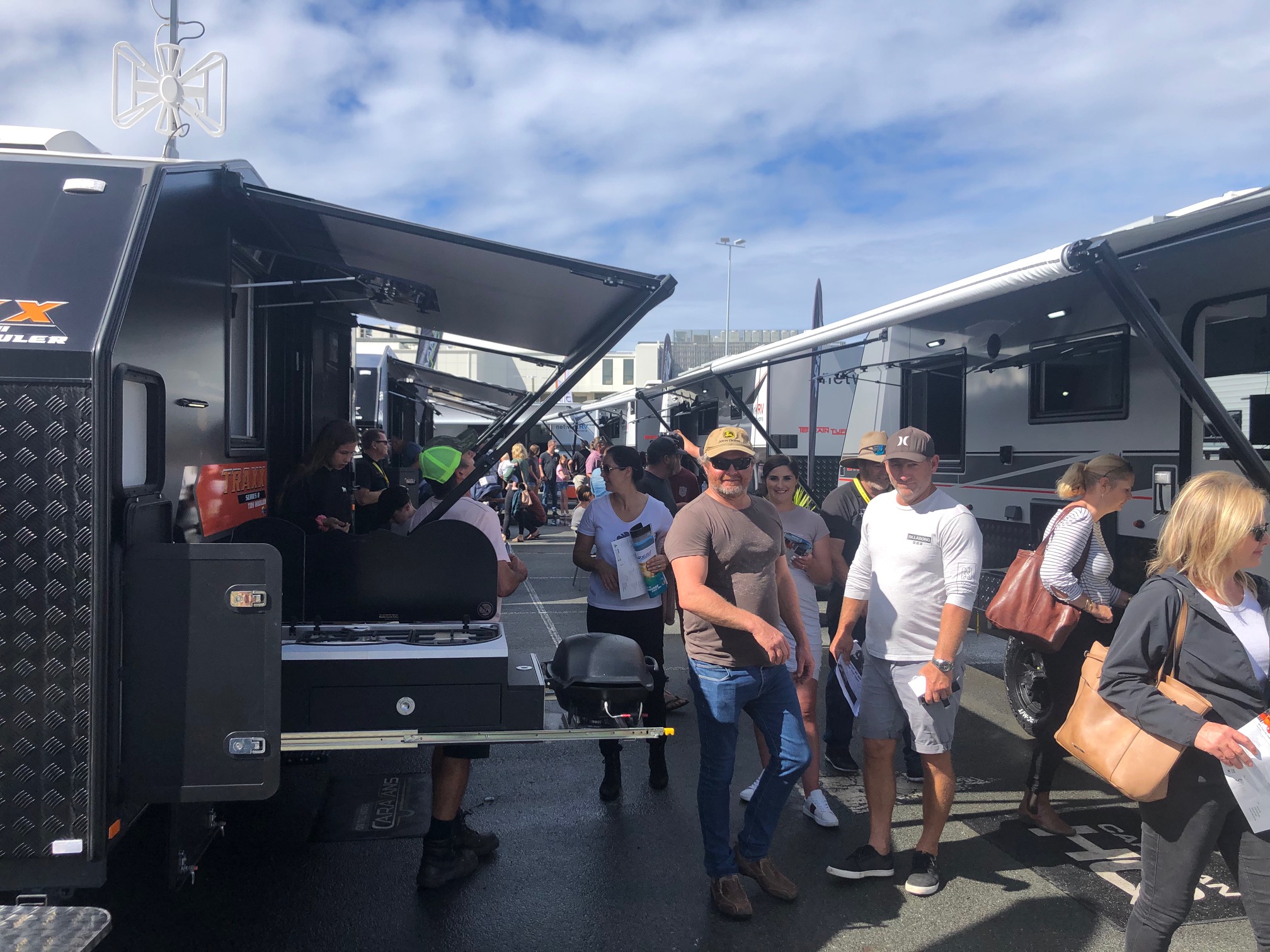
Gold Coast Expo held 24-26 July saw almost 9,000 people in attendance despite very wet conditions
“We really feel for our colleagues in Victoria and obviously this situation has delayed the restart of events in Victoria,” said Claudia Sagripanti, chief executive of the Exhibition and Event Association of Australasia.
“Clearly the Victorian Government is taking all steps necessary to contain the spread of the virus, and we will work with them to get the industry operating again as soon as possible. At this stage, given the containment efforts, we are confident that the industry has the capacity to return from October or November 2020 onwards,” Sagripanti told TTGmice.
However, a different situation is seen in other Australian states, where event houses have started to see green shoots of recovery. A small number of exhibitions and events have begun returning since July. This includes the successfully staged Gold Coast Expo which saw almost 9,000 visitors over three days in what was Australia’s first exhibition since the pandemic began.
Weeden: MICE recovery in Western Australia will only come when interstate borders are reopened
Rob Weeden, general manager of Pan Pacific Perth, confirmed Perth was also seeing an uptick in bookings for day meetings and social events.
“That’s everything from university faculties to school formals to even weddings, and that’s a precursor to business (events) because once there’s confidence, (it will flow on to meetings),” Weeden said.
Village Roadshow Theme Parks in Queensland’s Gold Coast has similarly seen corporate bookings return. “Interest is spiking for 2021,” said Caroline Duveau-Clayton, head of conferences and events.
“We are working in line with a government-approved Covid-safe plan that includes maintaining social distancing, which has reduced the capacities of all our venues. However, across our 64 indoor and outdoor venues we are in an enviable position to still cater for multiple large events,” she added.
“We have also been very creative in looking at other ways to use our unique venues, for example introducing daytime conferences at Australian Outback Spectacular, and offering customers the possibility to postpone their event or relocate between venues depending on the restrictions applicable at the time of their event, giving everyone peace of mind that their event can still go ahead safely,” said Duveau-Clayton.
Meanwhile, The National Wine Centre in Adelaide has hosted seven events last week, representing about 20 or 30 percent of usual business compared to pre-Covid-19.
But the venue’s general manager Jason Bird suggested state and territory governments will now delay plans to lift restrictions further to the next stage as Victoria attempts to control the spike in Covid-19 cases.
“It would have to be said, that with the current national circumstances, all (state and territory) governments within Australia are rightfully hedging their bets a little. So I don’t think we’ll see any next round of restrictions lifted in (the immediate future),” he opined.
Both Bird and Weeden said all interstate borders need to reopen for their states to see much-needed improved traffic for events.
“If (your venue is) blessed with large space, you will probably be doing better than others. But the cry is, open the borders so that we can get business from the east coast. And until that happens, we might not see recovery in Western Australia,” Weeden concluded.
Regional industry leaders on the keynote panel of Monday’s Virtual IT&CM China and CTW China 2020 have pushed a different view of the pandemic, saying that the digitalisation of business events today is just part of its evolution, and that industry stakeholders who are able to adapt have found new business opportunities.
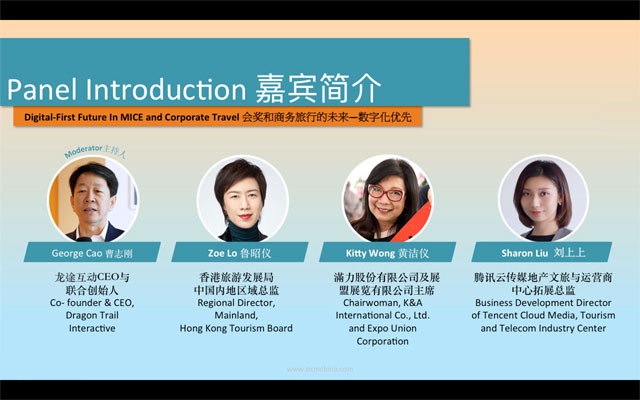
George Cao, co-founder & CEO, Dragon Trail Interactive, opened the keynote session with an acknowledgement that “the pandemic has changed many things, both personally and professionally. But the changes may not be as big or fundamental as some seem to suggest”.
Panellists discussed the positive changes in the business events industry during the pandemic
Drawing comparisons between a traditional exhibition and one that is cloud-based, he pointed out that pre-pandemic tradeshows were already utilising many technologies, such as registration by facial recognition, digital match-making programmes, and event apps that help attendees navigate the show floor.
“In a physical event, people meet face to face whereas in a virtual tradeshow, people communicate over video calls. I’d say that this is the major difference between the two formats, but this is merely a continuation of the digitalisation of (events).”
Cao also emphasised that virtual event participation is not new, as in 2017 the late Stephen Hawkin had co-hosted a physical conference in a holographic form.
Fellow speaker, Zoe Lo, regional director, Mainland, Hong Kong Tourism Board (HKTB), agrees that the digital event shift brings with it new business opportunities.
Since the outbreak in February, HKTB has organised nearly 20 online product training sessions for more than 800 industry professionals, as well as a three-day live-streaming training for more than 1,500 Mainland buyers and a business matching platform that were both launched in June.
“We are glad that we kept up with market changes and transformed the crisis into new business opportunities. Online events are cost-effective and flexible, and they allow us to go deeper with content,” shared Lo.
For event owners and planners looking for a digital event solution, Sharon Liu, business development director, Tencent Cloud Media, Tourism and Telecom Industry Center, suggested that they consider the solution’s credibility, platform, technology and channels.
Using Tencent as an example, Liu said: “Tencent’s strength is in consumer Internet, cloud technology and industrial solutions. We have the largest social platform in China, which includes WeChat, QQ, Tencent News and Tencent Video – and they can all be used as advertising channels for exhibition organisers.”
Drawing on her vast experience in event organisation, including the execution of a virtual conference during the dot com boom, Kitty Wong, chairman, K&A International and Expo Union Corporation, advised fellow event specialists looking to transition online to imagine themselves producing a play.
“Write a script so that everyone involved is clear about their role and purpose, and then rehearse. The goal is to make the communications work so that an episode two or three is possible,” Wong quipped.
More than 800,000 page views from over 140 countries and regions have been recorded within the first three days of the Global Sources Online Show (GSOS), which went live on July 29 to reach global trade buyers from across multiple industries.
GSOS has more than 1,700 buyers set up for GS Match business matching services, and around 20,000 business meeting recommendations were provided with compatible suppliers.
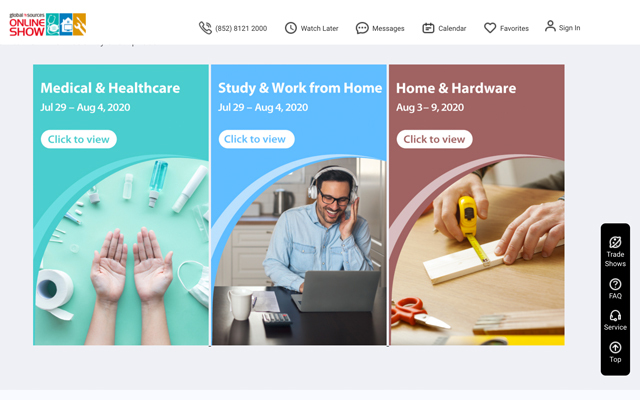
GSOS features products segmented by themes
The first week of the event, which concluded on August 4, featured products under the themes of Medical & Healthcare and Study & Work from Home.
The second week, which runs from August 3 to 9, focuses on Home & Hardware products.
Several features were established to deliver what was described as “new sourcing experiences”, according to a GSOS press statement. They include themed product pavilions that allow buyers to quickly browse products of a specific category; virtual meeting rooms to build business relationships in a private environment; supplier live-streaming led by professional hosts, featuring suppliers’ exclusive designs as well as factory or showroom tours to provide buyers with an intuitive sourcing experience; and live performances tailored for the online audience.
There were also 40 seminars conducted by 50 expert speakers, with a range of sourcing topics in English, Spanish, Portuguese, Mandarin, and Cantonese.
Hu Wei, CEO of Global Sources, said: “Global Sources has been dedicated to promoting trade for 50 years. As the only O2O platform in China’s export industry, Global Sources makes tireless efforts to meet buyers’ ever-changing sourcing requirements.”
Buyer Ruby Fung, founder of Pedda Marri, commented: “It is difficult for us to visit physical tradeshows or other offline sourcing events during the pandemic. Global Sources Online Show is a great solution to that challenge.”
The newly-opened Ritz-Carlton, Bangkok anchors the One Bangkok development with cosmopolitan elegance. Featuring the city's largest ballroom and a spectacular new penthouse suite, it delivers exceptional hardware and deeply authentic, soulful service for business and leisure travellers alike
Behind the imposing, Brutalist concrete that defines Zurich’s Oerlikon district lies a surprising secret. While its exterior honours the neighbourhood’s industrial roots, stepping inside Mama Shelter reveals a vibrant, neon-soaked world that is a far cry from its rigid shell
A polished urban retreat designed for business travellers, Hyatt Regency Kuala Lumpur at KL Midtown combines thoughtful design, seamless service, and exceptional facilities.