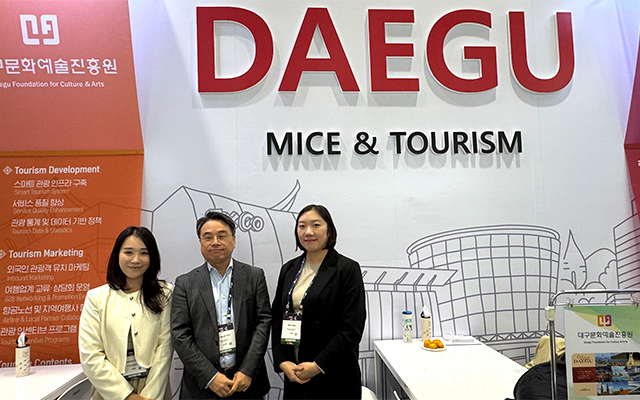
From left: Daegu Foundation for Culture & Arts’ Bella Daeun Choi, Jin Seob Kim, and Mi Ra Seo; photo by Rachel AJ Lee
As South Korea’s fourth-largest metropolitan hub, Daegu is focused on elevating its status as a destination for business events, while systematically addressing areas for improvement.
Jin Seob Kim, executive director, Daegu Foundation for Culture & Arts, told TTGmice at Korea MICE Expo 2025: “Daegu is well-known for textiles and electronic manufacturing, but this segment (is shrinking), hence we are working hard to boost the business events and tourism sectors.”
From left: Daegu Foundation for Culture & Arts’ Bella Daeun Choi, Jin Seob Kim, and Mi Ra Seo; photo by Rachel AJ Lee
On average, Daegu hosts approximately 50 international business events each year, drawing around 50,000 inbound visitors. Recent major events include the Federation of Asian Small Animal Veterinary Associations Congress 2025 (4,500 attendees), and the International Congress of Theoretical and Applied Mechanics 2024 (3,243 attendees).
Daegu has also secured two major upcoming congresses – the World Congress for Neurorehabilitation in 2026 (2,000 attendees), and the World Filtration Congress in 2028 (1,200 attendees).
To incentivise business events, the Daegu tourism board offers a dual approach of financial support and convenient planning options. As an example, Bella Daeun Choi, manager of the tourism marketing team at the Daegu Foundation for Culture & Arts, shared that the city can provide direct transport from Incheon International Airport as well as arrange social events or leisure tours for groups.
“We can customise the incentives based on what the group, and its size, requires,” she stated.
Daegu’s business events and tourism strategy targets shorthaul markets like Taiwan, Hong Kong, China, and Japan, capitalising on direct flights to its international airport. Nonetheless, the city faces significant challenges as it strives to secure more business events.
“While Daegu is a safe, convenient city with the required infrastructure, we need to address the language barrier to secure more international events,” Choi opined.
Kim regards Daegu as a “little behind” major hubs like Seoul and Busan in terms of business events and tourism marketing.
He elaborated: “The awareness of South Korea as a MICE destination is very high, but many groups opt to only stay in Seoul or Busan. I hope in five years time, they will move out to explore other cities.”
Addressing a core structural issue, Kim also pointed out that unlike many South Korean cities where business events marketing is integrated with tourism, Daegu’s tourism and business events are currently managed by separate departments.
“The city is aware of this and is actively working on cooperation and developing joint policies, with the goal of combining these efforts in the future to increase overall awareness,” Kim shared with TTGmice.
Jo: Songdo Convensia’s expansion driven by a full calendar
Songdo Convensia, a convention centre located near Incheon International Airport, is currently waiting for the South Korean government to green light its plans to expand and build new exhibition halls.
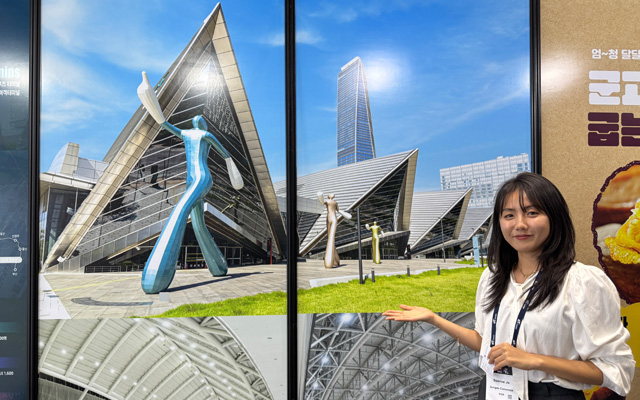
Sae-rae Jo, assistant manager, exhibition team, Songdo Convensia, told TTGmice at Korea MICE Expo 2025: “The proposal is done, and we are hopeful that it will be approved because we’re focused on MICE. MICE is the direction the government is moving in, and we aim for the expansion to be ready by 2030.”
Jo: Songdo Convensia’s expansion driven by a full calendar; photo by Rachel AJ Lee
If all goes well, the new halls will be built next to the existing four, utilising the current open-air space and adjacent parking lot. The parking lot will then be moved underground
When asked about the expansion, Jo explained that the venue’s four exhibition halls are already fully booked for 2026, forcing the facility to turn away business. At press time, the 2027 calendar is not open yet, but Jo opined that it will be continue to be “quite full” once bookings open in March 2026.
The venue plays to Incheon’s strengths, attracting both international and domestic conferences in the key fields of airport technology, drones, robotics, and biomedical sciences. For instance, next year’s calendar includes two major robot exhibitions from Canada and Europe, one of which is scheduled to run for a full month.
“We also host the yearly Korea Police World Expo, an annual B2B exhibition focusing on the public security and safety industry, and organisers have asked for more space to grow the event. We want to keep the conference here (at Songdo Convensia), so we’re trying to provide them with more space through the expansion,” Jo elaborated.
Songdo Convensia currently boasts a total exhibition space of 17,021m², capable of accommodating up to 900 booths and 20,000 people, alongside two ballrooms that can accommodate around 3,000 people, as well as 35 meeting rooms.
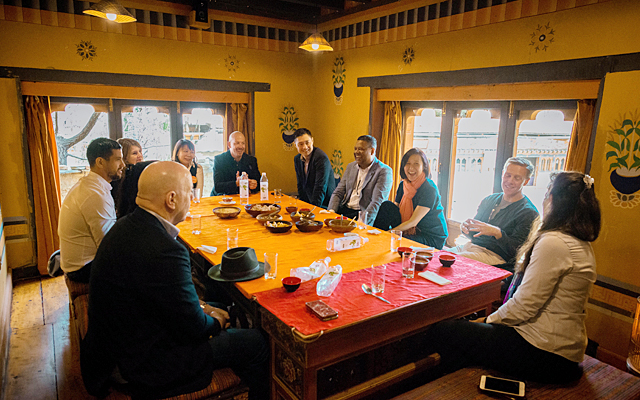
Corporates have various ways to contribute to Bhutan’s economy
Bhutan travel specialist Druk Asia – also the sole representative of Royal Bhutan Airlines (DrukAir) – launched its MICE Bhutan division earlier this year, dedicated to bespoke event planning for business events and bleisure travellers.
Joni Herison, managing director of Druk Asia, told TTGmice: “Our goal is to go beyond traditional MICE events, offering unique itineraries for organisations seeking meaningful, purpose-driven experiences.”
Corporates have various ways to contribute to Bhutan’s economy
To support this goal, Druk Asia recently launched a Philanthropy Tour for corporate groups, which Herison described as being “curated for groups seeking to gain a deeper appreciation of local culture and embrace mindfulness”.
Herison added: “We will gradually add more philanthropy tours for MICE participants to contribute to sustainable projects aligned with Gelephu Mindfulness City’s (a planned Special Administrative Region in Bhutan designed to be a green, sustainable economic hub) goals.”
Interestingly, stargazing experiences is another addition to Bhutan’s business events offerings, in partnership with GovTech Bhutan. These sessions combine astronomy, astrology, and Bhutanese cultural storytelling, allowing guests to engage with constellations, planets, and other celestial phenomena in ways that are both educational and culturally enriching.
Druk Asia is also encouraging event planners to host events at the National Museum of Bhutan, to support fundraising efforts by Bhutan’s Department of Culture and Dzongkha Development.
“Venue rental fees contribute directly to a Building Fund that will help transform Bhutan’s museums into vibrant hubs for community engagement, dialogue on global challenges, and international cultural exchange,” stated Herison.
As to which countries have shown the strongest interest in Bhutan as a business events destination, Herison pointed to Australia, Singapore, Hong Kong, and the US.
He told TTGmice: “We recently received a request from a multinational company seeking a unique setting for their annual incentive trip for employees in Asia. We are also seeing more enquiries from international companies for business mission trips, and private banks looking for client-hosting experiences, as sustainability and impact reporting become a priority for global organisations.”
Moving forward, Herison aims to bring in more leadership retreats, boardroom meetings, and impact learning journeys for corporates to Bhutan.
When asked if Bhutan’s Sustainable Development Fee waiver – available for groups for up to four nights per event excluding travel days – is helping to drum up interest, Herison said: “While the SDF waiver is a helpful incentive under certain conditions, our focus is on ensuring companies see hosting events in Bhutan as an investment in impact travel. In cases where waivers apply, we encourage groups to consider channelling those savings towards cultural preservation or community engagement projects.”
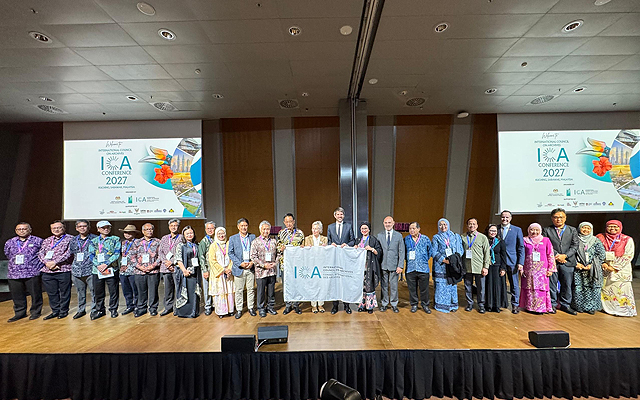
Abdul Karim Rahman Hamzah, Sarawak’s minister for tourism, creative industry and performing arts, formally received the hosting rights on behalf of Sarawak
Sarawak has received the hosting rights for the International Council on Archives (ICA) Conference 2027, a major win for Malaysia and a historic first for the state.
The formal handover took place in Barcelona, Spain, on October 31, 2025, during the closing ceremony of the ICA Congress 2025.
Abdul Karim Rahman Hamzah, Sarawak’s minister for tourism, creative industry and performing arts, formally received the hosting rights on behalf of Sarawak
The ICA Conference 2027 is scheduled for November 1 to 5, 2027, at the Borneo Convention Centre Kuching and is expected to attract over 1,000 delegates globally, including archivists, policymakers, and academic leaders.
The conference will be co-organised by the Sarawak State Library and the National Archives of Malaysia. Its focus will align with Sarawak’s Post Covid-19 Development Strategy 2030, emphasising heritage preservation, digital transformation, and cultural diversity.
The successful bid was the result of strong multi-agency collaboration led by the Sarawak State Library and the National Archives of Malaysia, with support from Business Events Sarawak, Malaysia Convention & Exhibition Bureau, and several federal and state partners.
ICA is a global organisation dedicated to advancing archival and records management.
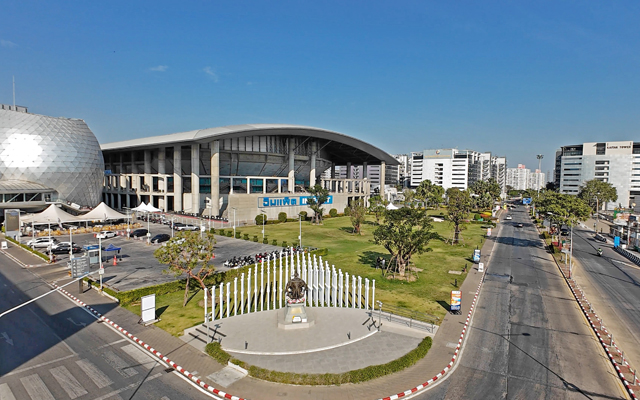
Impact remains committed to continuing its long-term sustainability journey
Bangkok’s Impact Muang Thong Thani has achieved certification under the rigorous ISO 20121:2024 Event Sustainability Management Systems standard, making it the first venue in Thailand to certify all five of its core event categories – weddings, parties, exhibitions, meetings, and concerts – under the updated global standard.
The certification validates Impact’s success in integrating sustainable practices across its operations, which host over 1,000 events and over 10 million visitors annually.
Impact remains committed to continuing its long-term sustainability journey
Key achievements include achieving a 29.8 per cent diversion rate for event-related waste (surpassing targets of 15 per cent for food and 10 per cent for non-food items), while the fully operational Pink Line Monorail has helped to reduce traffic congestion and carbon footprint during mega-events like Thaifex Anuga Asia and the Bangkok International Motor Show.
The venue’s Green Meeting Package, launched in 2022, also continues to gain traction, successfully hosting 98 green events to date. This accounts for nearly 10 per cent of the venue’s annual number of business events.
Impact Exhibition Management Co. also emphasised its social responsibility commitment, which includes supporting the local Muang Thong Thani community. With over 1,300 full-time and nearly 400 part-time staff, the company actively prioritises recruiting candidates from the surrounding neighbourhood.
Event brief
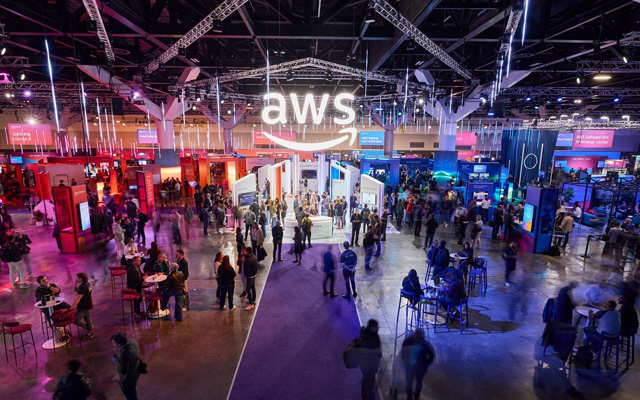
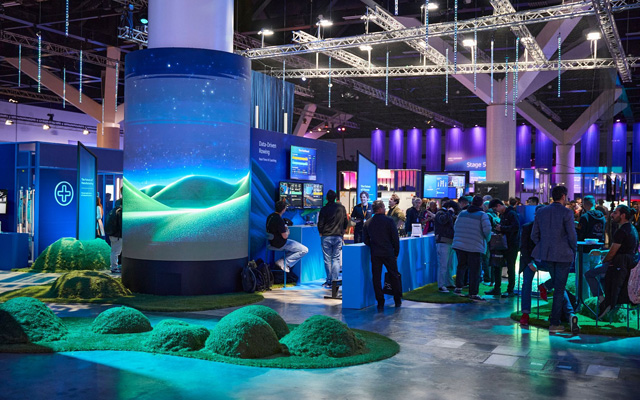
The International Convention Centre Sydney (ICC Sydney) partnered with Imagination in delivering Amazon Web Services (AWS) Summit Sydney 2025 for the fourth consecutive year.
In 2025, AWS Summit aimed to inspire – showcasing the real-world impact of AI and AWS technologies in action. Over two days at ICC Sydney, thousands of developers, business decision makers and leaders explored immersive and interactive activations like ‘The Discovery Zone’ and ‘The Proving Grounds’, where bold ideas met practical applications.
Delivering a seamless and premium experience remained a top priority for ICC Sydney throughout every stage of the event. From inspirational keynote moments in its world class theatres to hands-on demonstrations across our versatile spaces, every element of AWS Summit Sydney was designed to bring the future closer – making it tangible, relevant, and human.
Event highlights
Delivering an event of this scale required seamless coordination and premium service, and ICC Sydney was fully equipped to meet this expectation.
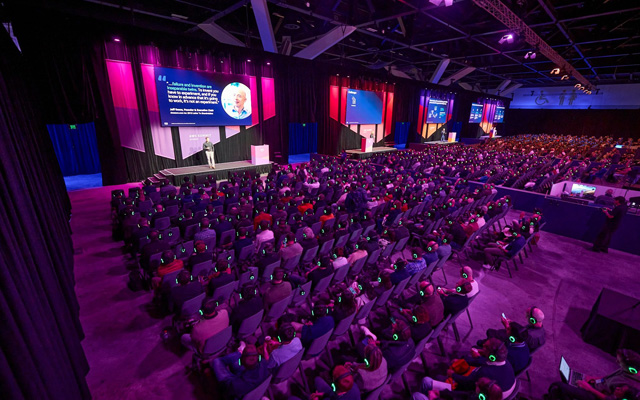
The AWS Executive Forum, as part of the AWS Summit, welcomed over 700 executives to the Cockle Bay Room in ICC Sydney’s Convention Centre, where the forum featured three distinct breakout spaces: “Ignite,” “Inspire,” and “Innovate.” Each of these spaces were brought to life by ICC Sydney’s audiovisual team.
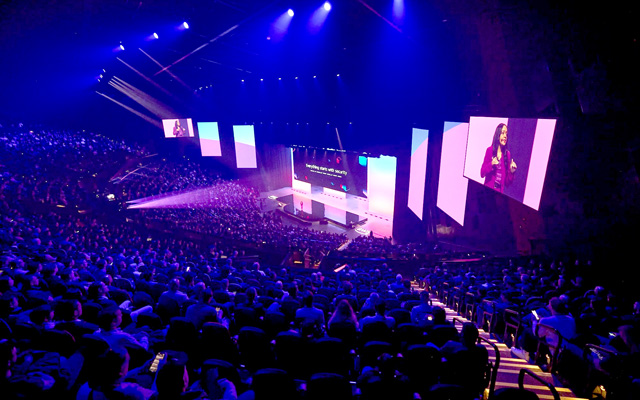
Guests began with a private breakfast in ICC Sydney Theatre before moving into the keynote – setting the tone for an exclusive and high-impact programme. AWS Summit’s custom-built round stage required a full room transformation. From re-setting the space to overseeing technical setup, every detail was handled with precision and care.
Challenges
To support an inclusive and seamless experience, ICC Sydney guided the client through event spaces to support the creation of visual stories. These visual stories enabled attendees to plan their day and navigate the 240,000m2 venue spanning the Convention Centre, Exhibition Centre, and ICC Sydney Theatre. By providing clear, accessible information in advance, these resources reduced anxiety, supported sensory and communication needs, and empowered delegates to engage more fully in the event.
In addition, ICC Sydney’s team ensured seamless wheelchair access and proactively installed tents on the Level 2 balcony, minimising weather-related disruptions and reinforcing the venue’s commitment to accessibility and comfort.
In collaboration with AWS Summit Sydney, ICC Sydney also provided key insights and data to create custom Sustainability Cards, helping communicate the event’s positive environmental and social impact. These cards highlighted initiatives such as sourcing local, reducing carbon emissions, diverting waste from landfill, and supporting community causes.
ICC Sydney’s Corporate Social Responsibility team implemented water stations to minimise single-use plastics and achieved an 83 per cent waste diversion rate, verified through an ICC Sydney-conducted audit. The event championed circular practices by reusing existing assets, such as the registration desk at the AWS Executive Forum, demonstrating how thoughtful design and sustainable choices can deliver fresh, on-theme experiences with a lighter environmental footprint.
Event Amazon Web Services (AWS) Summit Sydney 2025 Dates June 4 to 5, 2025 Organiser Imagination and Amazon Web Services Venues ICC Sydney Convention Centre, Exhibition Centre and ICC Sydney Theatre Attendance 10,000+
The iconic Tokyo Bay Area offers scenic charm, accessibility and interesting Unique Venues for event organisers looking for memorable experiences
Successful business events go beyond stylish venues and modern facilities. They thrive on thoughtfully curated programmes in destinations that combine scenic backdrops with meaningful activities – creating holistic, memorable experiences that keep participants engaged and inspired.
Tokyo Bay, offering both stunning ocean views and big city amenities, combines modern dynamism and recreational activities required for an event that participants will never forget.
Tokyo Bay: renowned for waterfront views and accessibility
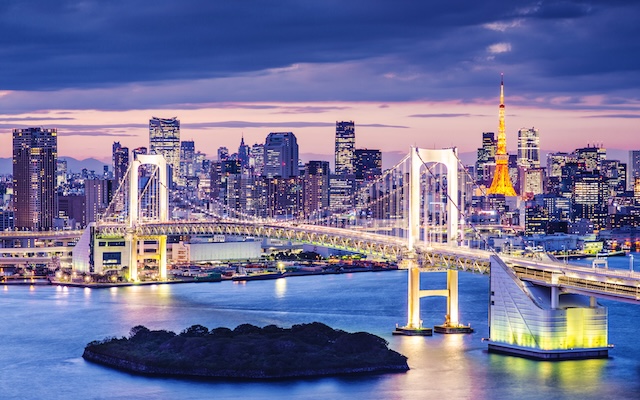
Overlooking a scenic waterfront, Tokyo Bay is a side of the city that offers a wealth of options for planners. Iconic landmarks like the Rainbow Bridge, Tokyo Skytree and the city skyline make for an inspiring event destination.
Its prime location, offering seamless access from both Haneda and Narita airports, excellent public transport networks, a wide variety of hotels in close proximity and an abundance of appealing activities from cruises to fine-dining, ensures that event planning is made easy.
Modern event infrastructure is another key draw, with convention venues offering advanced facilities and flexible meeting spaces.
Unique venues for memorable experiences
Within the Tokyo Bay area, there is also a diverse collection of Tokyo Unique Venues, each offering distinctive and memorable settings for standout business events that break the mould.
Here is a preview of just some of the unique venues available for events:
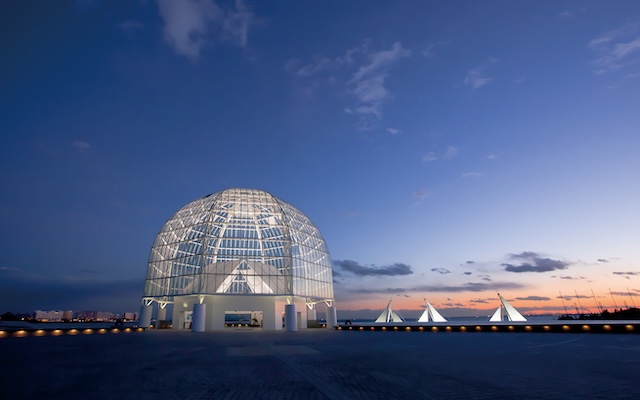
Tokyo Sea Life Park with its iconic glass dome is a unique venue that is bound to impress attendees
Recognisable for its iconic glass dome, the Tokyo Sea Life Park is home to more than 500 species of sea creatures, including schools of bluefin tuna swimming within.
Event attendees can enjoy a welcome drink from within the stunning glass dome as they take in the panoramic views of Tokyo Bay, and on cloudless days, even catch a glimpse of Mount Fuji in the distance.
For organisers, Tokyo Sea Life Park provides a variety of versatile venues to suit different occasions. In addition to the 1,333m² Sky Plaza and the 970m² tent deck, there is a cafeteria, terrace, and auditorium. These flexible spaces can be transformed for gala dinners, buffets, or cocktail receptions, where attendees can mingle while immersed in the wonder of the aquarium.
Miraikan – The National Museum of Emerging Science and Innovation
Home to futuristic exhibitions, Miraikan shows visitors the possibilities of the future – an interesting learning activity to include in itineraries
Miraikan showcases some of Japan’s most advanced technologies, offering visitors a journey into the future through immersive exhibits on robotics, space exploration, and sustainable living.
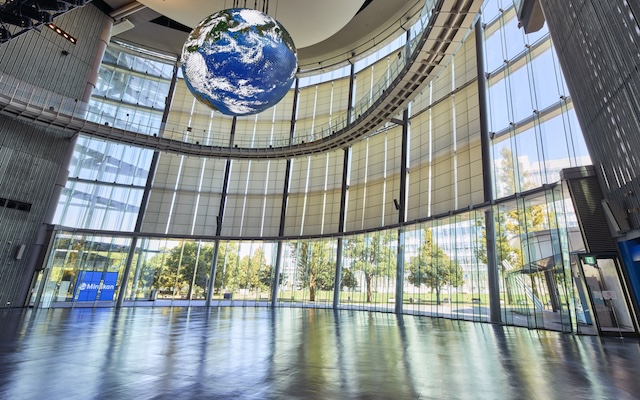
Its striking glass architecture provides a sleek, futuristic setting for memorable social events, transforming into a dazzling spectacle when illuminated after dark, with its shimmering façade reflecting its spirit of innovation.
The facility is exceptionally well-equipped for international conferences and corporate gatherings, featuring two large halls for seminars, multiple conference rooms for about 100 persons, spacious exhibition zones for 400 to 450 persons, and a viewing lounge. Several multipurpose rooms are also available, making Miraikan a versatile choice for meetings, networking sessions, and incentive parties.
One of the venue’s highlights is the Symbol Zone, featuring the high-tech Geo-Cosmos, a large sphere suspended from the ceiling that projects a realistic vision of the Earth. Hosting a gala dinner beneath this spectacular installation creates a truly unforgettable experience.
Ideal for large sporting events, Sea Forest Waterway is your next stop for excitement
Originally developed for the Tokyo 2020 Olympic and Paralympic Games, the 67-hectare Sea Forest Waterway stands as one of the city’s best outdoor event venues. The multipurpose venue features a world-class regatta course capable of welcoming up to 2,000 spectators in the grandstand, providing a dramatic setting for international sporting competitions.
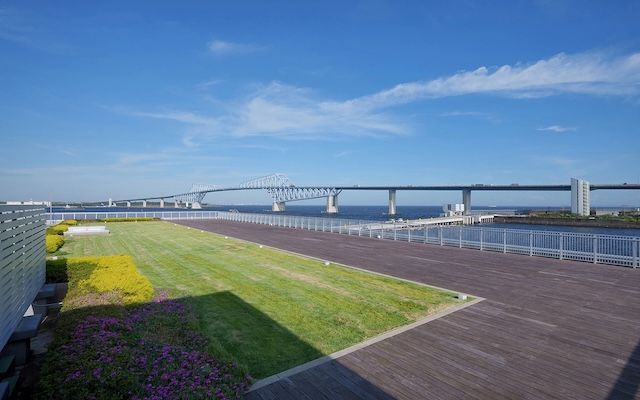
Beyond thrilling sporting attractions, the Sea Forest Waterway is a vibrant and adaptable venue for dynamic events, from sleek sports car exhibitions to trendy music festivals, cementing its reputation as an exciting, lively destination. Adding to its allure is the iconic Tokyo Gate Bridge, rising in the distance, creating a dramatic backdrop for events.
For organisers seeking a different perspective, the 788m² Boat House Rooftop Garden offers sweeping views of Tokyo Bay, providing an inspiring space for receptions and cocktail parties. Complementing this are facilities such as a 300m² dining hall with seating for 144 guests and multiple meeting rooms suitable for smaller groups or breakout sessions.
With its unique combination of outdoor space and versatility in holding large-scale lifestyle events, planners can make a splash with an event at Tokyo’s premier watersports venue.
The serene Hama-rikyu Gardens offers a tranquil environment for large outdoor events
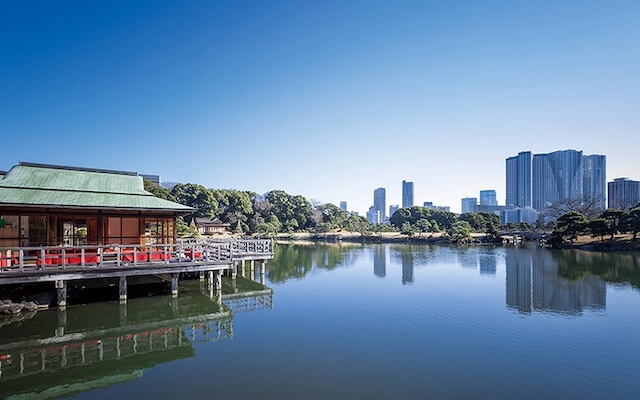
With a long history dating back to the Edo-period, Hama-rikyu Gardens was formerly a detached residence of the Tokugawa Shogun’s family, who used the grounds for duck hunting. This beautiful Japanese garden now offers locals a green oasis within the city, exquisitely landscaped and housing a tranquil tidal pond. Strolling along its meandering paths and taking in the meticulously maintained gardens, attendees can marvel at the beautiful contrast of serenity against the backdrop of Tokyo’s towering skyscrapers in the distance for a truly distinctive atmosphere.
With large open spaces ranging from 1,000m² to 2,000m², the gardens provide a magnificent backdrop for outdoor events. There are also teahouses where guests can partake in a traditional tea ceremony, making for an intimate cultural experience for VIP guests. The entire venue can even be rented out for a large-scale event, sure to impress participants with Tokyo’s one-of-a-kind fusion of the old and new, such as the Tokyo Unique Venues Showcase Event 2023.
For event organisers interested in hosting an event at Tokyo’s unique venues, please visit Tokyo Unique Venues. Dedicated and experienced support staff are ready to assist with booking procedures, vendors and event delivery. It is our mission to assist you in curating an event that your participants will remember forever.
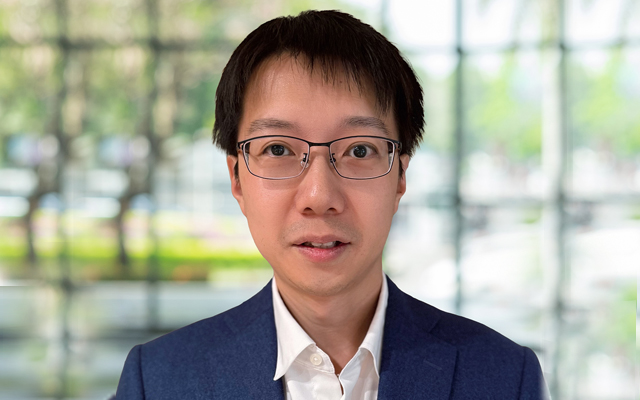
BCD Travel has appointed Martin Ko as managing director, Japan, effective November 1, 2025.
Based in Tokyo, Ko will lead BCD’s strategic growth in Japan, with a focus on expanding market presence, driving innovation, and strengthening client partnerships.
Ko joins BCD from JTB Business Travel Solutions, where he most recently served as general manager, business travel management. With more than 13 years of leadership experience in the travel management industry, Ko has held senior roles at both JTB and Carlson Wagonlit Travel.
Ko succeeds Jonathan Kao, who successfully led the integration of Hitachi Travel Bureau into BCD and advanced the company’s Japan strategy over the past two years. Kao will now refocus on BCD’s Greater China business.
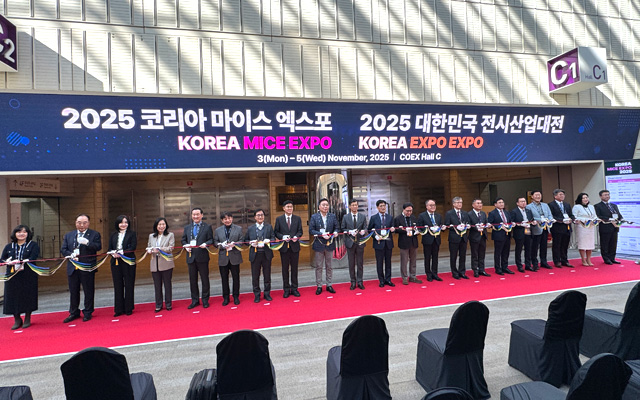
Key figures from government, industry, and academia cutting the ribbon to symbolise the opening of KME 2025; photo by Rachel AJ Lee
The Korea MICE Expo 2025 (KME2025), billed as the largest business events gathering in the country, opened this afternoon at COEX, Seoul.
KME’s theme this year is Meaningful Impact Connects Everyone, and includes an exhibition, business meetings, and conferences. The exhibition hall sees the participation of all 17 metropolitan and local governments of Korea, joining forces with their respective local MICE alliances to conduct joint marketing initiatives.
Key figures from government, industry, and academia cutting the ribbon to symbolise the opening of KME 2025; photo by Rachel AJ Lee
Danny Hyundae Shin, chairman of Korea MICE Association (KMA), said that Seoul is already a popular destination for both business events and leisure tourists, hence KMA is working with local governments to spread the benefits of business events further afield.
Over the next three days, KME 2025 will welcome more than 5,000 domestic and international business events professionals, and feature 450 exhibition booths and 200 buyers. Of the 200, half are international buyers, all of whom are verified decision-makers with actual plans to host events in Asia within the next three years.
On the increase of international buyers this year, Shin said: “We took over the organisation of KME (from the Ministry of Culture, Sports and Tourism, Korea Tourism Organization (KTO)) in 2023. We feel that that now is the right time to advertise KME to international markets, because they will be main buyers and visitors to South Korea.”
The top inbound markets for business events – in no particular order – is currently China, Japan, Taiwan, Malaysia, and Singapore, he shared.
International buyers attending KME2025 can experience South Korea’s culture through two extensions: the Seoul Night Tour (supported by KTO) for after-dark city charm, followed by a two-day post-tour exploring Gunsan, Gwangju, and Gangneung, hosted by local convention bodies.
Meanwhile, domestic buyers hail from 45 organisations, and represent a diverse mix of academic, societies, associations, and corporates. In all, a total of nearly 4,000 business meetings is expected to take place.
KME 2025 is also co-located with the Korea Expo Expo, and will also host the 2025 MICE Joint Academic Conference. The conference programme is structured around two key concepts – MICE Wave and Open Session. MICE Wave focuses on Impactful MICE Planning to lead new trends and emerging concepts, while the Open Session will feature collaborative sessions with partners, pitching sessions for innovative business events tech/services, and focused training for all professional levels.
Following the successful conclusion of APEC South Korea 2025 in Gyeongju last week, Shin expressed hope that hosting such a large-scale event will serve as a powerful testament to the nation’s capability to successfully manage major international gatherings for the business event industry.
“For 2026, I believe the Korean MICE industry will shine even more brightly,” Shin stated.
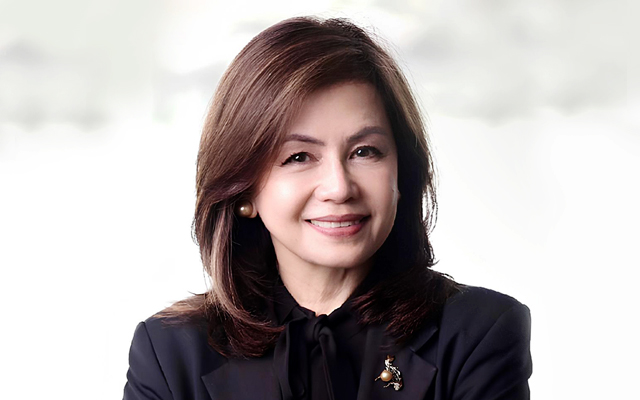
World Trade Center Metro Manila (WTCMM) has announced the re-election of its chairman and CEO, Pamela Pascual, to the Board of Directors of the World Trade Centers Association (WTCA) for the 2025–2029 term.
The WTCA is a global network of more than 300 World Trade Center locations in nearly 100 countries. It connects businesses, communities, and iconic properties to promote trade and investment opportunities worldwide.
Pascual was re-elected to represent the Asia-Pacific rregion, continuing her service on the Board that began in 2021.
Since joining the Board in 2021, Pascual has championed collaboration, strengthened WTCA’s credibility, and advanced meaningful trade initiatives on the world stage.
Her continued presence on the WTCA Board also reaffirms the Philippines’ leadership within the global WTCA network and its dedication to fostering international trade partnerships.
Currently, Pascual also serves on the WTCA Regional Advisory Council for Asia-Pacific as its vice-chair, as well as sits on the Board of Directors of the Union des Foires Internationales (UFI), the global association of the exhibition industry.
Just 10 minutes from Phuket International Airport on the serene northern coast, this 178-key, Bill Bensley-designed resort offers delegates a quiet, tropical paradise steeped in Phuket’s tin-mining heritage
The newly-opened Ritz-Carlton, Bangkok anchors the One Bangkok development with cosmopolitan elegance. Featuring the city's largest ballroom and a spectacular new penthouse suite, it delivers exceptional hardware and deeply authentic, soulful service for business and leisure travellers alike
Behind the imposing, Brutalist concrete that defines Zurich’s Oerlikon district lies a surprising secret. While its exterior honours the neighbourhood’s industrial roots, stepping inside Mama Shelter reveals a vibrant, neon-soaked world that is a far cry from its rigid shell





 Ko joins BCD from JTB Business Travel Solutions, where he most recently served as general manager, business travel management. With more than 13 years of leadership experience in the travel management industry, Ko has held senior roles at both JTB and Carlson Wagonlit Travel.