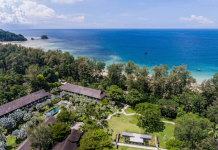
Spanish hotel group Meliá Hotels International has opened Meliá Koh Samui, its first hotel in Thailand.
The beachfront resort offers 159 rooms and 41 suites, suitable for large business events groups heading to Koh Samui for meetings and teambuildings.
Meliá Koh Samui
1 of 8
Event planners can take advantage of the extensive conference facilities of seven multifunctional rooms including a room with a beach view, a ballroom that can accommodate up to 200 guests and an outdoor pool-side and beachfront function spaces which recently hosted a gala dinner for 500 guests.
During their downtime, guests will also be able to unwind in the two outdoor swimming pools, including a large lagoon pool that loops like a river through the resort’s gardens.
Other amenities include two restaurants, an executive lounge, a beach club and a swim-up bar, the YHI Spa, and a fitness centre. For families of corporate travellers, they can also enjoy access to a kids’ club, outdoor playground, and mini water park.
Melia Koh Samui also houses the Gallery, a not-for-profit social enterprise of art and design gift shops under the aegis of the Asset World Foundation for Charity, which embraces socially responsible practices to contribute to society and communities. The shop will give customers the opportunity to be part of supporting the local communities with all profits contributing to further artistic endeavours, as well as preserving and promoting local culture and areas in need.
This opening is the start of a strategic roll-out of the Meliá brand in Thailand and at least two more hotels will be opened in key destinations in the country, namely INNSiDE by Meliá Bangkok Sukhumvit and Meliá Chiang Mai.
TTG Asia Media is debuting a TTG Conversations webinar series at the end of this month to connect industry peers whose ability to meet and discuss key business issues has been disrupted by the Covid-19 pandemic.
TTG Conversations joins the company’s stable of widely-read and established trade titles as well as at the many knowledge sessions of IT&CM Events and CTW Events that take place several times a year.
Panellists will discuss if virtual events are here to stay even after the pandemic, and how one can take a physical event online
The first webinar will take place on Wednesday, April 29, from 15.00 to 16.00 (GMT +8) with a topic designed for its TTGmice and TTGassociations audience.
The hour-long TTG Conversations: The end of events as we know it? calls on four panelists to debate the value of virtual meetings and determine how extensively companies and event organisers will utilise such event formats as the world recovers from the pandemic, as well as share their learnings in converting physical gatherings to online ones.
The panellists are: Iain Bitran, executive director, The International Society for Professional Innovation Management; Veemal Gungadin, CEO, GlobalSign.In; Joe Ciliberto, global director, sales and marketing, EventsAir, and Cheryl Tan, head of events, TTG Events.
The session will be moderated by Karen Yue, group editor of TTG Asia Media.
Registration for TTG Conversations: The end of events as we know it? is now open. Capacity is limited and registrations are on a first come, first served basis.
TTG Asia Media intends to maintain a flexible frequency for TTG Conversations, with new sessions surfacing every four to six weeks for now to tackle the latest developments and talking points.
There are plans to make TTG Conversations a part of the company’s physical events, facilitating a hybrid model that allows delegates to participate remotely from wherever they are and join in the discussion and conversations live.
From a solutions-offering perspective, TTG Conversations will further sharpen the company’s integrated communication and trade engagement capabilities.
With the continued support of advertisers and sponsors, TTG Asia Media hopes to keep TTG Conversations free for attendees.
Japan National Tourism Organization (JNTO) has appointed Hatsume Nagai as executive director for the Singapore market, effective April 1, 2020.
In her new role, she will be responsible for leading the development and implementation of strategies to promote Japan as a preferred destination among Singaporean leisure and MICE travellers.
Nagai joins JNTO at a time when the global tourism industry is undergoing its biggest crisis yet due to the coronavirus pandemic, and she will be helming the organisation’s recovery efforts for when travel resumes.
Furthermore, Nagai said that the NTO will also be strengthening promotional efforts such that the Singapore market will prioritise Japan as their first travel destination when the situation improves.
Hot idea
House delegates close to the convention centre to ease their commute and provide them with more time to do business
Brief
The biennial Convention of the Teochew International Federation unites people of Teochew descent from 110 organisations globally. The get-together allows local business executives and entrepreneurs to network and build relationships with international delegates, promoting collaboration across trade, culture and social welfare.
Zhi Chen, vice chairman of the 20th Convention and vice chairman of the Chao Shan General Association of New Zealand, said: “The convention is a chance to not just celebrate the friendship of the Teochew global community, but an opportunity to look at the host country and see whether there’s a chance to do business there.”
Chen added that hosting the convention in Auckland provided “a good chance to promote New Zealand to the world”.
Currently, there are more than 80 million people identifying as Teochew – originating from the east of Guangdong Province – some 30 million of whom live outside China.
Highlights
Delegates were welcomed on the first night with a banquet at SkyCity Convention Centre. Entertainment was an international showcase, from Japanese and Korean drumming, to Russian, Middle Eastern and Latin American dances, before presentations by the Chao Shan orchestra and Wushu group.
The next day’s opening ceremony took place on a stage decorated with a giant Maori pou (statue) complete with a traditional Maori powhiri (welcoming ceremony) and cultural performance.
Four different forums then followed: one on Teochew culture; another for the medical academic community; a youth forum, and an economic development and investment trading forum.
During the forums, New Zealand’s opportunities for trade and business were highlighted with strong political support. For instance, VIP attendees at the convention included New Zealand’s trade and export minister, minister of ethnic communities, and minister for employment, as well as Auckland mayor Phil Goff, former prime minister John Key, and the Chinese Ambassador to New Zealand.
The evening functions were also leveraged to present the best of New Zealand – through food. Delegates feasted on lobster the first night, and paua (abalone) the second.
In addition, the convention precinct was festooned with flags representing the conference, with the SkyTower flashing red and blue at night – the colours of the convention.
Chen said the event was very successful “We have already had enquiries about new business from the education, tourism and health products sectors. The benefits are already happening,” he said.
Challenges
The large influx of visitors who spoke limited English was supported by a crew of 300 enthusiastic local volunteers.Volunteers met VIPs at Auckland International Airport to take them through biosecurity and customs, and booths were set up in conference hotels to help guests with their check-in and provide destination information.
During the conference, a translation system run by artificial intelligence was also deployed, and “while it wasn’t perfect”, Chen believes it was a commendable effort on SkyCity’s part.
The Chao Shan General Association worked closely with Tourism New Zealand, to obtain its support when bidding. Through the Conference Assistance Programme and working with Auckland Tourism, Events and Economic Development, the association also helped develop a bid document translated into the Teochew dialect.
Event The 20th Convention of the Teochew International Federation Organiser Chao Shan General Association of New Zealand Venue SkyCity Convention Centre Date September 21-23, 2019 Attendance 1,500 international delegates, 500 accompanying visitors, and 1,200 local attendees
China’s move to reopening public schools in coming weeks is raising hopes among meetings industry stakeholders that large gatherings could soon be allowed again.
This was shared during the April 14 Global Meetings Industry Day webinar organised by MCI China and PCMA (Professional Convention Management Association) entitled China: From Crisis to Recovery.
China is moving relatively quickly, eagerly shifting gears from crisis to economic recovery
Panellist Wayne Cha, general manager, Suzhou International Expo Center, reported that government meetings with no more than 400 delegates have already begun.
However, Xiaodong Gao, representative of the Shanghai International Forum of Infection Control, commented that while Covid-19 is under control, it is here to stay. Gao further recommended that meeting numbers be kept small, and that social distancing, the wearing of masks, provision of hand sanitisers and good personal hygiene had to continue.
To aid China’s recovery, the China Council for the Promotion of International Trade (CCPIT) Commercial Sub-Council, has put in place current and future plans to support stakeholders and industry members, according to Jack Yao, its secretary-general.
Apart from organising webinars, CCPIT last week disseminated professional standards for exhibition and exhibition professionals in preparation for recovery.
Yao said that CCPIT had come up with the SPA model, with S – survival and providing services for 1Q/2Q; P – preparing (to recover) in 2Q/3Q; and A – actualisation (of business) in 3Q/4Q, adding that the council was helping industry members to analyse and apply the model to their businesses.
Meanwhile, Frankie Gao, managing director, MCI Group China, said its recovery plan required a “clear objective of what kind of business do we want to be in”; as well as consider existing players, competitors, new opportunities; understand the different stages of recovery and how to identify supplier and partners; and the “face-to-face DNA” of the business.
He questioned if webinars could be profitable, how then, could traditional meeting planners face the new challenges, and coined the term “phygital” events in integrating future face-to-face events with digital ones. The MCI head noted this was already being looked at in cities such as Chengdu and Suzhou, with partners such as Hyatt.
In his message to webinar participants, PCMA, president and CEO, Sherrif Karamat stated: “PCMA is resolute in the role business events will play in the recovery and our purpose in the post-Covid-19 world.
“Tomorrow, our industry is going to be different. That doesn’t mean it’s going to be better or worse. But it does mean we are going to have to move outside our comfort zone. It means developing new skills, re-engineering our business models and finding new partners that weren’t on our radar just months ago.
“Simply put, we need to meet differently,” Karamat commented.
Smaller companies whose events have been impacted by the Covid-19 pandemic are finally paying attention to the long-ignored event insurance.
Mona Manap, CEO of Place Borneo, told TTGmice that she has observed an increase in clients enquiring about event cancellation insurance. On her part, she’s also looking at insuring all her events to ensure organisers are protected.
Event organisers should consider insurance as an investment to protect their business, instead of opting out due to high costs
“For events that are we are bidding for in coming years, the bid committee and local host have indicated that event insurance must be budgeted for. This was never the case before Covid-19,” Mona revealed.
“This could also kickstart some convention bureaus or government agencies to make it compulsory for events of a certain size to be covered by insurance to reduce a government’s bailout costs,” she added.
She shared that association and corporate meetings were often less inclined to purchase event insurance.
“Smaller events tend not to buy (event insurance) because their expected losses are less and the attendees are usually members of the association. Therefore, it would be easier to convince members to defer the registration fees to the next date (should the event be postponed or cancelled),” opined Mona.
At the same time, event insurance can be a hefty sum for smaller event organisers to bear, and is usually considered unnecessary when there is no impending crisis.
Melvyn Nonis, director of Singapore-headquartered MICE Matters, agreed that the cost of such policies are usually prohibitive for his clients, and most incentive trips proceed without protection against cancellations and postponements because clients are confident the programme will take place as planned.
Should a crisis occur, clients would rely on supplier goodwill to recover money from hotels and airlines.
On the other hand, event insurance is no stranger to larger event owners and organisers such as IMEX and PCMA. This is due to the complex nature of larger events, which attracts a multitude of costs including deposits, contractor fees, advertising and marketing losses.
Carina Bauer, CEO of IMEX Group, told TTGmice that event insurance is “critical for events of any size”.
“When it comes to IMEX, we look at including a number of different elements into our insurance policies, such as terrorism and communicable disease. It’s also critical that each of our exhibitors has insurance, as well as our attendees and hosted buyers, and we recommend that they do so.”
As IMEX was recently cancelled, Bauer shared that the company is currently going through claim motions.
PCMA’s president & CEO Sherrif Karamat, too, revealed that the association always purchases event insurance regardless of the size of the activity.
When asked if Covid-19 will forever alter client’s view of event insurance, Nonis said: “This will not motivate people to buy event cancellation or postponement insurance, as most would see this (the pandemic) as an irregular incident. Once everything normalises, people will start travelling again.”
Mona agrees, saying that “when the danger is long gone, more will take this for granted and (again choose to) save the extra dollars”.
Regardless, Karamat hopes that the pandemic will present a valuable lesson for all organisers to take event insurance seriously, and added that PCMA is currently working on an industry solution to “provide insurance on a global scale at affordable rates”.
“Insurance always appears to be a cost until you need it. Is insurance a cost or an investment to protect your business? What would be important is for organisers of any specific event to understand the type of insurance they need and to ensure that the policy covers their needs,” concluded Karamat.
Penang Convention & Exhibition Bureau (PCEB)’s CEO Ashwin Gunasekeran has been elected chairman for the ICCA Asia Pacific Chapter Executive Committee (EXCO) for the 2020-2022 term.
The first Malaysian to hold position in the EXCO takes over the outgoing Chairman, Jason Yeh, founder and CEO of GIS Group.
Ashwin Gunasekeran
Prior to his time with PCEB, Gunasekeran has been involved with ICCA for many years. He is also currently heading the ICCA Malaysia Committee.
Joining Gunasekeran in the EXCO are deputy chairs – Keiko Nishimoto (research fellow, Kyoto University Graduate School of Management Japan) and Eric Abramson (international project director, Guangzhou Yuexiu International Congress Centre China).
The committee was elected through an electoral process that was carried out from March 6-31, 2020.
Noor Hamid, regional director Asia Pacific said, “As the Secretariat, I congratulate these candidates for volunteering to take the lead in championing the Chapter. I would also like to place on record my grateful appreciation to the past EXCO, Jason Yeh, outgoing chair and current ICCA’s first vice president, Keiko Nishimoto and Anna Case, former deputy chairs who made meaningful impact and supported the growth of the Asia Pacific chapter. The new EXCO are here to continue that legacy and we look forward to working with the new leadership to serving the ICCA Asia
Pacific community.”
ICCA Asia Pacific Chapter consists of 289 member organisations in 16 countries and regions, and represents the largest membership in all the total of 11 Chapters. Penang currently has three ICCA members – PCEB, Setia SPICE Convention Centre and Hotel Equatorial Penang.
FCM Travel Solutions’ parent company Flight Centre Travel Group (FCTG) has announced a comprehensive package of initiatives to strengthen its balance sheet and liquidity position.
These initiatives mean that FCTG has secured a total A$900 million (US$576.8 million) through a mix of capital raising and new debt facilities. They complement previously announced cost reduction and cash preservation initiatives implemented by FCTG to help overcome the unprecedented travel and trading restrictions imposed by governments.
Saillet: funding will help FCM quicken pace of recovery, with China one of the bright spots
The additional funding means the group’s total liquidity position now amounts to over A$2.3 billion.
This will enable FCM Travel Solutions to increase its focus on key investments and to support all customers during prolonged challenging business travel trading conditions. The move also allows the TMC to execute its long-term strategy, expand its capabilities and service a significant number of new clients.
The TMC, which has a global presence in over 100 countries, is reporting strong customer activity in both sales and implementation.
Bertrand Saillet, managing director, Asia, FCM Travel Solutions, said in a statement: “The strength of interest from investors reflects the increasing recognition of FCM’s strong fundamentals in the business travel market. With this funding, it will allow us to quicken our pace of recovery, which we have already started to see in mainland China. We anticipate this momentum to continue and are excited to be able to optimise our resources and offer higher value and service to our customers.”
Lively New Year celebrations this month were absent in Laos, Myanmar and Cambodia due to Covid-19 fears
Mid-April New Year celebrations were cancelled in Laos, Myanmar and Cambodia in a bid to halt the spread of Covid-19, along with existing border restrictions on foreign arrivals.
While Cambodia is currently not under a lockdown, its borders with Thailand, Vietnam and Laos remain closed until further notice. A travel ban is in place for entry from Germany, the US, Italy, France, Spain and Iran.
Lively New Year celebrations this month were absent in Laos, Myanmar and Cambodia due to Covid-19 fears
International visitors must go into mandatory 14-day quarantine, with visa-on-arrivals currently postponed.
Bars, beer gardens, karaoke bars, spas and massage parlours have been closed, with restaurants, markets, hotels and other stores remaining open. During the cancelled Khmer New Year period, a one-week provincial travel ban was enforced.
In Myanmar, all international commercial flights have been suspended until April 30. Beaches have been shuttered early for the season, with the government recommending hotels in Mandalay and Bagan close. Many have reportedly followed the suggestion. Some hotels in Yangon have closed for April and May.
The government is encouraging people to stay at home until the end of the New Year holidays on April 20; while celebrations have been cancelled the public holidays remain in place.
Anti-Covid-19 measures are stiffer over in Laos. A lockdown came into effect on April 1, restricting people from leaving their homes except only to buy essential goods, visit hospitals or to work in limited essential services such as restaurants and cafes.
Hotels are allowed to operate but only to provide F&B services and accommodation. International and inter-provincial borders are closed to all movement apart from those transporting goods.
The measures are slated to be reviewed on April 19.
On April 1, Vietnamese authorities imposed a 15-day social distancing and stay-at-home order. It has said these will continue this for “some time” in regions considered high-risk while other areas will see restrictions relaxed.
From April 9, all visitors arriving at Ho Chi Minh City’s airports and train and bus stations must receive a Covid-19 test.
As of April 15, Vietnam has 266 confirmed cases and no deaths; Cambodia has 122 and no deaths; Myanmar 63 and four deaths; and Laos 19 and no deaths.
Skye Suites is fast-tracking the opening of its third hotel in Zetland, New South Wales, located within the US$575 million architectural precinct, Infinity by Crown Group, in response to the surge in demand from the long-stay market.
Skye Suites Green Square is set to officially open as a hotel in July, but from next week, Skye Residences will offer luxurious serviced-apartment stays of three months or more to long-stay residents.
1 of 2
The other two Skye Suites hotels opened in Parramatta in 2017 and in Sydney’s Arc by Crown Group on Clarence Street in late 2018. All three properties offer a range of studio, one- and two-bedroom apartments.
Amenities include kitchens which boast SMEG cooktops, microwave ovens and a fridge, a washing machine and dryer, an enclosed balcony or courtyard, and second wall-mounted flat-screen TV in the two-bedroom apartments.
Keyless entry and “virtual concierge” tablets in each suite allows guests to access hotel services, with an option for mobile check-in.
The newly-opened Ritz-Carlton, Bangkok anchors the One Bangkok development with cosmopolitan elegance. Featuring the city's largest ballroom and a spectacular new penthouse suite, it delivers exceptional hardware and deeply authentic, soulful service for business and leisure travellers alike
Behind the imposing, Brutalist concrete that defines Zurich’s Oerlikon district lies a surprising secret. While its exterior honours the neighbourhood’s industrial roots, stepping inside Mama Shelter reveals a vibrant, neon-soaked world that is a far cry from its rigid shell
A polished urban retreat designed for business travellers, Hyatt Regency Kuala Lumpur at KL Midtown combines thoughtful design, seamless service, and exceptional facilities.