


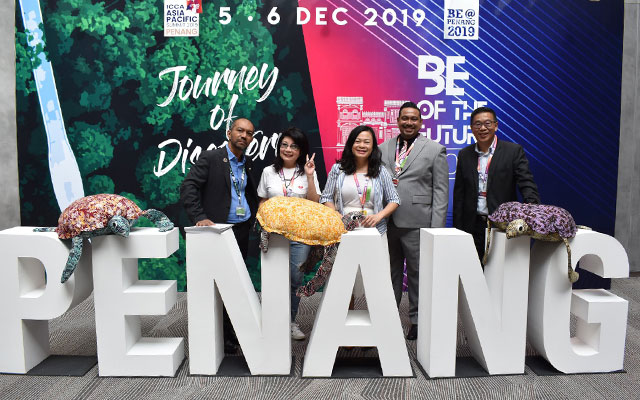
Once said to be too European, the International Congress and Convention Association’s (ICCA) largest global chapter is now in Asia-Pacific, with the region making up 25 per cent of the 1,100-strong worldwide membership pool.
During the opening address at the inaugural ICCA Asia Pacific Summit 2019 in Penang on December 5, Jason Yeh, a member of ICCA Board of Directors and chair of the Asia Pacific Chapter, described his chapter as “a big Asia-Pacific tribe”.
Since the birth of ICCA Asia Pacific Chapter in 1995 with 97 members, there are now 291 members from across 16 countries and territories. According to Yeh, numbers are climbing steadily.
To take the ICCA Asia Pacific Chapter forward, the Summit created two sessions for members to discuss how they could work together to leverage their expertise and diversity for business opportunities; how they had benefitted from their membership; and what else they hoped the larger association, as well as the local chapter could do to remain relevant and strong.
Members identified rich networking opportunities, access to meetings experts and congress database, and business development among the many benefits they have enjoyed through their ICCA membership.
At the same time, members have also expressed strong desire to see various structural improvements, such as the creation of a multi-tier membership to suit different industry segments, the appointment of multiple directors to support the large and diverse Asia-Pacific region, and an end to chapters working in silo.
Another popular request was the launch of an ICCA-driven congress management education programme built with regional professionals in mind.
Speaking to TTGmice on the sidelines, Noor Ahmad Hamid, ICCA’s regional director Asia Pacific, said: “With this Summit, a new president, a new CEO and 80 per cent of new faces on the Board, ICCA has a huge opportunity to start new things. The two sessions have given us a long list of things our Asia-Pacific members want. We will have to go back and look very carefully into what we can make happen.”
When asked which items on the wishlist were mostly likely to be fulfilled, Noor said: “Greater collaboration among members, enhancements to our future summit to provide the networking and business development opportunities our members seek, and education.”
Noor revealed that a Board working group has been formed to look into developing an ICCA-led certification programme.
“ICCA has been running many training seminars and workshops, but they are not certification or accreditation programmes. The Board working group is seriously considering the possibility of creating a certification programme, but this isn’t so easily done because we need to create a complete module, identify trainers and then train them so they are ready to teach the programme,” he said.
“ICCA was never an organisation that sells education. Our forte is our database and intelligence but if education is in demand, we will look into it,” he added.
As creating a certification or accreditation programme “is a complex process”, Noor was unable to offer a timeline as to when it would materialise.













Two of South-east Asia’s strongest markets for corporate meetings and incentives are said to have potential for further growth, provided the region’s events service providers are able to identify trends and capitalise on them, according to two market opinion leaders who spoke at the fourth BE@Penang conference organised by the Penang Convention & Exhibition Bureau (PCEB).
Speaking during the session titled, Market Digest: Insight & Trends, last Thursday, Prashant Yadav, CEO of Liberty International India, shared that South-east Asia was a natural favourite among Indian event organisers because it is a medium-haul destination. However, to keep them coming, regional CVBs and inbound events agents must be more creative in marketing their destinations.
One of the misconceptions about Indian MICE groups that must go was the belief that Indians want only Indian cuisine while on their travels.
Prashant said: “There is a growing number of Indians who are willing to try local food when overseas.”
Further illustrating his point, he said 15 per cent of his corporate clients today avoided “Indian food of any kind” when overseas, and he predicted this number to grow to become 40 to 50 per cent within the next decade.
Prashant added that while Indian clients have done their events at major South-east Asian cities, most were willing to return to the destination if inbound specialists could offer memorable experiences that cannot be found themselves.
He also tipped the audience off to a growing desire among Indian corporates for “interactive and participatory” corporate social responsibility (CSR) programmes.
As for the UK market, Ross Barker, commercial director of the meetings portfolio for Northstar Travel Media UK, shared that event organisers in Asia to seriously look at digital protection and hire the services of pedigree technology providers with a reliable track record to support events. He explained that corporate groups from the UK pay particular attention to digital breaches and delegate data protection.
In addition, he emphasised a growing trend in the UK for personalisation of events for a multi-generational audience. Such events has to allow human connections and cultural enrichment for attendees in destinations they visit.
Sustainable meeting venues are also no longer trendy, but a necessity for UK event owners.
Against a backdrop of Brexit uncertainty, Barker said longhaul travel for UK meeting and incentive groups have remained buoyant. Referencing the Meetings & Incentive Travel 2016 & 2018 Trends & Spends report, he pointed out that the number of business events groups and participants to longhaul destinations from the UK had increased in 2018 against 2016. The report found 574 business events groups in 2018 with a total of 57,849 participants, compared with 247 groups with 22,239 participants in 2016.
Average group size in 2018 was 101 delegates compared with 90 in 2016 while the length of stay over both periods remained at three nights.
The Meetings Show 2019 survey further revealed that over 36 per cent of UK buyers identified South-east Asia, namely Indonesia, Malaysia, the Philippines, Singapore and Thailand as future destinations for their meetings, events and incentives. Meanwhile, 55 per cent of those surveyed said they were planning events in longhaul destinations over the next 12 months.