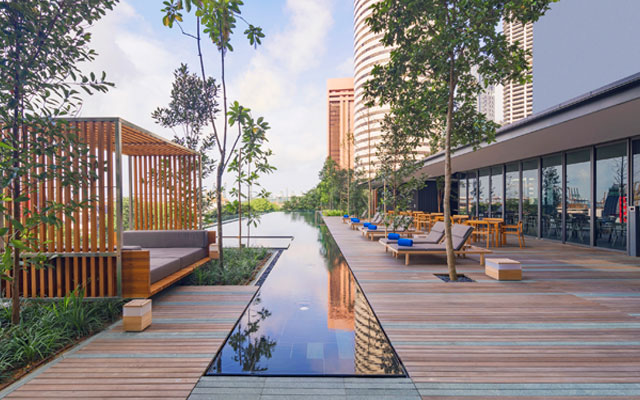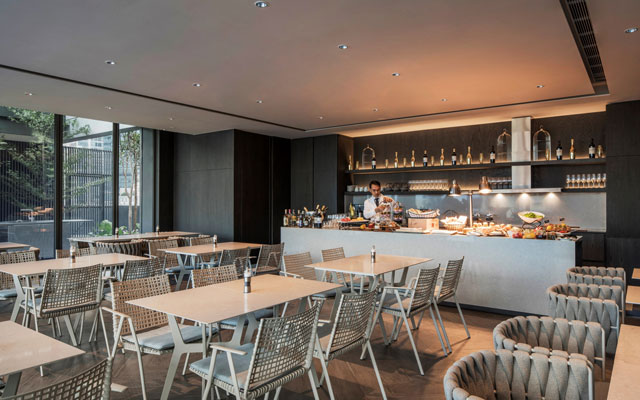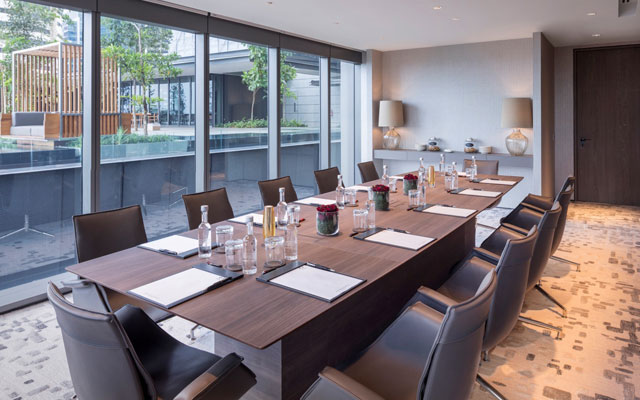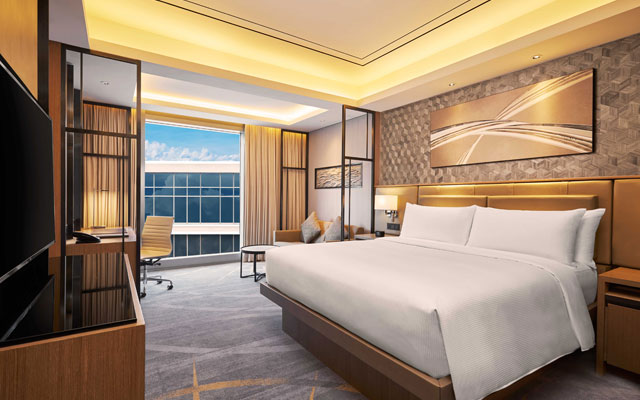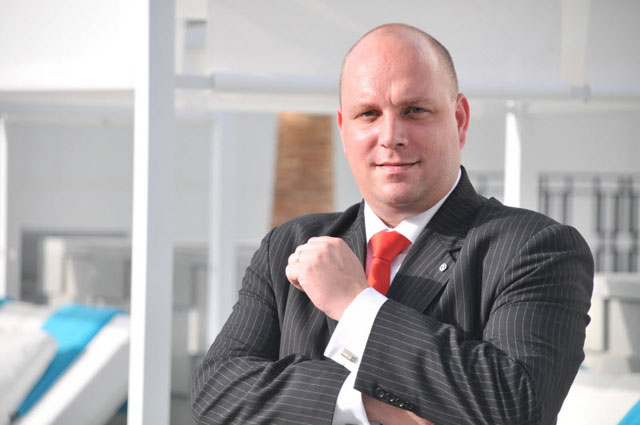
Onyx Hospitality Group has appointed Sukamal Mondal as general manager of Shama Lakeview Asoke Bangkok.
An Onyx veteran with 12 years of service in China and Thailand, Sukamal was most recently general manager at Oriental Residence Bangkok. Prior to that, he headed Shama Sukhumvit Bangkok as general manager.
Trump’s presidency may have put Trump Hotels’ overseas expansion on hold, but the wheels for business growth are well in motion.
The group is readying for its Asian debut with two openings in Indonesia in the coming months, and there are plans afoot to target more of the business events and incentive segments.
The brand has two confirmed openings in Indonesia; Trump International Hotel Washington DC pictured
“About four years ago, the goal was to have 30 Trump hotels (up from the current 11) by 2020. But with Trump’s presidency, the choice was made to not do any more developments outside the US to make sure there is no conflict of interest.
“If a Trump hotel opens in Shanghai for example, people will wonder if it is for some (non-business) reason. The decision was a sacrifice, but also a safe play,” Andy Conklin, vice president of sales at Trump Hotels, told TTGmice during ILTM Asia Pacific.
Against this backdrop, several segments are coming into greater focus as growth drivers – Asian travellers, business event and incentive groups, as well as three- and four-star tiers with plans to launch two new brands, American Idea and Scion.
“All of Asia has grown in the last two years. We first saw big growth on a small number, and now (there is) big growth on a much bigger number,” Conklin observed.
Deals for Trump Hotels’ first two Asian properties, signed before Trump’s presidency and expected to materialise soon in Indonesia’s Lido and Bali, are hence seen as milestones in the group’s strategy to build brand recognition among Asian travellers and attract them to its hotels around the world, said Conklin.
Following the announcement of a resort and residential development overlooking the south-west coast of Bali, the group has announced another partnership with Indonesia’s MNC Group, a rebrand of the existing Lido Lakes, for a property 65km south of Jakarta.
MNC Group president and CEO Bapak Hary Tanoesoedibjo shared in a press statement: “The area will be a 3,000ha integrated lifestyle resort destination, heralded by the completion of the Bogor-Sukabumi toll road – also developed by MNC Group – which will provide guests an opportunity to escape to this new destination.”
Trump Hotels will be involved in phase one of the 700ha Lido development which will include a six-star luxury resort, 18-hole Ernie Els championship golf course, Lifestyle Country Club, spa as well as a high-end residential products.
Business events and incentive groups make up another key growth segment, as Conklin said that “as a brand we are evolving more into a MICE and groups brand (compared to) four years ago”.
Conklin said recent developments, including the ones in Indonesia, are reflecting that ambition. Trump International Hotel Waikiki, the Trump hotel that traditionally sees the largest number of Asian guests, has just one meeting room, and Trump hotels in Las Vegas and New York are also more leisure-focused. In contrast, the group’s more recent openings have gone big on corporate-friendly facilities.
Conklin elaborated: “We spent US$250 million on four golf courses in Miami, where there’s over 1.1ha of meeting space. Our conversion project in Washington DC (only 1.5 years old) features 3,530m2 of meeting space, and the largest ballroom in the luxury set in DC. Our latest hotel, the year-oldTrump International Hotel & Tower, Vancouver, is a small hotel with just 147 rooms, yet features 1,394m2 of meeting space.”
With awareness of these offerings still lacking, Conklin is now at “the many opportunities to educate everyone” stage.
To drive interest, the group is planning to enhance its Trump Card programme to extend rewards beyond “transient guests” to individuals travelling in groups, be it for leisure or business. There are also plans to roll out planner privileges, which rewards planners with free stays at participating hotels.
Delegates were welcomed to this year's This Is Gold Coast Business Exchange with a food fiesta at Miami Marketta. Photo credit: Adelaine Ng
Destination Gold Coast has successfully concluded its largest ever business showcase event, This is Gold Coast Business Exchange (TIGCBE), and plans to include more international buyers next year.
A record number of participants attended the three-day event which ended on Saturday, profiling 40 venues and suppliers to 68 hosted buyers from Australia, New Zealand and South-east Asia.
Delegates were welcomed to this year’s This Is Gold Coast Business Exchange with a food fiesta at Miami Marketta. Photo credit: Adelaine Ng
“This was our most successful programme yet,” said Anna Case, director of Gold Coast Business Events (GCBE). “Our hosted buyers embraced this fast-paced programme with energy and enthusiasm and all left with a huge smile and great memories of their Gold Coast experience.”
GCBE estimates that leads generated from TIGCBE 2018 will amount to A$19.5 million (US$14.9 million) in economic impact.
But Case said her team has also become more selective with the hosted buyers they invite for the annual showcase.
“(This year) we had 100 registrations and we’ve been very stringent with running them through a qualification policy as we have a responsibility to our clients. We’ve turned away many applicants,” she said.
This year’s event also marks the first time buyers have been hosted from Asia since the first event in 2014.
“In the first year we had a few clients from China and it had its challenges,” shared Case. “We weren’t equipped because we were trying to run a mainstream programme that was designed for the domestic market. So we went into recovery mode… and this time we’re a little bit smarter and have some fantastic clients from Singapore (with a programme) designed just for them”.
Case hopes to host more buyers from South-east Asia next year, as well as making the programme more “China-ready” for hosted buyers from China.
The New Zealand government has allowed business events of no more than a 100 to start; Auckland skyline pictured
The industry association for New Zealand’s business events sector, Conventions and Incentives New Zealand (CINZ) is seeking the removal of the GST disadvantage New Zealand-based international conferences face, as compared to other global destinations.
Speaking to a group of industry stakeholders, leaders and media at the annual business events showcase MEETINGS 2018 in Auckland, CINZ chief executive Sue Sullivan shared that discussions with Inland Revenue are ongoing.
A tax reform would bode well for the New Zealand business events sector; skyline of Auckland pictured
Currently, GST must be charged at 15 per cent on registration fees for conferences held in New Zealand, regardless of whether the conference attendees are residents or non-residents. This is putting New Zealand conferences at a GST disadvantage compared to Australia, in particular.
“This will have wider economic consequences for ‘NZ Inc’ too, if New Zealand cannot provide a workable and straightforward scheme for GST refunds to overseas businesses attending conferences in New Zealand,” she said.
“Australia now has an edge on us in a number of ways including zero-rated GST for international delegates since October 2016, state bureaux funding in various forms for conference bid support, and the recent Federal Government announcement of a A$12 million (US$9.2 billion) Bid Fund Program over three years, one of most important recently announced developments.
“We need to be looking at ways New Zealand can keep up and compete,” Sullivan pointed out.
Allan Bullot, tax partner with Deloitte has been liaising with Inland Revenue on behalf of CINZ to look at a proposed solution to the GST disadvantage.
“In 2014, changes were made to the New Zealand GST legislation that allowed non-resident businesses without New Zealand operations to claim back GST on costs incurred within New Zealand, bringing us in line with various international guidelines for the treatment of business related costs.
“While opportunities exist for non-resident businesses sending staff to New Zealand to attend conferences to technically claim GST refunds, in practice it is difficult, if not impossible, to economically recover the GST on New Zealand conference costs. The 2014 GST legislative changes have in practice not been effective for the New Zealand conference industry and the GST problem has remained.
“Amending the New Zealand GST legislation to allow zero-rating of certain services made in relation to conferences would be a solution similar to the Australian approach,” Bullot said.
International meetings are a misunderstood phenomenon.
Most people think about bed-nights and tourism-type expenditure when they think about our business. But meetings are so much more than a high-value, season-spreading segment of tourism: that’s just the tip of the iceberg.
Hidden below the surface are the impacts that really make meetings special: knowledge creation and transfer; dissemination of skills and best practice; great new friendships and serendipitous encounters; new solutions to societal or environmental issues; and of course, opportunities for inward investment, partnerships and business deals.
We’re great at measuring the cost of a US$30 breakfast get-together during a congress, but terrible at recognising the US$30 million deal that those delegates are finalising. But obviously the latter is entirely the point of the meeting, and the former is just a small by-product!
So how do we square this view with the way in which destinations showcase themselves at meetings industry trade shows like the recent IMEX in Frankfurt? Here the stands screamed out cultural and tourist-appeal messaging through their imagery and graphics. Are we all selling an outdated concept of why decision-makers choose meeting destinations?
I’m reminded of a bidding seminar I led in Japan over a decade ago, where, after two days of explaining why and how to focus on the decision-makers’ and delegates’ business and intellectual objectives, a young attendee asked: “So are you asking us to forget about the Kimono and sushi?”
She recalled the practice of presenting business gifts in Asia as a simile for bidding for an international meeting, so I suggested: “Think of your solutions to their objectives as the contents of the box; your cultural appeal is the wrapping paper. Both are important, one rational, the other emotional.”
Hopefully the stands at IMEX were filled with discussions about the goals and business needs of the events the buyers are planning, not just reiterations of the tourism appeal on display around them.
“Empty Box marketing” is our industry’s most tempting mistake.
–
Martin Sirk is the CEO of ICCA. He has extensive experience working in national and city destination marketing organisations, congress centres, and with a leading global hotel brand, and is an acknowledged expert in the design and organisation of international congresses and the trends that are shaping the future of the meetings industry.
American Express Global Business Travel (GBT) has announced that , CEO of Hogg Robinson Group (HRG), will join the GBT Board upon the completion of its acquisition of HRG.
Radcliffe was appointed CEO of HRG in 1997, and led the company’s repositioning as a focused corporate services group. He was appointed to its board in 1989, having joined the group originally in 1978. Radcliffe is also a non-executive director of Wincanton, the transport and logistics services provider, and a member of its Audit, Nominations and Remunerations Committees.
David Radcliffe
Greg O’Hara, chairman of the Board, GBT, said: “I will be delighted to welcome David to the GBT Board following the completion of GBT’s acquisition of HRG. He brings a wealth of industry experience and expertise and will play an important role as we integrate HRG, delivering continuity and helping to provide value for all stakeholders and shareholders.”
“I’m excited to be given the opportunity to join the Board of the combined group following the completion of GBT’s acquisition of HRG and to work with the best talent and technology from both organisations. The transaction will create a truly world-class company capable of delivering significant benefits to clients, colleagues and suppliers,” Radcliff said.
Globally, three in 10 business travellers are happy to sacrifice safety for hotel loyalty and rewards incentives, according to research commissioned by travel management company Carlson Wagonlit Travel.
Travellers in the Americas are likeliest to do so (39%), followed by Europeans (34%) and travellers from Asia-Pacific (28%).
“Clearly, travellers are very focused on their hotel loyalty points – they will go to great lengths to get their hands on those benefits. One way of meeting that challenge – short of tougher enforcement – is to let travellers collect points for booking within policy,” ” said David Falter, president, RoomIt by CWT.
What makes business travellers feel unsafe at hotels?
Almost one in three (30%) Asia-Pacific business travellers expressed concerns about safety at hotels, in contrast to 27% travellers from the Americas and 23% of European travellers.
When asked what makes them feel unsafe, exactly half the travellers surveyed said they worry about an intruder breaking into their hotel room. Four in 10 travellers said they worry about hotel staff inadvertently giving out their room key or information to a stranger (41%) or disruptions caused by the actions of other guests (40%). And a third of respondents identified fires (36%) and terrorist attacks (33%) as causes for concern.
What precautions do travellers take to stay safe at hotels?
As expected, the vast majority of travellers (75%) said one of the measures they take to stay safe is keeping their room door locked at all times.
“While most hotel rooms lock automatically, a number of solutions available on the market can provide an added layer of security,” said Falter. “Items such as door wedges, portable door locks and travel door alarms can help a traveller secure their room more effectively.”
More than a third of travellers surveyed (37%) said they take the room key out of key folder so people can’t link the key to the room. Travellers from the Americas (42%) are more likely to do this than those from other regions.
Another tactic is to put the “do not disturb” sign on the door when they leave the room – one adopted by 30% of travellers globally and 35% in Asia Pacific.
Travellers also believe that the floor they stay on can impact their safety and security. Almost a quarter of those surveyed (23%) said they opt for a higher floor when possible, while 15% choose a lower flower. Around two in 10 travellers (21%) said they avoid staying on the ground floor.
“Security experts typically advise staying between the third and sixth floors, where it becomes difficult for an intruder to break in, but you’re still within the reach of most fire departments’ ladders,” added Falter.
Lufthansa Group Airlines has appointed Alain Chisari as vice president sales in Asia Pacific, with effect from September 2018.
Based in Singapore, he will be managing and directing sales activities of the Lufthansa Group Airlines (Lufthansa German Airlines, SWISS and Austrian Airlines) and also Brussels Airlines, in the Asia Pacific region.
The Swiss has held several key positions in the airline industry over the last 20 years.
He previously served as chief commercial officer and management board member at Edelweiss Air, the sister company of Swiss International Air Lines, and prior to that he was head of external relations & alliances and head of leisure sales Switzerland at SWISS.
He also held various positions with Delta Air Lines in Germany, Austria, South Africa and the UK after he had worked in corporate sales functions at British Airways and American Airlines.
Evason Hua Hin in Thailand has appointed Edmond Kwan Che Hang to the role of executive chef.
He will oversee all dining facilities of the resort as it continues to innovate and enhance its menus, intertwining the ethos and philosophy of Blue Lotus, Asia’s premier plant-based learning centre which is located at Evason Hua Hin.
Kwan joins Evason Hua Hin from his previous role at Fusion Resort Phu Quoc, in Vietnam. Prior to that, he spent four years at Kamalaya Koh Samui where he was the executive chef of spa cuisine, specialising in detox and health foods.
The resort will draw upon his more than 20 years of experience across hotels including JW Marriott Hotel Hong Kong, The Ritz-Carlton, Hong Kong, The Westin Resort Macau, and Bandara Resort and Spa Koh Samui.
Launceston in Tasmania, Australia, has welcomed a new hotel Peppers Silo, the first such development in the city since 2010.
The redeveloped site – from unused grain silos in Kings Wharf – along River Tamar is now a 10-storey hotel featuring 108 guestrooms, including 52 inside the barrels of the former silos, which includes one- and two-bedroom apartments.
Gorge River Room
Amenities at Peppers Silo includes a fully-equipped gym, day spa, child-minding facilities, hairdressing salon, and a restaurant and bar called Grain of the Silos. There are also conference facilities for up to 500 people, as well as private dining rooms available.
A polished urban retreat designed for business travellers, Hyatt Regency Kuala Lumpur at KL Midtown combines thoughtful design, seamless service, and exceptional facilities.
The five-star property excels in backing its expansive facilities with seamless service and personalised attention, setting the benchmark for luxury in Bangkok.