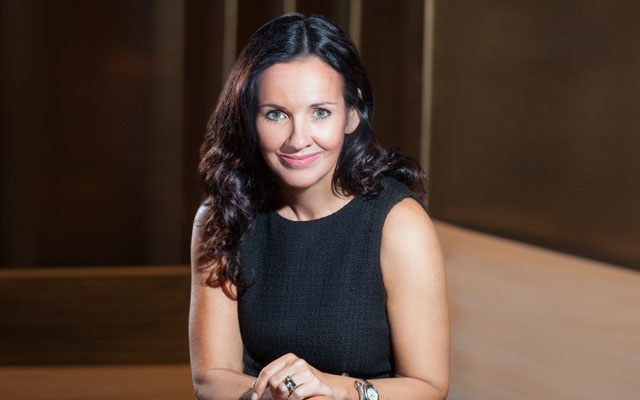
Melbourne Convention and Exhibition Centre (MCEC) has appointed Celeste Johnston as director of information technology, a newly-created role within the organisation.
Johnston will start in her new position on August 6, 2018.
She joins MCEC from AGL where she was head of digital technology quality assurance, digital transformation capability leader. Johnston also has extensive experience in digital transformation, where she ensures technology delivers business value, and has led large, complex digital delivery services.
Prior to joining AGL, Johnston was head of quality assurance, project governance and release management at Latitude Financial/GE Capital. She has also held a number of senior positions with organisations including Credit Suisse, Telstra and Coles Myer.
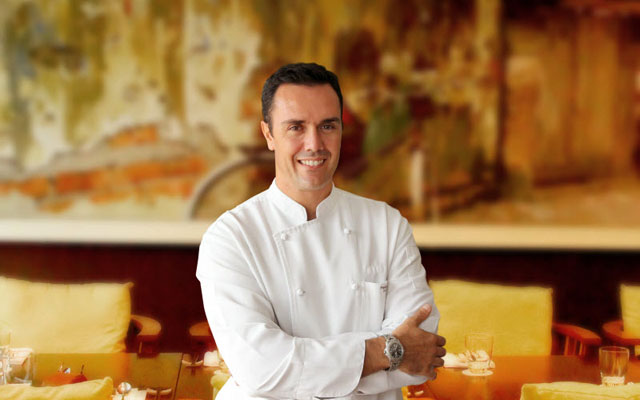
Hyatt Regency Bangkok Sukhumvit has appointed Frederik Farina as its executive chef and director of F&B.
He assumed both roles last month at the first Hyatt Regency in the Thai capital, which is scheduled to open later this year. In his new position, he will oversee all culinary attractions at Hyatt Regency Bangkok Sukhumvit.
Prior to his transfer, the Sicillian spent most of the last seven years in similar roles at Hyatt Regency Danang in Vietnam. He previously started with Hyatt Hotels in 2005, when he first worked at Grand Hyatt Erawan Bangkok for almost 10 years.
Farina started in 1999 as a cook helper at Jonico Restaurant in his hometown of Siracusa, Italy, before taking on culinary positions at renowned restaurants in Milan and Miami.
Ngurah Rai International Airport’s parking stands are in the process of being increased
Bali is gearing up to welcome the Annual Meetings of the International Monetary Fund and the World Bank, happening later this year, by improving various infrastructure and amenities.
The meeting from October 8 to 14 will be the biggest event to ever take place on the island with 15,000 delegates from 168 countries.
Ngurah Rai International Airport’s parking stands are in the process of being increased
A total of 1,200 meetings will take place in 89 venues across two convention centres and hotels. As well, 4,600 hotel rooms in Nusa Dua have been booked to accommodate delegates.
In addition, state-owned airport operator Angkasa Pura I, which manages Ngurah Rai International Airport, is expanding the airport’s apron to allow 11 additional parking stands, bringing the available slots up to a total 63 aircraft. This development is currently underway and is expected be ready in time for the meeting.
Improvements are also being made to the regency’s infrastructure. The 712m-long Ngurah Rai Underpass – set to be ready in August – will reduce traffic congestion around the Ngurah Rai Statue roundabout by 50 per cent.
Badung Regency stretches from southern Nusa Dua, Uluwatu and Jimbaran to Seminyak and Canggu along the west coast, up to Mengwi and Plaga in the northern part of the territory.
The regency is in the midst of developing itself into a ‘smart city’. A project, which involves the installation of 385 CCTV cameras in 986 locations across the regency, as well as a Wi-Fi network, is scheduled to be completed by October.
Addressing the media at the Bali and Beyond Travel Fair 2018 held in Bali last week, I Made Badra, Badung Regency’s head of tourism, said: “The CCTV cameras are placed at tourist attractions and other strategic locations to provide safety and security for travellers and the community alike. The Wi-Fi network will be available across the regency free of charge to (enable tourists to stay connected).”
These, according to Badra, will not only be available during the conference period but will become part of the service the regency provides to both locals and travellers.
Meanwhile to make it easier for delegates to move around, the regional government has provided 20-seat buses, and put in place a traffic central system. In addition, some 9,000 members of police force and pecalang (Balinese traditional guards) will be on duty during the event.
The Asian tech startup community is thriving on the back of numerous business events, highlighting Singapore as the go-to destination for startup capital and accelerating the pace of Singapore’s tech scene.
At the e27-organised event Echelon Asia Summit 2018 last week, more than 8,000 participants paid for entry to the event featuring 250 exhibitors, with participants from 15 countries such as Cambodia, South Korea and Kazakhstan.
Finology’s Jared Lim (right) and his colleague at the Echelon Asia Summit. Photo credit: Ruth Chen
Regional participation was significant with many startups pitching their successes to investors for capital.
Jala spokesman Syauqy Aziz said the company is looking at gaining more investments since its first US$25,000 seed money from Hatch Blue, a Norwegian investor. According to Syauqy, setting up an office in Singapore was part of the deal for the seed money. Jala is an aquaculture farm solution that provides online farming assistance and consultation service to help farmers increase their yields. It has presence in Java and has plans to expand to Sumatra in Indonesia, Vietnam and Thailand.
Consumer credit provider Finology founder Jared Lim said he hope to leverage on this event to set the stage for his company’s impending regional expansion into Indonesia. The Malaysia-based company attended the event to showcase its product and network with other startups.
Echelon Asia Summit 2018 also featured workshops and panel discussions on cryptocurrencies, blockchain, Internet of Things (IoT) among other topics. Several participants said that while the workshops were helpful, they benefited more from the networking opportunities at the event.
According to an angel investor who declined to be named, such events provided an opportunity to assess the scalability of startups pitching for capital.
ICCA members in Asia, reacting to last week’s sudden announcement that CEO Martin Sirk is leaving at end-July after 16 years in service, say the organisation is well run and the appointment of chief value officer Dennis Speet as acting CEO – until a permanent replacement is found – will ensure a smooth transition.
Asia, with 259 members out of a total of 1,100 worldwide, represents ICCA’s biggest region, with China, Japan and Australia taking the top three spots with 57, 36 and 32 members respectively.
From left: Martin Sirk and Dennis Speet
In a press statement the ICCA board said it would be “working with new leadership to drive the association forward over the coming decade, and to identify and implement new business models that will future-proof ICCA in what is certain to be a dynamic and hyper-competitive environment”.
ICCA will appoint a new CEO as soon as possible and has engaged an international recruitment firm to assist with the selection and evaluation process, the statement added.
Alicia Yao, a founding member of the ICCA China Chapter, is optimistic a permanent CEO would be announced by the time the 57th ICCA Congress in Dubai takes place in November.
Yao commented that ICCA is a “stable” association and leadership change is part and parcel of the renewal and rejuvenation process.
“Asia is safe and the economy is doing well, good reasons for ICCA to continue to focus on Asia and grow its members who value the marketing, training and database services it provides,” she observed.
Nancy Tan, managing director of Singapore-based PCO Ace:Daytons Direct (International), added: “ICCA is well run and the association has the right people in place to ensure nothing is affected.”
Meanwhile, Noor Ahmad Hamid, ICCA regional director Asia-Pacific, said the new ICCA CRM platform was rolled out in early-June to better capture and integrate information and to consolidate its tracking and servicing of its membership. It was one of the initiatives driven by Speet, who was formerly ICCA’s director of sales and marketing before he was promoted, to add value to members.
The 59th ICCA Congress returns to Asia in 2020 and will be held in Kaohsiung.
Sydney has won the bid to host the US-based Million Dollar Round Table’s (MDRT) inaugural Global Conference in September next year.
The 2019 MDRT Global Conference Sydney will see some 8,000 of the world’s top earning professionals in the sector join their Australian peers to exchange insights, share innovative practices and collaborate with the best in their profession.
Sydney wins inaugural elite financial meet
Previous speakers include Bill McDermott, CEO of SAP, one of the world’s leading business software companies; and motivational speakers Bill Gates and Amanda Gore.
With MDRT membership taking in 500 companies in 72 countries, 98 per cent of the delegates are expected to be international, generating in excess of A$19 million (US$14 million) to the local economy.
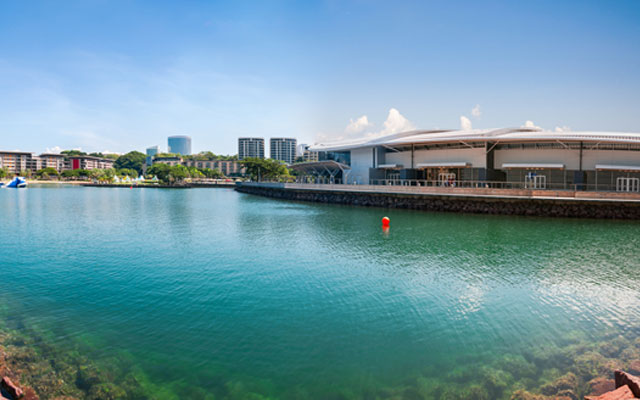
Darwin Convention Centre in the Northern Territory
KPMG is set to develop the first long-term business events strategy for the Northern Territory (NT) in Australia, where the NT government’s A$103 million (US$76 million) Turbocharging Tourism stimulus package includes A$2.33 million to support business event bids.
“Business events in the Territory deliver significant economic benefits and create local jobs – that’s why we are seriously targeting this area,” said minister for tourism and culture, Lauren Moss, in a statement.
Darwin Convention Centre in the Northern Territory pictured
“Securing just one additional 500-delegate business event for the Territory can deliver over A$2 million in incremental visitor spend; demonstrating the value of this sector.”
Moss added this is the first-ever long-term business events strategy for the state, and it will guide the development of NT’s business events sector through to 2030, and articulate a shared vision and framework for the sustainable economic growth of business events in the state.
KPMG will undertake a comprehensive industry consultation process and has partnered with business events specialist Michael Cannon to best realise and pinpoint opportunities and challenges for the NT business events industry and how to maximise its growth.
The report is expected to be delivered by October 2018.
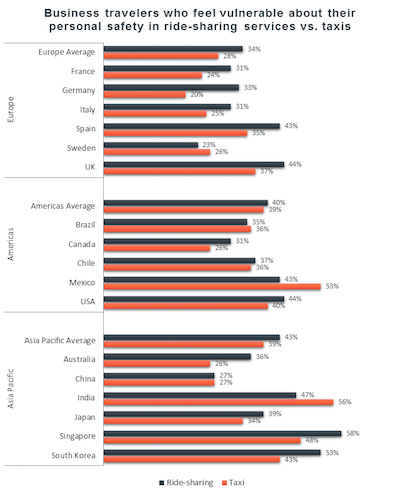
Business travellers around the world feel marginally safer in taxis than in ride-sharing services, according to research commissioned by global travel management company Carlson Wagonlit Travel (CWT).
Around two in five (39%) business travellers surveyed said they feel somewhat or very vulnerable about their personal safety in ride-sharing services, compared with 36% for taxis.
Business travellers more worried by ride sharing than taxis
Business travellers from Asia Pacific are the most concerned overall: 43% feel worried using ride-sharing services and 39% when taking a taxi. In the Americas, the numbers are 40% and 39% respectively, and in Europe 34% and 28%.
“In cities across the globe, using ride-sharing services has become a way of life,” said Bindu Bhatia, managing director, Asia Pacific, CWT. “The familiar and convenient experience they provide has made them a preferred mode of transport for many business travellers. Still, one continues to hear about safety incidents surrounding ride-sharing services around the world, which might explain in part why some travellers are worried about using them.”
Female business travellers in Europe and Asia Pacific are more likely to feel nervous about personal safety in ride-sharing services or taxis than men.
Looking at ride-sharing, 56% of Asia Pacific women feel very/somewhat nervous versus 38% of men. For taxis, that is 48% and 35% respectively. In Europe, the differences are less pronounced. For ride-sharing, the numbers are 38% for females versus 31% for males. For taxis, it is 36% versus 22%. In the Americas, there is no statistical difference between genders.
Even though ride-sharing is associated with the younger generation, the findings show that these travellers are more concerned about personal safety. Millennials, in all regions, are the most worried, followed by gen X travellers and baby boomers.
In Asia Pacific, half of the millennial travellers are very/somewhat concerned when using a ride-share service, followed by 44% of gen X and 35% of boomers. In the Americas, the percentages are 47% for millennials, 42% for gen X and 29% for boomers. In Europe, the numbers drop to 44%, 34% and 21%, respectively.
These differences might be down to gender. According to the research, gender differences appear to track the differences seen between generations. This may be because males are more likely to travel for business the older they get, but the opposite is true of female business travellers. The younger women are, the more likely they are to travel for business.
The sharing economy presents both opportunities and challenges for corporate travel programmes. In some cities ride-sharing services can be considerably cheaper than taxis or car rental services, while also providing greater convenience to travellers. On the other hand, traveller safety and the legality of these services in various markets remain important concerns. As a result, corporate travel policies around the sharing economy can vary widely from one company to the next.
“Ride-sharing services may be right for some corporate travel programmes but not for others,” said Bhatia. “Whether the sharing economy is a good fit for a company will depend on their company culture, their traveller demographics and their risk management policies, among other things. Either way, companies should create travel policies that define if, when and how travellers can use these services, and communicate these clearly to their employees.”
Wharf Hotels has appointed Sandy Russell as vice president, sales & marketing.
Overseeing the hospitality management company’s division, Russell will spearhead revenue optimisation and distribution initiatives alongside global sales and marketing to strategically build the group’s sales and marketing efforts internationally.
With over two decades of industry knowledge, Russell most recently held the position of vice president commercial operations Asia-Pacific at Carlson Rezidor Hotel Group, where she drove commercial strategies across the region for 116 hotels under six brands.
Mantra Samui Resort in Thailand has launched a Work | Lounge on its property, a dedicated workspace for digital nomads.
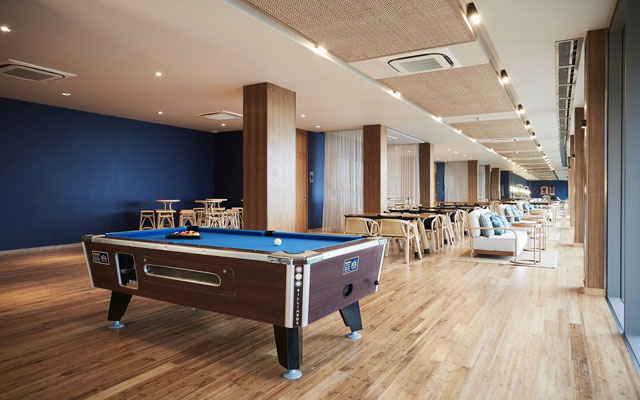
The air-conditioned space provides high-speed Wi-Fi, a guest pantry stocked with drinks and snacks, a printer, an IP telephone for free international calls, hot desks, and a blackboard. There are also sofa areas, a billiard table, TV screens, and a PlayStation to unwind. Work | Lounge is open from 09.00 to 21.00 seven days a week.
A billiard table in the lounge
Guests staying on the island for an extended period can book one of the resort’s new ‘Work | Stay | Play’ plans, with options stretching from two weeks to three months. Rates start from US$82 per night per person or US$91 for two people sharing a room, when staying a minimum of 31 days.
Non-resort guests can choose a half-day access for 300 baht (US$9) or opt for as much as a monthly pass for 12,000 baht. They can also purchase infinity pool access, an on-site gym pass and meals at the resort’s hilltop restaurant.
The resort’s latest move comes as the demand for non-fixed work environments soars in Thailand. The Bangkok Post reported last month that the market for co-working space in Thailand is increasing by 25 per cent this year. In 2012 there were only four co-working spaces nationwide. By the end of this year that figure is expected to reach 150.
Just 10 minutes from Phuket International Airport on the serene northern coast, this 178-key, Bill Bensley-designed resort offers delegates a quiet, tropical paradise steeped in Phuket’s tin-mining heritage
The newly-opened Ritz-Carlton, Bangkok anchors the One Bangkok development with cosmopolitan elegance. Featuring the city's largest ballroom and a spectacular new penthouse suite, it delivers exceptional hardware and deeply authentic, soulful service for business and leisure travellers alike
Behind the imposing, Brutalist concrete that defines Zurich’s Oerlikon district lies a surprising secret. While its exterior honours the neighbourhood’s industrial roots, stepping inside Mama Shelter reveals a vibrant, neon-soaked world that is a far cry from its rigid shell










 These differences might be down to gender. According to the research, gender differences appear to track the differences seen between generations. This may be because males are more likely to travel for business the older they get, but the opposite is true of female business travellers. The younger women are, the more likely they are to travel for business.