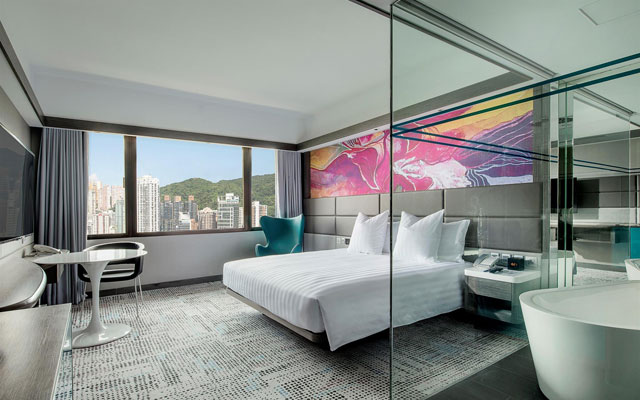
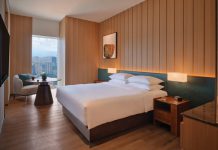
Room I stayed in a 34m2 premium deluxe executive room with an unobstructed view of Victoria Park – known as the green lung of Causeway Bay – and the harbour.
Executive room
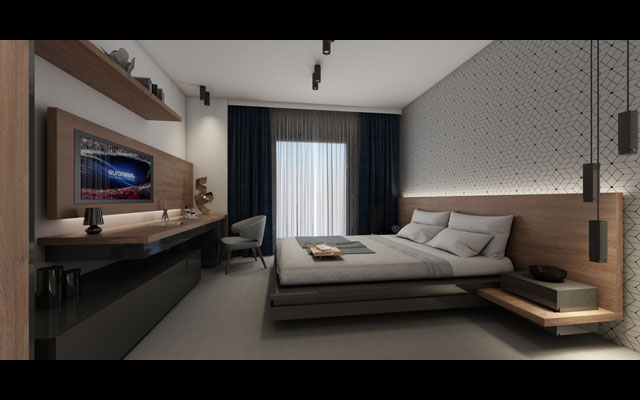
On top of an ultra-chic contemporary redesign, rooms have also been given new designer furniture that make the rooms seem more spacious. Other enhancements include boosted Internet connectivity, supply of sockets, free mobile phone usage with 4G data and Wi-Fi hotspot sharing. There is even a yoga mat included for in-room use.
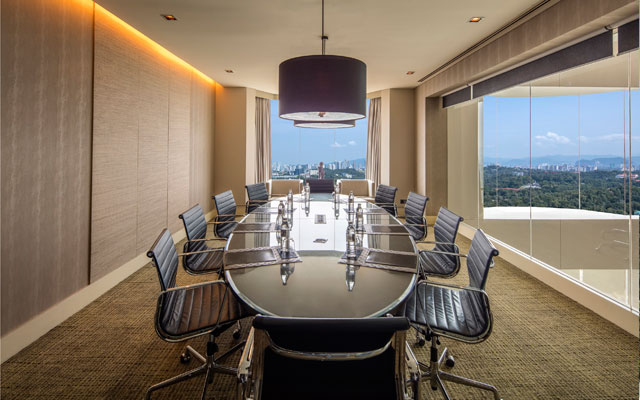
Meeting facilities A popular business events venue, the hotel provides 13 function rooms on floors 26-28. They can be partitioned into smaller units to suit different group sizes. The refurbished Park Lane Room on the 27th floor, for example, can be divided into five rooms, ranging from 52m2 to 90m2.
Meanwhile, the Harbour and Windsor rooms on the 28th floor offer a total of 213m2 and can hold 160 pax cocktail-style. I was particularly impressed by the access to an adjacent 350m2 rooftop garden from where guests can have dramatic city and harbour views. One downside is that the lift only reaches the 27th floor, which means guests must take the stairs to get to this beautiful venue.
Rooftop garden
Nevertheless, the al fresco roof garden has become a hotspot for cocktails, product launches, dinners and even weddings.
All 13 function rooms are equipped with high speed Internet access, built-in LCD projector and one-stop-shop events services.
Other facilities The hotel features three newly refurbished dining outlets – a café, lobby lounge and restaurant & bar, none of which can be booked for private functions. Other facilities include an executive lounge, a business centre and a gym.
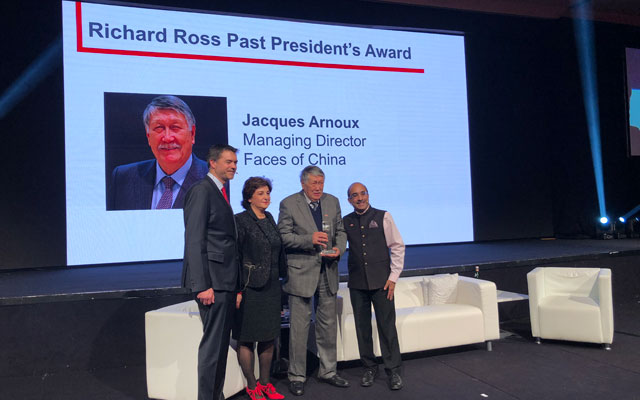
Industry veteran and icon, Jacques Arnoux of Faces of Asia, was presented with the Richard Ross Past Presidents’ Award for Outstanding Service to the Incentive Travel Industry at the SITE Global Conference in Rome this month.
Arnoux, who has been involved in the industry in Asia for the past 30 years, was recognised for embodying the ideals and impact of this award’s namesake, and for demonstrating integrity, honesty, and faith in others, with notable contributions and long-term service to the incentive travel and motivational events industry.
From left: Kevin Hinton, Annamaria Ruffini, Jacques Arnoux, Rajeev Kohli
The award, created in memory of SITE’s past president and long-time member Richard Ross, who died in the 9/11 terrorist attacks in New York City, recognises an individual or organisation that has furthered the vision, ideals and ethics of SITE.
Minor Hotels to debut Oaks brand in Lebanon
Minor Hotels will debut its Oaks brand in Lebanon in mid-2018 with the opening of the 110-key Oaks Beirut.
The property will provide modern guestrooms and suites, with facilities including an all-day dining restaurant, a Lounge Bar & café, a rooftop pool and bar, plus dedicated conference facilities.
It will be located in Sodeco, a commercial area of Beirut, approximately five minutes’ drive from the central downtown area, and 15 minutes from Beirut Rafic Hariri International Airport.
UFI strengthens Latin American presence
UFI, the Global Association of the Exhibition Industry, has opened a regional office in Bogota, Colombia.
The new office is located at Corferias venue, and will serve the growing number of UFI members across Latin America. It will also be the base for collaborations with national and region industry associations. The position of the UFI Regional Manager for Latin America will be filled by Ana Maria Arango.
Since it was established in 2014 at the UFI Global Congress in Bogota under the leadership of then UFI President Andrés López Valderrama, UFI’s Latin America Chapter has grown from 17 to more than 40 members.
New hall for Eurexpo Lyon
Eurexpo Lyon, France, is building a new 9,400m2 exhibition hall to support the growth of its leading trade fairs and shows.
Designed by the AIA Architectes agency, the new Hall 7 will give Eurexpo Lyon a total exhibition area of 140,000m2. It is managed by GL events.
For a limited time only, earn triple points per US$1 spent for new meetings and events bookings made before March 31, 2018 and completed by December 31, 2018.
The offer is valid at participating properties within the Hilton portfolio of brands across South-east Asia for new event bookings.
Further details have emerged on the Philippines’ new MICE roadmap to reclaim the destination’s place as a business events powerhouse a decade from now, through measures such as reducing the cost of doing business events and addressing other issues that hamper the sector.
A review of the country’s tax regime is on the cards to reduce the cost of doing business, said tourism undersecretary Benito Bengzon Jr., at the launch of the Philippines’ first MICE roadmap. He further noted that the common carriers tax and billings tax were removed in recent years.
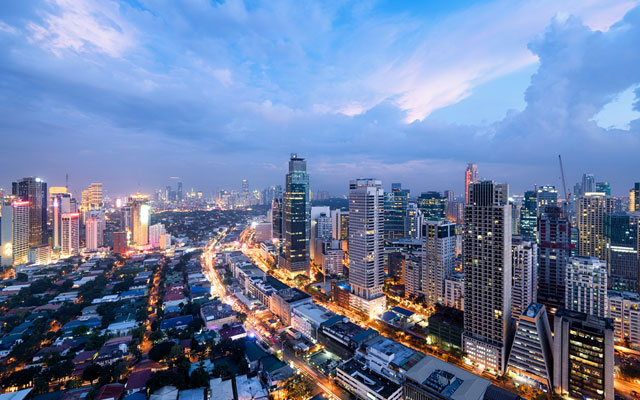
Makati, the financial center of the Philippines
The focus is on attracting business events groups from Asia – comprising 70 per cent of foreign arrivals – and the Middle East, a new market which was chosen for its potential, ability to grow and competitiveness.
When asked why the target was not the longhaul markets, Bengzon pointed out that they could not be everywhere and had to choose a focus.
“We have to have a strategic approach towards all MICE activities. We try to maintain a certain discipline for plan formulation that’s not simply a calendar of events but issues that have to be addressed,” Bengzon emphasised.
Among other issues to be tackled by a technical working group from both the government and private sectors include what kind of policy intervention was needed; what infrastructure was required; whether the support infrastructure for business groups need to be upgraded; the kind of focused advertising and marketing needed; and the data required to make informed decisions.
PACEOS (Philippine Association of Convention/Exhibition Organizers and Suppliers), which helped craft the MICE roadmap, said it will help organise the business events sector, and in turn, increase government awareness of how business events can contribute to the Philippines.
Monette Iturralde-Hamlin, who is part of PACEOS’ board of trustees, said the average spend of business events delegates was six times that of ordinary tourists, and has far-reaching effects as participants bring their families, friends and businesses into the country.
She added that the roadmap will be a big boost to Philippine business events which in the 1980s was the top conference destination in Asia and ranked eighth in the world.
Banikarim, appointed global CMO in 2015, will leave Hyatt after April
Hyatt Hotels Corporation will realign its corporate leadership team and operations to allow for faster execution of its growth strategy, announced president and CEO Mark Hoplamazian.
The key changes, expected to be completed in 2Q2018, include the formation of a new commercial services portfolio at the Executive Committee level to combine guest and customer engagement functions under a new chief commercial officer position.
Banikarim, appointed global CMO in 2015, will leave Hyatt after April
The company is also consolidating managed and franchised hotel operations and owner relations into one portfolio, reporting to Chuck Floyd, global president of operations. The legal and corporate services portfolio is also being realigned under new leadership.
“In order to achieve our growth potential and capitalise on opportunities that come from rapidly-emerging consumer, industry and competitive developments, we must be leaner and more agile,” said Hoplamazian. “This starts at the top with our leadership, and we are making changes to streamline the Executive Committee and to better enable us to maximise our core hotel business and continue our expansion into new lines of business.”
Reporting directly to Hoplamazian, the chief commercial officer will oversee a portfolio that includes global sales functions, global marketing functions, the global contact centers and information technology. The selection process for the chief commercial officer is expected to complete in the second quarter.
As a part of the organisational realignment, two executives have decided to transition out of Hyatt later this year. Global chief marketing officer Maryam Banikarim and global head of capital strategy, franchising and select service Steve Haggerty will leave Hyatt in the coming months. Their positions will be eliminated upon their departures.
Banikarim will continue to lead the marketing organisation through the end of April, and Haggerty will remain at Hyatt as a special advisor to the CEO through July focused on executing important transactions, among other things.
Margaret Egan, who has served as interim general counsel since last October, is promoted to general counsel, reporting to Hoplamazian.
The loyalty and new business platforms area led by Mark Vondrasek as well as the data, innovation and business transformation area led by Alex Zoghlin will remain in place, with both Vondrasek and Zoghlin continuing to report directly to Hoplamazian.
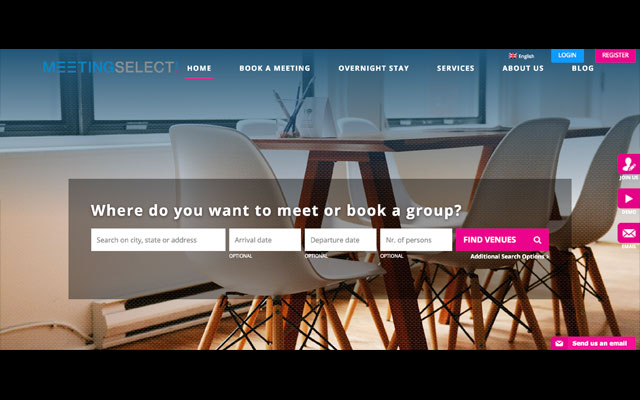
Venue booking software, Meetingselect, has become the seventh member of Event Tech Tribe, an event technology collaborative.
Established in 2007, Meetingselect is currently recognised as the world’s largest independent meetings distribution system and online venue booking tool. The Netherlands-based company will be integrating with all existing Tribe products as a part of the expanding suite of integrated solutions offered. It was recently named a one of the Top 10 Meetings Innovations of the Year.
“Our long history in the hospitality industry means we understand planner and marketer requirements innately, and love to help them solve what’s typically their first challenge, sourcing the best venue and giving them access to numerous datam duty of care solutions, meeting policies, reporting systems, loading preferred partners and many other options,” said Meetingselect’s co-founder, Judith Huisman.
Meanwhile, the Event Tech Tribe works with over 500 customers, and curate applications to join the Tribe ‘family’ to ensure the experience for planners is optimum.
“We’ve always felt that planners shouldn’t have to compromise on tech just to get systems that work well together – or navigate complex platforms to create integrations themselves. Having a world class venue booking tool like Meetingselect in our tech stack further rounds out the offer for planners wanting options outside of the old school all-in-one tools,” said founding Tribe leader, Leonora Valvo of Swoogo..
Despite a slowdown in its economic growth, China is already the biggest business travel market in the world with total spend expected to reach US$350 billion in 2017.
However, as China’s economy transitions to the new normal of single digit growth, the attitudes and priorities of key stakeholders in China’s travel ecosystem continue to evolve and adapt.
A survey of more than 100 travel managers in China by CWT Solutions Group – the consulting arm of global travel management company Carlson Wagonlit Travel (CWT) – and TTG Events found that while managing costs and driving savings still remain key priorities for travel managers in China, more attention is now also being paid to duty of care and the traveller experience.
More 52% of the travel managers surveyed identified the need to deploy fare tracking and rebooking solutions as an area of focus for their travel programmes. Significant fluctuations in airfares are making it extremely challenging to manage travel costs and budgets. Travel managers are increasingly interested in fare tracking solutions that enable them to re-book flights and hotels at lower rates if prices drop after the initial booking has been made.
At the same time, travel managers in China are also looking at ways to improve the traveller experience, with 50% of the survey respondents identifying the need to better manage travel-related stress and improve traveller well-being as a key priority.
The third-most common priority is to streamline expense management processes, with 49% of survey respondents saying they would be looking for ways to achieve this over the next year. As travel spend increases in China and transactions get more frequent and complex, companies in the market will need to adopt new tools and processes such as travel and expense consolidators, and follow a strategic sourcing approach to manage expenses efficiently for air, hotel and ground travel.
At the same time, travel managers in China continue to keep a close eye on economic and geopolitical developments globally, as they see these trends having the greatest impact on their corporate travel programmes.
With lingering concerns and uncertainty over the health of the global economy, it is of little surprise that 55% of the respondents said they expect this will have a considerable impact on their travel programmes in the coming months. At the time of this survey, many travel managers expressed concerns of freezes and budget cuts being imposed on corporate travel. The weak global economy also may result in stiffer supplier management, cost controls and savings goals.
Interestingly, social media is also seen as major area of change in business travel in China, with 54% of travel managers in the survey listing this as a key trend.
More than half the travel managers in the survey (51%) also said that political developments will continue to impact their travel programmes, keeping in view the increasing regulations and control on travel to the US, as well as China’s own diplomatic relations with its key economic partners, and how this might influence issues such as visa application, air travel and freedom of movement.
Lastly, bleisure has been widely discussed in the corporate travel landscape in recent times. While this trend is more commonplace in Western countries, the trend is much less visible in Asia, especially in markets such as China where traveling for work is perceived as a privilege extended by employers, and not to be ‘taken advantage’ of by employees.
However, a key finding in our survey came as a surprise – more than half of the respondents (57%) said their companies allowed for, and in some cases even supported or encouraged, bleisure.
The full report and analysis will be discussed at an education session during CTW China 2018 in Shanghai this March. Please visit http://www.corporatetravelworld.com/china/ for the latest programme.
Play-Doh was developed in 1933. The product was supposed to help clean dirty wallpapers, and 20 years later Joe McVicker discovered that the formula of flour, water, and salt could be used as workable modelling clay. Finally, it was put on sale for kids in 1956.
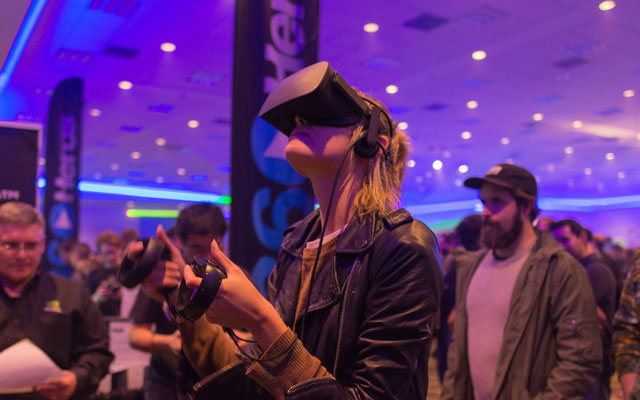
Virtual Reality in events may go through its own Play-Doh phases right now. There are plenty of useful applications of VR during events (e.g. interactive product configuration and displays in exhibitions), but the system development and hardware cost to create truly immersive experiences appear to be only justified for media assets that can be used long-term.
Think of VR as a tool that can improve current event experience
Those types of assets are traditionally developed not from event organisations but from advertising agencies or in-house marketing teams. VR in the current concept of event management might be just cleaning the dirty wallpapers.
On the other hand, it appears rather boring to think of VR only as a tool for the current event ecosystem. It might be significantly more interesting not to look from the position where we currently are to the future but look from the future back to where we are. From this perspective, VR will close some interesting gaps. As a matter of fact, VR appears to create opportunities that redefine the current event execution framework.
Here are two examples:
Flexible collaboration spaces: Conferences have become a creative space for discussions and collaboration on issues and solutions. The event setup permits not just the temporary teamwork of a unique group of experts but, very importantly, it has also become an accepted workspace and test-bed for new ideas and experiments.
VR now gives the participants a significantly more powerful canvas to try, simulate, and fail, and try, simulate, and fail, and try again. Imagine a Slack-&-TED online, in which you can significantly increase the reach and participation of global experts on a specific subject, even if they just step out from their lab for an hour. An environment in which exceptional thinkers can simply work on a topic multiple times even if it breaks. Could VR maybe create a space of unique collaboration as a subsequent next step of current conferences?
Imaging a sophisticated virtual environment of exhibitors, product experiences, social experiences, moderated discussions, experiments and other content that is dynamically generated and morphing to participants’ interactions and preferences. Already today you can join a circle of friends to experience virtual environment jointly (unfortunately those environments are still very basic). Once all currently existing technologies are combined, an event may not require any space at all. Existing revenue streams from hybrid events solidify and entirely self-driven virtual conferences may crystallise new market segments.
The way we think of VR is as a tool that can improve our current event experience. We try to answer what can be done better of what we already do. In this context, the applications remain rather limited and expensive marketing gimmick that slowly loses its appeal. If we think of VR as a tool that creates an entirely new context, the technology may become our next Play-Doh blockbuster.
So what’s next? How do you get involved?
Create 360-degree immersive VR channels into your events: Upstream from a well-positioned 360-degree camera into a private live-stream channel (e.g. YouTube). Test different headset experiences internally and how remote participants can contribute to and benefit from your programme.
Foster remote (onsite and offsite) contributions before, during and after the event: Provide infrastructure for contributions (e.g. Audience Response Solutions) and processes to immediately engage with such contributions.
Train your facilitators and moderators to fully integrated remote ad-hoc content into your event: Train and motivate moderators to leverage online content naturally as well as how to manage technical issues.
Create prominent visibility within the venue of online collaboration spaces: Make the virtual experience look physical, potentially with large screens and monitors that display online interactions.
Motivate and moderate online-offline content integration: Set specific goals and define direct responsibilities for individuals to generate value from online-offline integration.
Provide VR based “play-stations” within event venue to experience virtual access: Create zones in which onsite participants can learn about non-physical presence.
Remain hardware-agnostic on VR headsets and development frameworks: Do not focus on specific hardware and software platforms but processes that add value to your participants, speakers, and exhibitors.
The above steps will provide safe-zones for the organiser to learn, without creating much of operational risk. Play-Doh was also not invented to be one of the most successful children modelling compounds. It started somewhere and morphed to this function. VR can start with small stepping stones which might not require VR headsets or programming. After all, the market for VR-driven events will be there, the question is only, will you still try to sell a product to clean wallpapers at that point in time?
Felix Rimbach is the regional director for research & development at Globibo, responsible for around 1,200 projects throughout Asia, Europe and North America each year. His key focus area is the marketing impact of technology solutions with special attention to learning, collaboration and communication. Rimbach is also one of the leading researchers on AI architectures, modelling and knowledge representations.
The newly-opened Ritz-Carlton, Bangkok anchors the One Bangkok development with cosmopolitan elegance. Featuring the city's largest ballroom and a spectacular new penthouse suite, it delivers exceptional hardware and deeply authentic, soulful service for business and leisure travellers alike
Behind the imposing, Brutalist concrete that defines Zurich’s Oerlikon district lies a surprising secret. While its exterior honours the neighbourhood’s industrial roots, stepping inside Mama Shelter reveals a vibrant, neon-soaked world that is a far cry from its rigid shell
A polished urban retreat designed for business travellers, Hyatt Regency Kuala Lumpur at KL Midtown combines thoughtful design, seamless service, and exceptional facilities.