What motivated Banyan Tree to pursue business events?
A lot of our hotels are developed with good event facilities but our focus has always been on the leisure business, aside from our city hotels of course. We realised that increasingly, planners are looking for venues new and different, and we started to see that we fit quite nicely into that need. We are a leisure-driven resort but there is no reason (why) we cannot translate all that into a business events environment.
Des Pugson
To a lesser degree, that decision (to court business events) is also a realistic one. Resorts’ peak days are typically Fridays and Saturdays, while Mondays to Thursdays are always a little bit soft. We could fill that gap with the right type of business events.
What types of events are you most keen on?
Meetings and incentives, but (what we want and can handle) differ by brands. Angsana is built for volume and so the meeting and banquet facilities are geared to larger groups. Think of hotels like Angsana Xi’an, which houses the brand’s largest ballroom, over 1,000m2 (720 pax banquet-style), and 400 keys. It is catered to the meetings market that has time for an offshoot activity, such as a visit to the Terracotta Army Museum.
Angsana Fuxian Lake also has an enormous ballroom (1,000-pax banquet).
On the Banyan Tree side, people used to say to me, “Oh, we can’t do meetings there”. Well, we can. We just don’t do big meetings. We take executive retreats and board meetings with 10 to 15 people. Delegates can hide away to brainstorm, which is easily done at any Banyan Tree property.
We can also build distractions into their programme if they wanted, such as CSR-type activities which are part of our Meet for Good offer. Our hotels are very active on the environmental side.
How are you communicating to corporate clients who may know your brands more for their leisure appeal?
This has become one of our key messages going forward for all our main accounts. We’ve engaged with planners and will continue to do so to build the awareness.
Will your intensified focus on events influence how future properties are built?
Our new hotels are designed to contain good meeting facilities that are in line with (current and future) market demand.
When we were designing Angsana Xi’an, I remember wondering, my god, were we designing too big a ballroom? But at the end of the day, I’m glad we did!
Its (Chinese pavilion-style) courtyard is beautiful and designed for unique banquets. The massive hot springs (part of the hotel) also provide a great incentive activity option.
Planners sometimes associate resorts with beaches. That’s no longer the case. More and more resorts, particularly in China, are in the mountains. We’re about to open a Banyan Tree in Jiuzhaigou (Sichuan), half-way up the mountainside. It is a beautiful location, and another perfect place to host high-level, do-not-disturb type of meetings.
Can we expect to see more of your brands in non-beach locations then?
We still tend to be approached more for beach resorts than for hillside or mountainside resorts. The latter have a certain appeal though, and we are starting to get more requests from planners for something that’s not by the beach.
Europe would be an interesting place for such properties, with so many hills and mountains around. We are getting closer to Europe, with Banyan Tree Tamouda Bay opening last year in Morroco, a 20-minute ferry ride from Spain. We will open Angsana Corfu (Greece) in March 2018, and a Banyan Tree in (Bodrum) Turkey in 2019.
Your brands are seen as being luxurious. With the general business outlook being conservative, is it hard to get clients onboard?
I’m a positive thinker. When you tell me the economy is bad, I’ll say as bad as it may be, there are always companies doing well. And the desire to recognise achievers in the company transcends economic limitations. As a (commericial entity) ourselves, we’ve got to hunt down that piece of business, find those customers that are doing well.
How does the AccorHotels Group alliance benefit your company?
We now have a great opportunity in business development because of AccorHotels’ worldwide network, which a company our size can never have. This will raise our brand awareness worldwide.
We can leverage on AccorHotel’s worldwide reservation system to get more visibility. Corporate accounts wanting to book hotels will see Banyan Tree brands and properties in the system.
AccorHotels’ loyalty programme is also accessible to us. Their guests can redeem stays at our properties, which opens up another market for us. The cost of developing our own loyalty programme is prohibitively high.
Is there a risk of your management style, brand identity and products being influenced by the bigger partner?
AccorHotels’ interest in Banyan Tree is because it is Banyan Tree. They want our level of hotels in their portfolio. They consider us the market leader in luxury resorts.
The hotel business is increasingly centred around a few massive, global players, so smaller players like ourselves have to tie up a relationship with a bigger partner which does not affect our brand and experience yet enable us to fly more flags around the world.
Event brief
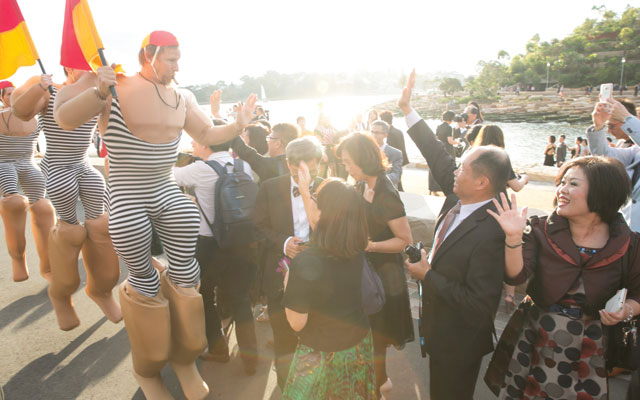
Amway Taiwan awarded 1,150 of its top achievers a five-day incentive programme to Sydney, culminating in an elaborate gala dinner at one of the city’s newest venues, the Cutaway at Barangaroo.
According to Chris Lewis, event director at Staging Connections, the event brief was fairly standard as far as gala dinners go – entertainment, processions, a toast and reveal of the following year’s destination, all within the allocated budget.
Staging Connections was awarded the contract based on two key factors – providing one point of contact from development though to event execution and its “warts and all” approach.
Lewis explained: “We look into all avenues of the concept and include things that won’t work and advise the client.”
Challenges
Staging Connections faced a number of challenges in executing the gala dinner. Being a brand new venue, the event was the first of its kind and size to be hosted at the Cutaway.
“It was a steep learning curve for all involved,” said Lewis. “There were power restrictions, limited weight loading on the floor, ceiling and rigging points, and engineering that had not been signed off. There were also massive audio delays being such a large venue.”
In addition, while guest numbers remained the same, the size of the event doubled in terms of production, projection, stage set, table styling and entertainment. While the original proposal estimated 70 performers, the final number grew to 130.
“Finding a solution for green rooms and travel distances from green rooms to back stage areas without being seen was a huge challenge. We could not fit another thing in the room,” he recalled.
“Plus we had to drive seven Classic Mustangs on and off the stage, do a loop of the room and pick up the next lot of winners for the procession. It was extremely tight.”
The final challenge was Amway Taiwan’s request for fireworks that were “bigger and better than New Year’s Eve”. Lewis said gaining approval for a pyrotechnics display is difficult at the best of times and having that in a new location made for a whole new level of complexity.
Solutions
Lewis said working closely with the Barangaroo Delivery Authority (BDA) was key to the success of the event.
“For a new, untested venue there lots of teething problems,” said Lewis. “But when they (BDA) raised concerns, they provided solutions for a work around.”
Good pre-production, detailed meetings, and allowing his team to take ownership of their roles were also essential according to Lewis.
He said the audio solution was the hardest to get around, but they were able to create walls and draping to absorb some of the sound and minimise delay.
“The set up through to the final fireworks was delivered flawlessly.”
Key takeaways
Lewis said allowing the client to get to know his team grew their trust in Staging Connections’ ability to deliver the event.
He concluded: “Trust in yourself and the team you surround yourself with and great things happen. The client sees it as well, which leads to a more than successful event.”
In what was perhaps the biggest mishap in the Oscars’ history, on February 26, movie La La Land was wrongly announced as the winner of the coveted Best Picture award instead of Moonlight. Human error, probability theory, celebrity distraction – regardless the mitigating explanation behind this mistake, the Oscars and the event organiser suffered an embarrassing hit to their reputation.
How can you avoid a similar blunder at your next event? We’ve got you covered with our top tips:
Planning
Attention to detail is key. Always take some time to check, double-check and even triple-check your work. Grab a colleague to take a second look at the project – we’re often so consumed that we may not spot errors a fresh pair of eyes can easily identify.
We always recommend having a pre-planning stage when organising events all around the world. Have procedures in place to minimise the possibility of nasty surprises.
Rehearsals
Carry out full running orders and rehearsals prior to the start of the event. This ensures that all stakeholders during the event, from your spokespeople to your event technicians, know what will happen and when.
Never assume anything and check every single detail during rehearsals. This is the time to answer any doubts and troubleshoot any possible problem.
Behaviour
When an issue does occur, event managers need to be trained in how to behave in order to maximise the best possible outcome.
They can own the moment (like Warren Beatty) or make good of it (like Jordan Horowitz who speedily and gracefully announced there was a mistake), while always remaining focused on the attendees’ experience.
Communication
When the wrong winner was announced, reports suggested that there was confusion among the backstage crew at the Oscars for over two minutes before someone decided to communicate that error. In those two minutes, three thank-you speeches were finished by the time the mistake was made known.
Keeping people informed at all times minimises time wastage and ensures everybody is clear in their roles. Technology and event management tools can play a huge role here in enabling clear and instant communication with all stakeholders.
Partners
Any event organiser will need strong partnerships with their suppliers to ensure the event runs successfully. Trust and familiarity form the bedrock of such relationships.
Having capable partners on-site will enable you to focus on your objective – to provide the best possible service to your clients and deliver an excellent event experience.
Reflection
Knowledge is power. Reflecting on the event within your team and with external stakeholders helps exchange and amass knowledge that would ultimately be useful to your team and future events.
No matter how well (or badly!) an event went, it is essential to carry out a full debrief to reflect on what worked and what could be improved.
People can learn from mistakes, while best practices during the event can be shared as a successful case study for future events.
CWT Meetings & Events, a division of Carlson Wagonlit Travel, the world’s leading business travel and meetings management companym is a global, full-service, award-winning meetings and events agency with unparalleled experience, providing innovative, effective, end-to-end strategic meetings and event management services. It has more than 1,400 event specialists worldwide, delivering more than 27,500 creative, high-quality events for customers from all industry sectors each year. Visit www.cwt-meetings-events.com for more information.
Family-run Donovans restaurant on the St Kilda foreshore has been in business for the past 21 years but it never feels old, thanks to owner Gail Donovan’s obsession with fresh, new interiors which she overhauls every six months.
With its location in a popular part of Melbourne and set against gleaming white sands and sparkling blue sea, the restaurant makes a lovely, relaxing spot for lunch during a post-conference city tour around the area.
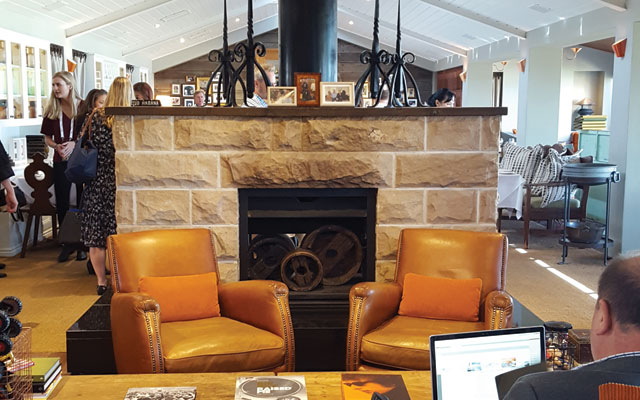
Concept Donovans restaurant feels like a beach house touched by Martha Stewart and inhabited by a loving couple that have travelled the world and collected plenty of souvenirs along the way. Furniture is large and plush, and the sandstone fireplace is enticing. The walls are adorned with happy photos of Gail and her family which includes her beloved dogs.
During my visit in February, the interior was a warm palette of orange and beige. The gents took on a baseball theme, complete with bats and baseball cards, while the ladies went all industrial with cogs and metal boxes. Gail intends to go with chocolate and navy hues for the second half of the year, and to give a new design theme to the bathrooms.
Food-wise, Donovans serves comfort food and the menu changes daily according to the freshest produce available in the market that day. However, 10 signature dishes loved by regular diners stay put on the menu. They include the old-fashioned chicken pie with mushrooms and vegetables in a milky gravy and a crispy pastry lid on top.
MICE application While full venue hire is not allowed – Gail insists on being able to welcome her regular diners always – there are two beautiful rooms set aside for private functions.
The sea-facing room with a small sandstone fireplace is the larger of the two, accommodating up to 20 guests seated. A smaller, more contemporary styled room on the other side can seat up to 12 guests. Room layout can be altered to suit the objective of the gathering. Menus can be customised.
Service Service staff are attentive and friendly, and Gail is always around to make diners feel at home. When it isn’t too busy, Gail might even take you on a private tour of the restaurant bathrooms!
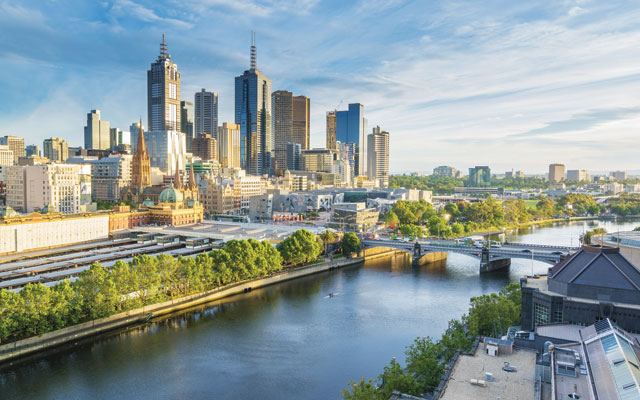
View of Melbourne skyline and Yarra River in the morning
There’s movement under the hood of the most livable city in the world.
Melbourne may be known for its expansive sights on the Great Ocean Road, the bustling Victoria Market and a lively theatre scene but the hidden gems are also coming to play to attract corporate visitors.
This can range from a quintessential Australian farm in regional Victoria to a mega international event like the Grand Prix, which surprisingly is far less well-known than the Australian Open in countries like China.
View of Melbourne skyline and Yarra River in the morning
And the key to promoting Melbourne’s offerings seems to be collaboration rather than competition. “There’s a ton of new products and hotels on board,” said Karen Bollinger, CEO of the Melbourne Convention Bureau (MCB). “What we’re doing is working with all the major events in Melbourne and figuring out how we can package them together and get them to the market with us.”
Four new hotels have opened just in the city area over the past 18 months, with about 10 more announced for the next three years, including the W and the Ritz Carlton. Also anticipated is the new Hyatt in Essendon which opens in June, next to the newly launched Australian Events Centre, located about six kilometres from Melbourne Airport.
Giving Melbourne’s business events scene extra tools to attract corporate meetings and incentive players are new attractions and services like the state-of-the-art gondola ride at Arthurs Seat overlooking a section of park and ocean views of the Mornington Peninsula and on-trend food truck precincts that will station permanently around the CBD from April this year.
As things are, the city is already doing well for corporate meetings. The Melbourne Convention and Exhibition Centre (MCEC) hosted about 690 corporate meetings last year, representing 66 per cent of their business events pie and bringing in A$12 million (US$9.12 million) in revenue.
“We are on track to have another record year,” said Anne Jamieson, MCEC’s director of customer experience. “We’re looking to do a couple more hundred corporate meetings going into the next financial year and build on that when our new expansion site opens,” she added, referring to MCEC’s A$205 million investment by the Victorian state government to expand its facilities with an opening scheduled for July 2018.
The MCB also had its most successful incentive business year on record in 2015/16, securing the greatest number of delegates for Melbourne annually but the sector appears to be slowing down.
“We’re just noticing that the very large incentive groups aren’t as actively seeking destinations as they were over the last two years,” said Bollinger, who noted the groups that had been coming seem to have halved in size, even though attendance still numbered around 5,000.
To grow the incentives sector, the MCEC is promoting its ability to host a pop-up gala event space that can accommodate 200 to 2000 guests in a highly customisable set-up called Lorem Ipsum, which has only catered to local groups for Christmas events before.
“We found out, in talking with meetings and incentive groups out of Asia that this really appeals to them as well, so we’re in the process of adapting it to be available all year round, not just at Christmas,” said Jamieson. “Asian incentive groups like to show off and make it a unique and fabulous experience. They want to enter the room and go, ‘wow, I wasn’t expecting this!’.”
Bollinger agrees that incentive groups have tailored and bespoke experiences high on their list and catering to that can pay off handsomely.
“They want bragging rights,” she said. “Last year, Amway Taiwan took a large group to Sydney but from that they had 70 people in Melbourne for the Grand Prix and they spent A$1 million, which included helicopter rides to the Great Ocean Road, an amped up bespoke experience to the GP, rides on horses and carriages and meals at some of the best restaurants in Melbourne”.
The MCB has also been reaching out to other tourism players like the Victoria Racing Club (VCR) to join them more actively in overseas trips.
The VRC hosts the annual Melbourne Cup Carnival but has more recently specialised in customised horse racing events for incentive groups which include millinery classes and workshops on how to bet on a horse. “(Our work in Asia) is only now coming to fruition,” remarked Lisa Patroni, head of international tourism for the VRC, which will welcome 200 Mary Kay delegates from China in October.
“We’re quoting a lot more in this space now than ever before, a tenfold increase over the past two years,” she added.
But smaller players are also a significant part of the mix. Green Olive at Red Hill in Victoria’s Mornington Peninsula has existed since 2002 but the picturesque farm and vineyard only recently started working with the MCB to attract corporate and incentive groups.
Owner Greg O’Donoghue’s interest in marketing to Asia has brought him to Singapore and China and resulted in his decision to open a new store in the CBD in May and the launch of a body products range.
Other attractions like specialty coffee shops and secret pop up gardens are also in the mix, ensuring that Melbourne remains the city of continual discovery for corporate groups.
The uber-hip Hotel Cappuccino opened in the chic Gangnam district in December 2015 as a lifestyle hotel appealing to millennials and creative types. Occupying 18 floors, the property adopts a décor that is industrial chic combined with primary colours and bold design strokes.
Rooms Guestrooms are out of the ordinary, with the Quad Room offering four bunk beds and lockers for clothes, making guests feel like they are in the military; Bark Rooms for dog lovers who travel with their pets and are equipped with dog beds and a selection of treats. The property is committed to social causes, with “angel” programmes supporting local charities and guests are invited to make the most of a car-sharing scheme and donate clothes that they no longer need.
The Hotel Cappuccino
MICE facilities The hotel’s 95m2 function room seats 50 people theatre-style, while two smaller meeting rooms can be used individually or combined to provide space for around 16 people.
Other facilities There is a cafe on the ground floor, a self-service laundry and a gym. The 17th-floor restaurant and bar have impressive views across the city, and the bar is stocked with a surprising number of gins.
The rooftop terrace is the crowning glory, and works well for cosy receptions for up to 150 guests. Previous users of this space include Google, Facebook, Swatch and Bulgari.
The hotel is also just three subway stops from the COEX convention and exhibitions facility.
Event brief
Catalyst Global partners – the largest international network of corporate teambuilding professionals – joined in from 42 countries on a 24-hour corporate treasure hunt, an event that is the first of its kind worldwide. Go Give, a corporate social responsibility event, saw 50 teams completing checkpoint activities including video and photo challenges that benefitted projects under Buy1GIVE1, a global business giving initiative.
The event kicked off at sunrise in Auckland, New Zealand and concluded 24 hours later in Mount Maunganui, New Zealand.
Go Give, Team building event
Challenges
Given the global scale of the event, deciding on even a date and time when each of Catalyst Global’s 42 partners could participate proved to be difficult.
“Invariably there would be one team that wouldn’t be able to attend during work hours because of an event,” said Catalyst Global’s spokesperson, Esther Daniel.
Apart from the four set checkpoint activities, unique tasks had to be created for each team in locations of their choice, with activation codes having to be distributed the night before.
A further challenge was collating videos streaming in from the different countries where the teams were located, after the event due to delays, which included the Turkey team’s cameras being confiscated by police for safety checks.
Solutions
Catalyst Global had to compromise and settle on a date that excluded three partners. The decision was also made to have the event at sunrise in the respective countries, with certain exceptions as “it was far too cold and dark in some countries to do right on sunrise, whereas in others like South Africa, sunrise was at 04.00,” explained Daniel.
Communication with each of the teams was made easier through the appointment of a ‘Go Give Go To’ person who was also responsible for watching deadlines. The team leaders coordinated activity locations, collaborated with teammates to create a task related to their country that another team would have to go through, and distributed activation codes.
Each team also appointed videographers who took charge of sending videos back to Daniel and her team of two, who collated and compiled them.
“I was so tired but the excitement and joy of watching all the videos and photos of the teams coming in kept me going. It was like an addictive online game,” said Daniel.
Key takeaways
Looking back on Go Give, Daniel said: “The benefits go beyond the joy of giving. When employees participate in an organised giving programme, there is usually a process of learning and engagement as a group.
“Appointing key people in each team enabled coordinated communication. (I’m) glad we set strict deadlines, (as) they helped us to complete the project.”.
Event: Go Give Organiser: Catalyst Global Venue: Worldwide in 42 countries Date: December 12, 2016 Number of participants: 313 participants split into 50 teams
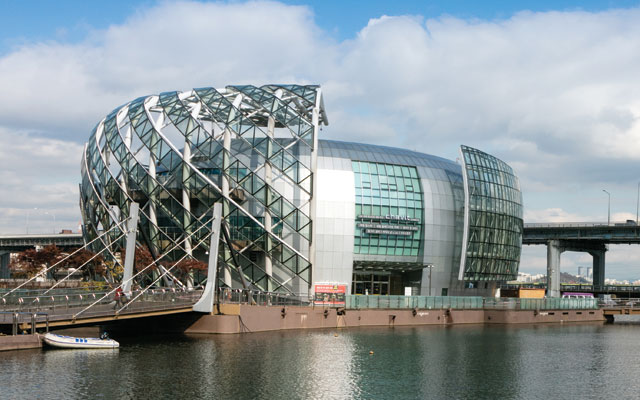
The addition of a water taxi terminus alongside the Floating Island Convention Centre lends a new dimension to getting to and from Seoul’s most eye-catching and unique event location.
Concept The convention centre occupies the lion’s share of one of three man-made islands in Seoul’s Han River, with impressive views to the east and west, particularly at sunset. Since opening in 2014, the convention centre has become a local landmark and a key component of the Han River Renaissance Project, which is designed to make the most of recreational areas along the river banks.
Floating Island Convention Centre
As well as convention facilities, the islands include an entertainment hall, a marina, restaurants, bars, shops and the floating Media Art Stage that incorporates a huge LED screen. The cutting-edge design of the centre, as well as the clever use of exterior lighting at sunset, have helped make the Floating Island Convention Centre the most quirky in the city.
MICE application Designed to host banquets, conventions, international symposiums, product launches and performances, the second floor Main Convention Hall has a capacity of 600 people. It is equipped with an under-floor lift large enough to hoist a car into the auditorium.
The domed roof can be used as a vast screen for light shows or video presentations, while the stage is backed by a window overlooking the river.
It has hosted events such as the 3rd Women Economic Forum and the local launch of Ferrari 486.
Villa de Noche European restaurant has a private balcony that is perfect for social events. Vista Pub wraps around the second floor of the venue and is ideal for events of up to 350 people. Rive Gauche is a hall for as many as 150 people.
The building is topped by a spectacular open space that is tailor-made for social parties.
There is little disguising the fact that South Korea’s travel industry has been affected by deteriorating relations between Seoul and Beijing over the deployment of the US Army’s THAAD anti-missile system in South Korea. The nation’s MICE sector, however, is determined that temporary political impasses will not hamper its long-term development and growth.
The number of Chinese incentive travellers to Seoul climbed 33 per cent in 2016 on the previous year, surpassing 123,000 arrivals. Given the state of bilateral relations, however, that figure is likely to fall significantly this year, along with Chinese attendees at meetings, conventions and exhibitions.
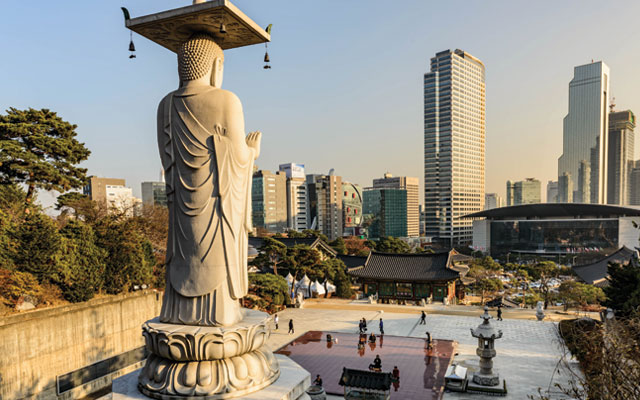
Skyline of downtown Seoul, South Korea
“Seoul jumped to third spot on UIA’s charts last year and we are working to build on that momentum for the business events sector this year,” said Park Jinhyeok, director of the Seoul Convention Bureau.
“We have just returned from a successful roadshow in Mumbai and New Delhi – coordinated together with the Korea Tourism Organization, Incheon Tourism and Gyeonggi Tourism Organization – in March, which was a first for us.
“We are also planning similar roadshows and marketing efforts in other markets, such as South-east Asia, throughout 2017,” Park added.
The Seoul Metropolitan Government has also stepped up its support for the sector, announcing in March an extra 10 billion won (US$8.74 million) in funding for 2017 and devising a five-point plan to make the capital city a more attractive business event destination.
The effort includes making more exhibitions and conventions eligible for financial support, developing a new range of promotion packages, and devising new programmes to provide delegates with hands-on experience of Korean culture, arts and entertainment.
That coincides with ambitious plans to develop the district around COEX, Seoul’s largest convention facility, and Jamsil Sports Complex into an “international exchange complex.” The city has announced that it intends to create a global MICE hub “where exhibitions, conventions, sports, entertainment and waterside cultural leisure will exist in harmony”.
Work on the project, which will include at least two hotels and a skyscraper that will be the tallest in the country and has been tentatively named the Global Business Centre, will start in 2019, with construction due to be completed in 2025.
Additional infrastructure is also coming online, with a 1.7km stretch of the Seoul Station Overpass – once a key artery through the centre of the city – reopening on May 20 as a park that is also available for event usage. Titled Seoullo 7017, the project is the first in a series designed to make the city more pedestrian-friendly.
Seoul is also experiencing a surge in the number of luxury, international hotel chains opening new properties or expanding their existing facilities.
The Signiel Seoul – the city’s first six-star hotel – occupying the 76th to 101st floors of the Lotte World Tower, opened in April to offer 235 guestrooms
In the same month, the former W Seoul Walker Hill reopened as the drastically remodeled Vista Walker Hill.
Come September, Seoul will welcome yet another high-end property by both Ambassador Hotel and AccorHotels, in the Yongsan district. A Four Points by Sheraton property will also rise in the up-market Gangnam area in November.
“I believe South Korea in general and Seoul in particular has developed into a very desirable destination for all travel sectors, but going forward I see that as being particularly applicable for the (business events) sector,” said Lubosh Barta, general manager of Four Seasons Hotel Seoul.
Barta pointed to the country’s safety, developed infrastructure and public transport system, and thriving history, cuisine, pop culture, music, shopping, fashion and design scenes as strong lures for business event groups.
The 317-room Four Seasons Hotel Seoul, located between City Hall and Gyeongbokgung Palace, is itself among the city’s newer hotels, having opened in September 2015.
Housing two ballrooms and six meeting rooms across 2,196m2 of space, the hotel targets smaller, high-end corporate groups.
Barta is not fazed by the influx of new luxury hotels in the city, and welcomes them instead. He insists that the hotel boom underlines his belief that the destination is gaining popularity, while the added competition ensures that properties be constantly innovative in their business events offerings and deliver a consistently high level of service.
Thailand Convention & Exhibition Bureau (TCEB) has recently intensified its marketing efforts, via the launch of campaigns, in China’s second- and third-tier cities.
Traditionally, TCEB’s marketing efforts were concentrated on first-tier cities such as Beijing, Shanghai and Guangzhou, but Nooch Homrossukhon, director of meeting and incentive promotion department at TCEB, said that she has seen a growing interest from other cities.
Citing examples, she said Thailand attracts direct selling companies from Shenzhen and Qingdao, and IT and finance companies from Hangzhou. As well, businesses in China, from third-tier cities including Suzhou, Xi’an, Chengdu and Nanjing, are growing tremendously and companies have travel budgets for incentives.
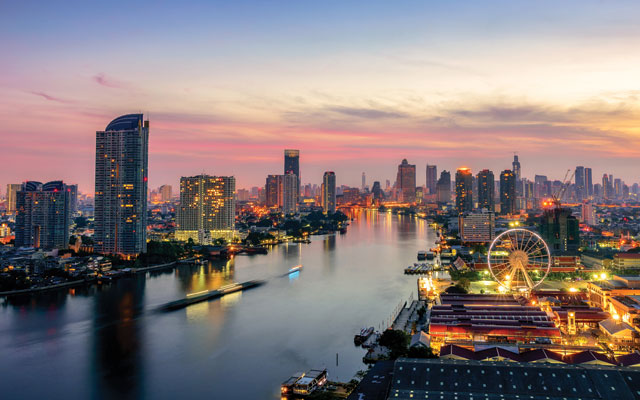
View of Bangkok business district at twilight
“Over the years, we have developed a Chinese client base and (cultivated) a good relationship with Chinese intermediaries, and this helps to bring back repeat business. (One example is) Infinitus (China) Company, a health firm focused on traditional Chinese medicine. The company will return to Thailand for the 14th time this year, and hold their event in Bangkok and Pattaya in May,” said Nooch. Around 8,000 delegates are expected, and as of press time, it will be China’s largest outbound incentive group to Thailand.
Aside from TCEB, the trade is putting in relevant efforts. For instance, Chiang Mai International Exhibition and Convention Centre’s marketing development and research manager, Kantarath Jirakittirath, said the four-year-old convention centre is targeting businesses from Beijing, Shanghai and Hangzhou due to direct air accessibility. She added that the facility was “planning to organise a fam trip for MICE organisers to Chiang Mai this year”.
On March 31, 2017, TCEB, together with allied Thai partners, kicked off Thailand’s MICE United IV campaign in Beijing, as well as launched the country’s brand campaign, Thailand CONNECT: Your Vibrant Journey to Business Success. Both campaigns were presented to more than 150 business event players at the Thailand CONNECT: China Business Events Road Show 2017.
Thailand’s MICE United IV, now in its fourth edition, features 10 alliances, two of which are new – Airport of Thailand Public Company (AOT) and King Power International Company. The two new partners contribute to the Thailand CONNECT Welcome Packages, through discounts and perks for business event delegates.
Another campaign, Thailand Big Thanks, which runs until December 31, 2017, is particularly popular with Chinese direct selling and multi-level marketing companies as it provides a financial subsidy of up to two million baht (US$58,055) for group sizes of at least 2,000 delegates and a minimum stay of three nights.
Nooch said: “The subsidy allows organisers to use the money to upgrade menus, or enhance the entertainment.”
Another campaign running until December 30, 2017, is the Meet Double Cities which offers a subvention of 100,000 baht per group of at least 200, and staying at least four nights in more than one destination.
“This campaign is to encourage groups to extend their events beyond Bangkok, for economic distribution to the regional level,” said Nooch.
Meanwhile, the Meet the Sustainable Way campaign provides a financial subsidy of up to 100,000 baht for events held at venues in Thailand that have been certified as Thailand MICE Venue Standard and/or meetings that incorporate CSR activities.
Caiyan Qin, assistant sales manager at Royal Cliff Hotels Group and Pattaya Exhibition and Convention Hall, said: “Subventions offered are important as MICE organisers are always asking for support. As other countries offer it, we stand to lose the group if there isn’t.”
Benjamin Krieg, general manager at Novotel Bangkok Sukhumvit 20, added: “Subventions will help attract repeat business. Thailand is good value. It is favoured by overseas business events organisers because you get good experiences for very good value.”
Sydney Yang, sales representative (China) for Sukosol Hotels said many corporate companies in China have been cutting their budgets since 2015 as company profits have dipped.
Regardless, he said: “Thailand is seen as an affordable and accessible destination. Subvention support makes the destination even more appealing. There are many beach destinations such as Pattaya, Phuket and Samui which interest the Chinese.”
Through these efforts, the bureau is targeting to grow Chinese business event arrivals by five per cent this year.
China has been the top international business events market for Thailand ever since it overtook India in 2013.
The newly-opened Ritz-Carlton, Bangkok anchors the One Bangkok development with cosmopolitan elegance. Featuring the city's largest ballroom and a spectacular new penthouse suite, it delivers exceptional hardware and deeply authentic, soulful service for business and leisure travellers alike
Behind the imposing, Brutalist concrete that defines Zurich’s Oerlikon district lies a surprising secret. While its exterior honours the neighbourhood’s industrial roots, stepping inside Mama Shelter reveals a vibrant, neon-soaked world that is a far cry from its rigid shell
A polished urban retreat designed for business travellers, Hyatt Regency Kuala Lumpur at KL Midtown combines thoughtful design, seamless service, and exceptional facilities.



 Staging Connections was awarded the contract based on two key factors – providing one point of contact from development though to event execution and its “warts and all” approach.