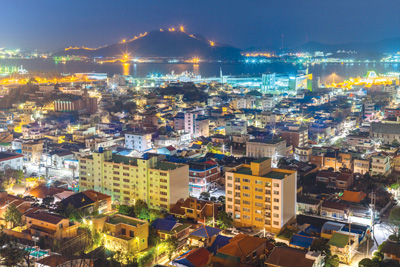


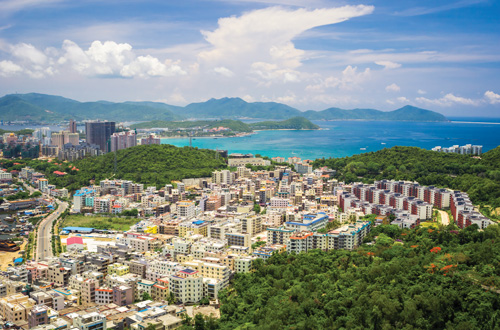
Panoramic view of Sanya city and Dadonghai Bay
A slew of MICE-ready hotels and a possible subvention programme will move the Chinese destination up the ranks. By Caroline Boey
With Sanya’s 32 new hotels in Haitang Bay – of which 12 have opened and all offering MICE choices galore – and the Sanya Tourism Development Commission’s (STDC) submission of a subvention proposal which is expected to be approved by this year, the destination is making all the right moves to become China’s next hot MICE destination at home and abroad.
Apart from kicking off the first International Island Sanya Forum, focusing on MICE and co-organised by HIMICE Convention and Exhibition Co and MICE China in September, STDC has also become ICCA’s 47th member in China. Further, STDC has stepped up private sector partnership by establishing an eight-member MICE Advisory Board – comprising China’s leading DMCs, consulting companies and the media – as well as hosting the first Sanya International MICE Sourcing Fair.
According to Wang Feifei, deputy director, STDC, a task force has also been initiated within Sanya Tourism Association to promote MICE and professionalise the industry.
With new regional and international flights operating to Sanya from Frankfurt, Ho Chi Minh City and Kaohsiung in the first half of this year, and the 14 flights that commenced since the beginning of last year from Japan, South Korea, Russia, Thailand, Vietnam, Hong Kong, Macau and Taiwan, Wang said STDC’s priority would be to target those markets.
It harnessed the power of six major social media platforms such as Facebook, Twitter, Instagram, YouTube, Pinterest to spread its destination marketing messages, and expanded its digital footprint with new websites in Japanese, Korean and Russian.
On a broader scale, Sanya has leveraged its position on the Maritime Silk Road to actively implementing the One Belt, One Road strategy to develop economic and international cooperation in South Asia, West Asia, Central Asia, Central and Eastern Europe, and Russia.
At home, Sanya wants to target the whole of China for MICE.
Other MICE initiatives include the beautification of the destination, establishment of policies that encourage sustainable development and the introduction of the Tourism Police last year.
The inaugural 2016 International Island Sanya Forum attracted more than 300 delegates, including international MICE media and 120 buyers from Beijing, Shanghai, Guangzhou and Shenzhen, while more than 200 suppliers attended the tabletop MICE Sourcing Fair.
Chen Guojiang, executive director, HIMICE, an ICCA member, said three more editions of the forum and sourcing fair have been confirmed.
HIMICE, Hainan’s leading DMC, chalked up US$35 million in sales last year, an increase of about 30 per cent. A spokesman said safety in Sanya, its good natural environment, weather and MICE infrastructure were strong factors in its favour.
“HIMICE will be handling a 3,500-delegate event next year for a US pharmaceutical company, GE already organises many events in Sanya annually, and Sanya is the regional choice among island destinations,” he added.
HIMICE, which also organises sports events, was also picked to deliver a 2,000-pax Mercedes Benz event with teambuilding in October.
As an international MICE destination, Kevin Chen, operation events manager of regional DMC EXO Events, said Sanya could do with more airlift and staff who are better trained, able to speak English and understand the needs of international travellers. Chen’s main markets are the US and Europe.
For Christophe Hazebrouck, general manager, Sofitel Sanya Leeman Resort and area general manager, Hainan, Sofitel Luxury Hotels, “direct flights from Asia, a few weekly flights from key cities in Europe and visa-free access for all countries or visa-on-arrival” are on his wish list.
“While Sanya is under pressure to push its aviation development, there is also the security issue with it being a military base and where the flight corridor is under military control,” Hazebrouck remarked.
Hoss Vetry, general manager, Ritz-Carlton Sanya, Yalong Bay, commented that the challenges and opportunities in Sanya’s MICE development in the last decade are similar to MICE frontrunner Shanghai.
The local government has responded very quickly to feedback on airport infrastructure and capacity, Vetry said, adding: “That the focus in Sanya is on more international busness and is now competing with destinations like Taiwan and Thailand, are signs of the industry maturing.”
For the first time, Sanya made it to ICCA’s 2014/2015 Asia-Pacific city rankings, marking a major milestone.
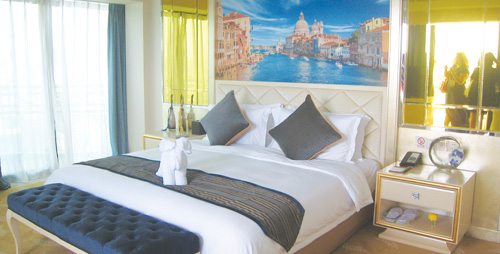
With the massive development in Haitang Bay – where AccorHotels has planted its first Sofitel beach resort, the Sofitel Sanya Leeman Resort, and where CDF Mall, said to be the world’s largest duty-free store, have opened – Sanya has new products to offer domestic and international MICE groups.
At the MICE forum, Noor Ahmad Hamid, regional director, Asia-Pacific, ICCA, advocated the formation of a CVB to help Sanya conduct research and bid for association events. “Competition is fierce among the first- and second-tier cities in China and associations will be critical because their meetings rotate.
“Sanya can work together with destinations with the same appeal like Jeju, Bali, the Gold Coast and Pattaya, start an alliance of coastal destinations and tap on the others,” he suggested.
Industry players agree Sanya needs to step up its marketing and promotions, stand on its own right and not be branded the “Oriental Hawaii” or the “St Tropez of China”.
Xu Feng, vice president, North Star Events Institute, which handles a number of medical groups and corporate meetings, said the safety and low-risk aspects of Sanya has been gaining attention and should be further highlighted.
Sanya received 18.4 million MICE delegates in 1Q2016 and 16.6 million in 2Q2016. Hotel occupancy rate in 1H2016 was 64.4 per cent, up 0.67 per cent year-on-year.
With STDC in the driver’s seat, increased involvement of the private sector, better connectivity, more attractive room rates and an overall improved product, Sanya is well positioned to reach its MICE ambitions.
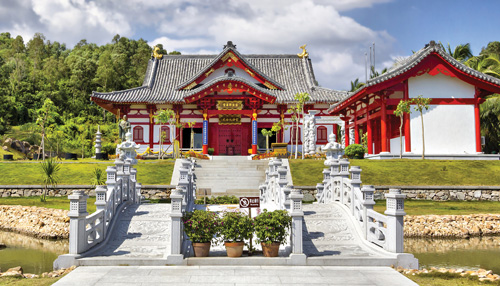
A stately traditional Chinese house can be found in modern
Sanya city
{Developments to Watch}
 Sanya has adopted an aggressive strategy to launch new international air routes targeting destinations within a four-hour, eight-hour and 12-hour flight radius. The priority is to further improve connectivity to Singapore, Malaysia and Thailand in South-east Asia, and Russia. In 1H2016, Sanya Phoenix International Airport welcomed 8.8 million arrivals, a year-on-year increase of 3.9 per cent.
 The Sanya Tourism Development Commission has submitted a proposal to introduce a subvention policy and until this is formally approved, Fan Mu, the commission’s director, said applications for support can be considered on a case-by-case basis.
 Sanya Tourism Development Commission wants the private sector task force to look at strengthening information exchange among members, collect MICE product information, conduct analysis and evaluation, launch joint MICE marketing, organise member participation in various promotional activities, develop MICE tourism standards and practices, promote service quality, develop MICE professionals and conduct MICE business training.
{Talking numbers}
51.7
In millions, the number of MICE delegates who attended national and international conferences and meetings, with between 50 and 2,000 people each, in Sanya last year
3,002
The number of events held in Sanya last year that were shorter than three days in duration, while 2,763 events had lasted longer than three days
200,000
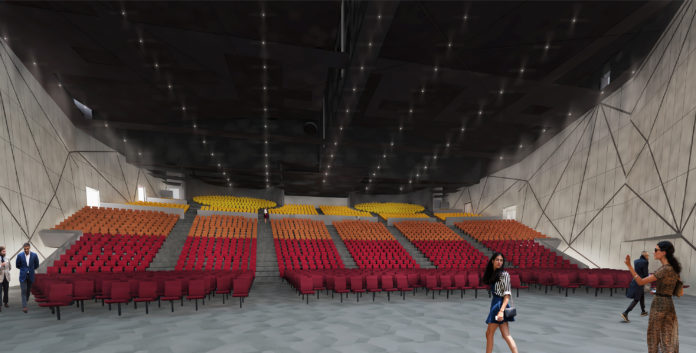
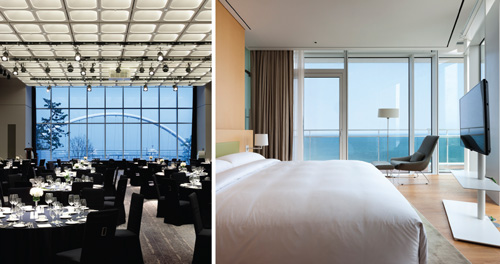
In square metres, the total meeting space available in Sanya, where there are a number of hotels offering column-free ballrooms measuring 1,500m2.