


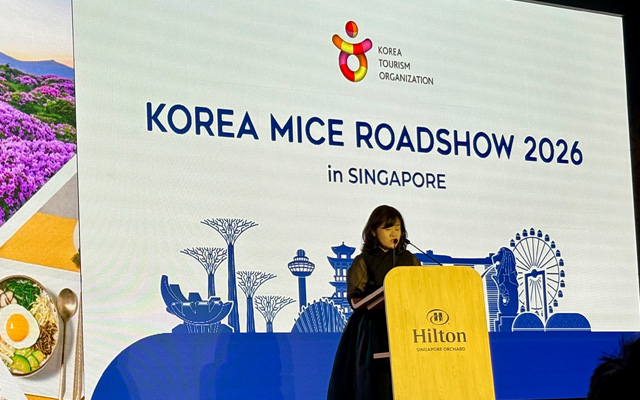
As powerhouse regional players and hubs for multinational corporations and global associations, Singapore and Indonesia continue to be crucial markets for South Korea’s business events sector.
On April 16, 2026, Korea Tourism Organization (KTO) held the Korea MICE Roadshow 2026 at Hilton Singapore Orchard, its first dedicated business events outreach in the country since the pandemic.
“We are thrilled to reconnect with industry partners in Singapore face-to-face and showcase Korea’s evolving MICE capabilities, from new destinations to enhanced support programmes,” said In Sook Lee, executive director of Korea MICE Bureau, KTO.
She noted that interest in South Korea from incentive groups in Singapore, particularly from multinational corporations and regional headquarters have seen continued growth in recent years.
The roadshow then moved to Jakarta the following day, another important source market.
“Indonesia’s rising travel demand creates strong potential for Korea’s MICE and leisure sectors. By engaging with our valued partners and key decision-makers in Singapore and Indonesia, we aim to transform this interest into meaningful business leads and attract high-value events to Korea,” explained Lee.
While Seoul has consistently ranked as one of the leading business events cities, KTO hopes to diversify events away from its capital to show a “more colourful and multifaceted” side of the country. Seoul’s popularity has also led to challenges around accommodation capacity and large-scale convention infrastructure.
In addition to Seoul, four other regional CVBs – Busan, Jeju, Gyeonggi and Gangwon – were also present, alongside hotel operators, DMCs and convention centres.
Jungsu Kim, MICE & Cruise team manager at Gangwon Tourism Organization, highlighted how the province is an all-year-round destination with something to offer for all seasons whether it is autumn foliage or winter ski resorts. Its proximity to Seoul also makes travelling convenient, while its abundance of nature adds a different dimension to itineraries should planners want a change from city-based itineraries.
Meanwhile, Ramy Gu, manager at Jeju Tourism Organization shared about Jeju’s unique venues, which include cultural and nature sites, that corporate groups can include in their programmes for an authentic experience of the island that cannot be found elsewhere in the country.
Jeju currently has 16 designated unique venues. Each year, new venues are added to the list to expand its offerings. The island also holds four UNESCO accolades, which planners can build into their itineraries.
Busan Tourism Organization shared that its was hoping to get more incentive groups from Singapore to showcase new MICE infrastructure, hotels, and uniquely Busan experiences, adding that its flight connectivity made it convenient for overseas visitors to come.
KTO’s Lee also shared how the destination can offer “more customised and personalised tourism experiences” for corporates.
She highlighted a landmark incentive delegation of over 3,000 North American visitors who sought an authentic immersion into Korean culture. To meet this request, KTO collaborated with the Seoul CVB to orchestrate a bespoke cultural event along the Han River – an exclusive experience not typically available to the public.
KTO is also forging strategic partnerships with iconic Korean brands to offer exclusive, branded experiences for international visitors. For instance, in collaboration with the premier beauty and health retailer Olive Young, KTO is developing specially curated merchandise kits tailored specifically for incentive groups.
To ensure South Korea remains competitive to corporate groups in the current uncertain geopolitical climate, Lee added: “This means working closely with airlines and partners to enhance accessibility and develop attractive support packages. We’re also emphasising tailored incentives and diversified offerings, so organisers can find solutions that fit their budgets and objectives.”