UFI has appointed Renaud Hamaide, CEO of Comexposium in Paris, France, president for the 2013/2014 season.
Hamaide succeeds Chen Xianjin, chairman of the Organising Committee of China Association for Exhibition Centers. Chen will continue to support UFI as immediate past-president.
Hamaide and Chen form part of UFI’s presidential trio, with each individual serving one year as incoming-president, one year as incumbent president and one year as immediate past-president.
Andrés López Valderrama, CEO of Corferias, Bogota, Colombia, completes the trio as incoming UFI president for the 2013/2014 term.
CORPORATE travel and business events to Cebu City and Mactan Island appear to have been spared from the same fate leisure tourism business in the province and the Visayas are enduring following the devastating landfall of super typhoon Haiyan.
Cebu City and Mactan Island are the business and commercial hubs of Cebu province and the Visayas.
Jerome Coronado, inbound supervisor of Swire Travel Philippines, Inc., said the 7.2-magnitude earthquake that hit Bohol and Cebu on October 15 – three weeks before the super typhoon struck – had caused more business travel cancellations and postponement of events in Cebu.
Agreeing, Wow Philippines Travel Agency general manager, Relly Magundayao, said business returned a week after the super typhoon struck, although there had been some postponement of business travel to Cebu, from this year to sometime in 2014, and fewer enquiries for teambuilding activities in Boracay.
In fact, several days after Haiyan struck, Cebu’s hotel sector is enjoying full occupancy due to the onslaught of foreign journalists, international relief agencies and non-profit organisations, and military aid personnel using Cebu as their gateway and warehouse centre to Tacloban and eastern Samar.
Some of the hotels that have reported strong occupancies include Cebu City Marriott, Radisson Blu Hotel Cebu and Best Western Plus Lex Cebu.
Hotels are expected to continue to be booked out as the stricken areas in the Visayas continue to merit international aid.
FOLLOWING two years of modest budget and activity increases in meeting spend per organisation, figures are expected to be flat or show a slight decline across all regions in 2014, reported the latest American Express Meetings & Events 2014 Global Meetings Forecast.
Industry activity appears likely to be stabilising due to a rise in meetings-related policies designed to ensure such events comply with company guidelines and deliver against strategic objectives.
Across all regions, meeting organisers will likely continue to face challenges as they strive to achieve more with flat or decreasing budgets expected, compared to previous years.
Most notable is the shift in expectations among meeting planners in Asia-Pacific. Respondents from the region were the only ones last year to predict an average increase in overall meetings spend per organisation, however, this year they are forecasting a 3.6 per cent decline – the largest dip among all regions.
The number of meetings is expected to dip 1.2 per cent while the number of attendees per meeting is projected to fall by 2.4 per cent.
“While businesses throughout Asia-Pacific still recognise the importance of meetings and events, over the past year there has been a shift towards greater control and transparency within meetings programmes,” said Danielle Puceta, director, American Express Meetings & Events, Asia-Pacific.
“After two years of optimism, in 2014 we expect slight decreases in the frequency and spend-per-organisation when it comes to meetings and events in the Asia-Pacific region. We believe this is indicative of a maturing industry and a phase of greater scrutiny, aimed at ensuring meetings and events activity truly meets organisational objectives.”
The study also ranked Shanghai as the top meeting destination choice among meeting planners in Asia-Pacific, followed by Singapore and Sydney.
Hong Kong and Macau jumped from seventh position last year to fourth this year, while Bangkok and Chiang Mai share fifth spot in the latest rankings.
The team that boards together bonds together. Raini Hamdi looks at a rise in Asian meetings on cruise ships and why teambuilding occurs more effortless at sea than on land, as cruise lines would have us believe
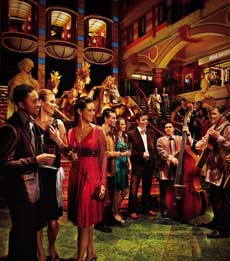
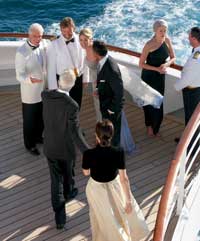
Out in their gala best Picture by Star Cruises
It is hassle-free, complete, all-inclusive – the same advantages that have attracted more Asian leisure travellers to cruise are also winning over Asian MICE planners.
And where the need to bond a team is a key aim of the meeting or incentive, cruise lines are pushing the message that theirs is a proposition that’s hard to beat. Ships are destinations in themselves, with ideas for teambuilding limited only by the imagination, they said. But even without as much as having to lift a finger to execute a team-building exercise, cruise companies argue that bonding happens more “naturally” at sea than on land.
Fresh air and gentle breezes aside, it is back to the nature of cruising as being hassle-free, complete and all-inclusive which they said break even the tiniest psychological barriers to teambuilding.
“Normally, it is not natural for a woman to buy a man a drink, for instance. As we’re are all-inclusive and no money changes hands, it is much easier for a lady to ask for a drink from the bar and get one for her male colleague as well.
“We have had many groups and charters where clients commented they had tried repeatedly over the years to bring their various teams together with activities and ‘mixing them up’ on coach, but failed. On board, the clients said they finally succeeded and they didn’t even try deliberately. Teambuilding is a natural occurrence on the ship, it always is,” said Melvyn Yap, Silversea Cruises’ regional director-Asia.
Said Marnie Whipple, Crystal Cruises’ regional sales manager, Asia & the Pacific: “Being at sea gives a rare opportunity to be in an environment where guests feel comfortable, relaxed and thus generally more open to candid conversation that may not perhaps take place in a corporate setting.
All smooth sailing: a pow-wow on board
“Because of this, we often see that incentive groups have a greater bonding experience with their colleagues as they connect in various locations – organised or not – around the ship.
“The environment onboard is more conducive to creative and spontaneous encounters versus a land resort or hotel, where guests tend to adventure more off-site on their own or in segmented groups. On the ship, everyone relaxes in one overall space, yet can mingle and discuss ideas in a variety of settings.”
Cruise lines like Crystal and Silversea, which have relatively smaller ships and are positioned at the higher end of the market, do not have a teambuilding department per se but see to all aspects of the meeting organiser’s requests, or those of the teambuilding specialist the organiser works with.
Asia’s oldest cruise line, Star Cruises, celebrating 20th anniversary this year, on the other hand, said it is equipped with skilled, trained staff to design and execute teambuilding programmes on board its ships. The company also has a strategic partnership with Focus Adventure in Singapore and at times rope in corporate training facilitators to implement teambuilding workshops based on the client’s requirements.
Said Star Cruises senior vice president-sales, Michael Goh: “These learning programmes are impactful and effective as they are developed based on real-time organisational issues. As a result, dynamic teams with strong synergies are formed. Importantly, the team enjoys a fun time during the ‘learncentive’ cruise, a combination of adventure teambuilding learning and incentive. What’s more, they discover exciting destinations each day, savour up to six sumptuous meals daily, enjoy sensational entertainment and indulge in pampering recreational facilities and services, with a touch of warm Asian hospitality.”
Operations also include the cruise entertainment team, F&B team with celebrity chefs, tours & travel and conference teams, all of whom work together to enhance organisers’ expectations.
Royal Caribbean International boasts having dedicated onboard convention service coordinators providing round-the-clock personal assistance to organisers, although it does not have dedicated teambuilding staff.
Said Royal Caribbean’s managing director-Singapore, Jennifer Yap: “These coordinators can work with our clients’ teambuilding planners (external parties) to make special, customised arrangements for onboard group programmes, menus for group dinners and facilities for group meetings and conferences. We can also assist to organise exclusive group shore excursions tailormade or selected from our shore excursion menu.
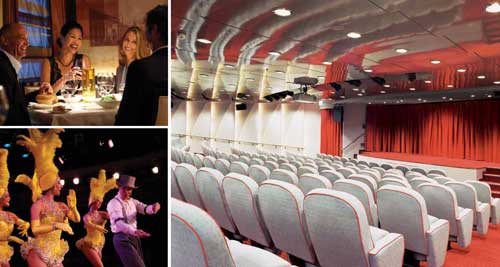
Cruise ships’ F&B, entertainment and meeting spaces complement teambuilding facilities to offer a holistic alternative to meet on board
Under one roof
Not only do event organisers and teambuilding specialists have a captive audience in hand, what a rich playground under one roof too.
Ships today have a wide variety of entertainment and relaxation options, outdoor and indoor spaces, and meeting rooms that lend themselves well to teambuilding. In fact, mega ships appear made for it: those from Royal Caribbean, for instance, have a 9m rock-climbing wall, full-sized sports court, ice skating rink, surf simulator, Zip Line, AquaTheatre for aquatic acrobatic performances and 3D movie theatres.
The opening of new cruise terminals in Asia, such as Singapore’s Marina Bay Cruise Centre last year, enable these companies to deploy larger ships, such as Royal Caribbean with its Voyager of the Seas and Mariner of the Seas, both 138,000 GRT. These ships come with a wider variety and larger onboard MICE and entertainment facilities, which invariably appeal to larger groups and discerning corporate clients.
This does not mean smaller ships are disadvantaged, however. Silversea’s Yap recalled: “We have had programmes where all delegates were dropped on land and the ship ‘left’ them on the island. The delegates had to do a treasure hunt involving getting to another location on land and, bingo, the ship was there again to pick them up.
“Or, how about the time when we had a group of radio-controlled model planes take off from the deck of our ship and participants had to ‘shoot them down’ with laser guns. All special audio effects were made onboard with the specialist equipment the clients brought.”
Entire Silversea ships have also been chartered for incentives, with clients tailoring the programme to give their delegates something they cannot buy off the shelf. Silversea’s Yap urged planners to “see us (ships) as the venue, the canvas on which the total programme can be projected”.
“There are very few things which are not possible. Whatever you can arrange in a hotel or resort, we can do it onboard and often better! The ships are the venues. Especially when you charter the ship – you can let your imagination run free,” he said.
Networking happens more naturally at sea than on land, said cruise operators
Cruise companies are also quick to point out that not only are they a one-stop, under-one-roof option, they also do not cause much out-of-the-pocket unexpected expenses for meeting planners.
All-inclusive cruises such as those offered by Crystal means “the entire cost of the shipboard experience for our incentive clients is represented solely in the cruise fare; the only services that are additional are spa and salon treatments and shore excursions”, explained Crystal’s Whipple.
“Our all-inclusive shipboard experience for incentive groups even includes any meetings or events you would like to arrange exclusively for your group. In addition, standard incentive group amenities on a Crystal cruise include one complimentary private cocktail party and US$200 per person shipboard credit. Our streamlined all-inclusive shipboard experience makes budgeting easy for meeting planners as it removes the concern of unexpected costs.”
Said Royal Caribbean’s Yap: “Most of our corporate groups onboard conduct teambuilding activities. The use of our venues and amenities onboard are complimentary. Manpower for the running of the activities and F&B will be chargeable.”
Sunrise industry
Cruise lines interviewed said they are seeing a healthy rise in Asian meetings and incentives, with most corporate groups conducting teambuilding sessions on board.
Said Crystal’s Whipple: “Teambuilding is an essential component. Part of teambuilding is networking and developing connections via special, organised private functions onboard and in ports. It also appeals to meeting planners and organisers because all of the services necessary for any event – dining, meetings, product showcases – are available onboard, typically at no additional cost.”
Star Cruises observed a double-digit year-on-year growth in Asian meetings. “More corporate companies and event planners are in search of unconventional venues to host their regional meetings and incentive holidays,” said Goh.
Royal Caribbean’s Yap said incentive travel is a popular trend for companies in Indonesia, India, South Korea and China – the line’s top Asian MICE markets – and the novelty of something new like cruising raises MICE sales that it now makes up “almost 50 per cent of our total sales, and we expect this to grow further”.
Princess Cruises’ director, South-east Asia, Farriek Tawfik, cannot wait to get in the act. “When Sapphire Princess homeports in Singapore for an extended season of cruise trips in the region next year, we will be offering shorthaul cruise trips of three or four days which are highly suitable for teambuilding and meeting purposes.
“We have plans to set up a separate department to cater to the corporate meetings market and we are confident that as cruise travel in Asia continues to increase in popularity, we will see a healthy pipeline of interest from this sector.”
Luxury cruises have also taken off. Silversea’s Yap said the growth is Asia “is increasing at a rapid pace”.
“We, Silversea, have acknowledged this quite a few years ago and are expanding our activities in Asia both with financial as well as human capital. We are beginning to see the fruits of our labour in the past and are stepping up our activities on all fronts.”
Likewise, Crystal is seeing “a healthy increased demand”. Said Whipple: “As the economy continues to have a healthy return, businesses are seeking more creative rewards for their top producers. Luxury cruises are presented as an option more than previously, and have proven to be a great value. As a result we are experiencing more Asian incentive groups.
“This year, we had our first two incentive groups, and will have another from Asia next year. We are working on more as we speak. All the groups are of a significant size. Banking is a key incentive market, and the most popular itinerary for Crystal’s Asian incentive groups are seven-day Mediterranean cruises. We typically host incentive groups on our European voyages, but are now experiencing increasing requests for Canada/New England as well.
“Generally voyages of seven days or shorter are an excellent fit for MICE.”
For Asians, cruise durations are shorter, typically between three and five nights in South-east Asia or fly-cruises to Alaska and Europe.
All aboard
The team that learns or plays together brings higher results to companies. Top, Crystal Cruises’ University at Sea. Left, fun on board Star Cruises
Cruise companies said teambuilding on board is virtually foolproof; aside from the ‘danger’ may be of putting on a few pounds on the waistline, and bad weather, which always is a factor whether at sea or on land, there is little that could go wrong.
The trick, they said, is for planners to understand what innovative amenities and unique-at-sea facilities are available at their fingertips.
“Once they understand and appreciate this difference with shoreside options, they can better leverage facilities to engage the group, instead of replicating a land-based teambuilding experience on a cruise,” said Royal Caribbean’s Yap.
And, as always with teambuilding, event planners must define their company’s business objectives, added Star Cruises’ Goh.
“From there, we will conduct ship tours with them to identify (potential) event venues, evaluate the integrated cruise options and onboard requirements, before we formulate a detailed cruise programme to fulfil their needs. Once communicated and agreed upon, we will move into event implementation. With such a foolproof plan, pitfalls can be easily avoided,” he said.
As for bad weather, one line at least claims to even be able to control it.
Recalled Silversea’s Yap: “We once had a deck BBQ set up for a client and it began to rain just before the event started. The captain rushed to the bridge and asked both the MD of the client company and I to join him there. He switched the radar on and you could see the rainclouds around the ship. He lifted the anchor and very slowly zig-zagged around the rain areas. The result was a successful deck BBQ; the MD took pictures of the rain clouds on the radar copies, which were given to each delegate. They talked about it for years!”
Planners’ experiences – Pros and cons of teambuilding at sea
Picture by Star Cruises
First United Travel Philippines president, Mayie Cruz
Every year, we send one or two incentive groups on a fly-cruise in Asia or Europe.
Filipinos love and enjoy cruising, even if it’s only in Singapore.
In Asia, the trip lasts four to five days. In Europe, seven days. Anything longer, say 10 days, they get bored.
The cost of a fly-cruise is about the same as going to Asia or Europe and staying in a hotel.
Cruising is easy to handle. Everything is pre-arranged. Everything that the incentive group needs is there.
Yet another advantage is the availability of good food – and it is served buffet-style. So the team is happy with the quality and quantity of food.
Another plus are the many activities to choose from. Our clients, under pressure from work, really look forward to cruising because they feel it’s a relaxing break.
Cruise ships are a good venue to build the team. It’s so easy to gather the group for shore excursions and to get them back onboard. Since there is a fixed time for going ashore and returning to the ship, everyone is mindful of the time and punctual. This is unlike group movements during overland incentive trips.
Meals and shore excursions offer opportunities for bonding. Delegates take their meals together every day; there are no fixed sitting arrangements so people are encouraged to mingle and get to know each other. It is the same during shore excursions.
There will be days of rough seas, but there are medicines for that. Moreover, people who are affected will usually just stay in their cabins.
One downside is the lack of priests onboard, as most of my clients prefer to hear mass every day. – Rosa Ocampo
Menara Tudjuh Sembilan Indonesia president director, Imam Syafii, and business development manager, Musthafa Luthfi
We had one client company that did a teambuilding programme on Costa Victoria earlier this year.
It was a software provider for education institutions and it brought the managers and their families on an incentive tour. The programme comprised a motivational forum where members shared their problems and best practices, a teambuilding programme, plus an award presentation.
Our client had done a similar programme on land and was looking for an alternative.
Syafi: a real ice-breaker
We proposed taking the group on a cruise and managed to convince the client that this was more cost-effective than a land programme. Unlike land programmes, cruise passengers need not check in and out every time they arrive at and depart from a destination, nor do they require transportation from one venue to another.
The package included accommodation, all meals and entertainment. A teambuilding activity was conducted around the swimming pool. Besides that, there were many onboard programmes to encourage bonding among participants, most of whom had not met each other before.
The four-day Singapore-Phuket-Penang-Singapore cruise saw participants spending much of their time together, doing things such as watching shows, taking aerobic classes and dining in their own corner in the dining room. All that facilitated communication and helped develop relationships.
The feedback from our client was positive, an indication that trip’s objective was achieved.
The only thing that needed improvement was the language barrier onboard. As a Preferred Sales Agent of Costa Cruises, we act as a liaison between the cruise company and the client; we do not have an employee to accompany clients onboard, not for a small groups at least. While English is one of the languages spoken onboard, not all Indonesians speak English. Furthermore, not all Italian crew members speak fluent English.
In future we will try to provide information in Bahasa Indonesia or send an employee to accompany our groups. – Mimi Hudoyo
Resorts World Tours Malaysia senior operations executive, Leon Yap
In 2012, we organised a three-night cruise for 600 salespeople from an insurance company, most of whom came from Malaysia and Indonesia. It was held onboard SuperStar Virgo, homeporting in Singapore with port calls at Langkawi and Phuket.
A two-hour teambuilding activity on the open deck was offered as a non-compulsory option. The client requested that the activities be kept simple and interesting for participants aged 30 to 60. Almost 70 per cent of the participants were males but we had to make sure the activities appealed to both genders. Thus, we created a series of games using hula hoops, eggs and ropes with the objective of fostering better relationships.
Judging by the attendance – 90 per cent of participants stayed for the entire teambuilding activity – the event was a great success. Seeing the smiles and hearing the laughter and cheers, we knew they all had fun.
The Star Cruises team gave us their full support and contributed to the event’s success. We provided a client profile, such as the age range and preferences of participants and in turn they gave us a selection of teambuilding activities to choose from. Star Cruises was also prompt in responding to our client’s queries.
Star Cruises was also able to tailor the teambuilding activities to the requirements of the client.
One of the benefits of organising a teambuilding event on a cruise ship is the availability of experienced cruise organisers to coordinate and make the event hassle-free for handling agents.
The cruise package is also all-inclusive with no hidden costs. Accommodation, meals and entertainment are taken care of. However, an additional cost is incurred for teambuilding activities.
The disadvantages of doing a teambuilding activity on a cruise ship include the need for clients to coincide their outing with the ship’s departure dates and the duration of the programme with the length of the sailing.
It is also more costly to host a teambuilding event on a cruise than at a local beach resort. For example, a two-day/ one-night stay at a four-star beach hotel with teambuilding activities would cost around RM900 (US$274) per person, but an international cruise package would cost from RM1,300 per person. – S Puvaneswary
Focus Adventure Singapore owner, Andrew Chua
Chua: novel idea
We had a group onboard the SuperStar Virgo for three days and two nights, including a port call at Malacca. The package included accommodation, food, meetings and entertainment, which encouraged the group to do everything together day and night.
For teambuilding activities, we planned games on the ship. The liner’s wide-open space allowed many types of activities.
The group was split into teams and played a game of treasure hunt. They had to crack codes and find treasures around the ship. The hunt continued when they disembarked in Malacca, this time using GPS receivers, walkie-talkies and digital cameras.
It was well received by all participants because some of them had never been on a big ship before and found it a novel and refreshing experience.
Meetings also felt more fun due to the different setting on the seas.
The advantage of running a cruise incentive is (getting a captured audience). Participants cannot run away. They will eat all meals together and do everything together for the next few days as the ship sails. Cruise incentives foster a strong sense of unity.
However, the downside of such a programme can surface when a participant has sudden personal matters to attend to. He/she cannot return to land unless a helicopter is deployed to fetch him/her! – Lee Pei Qi
Lotus Tours Hong Kong MICE manager, Arthur Choy
Choy: teambuilding-at-sea specialists needed
We organised an incentive trip for a direct sales company several years ago. It was a seven-day journey, combining meetings and recreational activities for 200 staff cruising from Vancouver to Alaska.
The client found the cruise ship enormous and requested that Lotus Tours conduct some activities such as a ship walk to familiarise participants with onboard facilities and directions around the ship. The goal was to ensure that participants knew how to get to meetings and maximise the use of facilities during their stay.
To that end, we proposed a treasure hunt on the second day at sea. Participants were divided into 20 teams and made to race against time to complete different tasks within two to three hours.
We established 12 checkpoints at locations such as restaurants, meeting venues, theatres, and the front and rear of the ship – places that would be frequented by participants throughout their event on the ship. At each checkpoint, teams were given a task to perform, such as taking a photo of a particular ship facility, forming a company symbol or shooting basketball hoops.
The treasure hunt proved to be a much better activity than a ship walk, as participants got to explore the vessel in a fun way.
Besides this client, we hardly had a chance to do similar activities for clients in Hong Kong. There isn’t any company that specialises in teambuilding at sea.
However, with the new Kai Tak Cruise Terminal, we hope to create a new product for clients who have the misconception that cruising is more expensive for teambuilding and corporate events. Unlike hotels, cruises offer the advantage of an all-inclusive deal. Many venues onboard can be booked for free, with an additional charge for technical services. However, permission is required from the cruise company when booking onboard venues for teambuilding. Different ships impose different limitations and an expert event organiser will choose the right ship for the event. – Prudence Lui
Faraway Places Marketing India managing director, Arvind Tandon
Tandon: cannot escape
We brought a Michelin group onboard a cruise, and it brought with it several cars that featured in a group activity. Participants were required to identify unmarked Michelin tyres and fit them to the cars. The first team that installed all the right tyres won prizes.
We also had a 170-pax L’oreal India group spending time on interactive and competitive games onboard an incentive cruise. One of the games saw teams mixing their own cocktails from ingredients supplied. Points were awarded for presentation and taste.
Results from these programmes were good – team bonding was intensive (and uninterrupted) as participants cannot escape from the venue, which happens often with land-based incentive trips. Confining participants in a defined space for a number of nights ensures bonding, which is especially good when they come from different offices across India.
However, not all companies will include teambuilding activities in an incentive cruise. As most incentive programmes are held partly to reward good performance and partly to motivate greater effort in the year ahead, most companies prefer to leave their participants to let their hair down and have fun on the cruise, instead of thrusting upon them tasks to complete.
Moreover, most sailings in Asia are for only three nights, too short for many activities.
Another disadvantage of corporate gatherings on cruises is that a ship does not allow segregated space for teambuilding activities involving smaller groups of, say, 100 to 150 guests. There is also the difficulty of having too many structured teambuilding activities onboard.
In Europe and the Caribbean, many small vessels are geared for corporate teambuilding. Perhaps when the demand grows, more of such vessels will be made available to Indian and Asian incentive planners. – Shekhar Niyogi
Would you consider teambuilding at sea?
“Yes. Cruises are considered a high-value reward in our industry.
We are always wanting to be the first to offer novel incentive tours. For example, when Universal Studios theme park opened in Singapore, Canon was the first IT company in the Philippines to offer it as an incentive destination.
When considering a teambuilding programme at sea, we will look at factors such as costs – the total expense should be around 50,000 pesos (US$1,136) per head, including all incidentals, land excursion, airfare and in-transit hotel; safety – ports of call should be free of armed conflict and security issues, and ample medical facilities must be available in case of emergency; onboard services and entertainment facilities – the ship must be well maintained and of five-star quality, there should be enough entertainment offerings to keep guests occupied, staff must be efficient and well trained, the event/account manager should be accommodating and quick to respond to all our inquiries; F&B – food must be well prepared and of good variety; and finally, the timing of the voyage.
We prefer programmes in March to reward 2H sales performance based on the calendar year, and in October when there are no more typhoons in the Philippines and there are longer weekends to reward 1H sales performance.
We also prefer a three-day/two-night itinerary since company owners in our industry could not afford to stay away for too long.
We favour teambuilding activities such as Amazing Race-type of games, Zumba, yoga and ballroom dancing, and look to conduct soft-skill training sessions, award ceremonies, special back-of-house ship tours so that guests can see the workings of a cruise ship, navy or pirate-themed masquerade balls and even speed-dating.” – Grace Obeya, sales & marketing manager, consumables group, Consumer Systems Products Division, Canon Marketing Philippines
“Yes, provided it is within our budget and the duration does not exceed two days/one night, as our staff have their own tasks and responsibilities and, collectively, the team cannot be away from the office for too long.
Teambuilding is always part of our company’s incentive programme, which we hold once every two years. Whenever we organise teambuilding for the staff, our entire office of almost 30 people are involved.
Teambuilding on a cruise ship will have offer a very different experience from the ones we have had in a resort setting in the past.” – Vincent Soon, director, F&B Facilities, Malaysia
“Generally, activities that can sustain team interest, and allow for team engagement and interaction would be ideal. In this case, teambuilding activities out at sea where members spend time together in a defined space would be suitable.
A day out at sea, complete with fresh air and beautiful scenery, makes for a fun and relaxed atmosphere which contributes to a positive teambuilding experience.
Off-site venues like the sea allow room for novel and interesting activities to engage the team and foster bonding. This brings better communication among the team and understanding of each other’s roles, and more effective collaboration at work.
A team that enjoys spending time together will more likely be a cohesive team that enjoys working together.” – Mark Fletcher, director of human resources, The Ritz-Carlton, Millenia Singapore
“I think that teambuilding at sea is a creative solution for incentive planners who want to add unique team experiences, but are challenged by tight budgets.
There are plenty of ways to incorporate teambuilding into a group cruise event, both onboard the ship and ashore. One option is a treasure hunt as we land on a beach, with clues being handed out as the group disembarks, and concludes with a barbecue competition.
I fully endorse teambuilding activities on a cruise as all activities are confined to the deck space or limited land excursions, and livens up the day as well as adds value by inducing bonding among an often disparate group of people.
– Anirban Sen, general manager, corporate marketing, Uniworld Logistics Bengaluru, India
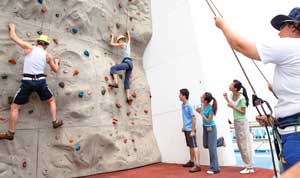
Facilities on mega ships such as those of Royal Caribbean appear made-for-teambuilding
Amway Hong Kong organises frequent teambuilding and training, including weekend camps. At our 35th anniversary distributor incentive trip onboard a Mediterranean cruise, Amway Hong Kong specially invited a segment distributor group to join the outdoor activities which included basketball games and rock-climbing in a bid to enhance bonding and foster team spirit. This successfully concluded a series of formal business presentations. – Louisa Chan, general manager, Amway Hong Kong
HOGG Robinson Group (HRG) has been awarded the contract to provide a global meeting booking and venue sourcing solution for Vodafone, one of the world’s largest telecommunications providers.
Amanda Hanlin, director of global sales, HRG Meetings, Groups and Events (MGE), said: “We are delighted by the continued success of the HRG MGE team, which is testament to our market leading knowledge, experience and expertise. Vodafone’s comprehensive and extensive tender process enabled us to showcase our full range of capabilities, our creativity and our commercial acumen.
“By awarding us their business, we see a fantastic opportunity for HRG and Vodafone to work in partnership to develop a truly global solution, delivering real savings and value across the meetings management programme.”
HRG has a global network that spans 120 countries.
HILTON Kuala Lumpur is optimistic of continued incremental growth in MICE business over the next three years, due in part to the hotel’s recent refurbishment that has given it new dining and entertainment outlets as well as efforts in targeting new markets.
Completed in August this year, the hotel’s five new dining and entertainment outlets – Vasco’s, Chambers Bar & Grill, Graze, Oro Cafe and The Lounge – feature new design concepts that engage diners. For instance, all-day dining restaurant, Vasco’s, offer four interactive show kitchens.
A dine-around concept has also been introduced to Hilton Kuala Lumpur’s stable of 11 F&B outlets to meet the needs of business event clients who desire variety in their dining options.
General manager, Daniel Welk, said: “We are aware that organisers are always looking for creative options that offer flexibility and unique experiences.
“Our extensive hotel refurbishment was designed to cater for the evolution of clients’ demand (which is indicating a growing preference) for more than the traditional boardroom-style space. We’re able to offer al fresco settings with natural lighting and an outdoor feel, cosy nooks for break-out sessions and a relaxed, lounge-like environment.”
Welk added that forward bookings for 1Q2014 and 2Q2014 have been encouraging.
He said: “Besides our traditional MICE markets which are domestic, Singapore, Hong Kong and Australia, we are also targeting new ones in the Middle East, especially the UAE and Doha due to direct air accessibility to Kuala Lumpur.
“We get leads from our distribution network which includes Hilton Worldwide sales offices as well as from incentive and meeting planners.”
TWO exclusive private dining rooms on the roof terrace and two function rooms at the mezzanine level have been added to the Fairmont Peace Hotel Shanghai’s collection of event spaces.
The roof terrace offers the Scotland Room, a 25m2 space that is reminiscent of a traditional English gentleman’s club, complete with a high ceiling, dark wood panelling, rich upholstery and plush leather chairs; and the England Room, a 35m2 venue.
Adjacent to the roof terrace is the Nine Heaven Hall, which was once used exclusively for the private parties of the hotel’s British founder, Victor Sassoon. It has been perfectly restored to its original 1920s splendour and offers a 270-degree view of the Huangpu River. The two private dining rooms and the Nine Heaven Hall make up the extension of the roof terrace.
Located on the mezzanine level is the Chun Shen Room, a 215m2 space that has been designed with wood panelling and original cast-iron windows to complement the Art Deco style of Fairmont Peace Hotel. Good for up to 100 guests in a banquet setting or 160 in a theatre set-up, this venue offers a compelling view of the Bund.
Adjacent to the Chun Shen Room sits the new Thames Room, a luxurious 110m2 venue overlooking historic Dian Chi Road and Huangpu River. It can accommodate up to 50 people in a banquet set-up.
Both function rooms offer cutting-edge audiovisual technology and high-speed wireless Internet access.
YASAKA Taxi, a member of Kyoto Convention Bureau and a supplier for high-end incentives, meetings and conferences in the Japanese city, has started to provide meeting delegates with wireless Internet access during airport transfers.
The use of vehicles equipped with Wi-Fi hotspots can be arranged though Kyoto Convention Bureau.
James Widgren, international marketing manager of the MICE bureau, said: “While the rest of the global meetings and events industry debates the importance and quality of Wi-Fi in venues and hotels, event attendees in Kyoto can bask in the knowledge that our suppliers are always looking to go one step further.”
He added: “This initiative has been welcomed by organisers, who recognise the need for their delegates to stay in touch – and in particular to check their emails after a flight.”
AN ALLIANCE of convention centres, which has been in operation since 2006, relaunched last month with a service to share congress information among members to enable a more effective bidding process for future editions.
Called Global Alliance, the grouping consists of Durban International Convention Centre in South Africa, Adelaide Convention Centre in Australia, Centro Banamex in Mexico, ACC Liverpool in the UK, and Boston Convention & Exhibition Center and Hynes Convention Center in the US.
The service uses a series of inter-venue processes to transfer information on a congress that was held in one of the member convention centres to others in the alliance.
Global Alliance chair and CEO of the Durban International Convention Centre, Julie-May Ellingson, told TTGmice e-Weekly that the service would take away the hassle of having to repeat details and requirements of a congress whenever it is up for bidding.
“By sharing leads and event information, we can fortify each other’s capability in the next bidding process,” said Ellingson, adding that PCOs “can utilise the alliance’s know-how to strengthen their own bid attempts”.
Global Alliance also aims to provide a platform for members to share best practices, collaborate on research and conduct training exchanges for convention centre staff.
To encourage an “open relationship” among its members, Ellingson said Global Alliance would strive to have a single member from each continent where possible.
“Similar alliances often fail because (multiple) members (from the same destination or region) are competitive and feel threatened when asked to share leads and information on past events,” she explained.
Ellingson believes that the alliance could welcome an Asian member and has identified “two to three potential ones” in the region.
To qualify for entry, convention centres must be of a world-class standard and possess sufficient space for large congresses.
“We are careful about who gets to be part of the alliance. We will not just look at pictures of the venue and decide, as the real thing can be so different. We will attend events at potential convention centres to suss out their capabilities – much like mystery shopping,” she said.
Dusit International has appointed Sameh Shawkat regional director of sales and marketing – Middle East and Africa, based in Dubai. He was last executive assistant manager, sales and marketing at Grand Hyatt Doha.
The newly-opened Ritz-Carlton, Bangkok anchors the One Bangkok development with cosmopolitan elegance. Featuring the city's largest ballroom and a spectacular new penthouse suite, it delivers exceptional hardware and deeply authentic, soulful service for business and leisure travellers alike
Behind the imposing, Brutalist concrete that defines Zurich’s Oerlikon district lies a surprising secret. While its exterior honours the neighbourhood’s industrial roots, stepping inside Mama Shelter reveals a vibrant, neon-soaked world that is a far cry from its rigid shell
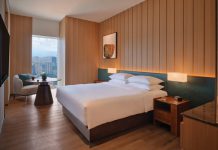
A polished urban retreat designed for business travellers, Hyatt Regency Kuala Lumpur at KL Midtown combines thoughtful design, seamless service, and exceptional facilities.




 Princess Cruises’ director, South-east Asia, Farriek Tawfik, cannot wait to get in the act. “When Sapphire Princess homeports in Singapore for an extended season of cruise trips in the region next year, we will be offering shorthaul cruise trips of three or four days which are highly suitable for teambuilding and meeting purposes.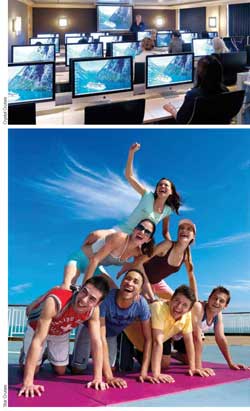



 “Yes. Cruises are considered a high-value reward in our industry.
 “Yes, provided it is within our budget and the duration does not exceed two days/one night, as our staff have their own tasks and responsibilities and, collectively, the team cannot be away from the office for too long.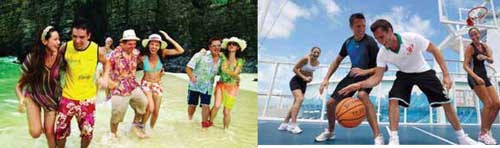
 “Generally, activities that can sustain team interest, and allow for team engagement and interaction would be ideal. In this case, teambuilding activities out at sea where members spend time together in a defined space would be suitable.
 “I think that teambuilding at sea is a creative solution for incentive planners who want to add unique team experiences, but are challenged by tight budgets.
 Facilities on mega ships such as those of Royal Caribbean appear made-for-teambuilding
 Amway Hong Kong organises frequent teambuilding and training, including weekend camps. At our 35th anniversary distributor incentive trip onboard a Mediterranean cruise, Amway Hong Kong specially invited a segment distributor group to join the outdoor activities which included basketball games and rock-climbing in a bid to enhance bonding and foster team spirit. This successfully concluded a series of formal business presentations. – Louisa Chan, general manager, Amway Hong Kong