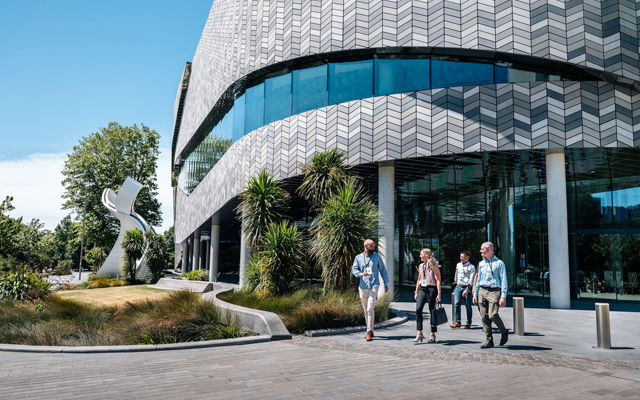
Delegates walking out of Te Pae Convention Centre in Christchurch
Christchurch is gearing up for a busy off-season with seven major conferences – in the fields of healthcare, engineering, and aerospace – bringing over 2,600 delegates and an estimated NZ$3 million (US$1.9 million) economic boost from late August to late September.
Among the upcoming events are three healthcare conferences attracting 1,200 health professionals. There is also the Aeromed Conference 2024 (September 24-26), focusing on air retrieval services, which will draw 250 specialists from around the world. In the same week, the New Zealand Aerospace Summit is expected to attract 700 delegates.
Delegates walking out of Te Pae Convention Centre in Christchurch
These conferences not only contribute to the local economy but also help to smooth out seasonal tourism patterns. According to ChristchurchNZ, 83 per cent of international delegate arrivals in 2023 came during the off-peak months, compared to 62 per cent of holidaymakers.
In addition, business events attendees are New Zealand’s fourth largest market by visitor spend, with an average spend of NZ$426 per day compared to NZ$304 for holidaymakers. The business events sector was also worth NZ$403 million to the country in 2023.
Beyond the immediate economic benefits, conferences also provide opportunities for knowledge sharing, networking, and showcasing local products and services, where “the wider impacts of successful conferences are incalculable”, said Kath Low, head of visitor economy at ChristchurchNZ.
The ICCA Skills 2024 training will also be hosted in Christchurch next month.
Christchurch Airport is anticipating a further 10,000 passengers next year due to increased delegate numbers. Justin Watson, the airport’s CEO, highlighted the positive impact of conferences on off-peak tourism and the boost it provides to regional airlines.
From April to September, the ChristchurchNZ Business Events team helped secure 20 large business events with 9,000 delegates, bringing in an estimated economic impact of NZ$16 million.
Nteractive, the global brand experience agency, has appointed Ian Cummings as global CEO. He will join the company on September 2, 2024.
Ian brings with him a wealth of experience, having successfully served as the CEO of a major travel management company. He is a well-respected industry leader with a host of complementary skills and expertise in driving metric-based client performance.
Founded in 2010 by Neil Evans and Matt Brownfield, Nteractive is an agency that architects experiences; consistently setting the standard for delivering exceptional client experiences, particularly within the tech and lifestyle sectors. The agency has established offices in the UK and the US, and a diverse team spanning Europe and Asia, Nteractive is strategically positioned for continued global expansion.
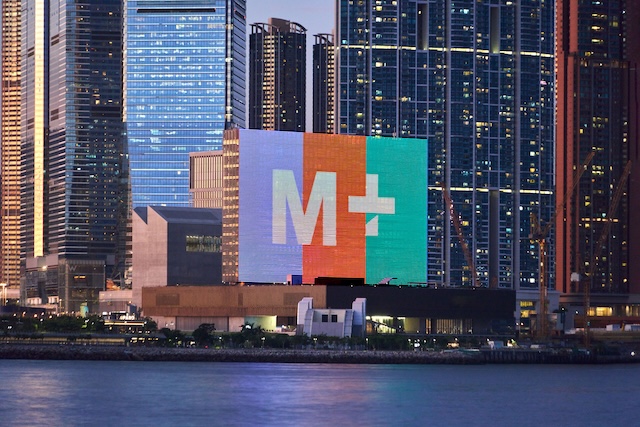
M+, a leading museum for contemporary visual culture, showcasing art, design, architecture, and moving images
Located in Hong Kong’s West Kowloon Cultural District on the Victoria Harbour waterfront, M+ is Asia’s first global contemporary art museum of visual culture. It is one of Hong Kong’s most recognisable landmarks, iconic for its unique architectural form and waterfront position in the urban landscape.
Designed by Herzog & de Meuron in partnership with TFP Farrells and Arup, the building is composed of a podium and a slender tower that fuse into the shape of an upside-down ‘T’. The expansive podium cantilevers above ground and includes 17,000m² of exhibition space across 33 galleries, 3 cinema houses, the Mediatheque, Learning Hub, and Roof Garden that faces Victoria Harbour.
Meetings, conferences, and more
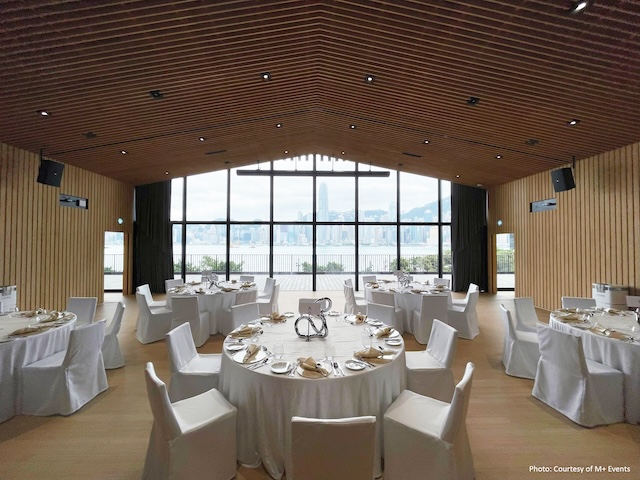
With more than 10 event spaces available, M+ can host anything from meetings, conferences, and ceremonies to elegant banquets and intimate receptions. Each space is distinct and some offer panoramic views of Victoria Harbour, perfect for cultural, corporate, or celebratory occasions.
Professional event service
M+ also provides a one-stop support service including, but not limited to, event management, production, personalisation, sound, lighting, and more. A dedicated and passionate team of specialists will ensure every need is met and create your event with the highest standard.
Highlighted event spaces include:
1 of 5
Grand Stair
The Forum
Main Hall
Atrium
Lightwell Hall
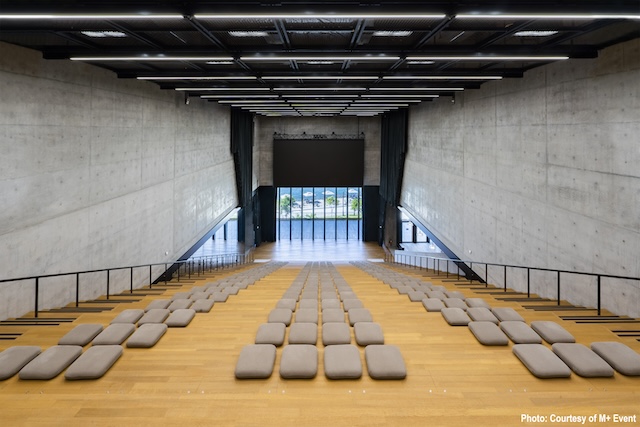
Grand Stair: An amphitheatre with capacity to accommodate large groups, offers stunning city skyline views through floor-to-ceiling windows that let in natural light. When the curtains are closed, it transforms into an ideal event setting with a high-definition screen, stage, and backdrop, perfect for forums, conferences, and ceremonies.
The Forum:Flooded with natural lights, this space radiates comfort, elegance and modernity — great for those looking for private event venues. Seating arrangement here is positioned to take in the view of the harbour beyond the floor-to-ceiling windows. The space can be used for meetings, team events, and intimate banquets.
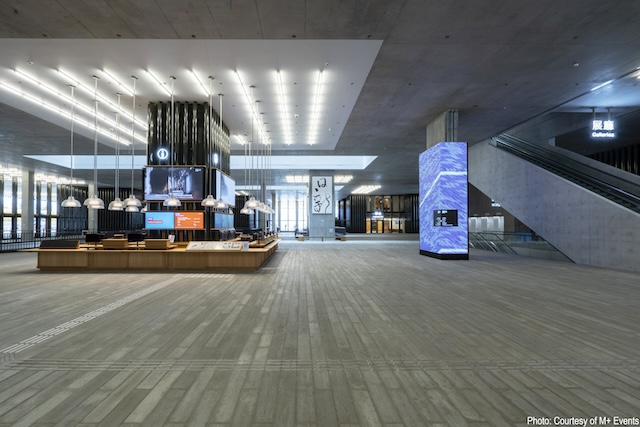
Main Hall: The museum’s iconic centerpiece, near the main entrance, offers natural light and access to the Horizon Terrace with 300-degree harbour views. Ideal for both large crowds and intimate gatherings, its architecture, ambience, and acoustics ensure a unique event experience.
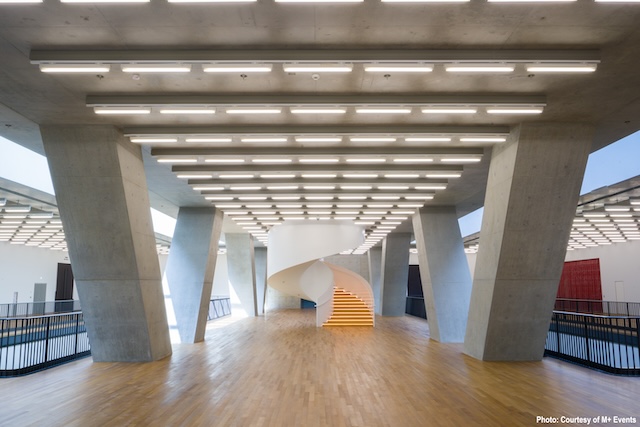
Atrium: With natural light and warm wooden floors, the Atrium offers a relaxed atmosphere for guests to mingle, while the iconic spiral staircase in the centre provides opportunities for speeches and toasts. Surrounded by galleries, Atrium is suitable for evening cocktails together with private exhibition tours.
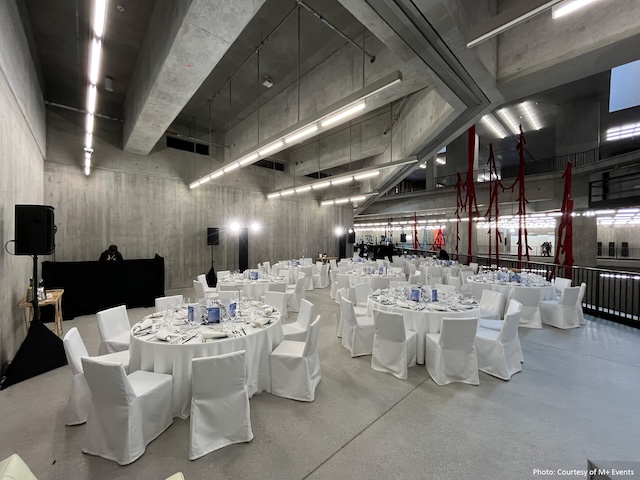
Lightwell Hall: This versatile, triple-height hall offers multi-layered views of the interior, while the geometric layout and artwork on display, enhanced by natural light, making it ideal for mid-size daytime and evening events.
Want to host your next event at Hong Kong’s first global museum of contemporary visual culture? Contact the M+ Event Team at (852) 2200 0800 or eventsales@mplus.org.hk. Find out more about M+.
What are your reflections on a career that has spanned significant evolution in the business events industry?
I have been too busy to think about it but now it is August, I can see the finishing line. Although I do see it more as a next chapter, which might look like sleeping for a week or two to start!
We have gone through many phases: pre-opening, launching, Covid recovery, and contract extension negotiations. We are now at a point where it is crucial to step back and thoroughly reassess our approaches, embracing the cliché, ‘if it’s not broken, let’s break it,’ to adapt and evolve. I won’t be directly involved in this next phase but the market is rapidly changing, and the whole value system of the industry is evolving significantly.
But the industry’s journey has been terrific, and I feel privileged to have been a part of it, and to have helped ICC Sydney reach where it is today.
Few leaders have achieved as much in this industry as you have.What do you put your success and longevity down to?
Well, thanks for the kind words but my success has to be judged by other people. That was probably a big realisation I had very early in my career as a manager before I got into the venue business, which I have been in for 30 years now.
So jumping forward, I do not cook any meals or write event plans. If I was going to do anything in my career and devote as much of my time, energy and mental contribution, it was to work very hard to find the best people. Through a concept of CV plus chemistry – which underpins all of our recruitment programmes – we work very hard to give our staff the best circumstances to get even better. Care and kindness have been foundational in my approach because it is all about people.
Our venue is located in one of the most dynamic and beautiful settings in the world. However, the greatest risk of a negative impression relates to people. We regularly survey our clients and delegates, and run at close to 99 per cent satisfaction ratings. They might mention the building, but they talk about the people and how our team cared about them, their success, safety and security, and their enjoyment.
Have you ever had a blinding revelation, a moment of unexpected insight that had a profound impact on your professional journey?
Actually, there is, now that I think about it. It came during my time in the tourism industry in North Queensland. It was the early days of the Cairns Convention Centre, the first regional centre established outside a capital city in Australia, which presented significant challenges.
We had many ambitious plans, but reality struck when we opened the doors and realised that only half of them worked. So I had to make a whole lot of big changes. And people get excited by the big changes but after they buy in, you have the challenge of keeping people focused and motivated.
I was spending a lot of time in Japan at the time and I read about the concept of kaizen – small, constant improvement. And the story I read was in the early stages of the industrialisation of Japan and there was a business deal with an American company.
The American company said they would tolerate 10 per cent of the products they bought being defective. The Japanese people were very puzzled by that and went back to the Americans and said, we can deliver your product. But why on earth would you want us to make 10 per cent of them defective?
That was a bit of a blinding revelation to me, and out of that came the concept of constant small improvement or CSI, a phrase I coined that resonated and got embedded in Cairns, and then in Sydney.
I also extended the CSI acronym to mean the Client’s Success is Imperative, because when you are fully committed to a client’s success, you will be successful by automatic association. It also stood for Creative Solutions Invented because we know there is a solution for every issue presented. There is no reason to be paralysed by problems. The two biggest variables are time and money, and the best solution is the one you come up with.
What do you believe has been your biggest or most meaningful contribution to the industry?
Probably two parts. First was being able to lead the team through Covid, to retain, sadly not our full team, but very close to it. We worked with our owners and were probably one of the few convention centres in the country, if not the only one, that did not formally close. We kept people occupied and had the most meticulous storerooms in the country. We did a lot to keep as many people in place so that when things turned and came back, we were able to respond immediately and deliver those events.
Second, it was also an incredible privilege to play a part in the industry, serving as chair of what was BECA (Business Events Council of Australia) and then, during Covid, as deputy chair, along with my role in AIPC (International Association of Convention Centres) as chair.
I say privilege because that is another value I hold dear. As you know, ICC Sydney is an A$1.5 billion (US$1 billion) project delivered through the financial model of a private-public partnership (PPP), but I also took that acronym and made sure the staff understood that PPP also stood for Purpose, People, and Privilege. I like to do things in threes, apparently. But if you do not understand that you are in a very privileged position, that is when the sense of entitlement can come in, and that breeds arrogance. Clients will pick up on that pretty quickly.
What do you see as the key challenges and opportunities for the industry’s future and the next CEO?
The industry’s future is marked by an accelerating rate of change, increasing demands for sustainability, and the potential impact of AI and technology. The next CEO will need to deeply understand the importance of people and maintaining a strong culture. It is a dynamic space, and adaptability will be crucial. We must stay ahead of evolving client expectations and the constant evolution of events.
The new CEO will be coming into an incredibly well-established senior leadership team. We have got some of the best people in each of the streams that make up the nine or 10 divisions within the convention centre. We quite deliberately grouped those right at the start into three functional areas for the outcomes of winning events, running events, and supporting events.
Just as people’s technology in their own homes is constantly improving, so are their expectations when they come to a place like a convention centre, which needs to be so much better than what they can experience at home or in the cinemas. That is something the team here will work on.
Do you have a favourite memory from your time in this industry?
I often get asked that. And I am tempted to say, the best memory is the last successful event we ran. But it is probably the first big international event that we had at ICC Sydney, which was the big world banking event, SIBOS. We undertook the whole planning, bidding, and negotiations for that well before the construction even started for ICC Sydney, and it was the very first time SIBOS had chosen a venue that had not been up and running and had a track record. So they put a whole lot of trust in us.
I remember standing in the foyer, quietly in the background, when those delegates started arriving and seeing the different cultures represented by delegates from all around the world, coming together for a common purpose, and that probably reinforced to me what this business was all about.
What do you think you will be feeling when your last day arrives on August 30 and what are your plans moving forward?
I have mixed feelings about retirement and while I am stepping down from full-time duties, I am still in negotiations for a potential ongoing role for a short period. But I take pride in the impact I have had, particularly in selecting and supporting a great team. Beyond that, I look forward to spending a whole day reading a book instead of just grabbing bits here and there, and listening to a whole symphony all the way through.
I leave with an overwhelming sense of pride and satisfaction and if I accept credit for anything, it has been the ability to select and put together a team, and supporting them to be fantastic contributors in their allocated responsibility. I have been involved in so many buildings but at the end of the day, it is the people that made the difference in my life. I run into people who worked with me 10 to 20 years ago and it still gives me satisfaction when they tell me how much they learned from me.
These Standards for the business events industry will boost the country's global competitiveness
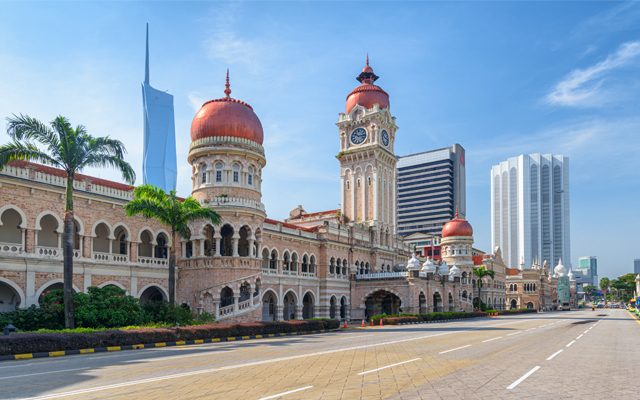
The Malaysia Convention & Exhibition Bureau (MyCEB), in collaboration with the Department of Standards Malaysia and various business events industry players including The Malaysian Association of Convention & Exhibition Organisers & Suppliers (MACEOS), is in the process of developing minimum Malaysian Standard requirements for PCOs, PEOs, and convention and exhibition centres in the country.
The Standard will emphasise compliance and practice in environmental, social and governance guidelines and UN Sustainable Development Goals.
These Standards for the business events industry will boost the country’s global competitiveness
The initiative aims to attract more international business events and investors by ensuring higher levels of professionalism and services.
During a recent closed-door session by the Department of Standards Malaysia, representatives from PCOs, PEOs, and business event venues presented draft guidelines for minimum standard requirements. This meeting took place as part of Malaysia Business Events Week, hosted by MyCEB.
Industry stakeholders, including representatives from government agencies, researchers, academia, business events players, the travel trade, and hospitality, were informed about the draft guidelines. They were invited to provide feedback and suggestions for improvement by October 14, 2024, to the Department of Malaysian Standards.
The guidelines are expected to be ready next year and it will be available on the Department of Standards Malaysia website.
Following this, MyCEB will train a panel of assessors to evaluate companies and certify those that meet the established standards.
The Malaysian Standard for convention centre, exhibition centre and event space outlines the general requirements of these spaces encompassing the physical setting, technology and services. Among the requirements of a physical setting of a convention centre is the capacity to fit at least 100 banquet tables or 1,000 people in theatre seating while the capacity requirement of an exhibition centre is being able to accommodate a minimum of 150 booths of nine square metres each.
Francis Teo, past president of MACEOS and working group committee head for convention centre, exhibition centre and event space, shared: “The Malaysian Standards will help future developers ensure that their facilities meet the benchmarks, creating venues that are competitive, efficient, and adaptable to a wide range of events while promoting growth in Malaysia’s business events industry.”
Meanwhile, The Malaysian Standard for PCOs establishes general criteria and a ‘tier-rating’ system to classify them.
Gracie Geikie, head of the working committee for PCO, explained that the requirements for a Tier 1 PCO include having provided PCO services for at least three years, managing a minimum of five national conventions or congresses with over 200 delegates in the past three years, and employing at least two certified key staff with a minimum of three years of PCO experience in the business events industry.
A Tier 2 PCO is considered more advanced, as the company must offer comprehensive PCO services for conventions and congresses, including handling the entire bidding process and strategic meetings management. Tier 2 PCOs should have managed at least five international conventions or congresses, each with over 800 delegates, and with at least 25 per cent foreign participation within the past five years. Additionally, the company must have a minimum of two certified key staff with at least five years of PCO experience, and employ at least two staff members who either hold or are in the process of obtaining international certification within the year.
This will provide clear benchmarks for companies entering the PCO business, Gracie shared. International organisers seeking to hold conferences or congresses in Malaysia will also benefit from a larger pool of qualified PCOs to choose from.
The Malaysian Standard also details the requirements for PEOs.
Exhibition organisers are responsible for identifying potential business opportunities, planning, and managing exhibitions either on behalf of a client or their own organisation. This role involves overseeing all aspects of an exhibition, from planning to execution, with a strong focus on customer service.
The minimum requirements in the draft of Malaysian Standard for a PEO includes having a registered physical premise for operations, experience in managing at least five exhibitions, and an upcoming exhibition within the year. Additionally, the company must have at least three certified key staff members with a minimum of five years of PEO experience in the business events industry to ensure the effective management of exhibitions.
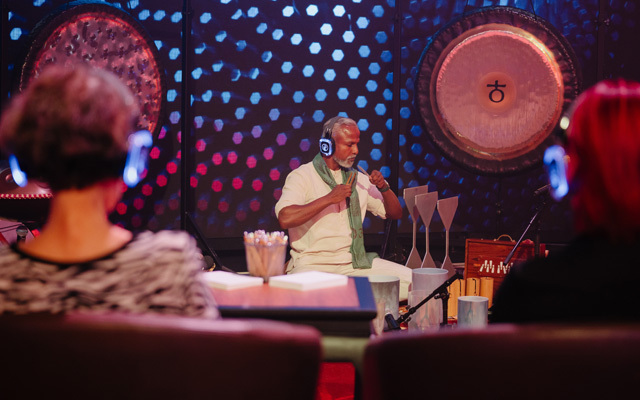
MBS' director of wellness Karu Nanithi taking guests through a Sound Meditation session
Sands Expo & Convention Centre has launched Thrive at Marina Bay Sands – a holistic suite of intellectual, mental and physical wellness experiences for event organisers and delegates.
A collaboration between Marina Bay Sands (MBS) and BEAMexperience, Thrive comprises Thrive Physically, as well as Thrive Intellectually.
MBS’ director of wellness Karu Nanithi takes guests through a Sound Meditation session
Thrive Physically builds on the integrated resort’s existing Where Mind & Body Connect wellness programme, something already offered by MBS for hotel guests and members of the public. Specifically, three classes – Sound Meditation, Soul Flow and Revitalising Strength – will be available for delegates. Sessions last between 30 to 60 minutes, and can be conducted for 10 or more people at a time.
Meanwhile, Thrive Intellectually offers five types of workshops conducted by certified positive psychology practitioners: Energy Forecasting, Empathy Mapping, Self-Regulating, Harmonious Communication and Sensing Synergy. Sessions last for 90 minutes, and are suitable for groups of 10 to 50 people.
Ong Wee Min, vice president, sales & MICE, Marina Bay Sands, elaborated: “Delegates will be guided to reframe disruptions and develop coping strategies to maintain control of situations, and tap onto the energy forecasting pillars to prevent burnout and optimise productivity in their daily lives.”
This is because the meetings and events industry is also moving towards incorporating an element of wellness during conferences and meetings, Ong noted, where a quick stretch or breath work contributes to a heightened ability to think and function.
He added: “Glimpses of this trend were seen at our wellness booth at PCMA APAC’s The Business of Events in April, where delegates enjoyed neck and shoulder massages and self-guided massage gun therapy, as well as sipped on refreshing detox juices.”
Thrive was unveiled last Thursday as part of MBS’ Synergy of the Senses: A Marina Bay Sands Showcase, a preview of the innovative event experiences that the Sands Expo & Convention Centre can offer. Aside from getting to meet partners such as Gevme and Event Design Collective, guests were treated guests were treated to culinary experiences by Bread Street Kitchen, Spago Dining Room, Wakuda, as well as South-east cuisine by MBS’ culinary team.
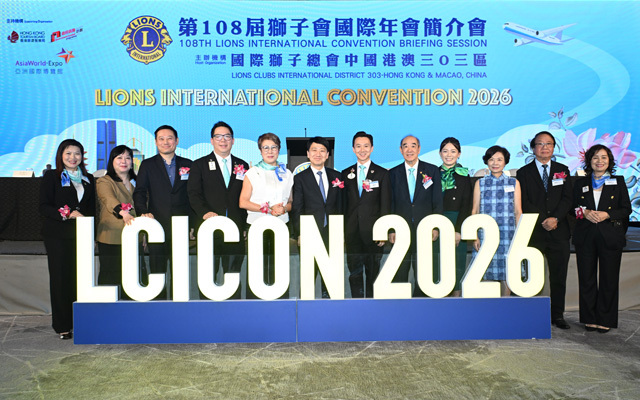
Hong Kong has secured the rights to host the Lions International Convention, which will be held at AsiaWorld-Expo in July 2026.
As one of the world’s largest service club events, the annual convention expects an estimated 20,000 attendees from all over the globe. During their stay in Hong Kong, delegates will be treated to an array of experiences demonstrating the city’s diverse charms.
Hong Kong is ready to roar with excitement
Pang Yiu-kai, chairman of the Hong Kong Tourism Board (HKTB), one of the supporting organisations of the event, said: “This event aligns with our mission to grow the MICE sector and bring the world’s most prestigious events to our vibrant city and drive social and economic benefits for Hong Kong. We can’t wait to welcome the members of the Clubs to our city once again with many new attractions and excitements developed in the past and coming years.”
“We’re thrilled to host the 2026 Lions International Convention in Hong Kong. The city’s diverse culture and dynamic energy will fuel ‘Lionism’ by providing a robust platform for members from around the world to come together and interact with each other as they enjoy making a difference in their communities,” shared Sammy Shum, district governor, Lions Clubs International District 303.
Lions Clubs International is the world’s largest service organisation, with more than 1.4 million members in more than 48,000 clubs in 200 countries and geographic areas around the globe, where members benefit their communities through social and humanitarian services.
Hong Kong last hosted the Lions International Convention in 1992 and 2005, and in winning the bid to host 2026’s event marks the return of one of the biggest conventions to the city.
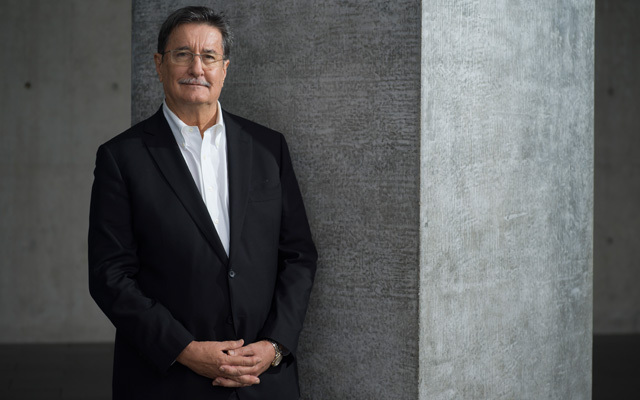
Robin Lokerman, mci group’s group president, has been nominated for the prestigious Hall of Leaders by the Events Industry Council.
The Hall of Leaders award is a prestigious recognition for individuals who have made significant contributions to the events industry. Recipients are acknowledged for their pioneering work, innovations, and lasting impact on the industry. Lokerman’s nomination highlights his contributions to shaping and advancing the events sector.
Lokerman has been a cornerstone of mci group’s success since 2007. He is jointly responsible for the leadership and strategic direction of the group, and has been instrumental in driving the company’s expansion beyond Europe, leading to impressive growth in the Asia-Pacific, Americas, and EMEA (Europe, the Middle East and Africa) regions.
He also consults for associations on strategic planning, board assessment, and global growth strategies, and works with several leading industries at the forefront of knowledge exchange.
Rising costs and restrictions on discretionary spending is impacting hospitality venues across the industry; a restaurant in an Accor hotel pictured
Accor, Australia’s largest hotel operator, has joined the newly formed Australian Restaurant and Café Association (ARCA) as a founding hotel partner.
ARCA was established to provide a voice and action on behalf of an industry that numbers some 54,000 venues, employs over 450,000 people, and contributes up to A$64 billion (US$43.5 billion) to the Australian economy.
Rising costs and restrictions on discretionary spending is impacting hospitality venues across the industry; a restaurant in an Accor hotel pictured
Renowned industry figures, including Neil Perry and Chris Lucas, set up the association, which has Wes Lambert as CEO.
The new industry association is already advocating to influence all levels of government in areas including taxation, skilled worker shortages, wages, rents, dining restrictions, and inflation.
It follows figures released recently by Australian credit reporting firm, CreditorWatch, which predicted that one in every 11 Australian hospitality businesses could fail in the next 12 months as the cost of living crisis worsens.
Accor Pacific director of F&B, Ben Creek, said it was important to partner with ARCA to provide a united voice on the issue.
“We look forward to working with other ARCA members to collaborate and advance the hospitality community as a whole… We invest considerably in training and development, which benefits the wider hospitality industry. Committing such high levels of investment relies on the profitability of our venues, but the current regulatory framework is not providing the support we need.
“The industry as a whole is looking for a fairer deal. We employ and train so many Australians, but there will always be times when we need skilled labour, and currently that is problematic, especially in attracting skilled personnel to regional areas.”
Accor operates more than 223 cafes and restaurants and 167 bars in its network of 350+ hotels, resorts and apartments across the country.
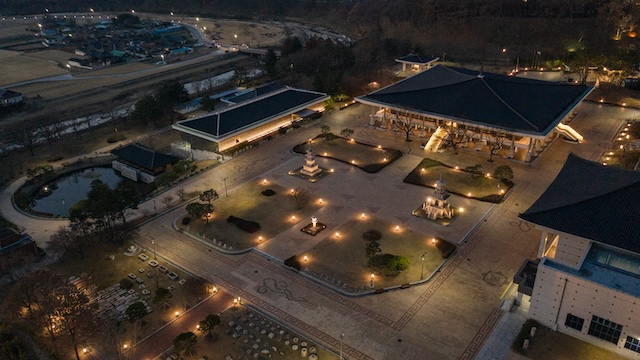
Gyeongju National Museum showcases the rich history and culture of the Silla Dynasty
The choice of venue can turn an ordinary incentive trip into an extraordinary experience.
Korea, with its rich culture, stunning landscapes, and dynamic cities, offers a wealth of unique venues that can add a touch of magic to any incentive programme.
From historical palaces to contemporary art spaces, the country boasts a diverse range of options — 52 unique venues, each with its own charm and is representative of the region it is located in.
By selecting venues that authentically reflect Korea’s charm and spirit, incentive groups can create unforgettable memories and strengthen company bonds.
Here are four unique venues to consider:
Gyeongju National Museum, Gyeongsangbuk-do Province
Located in Gyeongju, the capital of Silla for a thousand years, the Gyeongju National Museum is Korea’s leading museum for exploring the cultural heritage of the Silla Dynasty. Here, visitors can learn about the rich history and culture of the Silla Dynasty through various educational programmes, such as a 70-year-old Gyeongju Children’s Museum School and a Children’s Museum.
Each year, there is a different exhibition held for children to learn about the history and culture of Silla. The special exhibition hall also presents artwork recognised at the Cultural Heritage of Korea Drawing Contest, a long standing tradition.
The auditorium building can accommodate up to 110 persons.
Combine a visit here with nearby attractions, Bulguksa Temple and Seokguram Grotto, which are renowned UNESCO World Heritage Sites. These iconic symbols of Korea’s cultural and spiritual heritage showcase Buddhist architecture and artistry of the Silla kingdom.
Key facility: Auditorium Building (indoor), 110 persons
Clayarch Gimhae Museum, Gyeongsangnam-do Province
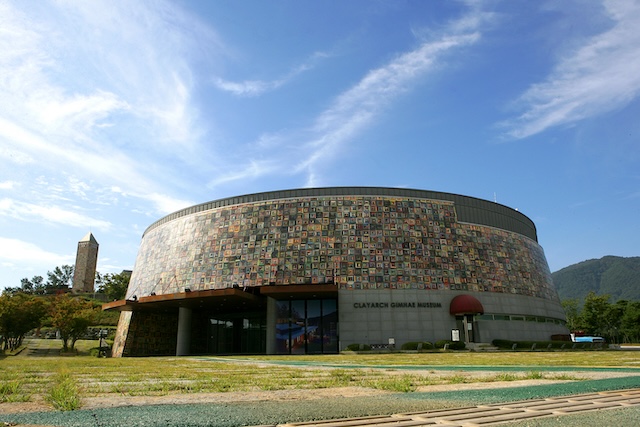
Clayarch Gimhae Museum can host large domestic and international events, exhibitions, educational classes and academic seminars
The Clayarch Gimhae Museum is located in Gimhae, the centre of the ancient Geumgwan Gaya dynasty and the birthplace of Buncheong ware.
The museum is a cultural arts complex with various spaces and facilities, which can host large domestic and international events, exhibitions, educational classes and academic seminars. It is the world’s first museum that specialises in architectural ceramics, and has 5,000 fired painting tiles surrounding the outer wall.
The building itself is considered to be a piece of artwork. There are the Dome House and the Cubic House, which are exhibition spaces, and Ceramics Creative Center, a residency space for domestic and international artists.
Meanwhile, Art-Kitchen and Clay Academy provide various educational programmes with hands-on experiences. Large outdoor events and performances can be staged in two places, a large square in front of Dome House and in Picnic Park, located behind Dome House. The venue also has a media room, which is equipped with sound and lighting systems and can be used as a venue for international academic meetings and seminars.
A unique activity for groups here is Happy Clay, a healing programme that combines yoga, exhibition viewing and ceramic experience.
Up the fun factor by planning a trip to the nearby Gimhae Nakdonggang River Rail Park, which has a scenic 3km rail bike ride that runs alongside the river.
The multi-complex culture and arts centre is renowned for its distinctive architecture
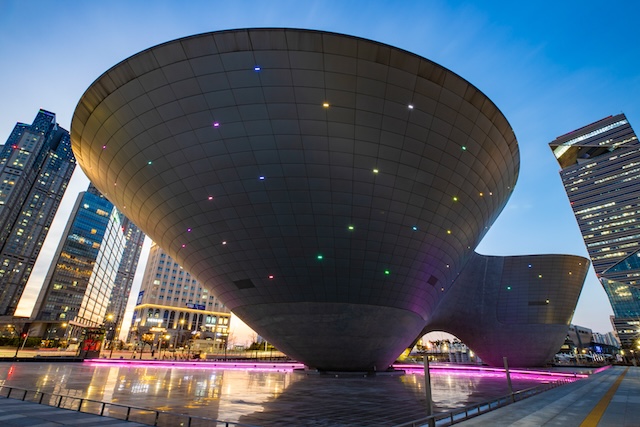
Tri-Bowl in Songdo, Incheon is a multi-complex culture and arts centre renowned for its distinctive architecture. Breaking away from conventional building design, it has a curved floor made up of three bowl-shaped spaces with a flat roof.
Visitors must cross over a bridge that spans over a pool of water to get to the building, which houses an 822m2 arena-type concert hall and 221m2 multi-purpose hall. The iconic Tri Bowl is ideal for anyone looking for a creative and inspiring venue for a wide range of events, exhibitions, and occasions. Viewing of exhibitions and performances can be pre-arranged if schedule permits.
Don’t miss out on the nearby Songdo Central Park, the first seawater park in Korea, where visitors can partake in various water activities including a water taxi ride and canoeing. There are also various arts and installations and cultural performances held regularly.
Sejahtera Forest RCE Tongyeong, Gyeongsangnam-do Province
Learn how to coexist with nature in the Sejahtera Forest RCE Tongyeong, a sustainable development education centre recognised by the UN University
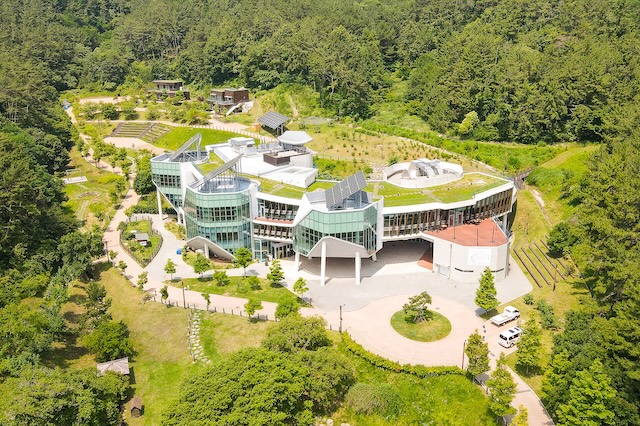
Designated as a sustainable development education centre by UN University, Sejahtera Forest RCE Tongyeong is a place to learn and practise the coexistence of nature and humans, humans and humans, and the present generation and future generations.
Located in Tongyeong, a city of history and art, it offers indoor and outdoor spaces to host multi-purpose domestic and international events such as large-scale seminars and workshops.
The spaces are versatile enough for events of various sizes, from large spaces that can accommodate up to 200 people to small and medium-sized spaces.
Outdoors, there are grass squares for recreational events and outdoor concert halls for small and medium-sized concerts and performances, some surrounded by ocean views. In addition, it has its own lodging facilities and a cafeteria with catering, ideal for one-stop events while healing in nature.
Groups can join Education for Sustainable Development programmes offered by RCE Tongyeong. The programme includes a tour of the facilities to learn about the Sejahtera Center’s sustainable development philosophy.
Combine the visit with a ride on Tongyeong Cable Car, which takes one up the 1,975m Mireuksan Mountain for panoramic views of the surrounding greenery and ocean.
MICE support programme for corporate meetings and incentive tours
Korea Tourism Organization (KTO) has a support programme for companies organising corporate meetings and company incentive trips.
To be eligible, the group size has to comprise at least 10 people and they must stay for at least two nights in Korea.
The support programme is classified into five grades and the type of support offered range from providing souvenirs to convention tourist destinations. Customised support is also available for groups of 201 to 500 participants (Grade 3).
For larger MICE group sizes of 501 to 2,000 (Grade 2) and 2,001 and above (Grade 1), they will be able to receive further support to enhance their stay in Korea. The type of support is subject to change on an annual basis.
The newly-opened Ritz-Carlton, Bangkok anchors the One Bangkok development with cosmopolitan elegance. Featuring the city's largest ballroom and a spectacular new penthouse suite, it delivers exceptional hardware and deeply authentic, soulful service for business and leisure travellers alike
Behind the imposing, Brutalist concrete that defines Zurich’s Oerlikon district lies a surprising secret. While its exterior honours the neighbourhood’s industrial roots, stepping inside Mama Shelter reveals a vibrant, neon-soaked world that is a far cry from its rigid shell
A polished urban retreat designed for business travellers, Hyatt Regency Kuala Lumpur at KL Midtown combines thoughtful design, seamless service, and exceptional facilities.