



- Lack of guiding policies and stakeholder pressure common reasons for events not pursuing sustainable practices
- Singapore Tourism Board sets example of a government agency taking the sustainability lead
- Accountability and courage to take the first sustainable step will be a good start
While sustainability has been a buzzword in the events industry for years, efforts have been slow and varied, opined speakers at PCMA’s recent Sustainability in Business Events Industry webinar, who went on to urge greater efforts to galvanise event organisers towards change.
During the webinar’s opening, Florence Chua, PCMA’s managing director, Asia Pacific, shared that 31 per cent of event organisers who participated in a study said their events were not very or not at all sustainable.
The findings came from the Sustainability in Business Events Industry Situational Analysis white paper that PCMA undertook with the Singapore Tourism Board (STB).
“They were not making inroads because there were not enough policies to guide them, and there was not enough pressure coming from stakeholders to make their event sustainable,” explained Chua.
“There are also other stakeholders event organisers couldn’t manage like sponsors, exhibitors, and delegates who were contributing to the emissions,” she added.
However, Chua believes that concrete measures can be taken to achieve progress collectively across the industry, and encouraged event organisers to play “the role of the ringleader” by “raising awareness” across all stakeholder groups.
She also encouraged event organisers to look at the circular economy moving forward. A circular economy involves both using and reusing more of the same items, thereby reducing the need to produce products that ultimately create waste.
To help event organisers in that direction, PCMA has developed a set of RFP and contract language that they can use to engage with suppliers during contracting. During this stage, organisers can look at how to make their F&B more plant-based, and check with their venues on renewable energy usage and waste management.
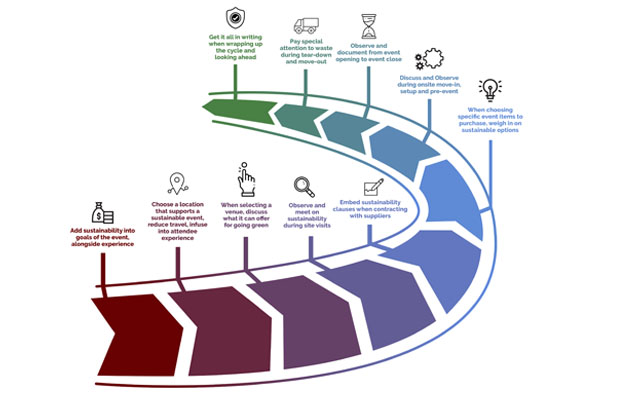
PCMA also has an event planning map, with five considerations that event planners can take collectively to scale progress. Breaking down the event lifecycle to 10 pin drops, PCMA provides at least five considerations per pin drop, to help event organisers consider their next-level actions and what they can be doing to make their event more sustainable.
Complementary efforts
On the governmental level, STB has aligned its sustainable efforts with United Nations’ Sustainable Development Goals (SDGs). This includes the launch of the Singapore Green Plan 2030 last year, and the development of a tourism sustainability programme.
Edward Koh, executive director, conventions, meetings & incentive travel experience development group, added that STB has also embarked on the journey to being certified as a sustainable destination by the Global Sustainable Tourism Council, and is currently working with the Celsius Industry Association to promote standards, certification, greater adoption of green practices and to build a sustainable minds ecosystem.
These efforts go towards Singapore’s ambition to “become the most sustainable business events destination in Asia Pacific by 2030”, Koh stated.
Another panellist, Kwok Wai Choong, deputy director, industry development and promotion national environment agency, which organises CleanEnviro Summit Singapore (CESG), explained how the event planned its sustainability journey from the start.
Held in April 2022 at the Sands Expo and Convention Centre, the event welcomed 15,000 people from 65 countries, with around 300 participating companies. Sustainability efforts during CESG included the elimination of goodie bags and physical brochures; temperature adjustment in the hall and waiving of business suit requirements; carpeting reduction; and appointment of sustainable food suppliers who converted bread crusts and peels into beer.
Conscious standards
At the end of the day, constant reminders will help industry stakeholders to shore up their sustainability efforts.
Daniel Chua, CEO, Aonia and Greentech Festival Singapore’s event director, said that a “good branding and marketing approach” would help to win more customers.
He added that a “trickle-down effect” from top organisations will also spur organisations along. For instance, in the European Union, there are more regulations on European companies to be green, where governmental organisations are “increasingly asking about justifications to carbon spend”, and more money “is flowing into ESG-related investments”.
Panellists also encouraged event organisers to develop accountability, and take the first step to start their sustainability journey if they have not already done so.
Koh elaborated: “It can be as simple as making a green choice (such as) reducing print, having green menus, and choosing certified green planners.”
“Continue to upskill yourself, and keep up to date with sustainability information and knowledge. Everybody needs to own (sustainability), and be part of the efforts,” Chua advised.







Philippine president Ferdinand Marcos, Jr has directed regional offices of the Department of Tourism (DOT) to work with their respective local government units to determine the extent of damage, and extend assistance to tourism-related establishments (TREs) affected by Wednesday’s earthquake.
The DOT’s infrastructure arm, the Tourism Infrastructure Enterprise Zone Authority (TIEZA), has also been tasked to explore support specifically for cultural and heritage sites impacted by the earthquake.
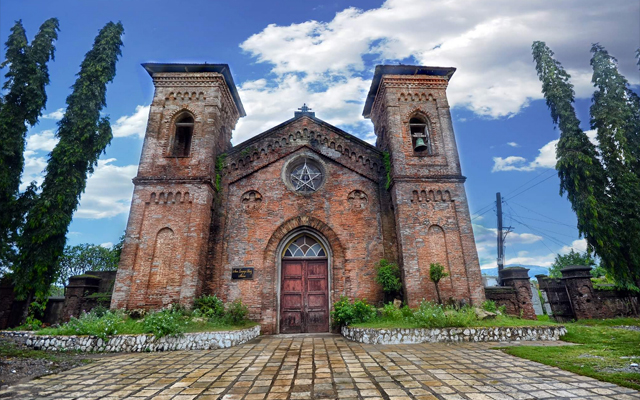
Initial reports note that at least two churches, declared National Cultural Treasure by the National Museum of the Philippines, are affected while several heritage and ancestral houses also sustained notable damage.
Other impacted tourism sites include the Vigan Cathedral in the Heritage City of Vigan in Ilocos Sur; multiple ground faulting in the popular Santa Ana Beach Area; and Lafaayette Luxury Suites Hotel and Crown Legacy in Baguio City.
Two properties managed and owned by TIEZA sustained damage as well. The riprap and ceiling of the Banaue Hotel and Youth Hostel in Ifugao partially collapsed, according to an initial report by the agency.
The quake also brought down the ceiling in the fireplace and lobby area of Mt Data Hotel in Bauko, while several hotel decorations were also damaged.
According to TIEZA, bookings for both impacted properties will be cancelled until a thorough assessment has been made.
DOT secretary Christina Garcia Frasco said in a press statement: “My concern and sympathy are one with those who have been affected by the recent earthquake in Northern Luzon. The Department will extend whatever help it can to tourism stakeholders and establishments that have been directly affected by this incident.
“Our resilience as a nation has already been tried and tested in the past. I am certain that this can be strengthened by the essential collaboration between our national agencies, local governments, and crucial stakeholders as we conquer our challenges.”