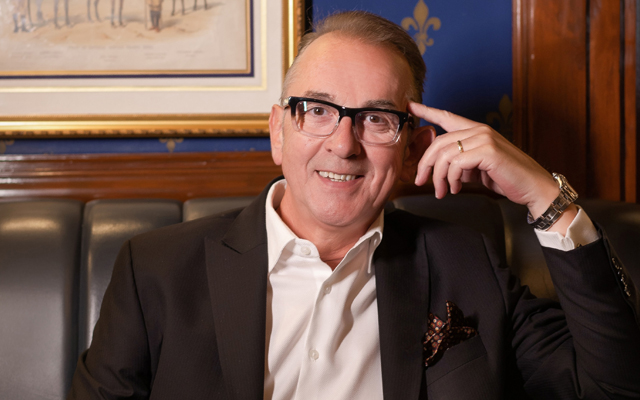
Louis Sailer is the new senior executive vice president of The Imperial New Delhi.
He brings with him an extensive multi-cultural business management background, having turned around global luxury hospitality brands and operations in Germany, Japan, Singapore, China, London, California, Hawaii, the Caribbean and India.
The Smart Stage studio offers delegates immersive meetings and conferences
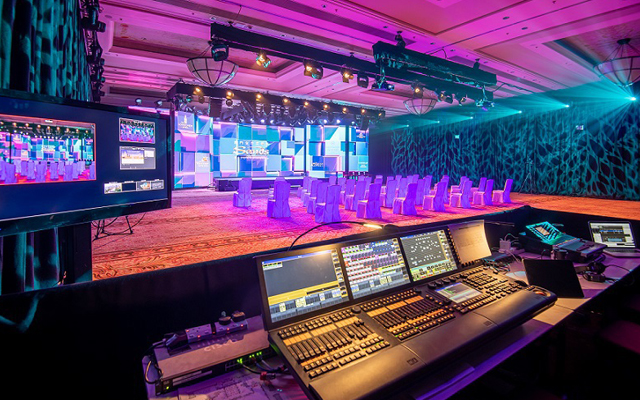
Sands China has unveiled Macau’s first hybrid meetings space, Smart Stage at The Londoner Macao, an Extended Reality (XR) studio.
Smart Stage offers professional broadcast quality live-streaming capability and hologram functionality. Unlike the classic ‘green screen’ environment, XR allows presenters to interact with real-time visual markers to deliver a more authentic experience.
The Smart Stage studio offers delegates immersive meetings and conferences
At the heart of the space is a stage set fitted with a high-tech backdrop and floor that can be reconfigured to fit various event needs. The stage lighting system can similarly be customised, designed and operated to suit an organiser’s requirements. Aside from live broadcast capability, the studio will be able to beam event participants from around the world ‘live’ into Macau via holographic technology.
Sands China’s sales team hosted over 400 virtual site inspections from the Smart Stage in its inaugural month, for customers across the globe including Hong Kong, Singapore, Australia, the US, India, South Korea and Japan.
Stephanie Tanpure, vice president of sales, Sands China, said: “In an ever-changing environment, one constant we face in the MICE industry is the need to create engaging events and experiences whether that be virtual, hybrid, or in-person. Hybrid solutions are quickly redefining the future of meetings and events, and we are excited to be leading this space in Macau.
“Border restrictions have posed a unique challenge for us in terms of customer site inspections, but Smart Stage has enabled us to conduct virtual site inspections, product training, live talks and other events to remain front of mind even in the midst of the global pandemic.”
The newest phase of the campaign will position Australia as a global leader in business events
Business Events Australia has rolled out the second phase of its international brand campaign which includes a suite of new brand films.
Building on the first phase of the There’s Nothing Like Australia campaign, which launched in March 2022, this latest phase forms part of a broader recovery strategy to drive demand for Australia as a business events destination among incentive and association customers in key global markets.
The newest phase of the campaign will position Australia as a global leader in business events
Tourism Australia’s executive general manager of commercial & Business Events Australia, Robin Mack said the new suite of film assets will be part of a targeted marketing campaign across trade and social media targeting customers in the UK, Europe, North America, South-east Asia and New Zealand.
“The film assets bring to life and build upon the new creative strategy for Business Events Australia, which promotes Australia as a destination that is home to friendly people with fresh perspectives, coupled with our diverse and iconic landscapes and world-class venues,” Mack elaborated.
“We are committed to supporting the industry in rebuilding the pipeline business for Australia and as a result are ramping up our business events marketing and distribution activity to ensure the world knows Australia is open for business. International tradeshows, such as IMEX Frankfurt, will be key to our success, providing the opportunity to reignite relationships and share with buyers the wealth of new accommodation, venues and experiences that have opened these past few years,” Mack said.
The film assets will be rolled out as part of an integrated campaign across trade and social media from this month and will be supported by content and public relations activity.
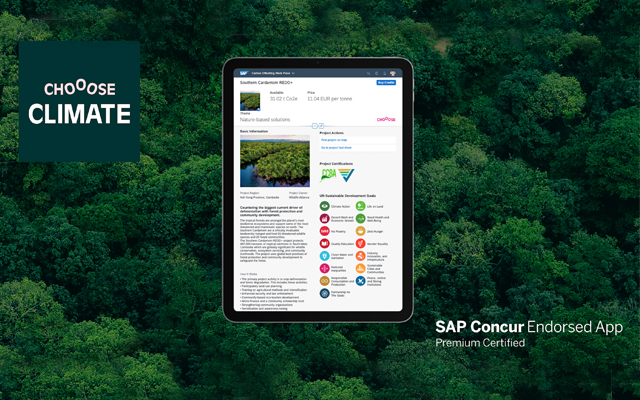
The CHOOOSE Climate App helps organisations worldwide to measure, reduce, and manage their travel emissions
CHOOOSE has partnered with SAP Concur to launch its new CHOOOSE Climate App, a carbon emissions management solution available on SAP Concur App Center in the SAP Concur Endorsed Apps category.
Andreas Slettvoll, CEO at CHOOOSE, said: “Climate App’s integration with Concur Travel and Concur TripLink can significantly contribute to accelerating access to climate solutions working to reduce global travel emissions. The integration enables companies worldwide to measure, reduce, and manage their travel-related CO2 emissions, bringing us one step closer to the net-zero society we are all working to achieve.”
The CHOOOSE Climate App helps organisations worldwide to measure, reduce, and manage their travel emissions
The Climate App automates flight-related carbon emission measuring and reporting and allows companies to reduce their carbon footprint or address unavoidable emissions by supporting verified, high-impact climate solutions, such as carbon removal, offsetting projects, and Sustainable Aviation Fuel (SAF). Travel emissions are automatically calculated based on the latest industry standards.
Benefits of integrating Concur Travel and Concur TripLink with the CHOOOSE Climate App include:
High-precision emission calculations, automatically generated from travel data in SAP Concur solutions.
Track, manage, and report on the performance of your corporate programme through the live carbon emissions dashboard.
Access and select from high-impact, vetted carbon solutions within an SAP Fiori native app.
Access rich content to track and learn about the selected climate solutions and the Sustainable Development Goals they impact for Environmental, Social & Governance reporting and communication purposes.
Businesses that use SAP Concur solutions can choose from a portfolio which contains climate solutions with proven impact around the globe, vetted by CHOOOSE carbon professionals and certified through internationally recognised standards. The portfolio of climate solutions ranges from renewable energy and nature-based solutions to community-based projects to Sustainable Aviation Fuel.
SAP Concur App Center offers 270+ partner applications that connect to and enhance SAP Concur solutions, enabling businesses to optimise travel and spend management programmes.
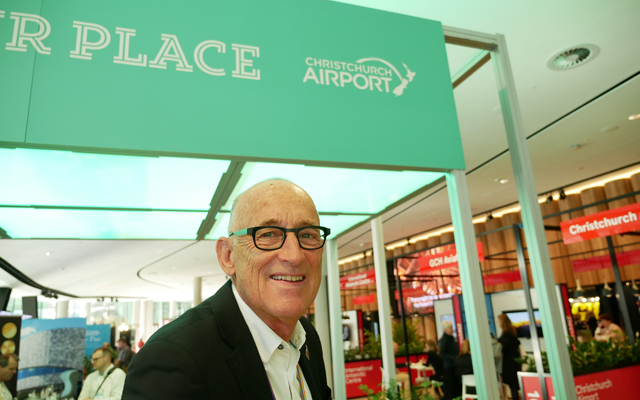
Christchurch Airport's Scott Callaway announces welcome packages at Meetings NZ. Photo: Adelaine Ng
Event organisers can now book a welcome package for business events groups at Christchurch Airport, in what is believed to be the first of its kind for an airport.
Unveiling the offer at New Zealand’s Meetings event last week, event planners can now book a purpose-built welcome lounge complete with signage in the terminal, as well as digital signage in various configurations from the arrivals hall through to baggage claim.
Callaway: airport packages to welcome delegates now available for event planners. Photo: Adelaine Ng
“The reaction we’ve received from conference organisers is that they absolutely want this,” said Scott Callaway, general manager of trade development Christchurch Airport.
“Our research revealed that organisers of large-scale meetings want the experience to begin upon arrival. It’s also the sort of thing that we can include in bid documents when the city is bidding for an event of more than 1,000 delegates, so it would come at no cost to the organiser,” he continued.
Christchurch Airport is offering the packages at a base rate of NZ$3,000 (US$1,902) per day for 22 panels of mixed sizes. It also provides additional opportunities for increased visual brand exposure of event sponsors.
“(Traditionally), you’d have to deal with the advertising agency that owns the assets and it’s a bit of a minefield to navigate for costs and number of screens. Making these packages available just makes it so much easier for event organisers to create a welcome experience,” said Callaway.
The welcome lounge is currently set up as a pop-up space at the airport but the plan is to make it a permanent build. A cafe next to the lounge is also in the works.
Held in Christchurch last week, the in-person Meetings tradeshow was hailed as a triumph, as a record 211 exhibitors met with 410 event organisers from Australia and New Zealand across two days.
The event was also the perfect opportunity to kickstart business events by showing off the re-designed city of Christchurch after the 2011 earthquake, as well as the brand new Te Pae Convention Centre.
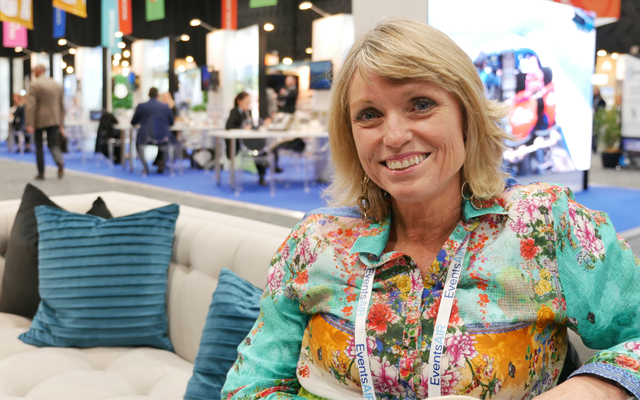
Watson: NZ has regional areas with lesser-known activities that would work for incentives. Photo: Adelaine Ng
“The appetite for Australians to do business events here is strong,” said Sydney-based Leona Watson of Leona Watson Leadership Adventures.
“I think people are ready to expand beyond the borders of Australia and there’s an additional layer of confidence now that we’ve had a few months without any risk of a potential lockdown, and I think New Zealand is a very safe bet for us.”
“What I’ve also discovered (at Meetings) are some unusual regional areas with quirky little activities and adventures, which I always knew about but now I’m really diving deep into them. I’m excited by how you can just take a helicopter ride and make it into this ridiculously amazing experience, whether that’s for a group of 10 or 1,000 people on an incentive,” she said.
Another buyer revealed that some corporate groups are still playing a game of wait and see.
“The biggest concern is the airline capacity,” said Heather Coplestone, managing director of Destination Pacific Australia.
“It’s good to know that Air New Zealand is putting on additional services but it needs to increase it even more. There’s also the concern about service levels. We know New Zealanders have a can-do attitude and they’re very capable, and they’ve been very truthful in sharing with us what they can and can’t do, which is encouraging,” she said.
Air New Zealand is currently operating at 40 per cent of its pre-Covid international capacity, with plans to increase this to 65 per cent by next month. Meanwhile, capacity to Australia is at 50 per cent capacity with expectations this will bump up to 70 per cent in July.
“People are keen to come and they’ll come quite quickly,” said Leonie Ashford, Tourism New Zealand’s international bids manager.
“There’s real demand that you can feel from offshore incentive business because (companies are looking) to reward their employees,” she added.
Voco Orchard Singapore has refreshed its business events portfolio with the rollout of its Thoughtful Meetings offer.
With the Thoughtful Meetings offer, organisers can customise their accommodations and events experiences with two additional perks from the list below. This offer is valid for events taking place till December 31, 2022, with a minimum of 30 delegates per event day or 30 rooms per night.
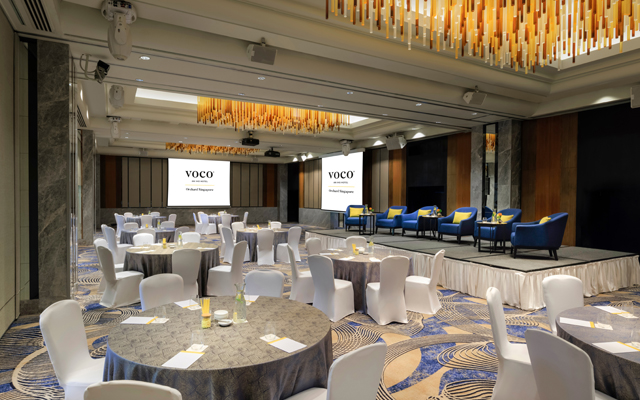
Grand Ballroom
One room upgrade to Club Room with Club Benefits
One complimentary room night for every 30 paid room nights
Complimentary one-way shared transfer to any destination in Singapore
Additional 10,000 IHG Business Rewards points
One round of drinks for the group
One complimentary delegate package for every 30 paid delegates per meeting
50 per cent off room hire for max two breakout rooms
15 per cent off audiovisual equipment
30 per cent off for one dedicated LAN line (50mbps)
Welcome break on arrival
Unlimited soft drinks during coffee breaks and lunch
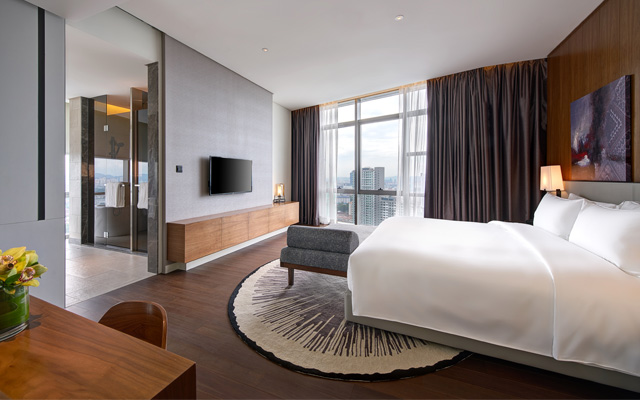
Le Méridien Hotels & Resorts has opened Le Méridien Petaling Jaya, 11km south-west of Kuala Lumpur, Malaysia’s capital.
The 300-key hotel offers an array of meeting and event spaces, such as a 1,700m2 grand ballroom that can accommodate up to 1,000 guests. There are also eight other meeting rooms, good for smaller corporate and social gatherings.
Other facilities on-site include an executive lounge, an infinity pool on the rooftop, fitness centre on the 29th floor, as well as a family programme for business travellers travelling with their families. There are also two F&B options – the all-day dining restaurant Pasar Baru, and PJ’s Bar & Grill on the 30th floor.
Le Méridien Petaling Jaya is 45-minute drive from Kuala Lumpur International Airport or a 10-minute drive from the Sultan Abdul Aziz Shah Airport.
Constellar has announced that Chua Wee Phong, chief executive (markets), will be stepping into the role of chief executive (venues) with effect from July 1, 2022.
Chua has been chief executive (markets) at Constellar leading the exhibitions arm of the business since February 2021.
Chua Wee Phong
His new appointment comes at a time when event activity in Singapore is off to a strong restart. At the Singapore Expo, confirmed venue bookings for 2H2022 are now at 60 per cent of pre-Covid levels in 2019. As such, Chua has been tasked with evolving the venue’s business, as well as accelerating the sustainability roadmap for Singapore Expo to become carbon-neutral by 2024.
Constellar Holdings’ CEO Jean-François Quentin will continue to oversee all matters related to its group of companies. Having covered the role of chief executive (venues) since October 1, 2021, he will now cover the role of chief executive (markets) with a greater focus on the development of Constellar’s events business in Asia, as well as expanding Constellar’s presence in the global marketplace.
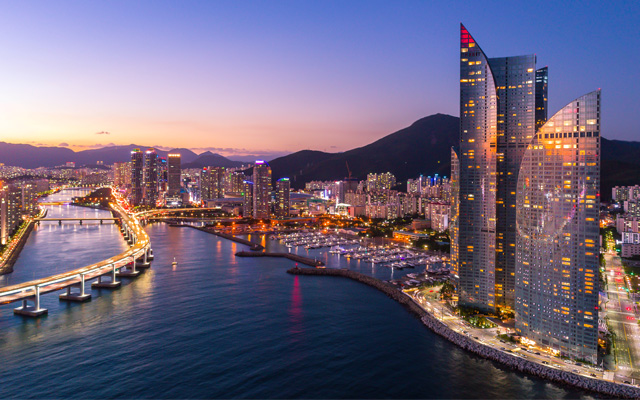
Busan aspires to become an international MICE city
The city of Busan in South Korea has won the hosting rights for the World Anti-Doping Agency (WADA) World Conference in 2025.
The largest international event on anti-doping, WADA 2025 is expected to welcome more than 1,800 visitors from 18 countries and provide an economic boost of around 10 billion won (US$7.7 million) in both production and added value.
Busan (pictured) aspires to become an international MICE city
WADA is an international surveillance body that promotes fair competition by athletes participating in international sporting events such as the Olympic Games and the protection of their health and well-being. Its World Conference is held every five to six years, where current international anti-doping regulations are reviewed, and discussions are had to identify ways to promote fair competition in sports.
Busan’s bid was led by the Korea Anti-Doping Agency, in partnership with Busan Sports Council, Busan Metropolitan City, Busan Office of Education, and Busan Tourism Organization.
Previous host cities of the World Conference are Lausanne, Switzerland (1999), Copenhagen, Denmark (2003), Madrid, Spain (2007), Johannesburg, South Africa (2013), and Katowice, Poland (2019).
Just 10 minutes from Phuket International Airport on the serene northern coast, this 178-key, Bill Bensley-designed resort offers delegates a quiet, tropical paradise steeped in Phuket’s tin-mining heritage
The newly-opened Ritz-Carlton, Bangkok anchors the One Bangkok development with cosmopolitan elegance. Featuring the city's largest ballroom and a spectacular new penthouse suite, it delivers exceptional hardware and deeply authentic, soulful service for business and leisure travellers alike
Behind the imposing, Brutalist concrete that defines Zurich’s Oerlikon district lies a surprising secret. While its exterior honours the neighbourhood’s industrial roots, stepping inside Mama Shelter reveals a vibrant, neon-soaked world that is a far cry from its rigid shell





 Grand Ballroom