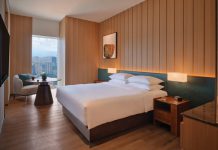
Overlooking Waitematā Harbour, the new Park Hyatt Auckland has been designed to reflect a Māori wharenui (house).
Within the seven-storey hotel are 195 guestrooms, where meeting delegates can be housed in the lead-in rooms measuring 47m², and VVIPs in the 245m² Presidential Suite. A majority of the rooms overlook the Lighter Quay or the harbour.
Park Hyatt Auckland
1 of 3
Events can be arranged for easily, as the property offers more than 9,500m² of flexible event spaces, including a ceremonial garden, meeting rooms and Waka; the rooftop bar.
There are also four F&B venues on offer, such as the Onemata, the hotel’s signature restaurant serving local produce; and the Captain’s Bar with an extensive list of spirits and snacks.
Asia Pacific Incentives and Meetings Event (AIME) has appointed Silke Calder as its new event director.
With over 20 years of experience across creative agencies, international trade conventions and venues, Silke joins the team at Talk2 Media & Events to spearhead AIME’s first hybrid event.
Her most recent role was head of sales guest events at one of the world’s
largest trade fairs and venues, Messe Frankfurt Venue.
AIME will take place next year at the Melbourne Convention and Exhibition Centre on March 15–17 and be available online March 15–26.
Ani Santos has been appointed to a new role at Conventions and Incentives New Zealand (CINZ) as communications and projects coordinator.
Santos d started her career in sales and marketing within the hospitality industry, before pursuing a career in events. Originally from the Philippines, she came to New Zealand in 2015 and took a graduate diploma in event communications.
After graduating, she joined The Conference Company and for the past three years she has worked with Jan Tonkin and the team as delegate services coordinator, later transitioning to sponsorship and exhibition coordinator.
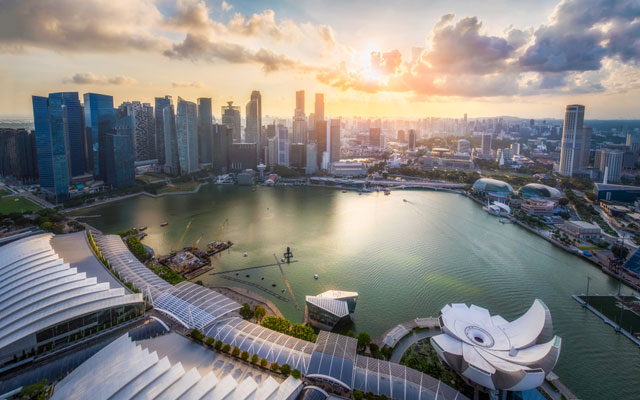
Singapore Tourism Board (STB) and Visa have signed a three-year MoU to buoy up tourism and lifestyle SMEs that have been impacted by Covid-19.
The collaboration focuses on two areas to revive the local tourism industry: marketing partnerships, as well as joint research and analytics.
STB, Visa partner to drive local spending and support tourism and lifestyle SMEs battered by Covid-19
In the first phase of their marketing partnership, which will be launched in October 2020, both organisations will tap on their respective campaigns – #SingapoRediscovers and #WhereYouShopMatters – to encourage Singaporeans to shop from local retailers and support the domestic economy.
STB and Visa will also roll out joint campaigns centred on three key themes: Escape, Feast and Shop. These themes are aligned to encourage spending at hotels, attractions, F&B outlets and other local retailers. Partnership efforts will also profile homegrown brands and business owners, including showcases of how SMEs can adopt e-commerce and technology such as contactless payments.
In the second phase of the marketing partnership – when international travel resumes – experiences, events and activities in Singapore will be promoted through content creation, promotions and tourist privileges. These campaigns will be launched in phases in key markets based on readiness to travel. STB and Visa will also trial initiatives to drive incremental spending through cross border e-commerce.
Under the push for joint research analytics, both organisations will combine proprietary data, as well as research and analytical capabilities, to derive insights on how Covid-19 has changed domestic and international consumer behaviour. These insights will help identify new trends and opportunities that will be shared with local SMEs.
This has been kickstarted by the collaboration’s first report, Impact of Covid-19 on Tourism in Singapore and the Road to Recovery and Transformation. The report found that local brands are the worst hit, experiencing double-digit negative growth, with a lack of online presence; while Orchard Road and Marina Bay were the hardest hit precincts.
In the next phase of their data and research collaboration, STB and Visa will focus on the impact of Covid-19 on business travel. Business travel represents the country’s highest-yielding segment, and this in-depth study will identify changing behaviours, new trends and growth opportunities to guide future campaigns on capturing inbound business tourism spend.
As international travel gradually resumes, the partnership will be scaled up to include joint international marketing, powered by data and insights derived from their combined research. The aim is to develop marketing strategies and initiatives to help Singapore businesses capture demand once global travel resumes.
Like its namesake inspired by four Chinese inventions – the letterpress, compass, paper and gunpowder – The Chinese National within the Swissôtel Jakarta PIK Avenue can be divided into four speciality venues when the sun sets.
Photos by Owen Raggett
The dining destination comprises Letterpress, a teahouse by day and cocktail bar by night; Iron Needle, a dumpling and noodle shop; Black Powder Red, a restaurant offering a modern twist on Szechuan cuisine; and Paper Duck, a luxury Cantonese roast duck venue.
During the day, the four different spaces meld together as one for breakfast. However, there are many hidden panels around, allowing the four venues to either connect or disconnect as needed, which is a boon for event planners.
The versatile, individual zones, or the entire space, are available for corporate events such as a networking session or meeting. Minimum spend for the private dining room is IDR 3,000,000 nett (US$205), while minimum spend to book the entire space is subject to the event.
For a delegate’s peace of mind, health and safety initiatives are also in place, ranging from the mandatory temperature check, and the implementation of social distancing.
All Nippon Airways
All Nippon Airways (ANA) has introduced vinyl curtains at check-in counters and lounge receptions. Hand sanitisers are available at self-service check-in machines and self-service baggage drop machines, while social distancing markers are in place. Machines and wheelchairs are disinfected regularly.
Passengers will be asked to pick up and scan their own boarding passes, and temperature checks are also in place at most airports. Boarding for both domestic and international flights will be according to seat, starting at the rear, from window to middle to aisle, moving to the front of the plane.
On flights, staff will wear masks and gloves. Passengers will be asked to refrain from leaving their seat and keep conversations to a minimum. Tables, armrests, TVs, controllers and toilet doorknobs will be disinfected after every international flight and after every night for domestic flights.
In ANA Lounges, food and drinks will be individually wrapped and some services will be suspended. – Kathryn Wortley
Cathay Pacific
Cathay Pacific first requires all passengers to answer health screening questions upon check-in. Passengers are also required to wear face coverings in most situations such as at security lines and baggage collection areas.
A two-metre social distancing rule is enforced by staff at check-in, during boarding, in-flight, and during disembarkation.
Onboard, quality air is ensured by HEPA filters which remove 99.9 per cent of airborne contaminants and fresh air recirculates every two minutes. Crew have to don masks, gloves and goggles, and are under strict layover orders to have no contact with the local community in destinations they travel to.
All Cathay Pacific lounges outside of Hong Kong, with the exception of Shanghai Pudong International Airport, have been closed. Those that are open have taken additional precautions by temporarily modifying dining options. – Prudence Lui
Emirates
Customers flying with the Middle Eastern airline from now until October 31, 2020, can claim medical expenses of up to €150,000 (US$174,000) and quarantine costs of €100 per day for 14 days, should they be diagnosed with Covid-19 during their travel. Applicable across all fare classes and destinations, this cover is valid for 31 days from when a passenger flies the first sector of their journey.
On the ground, chauffeur services for First Class and Business Class customers have resumed. All drivers will wear masks and gloves, and all cars will be cleaned and disinfected at the end of each shift. Upon check in, passengers will receive complimentary hygiene kits comprising masks, gloves, antibacterial wipes and hand sanitiser.
At Emirates’ lounge in Dubai International Airport, food is served in hygienically sealed meal boxes, while single-serve bottles of beverages are just some of the modified amenities to ensure safety.
All cabin crew on board will wear personal protective equipment. Magazines and printed reading material have been removed indefinitely, and comfort items such as mattresses, pillows, blankets and headphones are hygienically sealed.
Aircraft have been fitted with HEPA air filters which remove 99.9 per cent of viruses and eliminate dust, allergens and germs from cabin air. Upon arrival in Dubai, each aircraft goes through an enhanced cleaning and disinfection process. – Rachel AJ Lee
Qantas
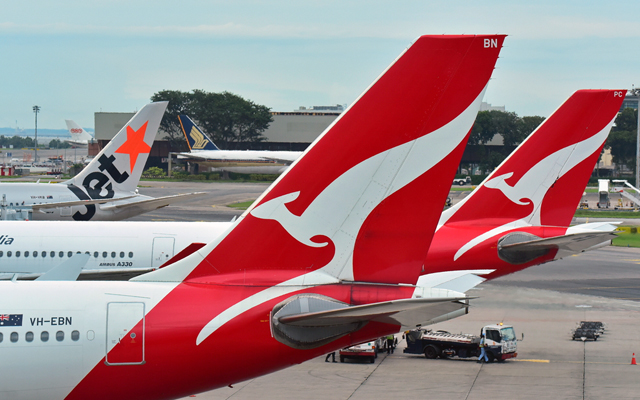
Qantas introduced a Fly Well programme in June, which includes a range of measures such as enhanced cleaning, minimising points of contact and individual packs of sanitising wipes and masks for each passenger. Customers are sent information before their flight so they know what’s expected and are encouraged to use contactless check-in methods and self-serve bag drops.
The airline has also installed hygiene screens at airline customer service desks and made temporary changes to the Qantas Lounge which encourage social distancing.
Onboard, passengers are provided with masks, sanitising wipes to wipe down their seating area themselves as an additional measure to the airlines’ already enhanced cleaning of high-contact areas including armrests, trays, seat belts, overhead lockers and air vents. Sequenced boarding and disembarkation are also operated to minimise crowding.
Qantas’ planes are already fitted with hospital-grade HEPA filters. – Adelaine Ng
Singapore Airlines
Singapore Airlines (SIA) and its sister airlines are currently providing Care Kits that each include a surgical mask, anti-bacterial hand wipes and a hand sanitiser to all passengers.
The airline has migrated all of its seatback literature to the SingaporeAir mobile app, on which passengers can also navigate the inflight entertainment system. Crew don face masks throughout the flight, eye goggles when interacting with customers, and gloves during the now-limited meal service.
Meal services have been suspended for flights within South-east Asia and services to China. These are replaced by snack bags. On longhaul flights, a single tray service has been introduced in First Class and Business Class in place of a table layout service.
Every aircraft under the SIA Group undergoes fogging procedures that follow regulatory requirements; as well as a wipe-down using strong approved disinfectant of common surfaces and areas. Reusable amenities, like headrests and pillows, are also washed and replaced after every flight.
Aircraft are equipped with HEPA filters, while almost all lavatories in SIA aircraft feature contactless faucets and have anti-bacterial hand wash. SIA is also trialling an ultra-violet light cleaning procedure for its lavatories before every flight.
At SilverKris Lounges, cleaning procedures have been stepped up, and customers now order meals from a menu instead of picking off a buffet line. – Pamela Chow
Corporate travel in 2019 was on an upwards trajectory, and growth looked set to continue this year, with Global Business Travel Association (GBTA) prediciting that global corporate travel spend would grow to an estimated US$1.6 trillion in 2020.
That prediction was tossed out with the onset of Covid-19 in early March and resulting border closures and restrictions. Worldwide airline capacity has fallen 80 per cent compared to 2019 levels; and almost 90 per cent for international flights.
A sliver of hope
At press time in September, green shoots of recovery have started emerging in markets with a large domestic base.
Greg O’Neil, president Asia Pacific of BCD Travel, expects the return to air travel “to be gradual and slow, starting with the domestic markets”.
In a survey conducted with 100 travel buyers by BCD Travel, essential business travel is slowly resuming (73 per cent), with 25 per cent of respondents indicating they would recommend direct flights to minimise risk.
Jo Sully, vice president APAC, American Express Global Business Travel (AMEX GBT), agreed: “We are already seeing evidence of this demand in the business sector with an increase in domestic travel in countries including China, Australia and parts of Europe.”
FCM Travel Solutions’ State of the Market Survey also showed encouraging travel intentions – 70 per cent of participants agreed or strongly agreed that they expected to increase business travel gradually over a period time with consensus peaking in business travel returning domestically in one to three months (40 per cent), and internationally in six to 12 months (32 per cent).
FCM Travel Solutions’ general manager, Bertrand Saillet, stated that the speed to recovery was dependent on government regulations around border restrictions and quarantine measures.
“In Asia-Pacific, we already see great traction on domestic routes in most markets and particularly in China and Australia. International travel remains extremely limited,” he added.
For business hub Singapore, where domestic business travel consumption is non-existent, rebound is dependent on four key factors.
James Chua, general manager of Singapore’s Global Travel, said: “These concerns include the reopening of borders, lifting of quarantine measures, airlines resuming their flights, and travellers regaining their confidence to fly.
“The quarantine of 14 days in the destination of visit will certainly be a deterrent to corporate travellers. Only if this is lifted or when a cure for Covid-19 is found, demands will be at a minimum at least for the next six months.”
New considerations
With health and hygiene factors a top priority now, corporate travel managers are expecting all travel suppliers – not just airlines – to provide reassurance of their safety and cleanliness protocols.
Another research with 1,260 business travellers that BCD Travel conducted revealed that top concerns included quarantine measures after travel, followed by social distancing and cleanliness of their environment during trips. Nine in 10 also rated frequent enhanced disinfection of airport and aircraft as extremely or very important, followed by new boarding procedures and empty seats on airplanes to accommodate social distancing.
The FCM survey found that 59 per cent of respondents regarded traveller and supplier health and hygiene factors as top priority. When asked what would trigger the prompt resumption of business travel, the easing or lifting border restrictions came in tops with 93 per cent of respondents saying it has significant or some impact.
However, the second trigger is the employer’s travel direction, with 89 per cent of respondents saying that they would travel if their “organisation deems it safe to travel and this is reflected in our travel policy”.
For those that are willing to travel now, Chua opined they will have expectations such as “wanting to know the safety measures that the airline has put in place, and wanting to be updated on new travel requirements for the intended destination including transit”.
Sully shared that her recent conversations with travellers found that “demand is strong”. In fact, most would still consider travelling this year, but would want “to be armed with the right information at the right time”. This is because “potential for disruption is now a constant”.
“Airline schedules, processes and entry rules can change at a moment’s notice in response to local government actions. We have already seen a government quickly responding to risk with the stopping and starting of travel most recently in Melbourne, Australia,” she said.
To keep travellers informed, AMEX GBT developed Travel Vitals, a source of information for use before, during and after a journey. It draws data from hundreds of sources, including governments, airports, airlines, risk management partners and hotels, to provide advice on travel restrictions, and identify Covid-19 infection rate spikes and hot spots.
Similarly, BCD Travel also developed the Informed Traveler, where users will have access to real-time information such as destination risk alerts, airline and hotel policies, ground transportation protocols and travel restrictions.
FCM Travel Solutions has its own information resource too, in the form of Traveller Hub.
Two-way communication
Airlines are doing their part to keep TMCs updated, as well as provide as much flexibility as they can.
Chua shared that his airlines partners were supplying flight restoration updates, travel health advisory, and Covid-19 checklists.
Saillet added: “While airlines are making a lot of changes for air travel in future for all travellers, we are seeing some airlines add specific measures to ensure their corporate clients are being looked after. For example, certain airlines are offering free name changes.”
AMEX GBT’s Sully has also received regular communications from airlines that address the increased measures they are taking, ranging from new cleaning processes and contactless check-in procedures to change fees waivers and unlimited booking changes.
O’Neil noted: “Airlines need to think now how they reposition and market themselves as the industry re-emerges – messages showing a clear commitment to safety (and) hygiene will determine the winners.”
He further opined that for corporate air travel to reach pre-Covid volumes, recovery would probably take two to three years.
“Meanwhile, TMCs must reinvent themselves, adopt new technologies, and increase productivity to stay relevant as the landscape has evolved and will certainly involve further,” Chua added.
Traditional event houses flourishing with digital transition
An educational journey internally and externally
Attention to data protection and privacy needed
With ‘pivot or perish’ being the battle cry for event companies amid this pandemic, many traditional setups have found themselves sharpening their online and hybrid event capabilities to remain relevant.
Corporate live-streams are becoming increasingly common (Photo credit: Aavii Worldwide)
Embracing the online shift, Chab Events invested in staff training to grow them into digital product experts to drive the growth of its digital platforms under Chab LAB.
Alexis Lhoyer, Chab Events’ chief business officer, said: “Before, the teams needed to be comfortable with construction and carpentry, audio and lighting, or registration and set-up logistics. (We shifted our focus to) training our existing live events teams, as digital events are about stronger video content, streaming and conferencing technologies, HTML, online event platforms and interactivity solutions.”
The investment is worth it, opined Lhoyer, as it has provided the company with “the opportunity to create additional capabilities in the company”.
Reading the potential market development right, Singapore-based events company, Jublia, developed a one-to-one virtual meetings software called Match Virtual, which “has since been used widely in various virtual and hybrid events since March 2020”, shared Errol Lim, COO and co-founder.
Malaysia’s Aavii Worldwide has also found success in supporting its clients in the online space as soon as the country enforced its nation-wide Movement Control Order in March. Between April and July, it managed nine webinars and five live-streaming launches and award shows.
The company’s group CEO Francis Cheong recalled that the transition was not an easy one, with some “casualties” along the way.
“Some of our team members simply weren’t savvy enough for platforms like such Zoom, GoToWebinar, Webex and Microsoft Teams, and they stumbled. I had to transfer certain employees to manage social media or write articles. Many of them had numerous late-night (meetings) via Zoom and private training sessions during the lockdown, and they encountered numerous trial-and-error to ensure that our webinars work,” said Cheong.
“I was extremely lucky to have a dedicated team,” he concluded.
Jeremy Ducklin, managing director of Congress Rental Australia & Singapore, too, shared that event specialists had to endure a rapid transition, as clients that relied on remote interpretation as a plug-and-play solution in the beginning soon learnt that a “successful, smooth and professional” online event requires the support of a “team of experts”.
Fortunately for Congress Rental, the shift towards a remote event solution was already taken over the past three years.
Ducklin said: “The overall shift towards hybrid and virtual events meant that the types of jobs we were getting had changed. We are now seeing more remote interpretation jobs, and a change in attitude towards the technology.”
Jublia also found time to develop a one-to-one virtual meeting software
When asked if new talents had to be brought into the team, Lim said: “We are definitely growing our team to meet the increasing demand. At the same time, we are cautious not to bite off more than we can chew in our growth plans. I say this because the virtual and hybrid events are still extremely novel. There are a myriad ways for implementation, hence grooming capable thought-leaders and digital event experts within the team needs to be done organically, in-line with our vision and purpose.”
Learning curve for all
The advancement in hybrid and virtual event format is no doubt an educational journey for event association and corporate meeting organisers and their suppliers.
Kenny Goh, founder, miceNeurol, said: “We know the concept, but until you do the hybrid or virtual event, one thing can lead to another. It is definitely a learning curve for everybody.”
Goh: sufficient preparation for speakers and delegates is critical for online event success
Working recently with a dental association with speakers and delegates across five continents, Goh said the virtual event had to be “market” and “target” focused and convenient session times limited to two time zones.
While a delegate can listen to a recorded session, he noted speaker management was more challenging because a speaker or panellist who gets the date and time mixed up “will have consequences down the line”.
Organisers also “cannot stinge” on live support, and Goh shared 80 per cent of the dental delegates had “computer problems” like university firewalls or users not clearing their cache, adding that delegates often don’t read the sign-in instructions and smartphones users may not be able to access the event if YouTube or Vimeo is banned in their country.
“The event technology company must be able to “share screen” to resolve the issues quickly,” Goh stressed.
Meanwhile, GlobalSign.in created a Digital Event Academy offering checklists, templates, guides and user cases to educate users when it launched its GEVME Live platform, which allows event organisers to create events by populating the content, at the end of June.
“We know at this time we have to do a lot of education as many clients are not familiar with live streaming production,” according to Daniel Tjan, director of customer success.
GEVME Live was tested for a Hong Kong public exhibition with some 300 exhibitors where China was the target market. It garnered more than one million views. Tjan observed that the challenge was to keep attendees engaged eight hours daily for the one-week event.
Ace:Daytons Direct, founder, Nancy Tan, observed converting face-to-face events to hybrid or virtual does not come cheap if very high quality engagement and professional studio facilities and personnel are needed.
“It is an education process and clients are now probably just familiar with Zoom and do not know much about the reliability and safety of streaming platforms, the different components of creative production, etc,” she added.
Still, Tan believes such events will stay relevant even after face-to-face gatherings are allowed because some delegates may not be able to travel to an event for whatever reason, or if attending a live event was too costly.
Eye on data protection and data analytics Part of the scope event technology company platforms provide is data processing audit trails and the necessary safeguards for data protection and personal privacy compliance under GDPR (general data protection regulation) and PDPA (personal data protection act), required by various countries.
Online registration and accreditation is akin to giving an event organiser a name card to register for a live event, but miceNeurol’s Goh observed many still do not know about GDPR which protects data privacy of EU delegates or PDPA in the case of Singapore.
Goh warns of the need to be aware of European privacy ‘pirates’, mostly law firms, he claims, who ‘register and sue’, and a number of affected companies have been fined.
“Companies need a system to track this,” Goh noted, adding that Facebook and Google were the first to face GDPR lawsuits.”
The advantage of event technology is the data collected and data analytics is a powerful tool to negotiate with sponsors, to determine what were well-received topics, speakers and sessions and how to better plan and market subsequent events. – Additional reporting by Rachel AJ Lee and Karen Yue
Slow corporate travel rebound expected, movement limited to business-critical trips
Arduous application-approval process and rigorous quarantine measures remain an obstacle
New approach needed for duty of care, meeting itinerary
Travel managers are withholding their verdict on the effectiveness of Singapore’s reciprocal green lanes with several countries in spurring business travel recovery, saying that traveller confidence and ease of visa applications will determine the arrangement’s success.
Most corporates are not ready to leap back into business travel
The city-state has recently added Brunei, South Korea and Japan to its list of reciprocal green lane arrangements for business and essential travel, joining earlier agreements with China’s Chongqing, Guangdong, Jiangsu, Shanghai, Tianjin and Zhejiang as well as Malaysia.
Singapore, whose travel and tourism industry is heavily dependent on international markets, had also on August 21 announced the lifting of border restrictions to allow entry of visitors travelling from New Zealand, although the move has yet to be mirrored by the New Zealand government.
Akshay Kapoor, CWT’s senior director, Multinational Customer Group, Asia Pacific, told TTGmice that companies are still in ‘wait-and-see’ mode to determine the resilience and stability of these arrangements.
“Without a doubt, the opening of green lanes between Singapore and other important business travel markets like China and South Korea, as well as the gradual resumption of bigger meetings and events, are viewed as positive developments by our customers who are keen to travel and meet face-to-face again. However, it’s still early days…so we can’t yet be certain how successful these initiatives will be in restoring confidence among corporates and their traveling employees,” added Kapoor.
While the reciprocal green lanes are with destinations that used to see significant business travel traffic to and from Singapore pre-pandemic, Bertrand Saillet, managing director for Asia, FCM Travel Solutions cautioned against high hopes of a quick recovery.
Saillet: rebound may be sped up with green lanes between Asia and Europe as well as the US
“The rebound will be slow and we do not expect to see recovery anytime soon, especially with second wave recurrence of the virus in some of these destinations,” he said, adding that “meaningful resumption for international business travel remains uncertain as consumer confidence is still weak”.
For significant business travel activity to resume among FCM’s Asia-based clients, Saillet said travel must be permitted to Europe or the US.
“Travel has an opportunity to return to acceptable levels only if there is relaxation of quarantine measures for most of Asia, Europe and the US, with companies and their travellers able to mitigate and accept a balanced travel-risk ratio,” he opined.
Calm the hearts
While the green lanes “might ease the challenges corporations face at this time”, Carl Jones, vice president and head of travel, SAP Concur Asia Pacific and Greater China, emphasised that business travellers must first feel confident about travelling and that their health and safety are taken into account.
“According to the SAP Concur 2020 APAC Business Traveller survey, ensuring personal health and safety while traveling is most important to Asia-Pacific travellers, with 67 per cent placing it in their top three considerations,” said Jones.
Companies’ more prudent approach now to risk management could also deter corporate travel revival, opined Saillet.
“One of the most critical influence for business travel at the moment is a vaccine and without one, many companies are unwilling to put their employees at risk unless the travel is deemed absolutely critical,” he explained.
At the same time, there are also companies that recognise the impracticality of restrictive travel conditions to support zero-risk policies. “There is no zero-risk when considering international travel,” remarked Saillet. “These zero-risk policies do not support business continuity and the impact on the economy is too great to be sustainable.”
For companies looking to resume business travel activity, “continuous and thorough travel risk assessment and management” on a regular basis are needed.
“Companies also have to find a better balance between government regulations around travel, their travellers’ acceptance and preparation to risk, and (rely on) qualified travel management companies that are able to support and help them prepare for their trip,” he said.
Complex underlayers
In facilitating business trips to China from his offices in the US and Asia, Peter Koh, Asia strategic sourcing manager, travel and professional services with Corning, Inc., discovered that green lanes only looked good on the surface.
“When you go into the details of these arrangements, you may decide against making that business trip,” Koh remarked.
Koh: pay attention to green lane requirements
“The visa application process on China’s part, for example, is extremely tedious. The traveller needs to produce a company invitation letter, which can be done easily. However, this has to be accompanied by an approval letter from China’s provincial or municipal Foreign Affairs Office or the Department of Commerce, which alone can take weeks to obtain. Travellers to China also need to clear a PCR test and submit that negative result with the visa application. PCR tests are pricey and slots are not so easily available. Altogether, it can take a company about a month to know if it can send a staff to China for work,” he explained.
Additional hurdles include government restrictions on flights into China as well as a second PCR test upon arrival in China and up to two days of quarantine in a designated facility until negative results are determined.
Illustrating a scenario, Koh said: “Let’s say my flight leaves Singapore every Monday to Shanghai. Once in Shanghai, I will need to take a PCR test and stay in for 48 hours pending results. If I am clean, I can proceed to my meetings or assignments on Thursday morning. That leaves me with just two days to get work done. Nobody will meet me on weekends so I will have nothing to do, and no leisurely detours will be allowed since we have to abide by an approved itinerary. Then, come Monday, I will fly home where I will need to take another swab test on my own dime and possibly undergo quarantine.
“All that trouble and costs for just two actual days of business activity does not make business sense.”
Saillet recalled a rush of excitement among his corporate clients when Singapore’s first green lane was announced with China in June but that was soon dampened by process complexity.
“The arduous application-approval process and rigorous quarantine measures will continue to play a part in a business traveller’s decision on resuming travel to these destinations,” he said.
For Singapore residents wanting to travel to Brunei, they must have a SafeTravel Pass approval letter, a negative PCR test result at least 72 hours before departure, a valid return air ticket, valid proof of payment for post-arrival swab test as well as proof of installation of BruHealth app on their phone; submit a pre-trip health and travel history declaration; and have a valid visa (for visa-required passport holders). Upon arrival in Brunei, a PCR test awaits and travellers will remain in isolation at the pre-declared accommodation until the test results are out.
Details for Singapore departures to South Korea are not available, but a press statement by the city-state’s Ministry of Foreign Affairs dated September 2 listed pre-departure and post-arrival testing as well as adherence to a controlled itinerary for the first 14 days in the receiving country as some safeguards that eligible travellers must abide by.
Because of the complexity of visa applications and travel requirements, Koh believes that most companies would only allow travel for business-critical purposes – which are few and far between.
Jones: virtual meetings may remain the best solution for corporates that need fluid travel and business arrangements
Commenting on SAP Concur’s approach to business travel, Jones said: “Business travel is limited to that which is pre-approved as business-critical. Our main priority is to keep our employees safe.”
Out with flexible meeting itineraries
While business travellers may be used to updating their meeting plans on the go, this practice will have to change with the need to abide by a pre-approved itinerary.
“Travel managers should review the travel patterns for their company in 2019, and work out with functional leads where their organisation will require essential travel in 2020/21 that doesn’t need a dynamic itinerary,” advised Jones.
“Essential business trips that may need more fluid travel (arrangements) might be better served through a virtual meeting,” he added.
AIPC, the International Association of Convention Centres; ICCA, the International Convention and Congress Association; and UFI, the Global Association of the Exhibition Industry, have joined forces to release Good Practice Guide: Addressing COVID-19 Requirements for Re-Opening Business Events – Version 2.
The guide addresses conditions and safeguards that will enable the smooth reopening of activities while observing the needs and expectations of relevant governments and health authorities
This Guide complements three earlier publications which were produced and distributed in March, April and May of this year:
Good Practice Guidance to Covid-19 for Convention and Exhibition Centres
Good Practice Guidance for the Use of Centres as Temporary Emergency Facilities
The Guide builds on the first report published in May and includes 12 mini case-studies and learnings from events which successfully took place during July and August around the world.
AIPC’s president Aloysius Arlando said: “This updated version includes lessons learnt from our members across our global community and some great examples of colleagues who have successfully re-opened for business and are happy to share their experiences with the entire industry.”
“(The guide) is a reflection of hard work and perseverance in the face of real difficulties and I recommend it to colleagues around the world. In particular, the case studies show a variety of different approaches and creative ideas to ensure events continue to be a success for all involved. There is something here for everyone, no matter what role they play in the delivery of conferences, congresses and events,” said ICCA President James Rees.
“Exhibitions and indeed the entire events industry have been among the worst affected by the pandemic. One of the first industries to be shut down in March, many parts of the world are yet to open their doors again. However, getting the green light to open our doors and reopen our events is only the first hurdle we are facing. We need to reassure our visitors and customers that they can be confident in coming to our events, to meet face to face and rebuild their businesses. As a face-to-face industry we always put the safety of our visitors first, and this Guide shows the many ways that as an industry we are working to implement the very best practices to achieve that,” said Mary Larkin, UFI President, and president of Diversified Communications USA.
As with previous Guides, this latest publication has been created as a collaborative project amongst different parts of the overall industry. It has been developed through the direct, practical experiences and expertise of members that are dealing with the impacts on a day-to-day basis.
Following distribution, the associations will be scheduling an online event to facilitate the implementation of the guidance provided in this publication and to assist members in interpreting its content into local actions.
A polished urban retreat designed for business travellers, Hyatt Regency Kuala Lumpur at KL Midtown combines thoughtful design, seamless service, and exceptional facilities.
The five-star property excels in backing its expansive facilities with seamless service and personalised attention, setting the benchmark for luxury in Bangkok.