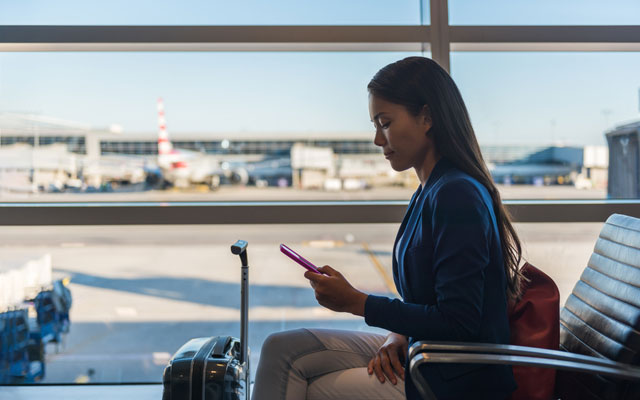
Travel managers are in a unique position to provide insight to their organization about the impact of business travel on employee wellbeing – but many do not have the KPIs that they could use to measure and monitor traveller wellbeing
American Express Global Business Travel (GBT) has published a report for travel managers that sets out a five-step framework for understanding and managing the impact of business travel on employees.
Developed by GBT’s Global Business Consulting team, On the road to wellbeing offers insights into duty of care as part of a safe return to business travel. The report further explains how travel managers can combine travel data with HR data, such as job codes or tenure, to gain a deeper understanding of how travel impacts individuals’ mental and physical health.
Travel managers will now have tools and KPIs they could use to measure and monitor traveller wellbeing
The report also sets out a five-step framework for greater visibility over traveller wellbeing, with advice on how travel managers can share insights on employee wellbeing with peers across their organisations.
The five steps are:
Impact: agree which aspects of business travel have the most impact on employees
Identify: develop traveller risk profiles to understand how travel impacts individual employees
Review: check that the company’s travel policy is updated with measures that support wellbeing such in-travel assistance and traveller-friendly expense allowances for food and drink
KPIs: introduce Key Performance Indicators (KPIs) to measure the performance of wellbeing initiatives and communicate on them across the organisation
Measure: make sure the travel satisfaction survey captures employee wellbeing
Equipped with insights into traveller wellbeing, travel managers would be in a better position to identify travellers at risk of fatigue or burnout, and introduce measures to support them, such as improvements in travel comfort or ‘time-for-time’ compensation for longhaul night flights.
The Global Business Travel Association (GBTA) has hired Suzanne Neufang as its next executive director, leading the combined GBTA and the Association of Corporate Travel Executives (ACTE).
Neufang, whose diverse executive career has included senior leadership roles with several high-profile travel and technology companies, most recently served as senior vice president-Americas for HRS Global Hotel Solutions.
Before HRS, Neufang worked for 10 years as an executive leader with Sabre Travel Network, GetThere and Travelocity and later as a divisional chief marketing officer for Fortune 500 software giant Intuit. An active member of GBTA since 2005, Neufang led ACTE as board president from 2012 to 2014 and as a board member from 2014 to 2018. She also served as ACTE’s interim executive director during summer 2012.
“It’s not a secret that business travel is at an historic low point as a result of the Covid-19 pandemic, but in crises we find opportunities to be bold and to excel,” said Neufang in a press statement.
“Business travel has been down before and we have recovered – always coming back more technologically savvy, data-focused, and globally connected. The key questions for me are when we as an industry will recover, and how we as GBTA can drive economic and industry recovery to be even faster.
“We need to emerge from this pandemic as a healthier, more transparent association, one with the strongest possible, globally-focused foundation.”
Neufang will take over on February 24 from Dave Hilfman, who since July 2020 has served as GBTA’s interim executive director. Hilfman will remain with GBTA in a temporary consulting role to smoothen the transition.
Business Events Industry Aotearoa (BEIA) has appointed two new board members – David Perks from WellingtonNZ, and independent board director, David Downs.
David Perks is general manager, regional development, destination and attraction at WellingtonNZ, the capital’s economic development agency. He is also the chair of Regional Tourism NZ, is a board member of Tourism Industry Aotearoa, and has held several other appointed governance roles in tourism sector organisations.
From left: David Perks; and David Downs
David Downs is an industry veteran, and a chartered member of the Institute of Directors. Among his many roles, he leads the NZ Government’s Agritech taskforce. Previously, he was a general manager at New Zealand Trade and Enterprise (NZTE) in the technology sector, and for 13 years he was regional director for Microsoft in South-east Asia.
The other current board members are Prue Daly from New Zealand International Convention Centre, who is also the deputy chair; Georgina Grey from Accor New Zealand; Tracey Thomas from Conference Innovators; and Jake Downing from Weta Workshop.
The board also includes two co-opted non-voting members Lisa Gardiner from Tourism New Zealand, and Blair Catton, Air New Zealand, plus chief executive, Lisa Hopkins. Bjoern Spreitzer from Tourism New Zealand has been nominated to take over Lisa Gardiner’s seat when she takes parental leave in March.
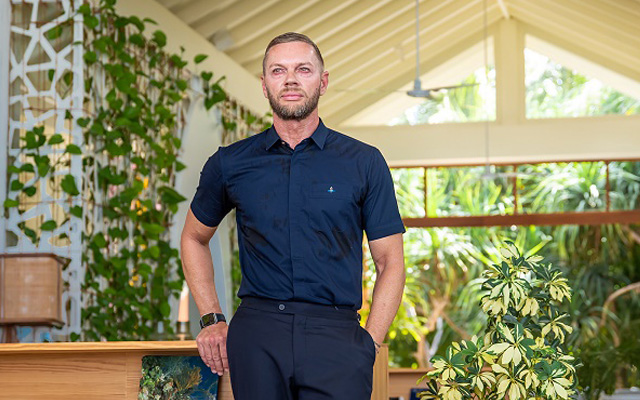
The Standard, Huruvalhi Maldives, has appointed Jesper Soerensen to general manager for the property.
The Danish national with over 20 years of experience in the hospitality industry moved to The Standard, Huruvalhi Maldives from his role as general manager at the Six Senses Hotels and Resorts in Singapore.
Prior to that, Soerensen was general manager at the Shore Club beachside resort under the Morgans Hotel Group in Miami Beach.
Before moving to Miami, Soerensen served as the director of rooms for St Martins Lane, a Morgans Hotel Group property in London. He was recruited as front office manager and promoted to be responsible for the performance of the room division.
South-east Asia has in recent years become an increasingly important market for Switzerland, with Asia as a whole delivering a growing number of tourists and corporate groups before the pandemic.
These figures are set to rise in coming years, especially as more companies recognise the country’s appeal as an incentive destination.
Paragliding in Interlaken
Picturesque meeting locations
The alpine country offers a long list of picturesque locations able to fit varying budgets and are suitable for a variety of events, from gala dinners to corporate meetings.
For example, located between Lausanne and Geneva, Portes des Iris offers six rooms that can host up to 700 guests for a sit-down dinner. Two terraces, which can accommodate up to 1,600 people, opens out to vast fields of green.
Over in Zurich, Bächlihof Jona on the banks of Lake Zürich offers both indoor and outdoor spaces for groups. Delegates can take part in a Farmer’s Tournament teambuilding activity that involves tractor-driving, wood-sawing and crossbow-shooting, before rounding the day off with a gala dinner complete with Swiss traditional music.
Despite its success with business events, Switzerland does not rest on its laurels. The country has continuously invested in new event facilities as well as refurbishment of existing ones to ensure they remain top notch.
Notable openings in the pipeline include The Circle Convention Center at Zurich Airport which will have over 2,800m2 of space across 18 venues. Providing accommodation support are two Hyatt hotels – a 255-key Hyatt Regency and a 299-key Hyatt Place. Over in Lausanne, the Millennium Center will offer a 500-seater theatre, a 450m2 ballroom, and 13 meeting rooms.
A plethora of activities
One of Switzerland’s unique selling points is the wide variety of social, cultural, urban and natural experiences all year-round.
Top winners in an incentive programme, for instance, can start their day with a tandem paragliding flight that soars high above the lakes and mountains of the Bernese Oberland.
They can then meet up with the rest of the group in Grindelwald for a spot of sledge building, an interesting activity not found in other parts of the world. Teams have to build a sledge out of materials such as old skis, car tyres, cushions, wire or cardboard.
A more sedate activity would involve taking the group to Bern, where delegates get to attend a half-day perfume-making workshop and take home a 50ml bottle of their own creation.
Similar activities include a three-hour-long watchmaking initiation workshop in Geneva; or learning about gin and creating one’s own concoction at the Turicum Gin Lab in Zurich.
During their free time, delegates can choose to visit the FIFA World Football Museum and explore over 3,000 exhibits; go on a guided tour of Lindt Home of Chocolate, which boasts the largest Lindt shop in the world; or hit one of the hiking trails in Grindelwald.
Pillar of support
Backing the country’s myriad offerings are Switzerland Convention & Incentive Bureau’s (SCIB) varying support policies.
For example, groups of 300 pax will be given access to an additional counter for tax refunds at the airport, while a 500-strong group will be provided with an award ceremony complete with a welcome speech by a local authority or a folklore music group as entertainment.
SCIB works with 20 other regional partners, such as in Lake Lucerne and Lake Geneva, who are happy to throw in other sweeteners. For example, Lake Lucerne Navigation Company offers a 10 per cent discount on charter cruises excluding F&B and additional services; while in Lake Geneva, Glacier 3000 offers a free Snowbus ride on the glacier.
Dominique Oi, M.I.C.E. manager Southeast Asia with SCIB, stated: “Switzerland is like no other country in the world. Already famous for its beauty and uniqueness of its landscapes, the country is also known to be safe, clean, dynamic and efficient. Put together, this makes Switzerland a compelling choice for your next business event.”
The Phase 1 launch of the four-star hotel and meeting facility Connect@Changi (C@C) on February 18 has kicked off the Connect@Singapore scheme to reopen Singapore’s borders by providing a “bubble” environment for high-level executives to do business face-to-face once they touch down in the city and test negative for Covid-19.
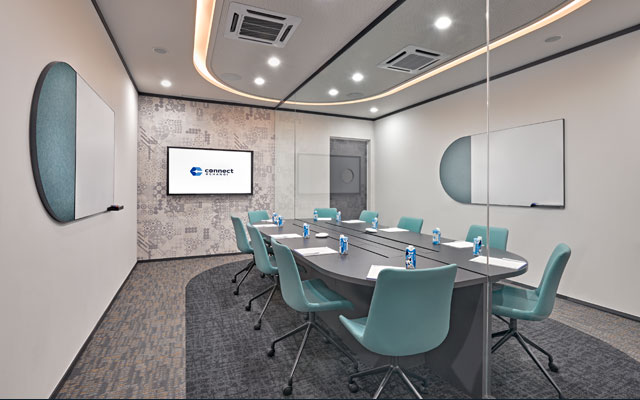
C@C, which offers an integrated “test-stay-work-meet” experience for Singapore residents and international travellers, occupies the former Singapore Expo Hall 7 which was repurposed into a Covid-19 care facility. C@C opened with 150 hotel rooms and 40 meetings rooms which can accommodate between four and 22 participants.
Connect@Changi provides inbound business travellers with a safe environment for Covid-19 tests, accommodation, work and meetings
There will be 660 guestrooms and 170 meeting venues when Phase 1 is completed by May 2021, and the facility can host 1,300 business travellers at any one time when it is fully completed later this year.
Billed as the first of its kind in the world, C@C room rates start at S$384 (US$290) inclusive of three meals daily, mini-bar, room amenities, Wi-Fi, airport transfers and Covid-19 tests required during the stay, according to its press release.
The pilot purpose-built accommodation to facilitate safe meetings between business travellers from across the globe is being developed by a local consortium led by Singapore-headquartered global investment company Temasek and includes The Ascott Limited, Changi Airport Group, Sheares Healthcare Group, SingEx-Sphere Holdings and Surbana Jurong.
Aloysius Arlando, chief executive, venues of SingEx-Sphere, told TTGmice, demand is expected to come from senior official meetings, MNC corporate meetings, business negotiations, document signing, legal consultations and wealth advisory service companies.
He said Singapore-based heads who have not met critical overseas staff face-to-face in a year, one-on-one or in a “board meeting environment” would be potential customers.
The consortium is bullish about demand from the US, Europe and Asia for the facility, which took 14 weeks to be repurposed again between Christmas and the Lunar New Year.
Arlando said: “Phase two details are now being worked out and all options are being looked at to determine what we can cater for as more people get vaccinated.”
C@C, he added, offered a “new advantage” to Singapore Expo to be the vehicle to restart the economy, revive the country’s aviation hub position and provide an “overnight” solution to hold high-value business meetings with border restrictions still in place.
Unlike air travel bubbles, green lanes and reciprocal travel corridors which broke down due to subsequent waves of Covid-19 infections and new virus variants, C@C was a permanent bubble and safe meeting venue, Arlando noted.
Advanced MedTech Holdings, a global medical technology leader, will be one of the first companies to conduct business activities at Connect@Changi.
Lee Weikang, senior director, business development, said the Singapore-headquartered firm plans to hold its first in-person global senior leadership meeting of up to 30 business executives at the facility – its first since the pandemic began early last year.
Additional services for C@C guests include tax and duty-free shopping, food delivery by Changi Eats and a personalised online shopping concierge service.
Senior corporate travel managers (CTMs) in charge of regional travel programmes say setting a vaccination strategy will require very clear guidelines from the authorities, HR and security advisers.
The buyers, attending an online Corporate Travel Community (CTC) roundtable discussion last week, added that while it is possible to use certificates or QR codes as proof of vaccination, it would take time for a global standard to be recognised and authenticated.
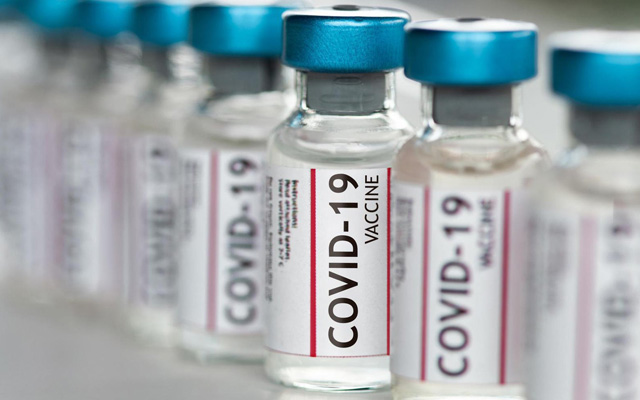
For corporate travel to pick up again, a standardised set of Covid-19 vaccination guidelines are needed
During the discussion, moderated by Benson Tang, CTC’s executive director, CTMs opined that some countries were slower in rolling out their vaccination programmes and had different priorities for the first in line.
The buyer of a US technology company noted the choice to be vaccinated against Covid-19 was a “serious” and “sensitive” human rights issue in some countries.
She pointed out employees cannot be forced to be vaccinated because of requirements from airlines and other entities to enable them to travel on business.
Another buyer expressed concern as to how travellers can get vaccinated before getting on a flight and also wondered if a vaccinated person could still be a carrier.
A veteran CTM remarked that “nobody knows what form corporate travel will take in the future”, and that it’ll be a long road to recovery.
The buyers also shared that ongoing Covid-19 restrictions were throwing up challenges such as employees being stranded due to border closures and taxation issues for the individual and the company.
In preparation for when travel can resume, but with quarantine measures still in place and lasting for up to a month in some countries, a Singapore-based CTM has begun keeping an eye on rising insurance premiums.
CTC’s Tang also shared that Lufthansa CEO Carsten Spohr at a recent CAPA Live session reported there was a backlog of corporate bookings and once travel can resume, forecasted demand would be very strong.
Michael Kunz, associate partner of Lufthansa Consulting, who attended the CTC roundtable, acknowledged there was pent-up demand and cited easyJet’s advance bookings were “250 per cent versus a normal year with travel in summer moving to autumn and winter this year”.
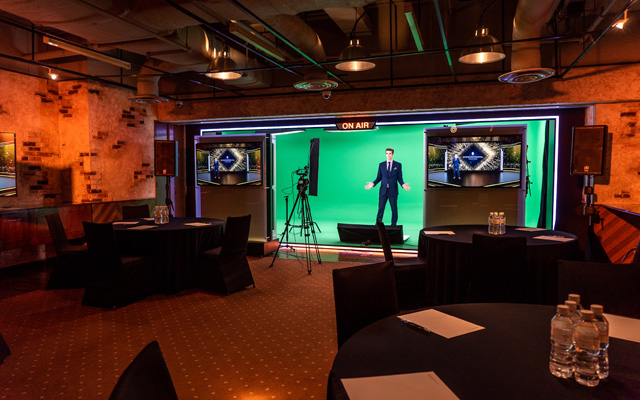
An example of an event being broadcasted worldwide
InterContinental Singapore has launched The Green Room, a state-of-the-art, purpose-built virtual and hybrid event studio equipped with full multimedia production facilities.
The Green Room comprises three zones within its 206m2 space. There is a 6m by 2.5m LED Display Wall; a 180-degree infinity cove green screen stage with studio lighting and multi-camera setups to optimise chroma keying for live green screen blending and editing; and The Event Space – a setting offering multiple configurations (classroom, cluster or cocktail) for live-studio audiences of up to 30 attendees.
An example of an event being broadcasted worldwide in The Green Room
The Green Room offers two meeting solutions – Virtual Meetings with broadcast-quality live-stream capabilities to deliver real-time connections between clients and guests around the globe; and Hybrid Meetings, ideal for events that include a live studio audience of up to 30 guests and unlimited online global attendees.
Meeting package options include the Silver Studio Stream that comes with usage of the LED display wall, and Gold Studio Stream, which comes with usage of the green screen stage and LED display wall. Studio package for a full-day event starts from S$9,600++ (US$7,220) with options to add on coffee breaks and bento lunch.
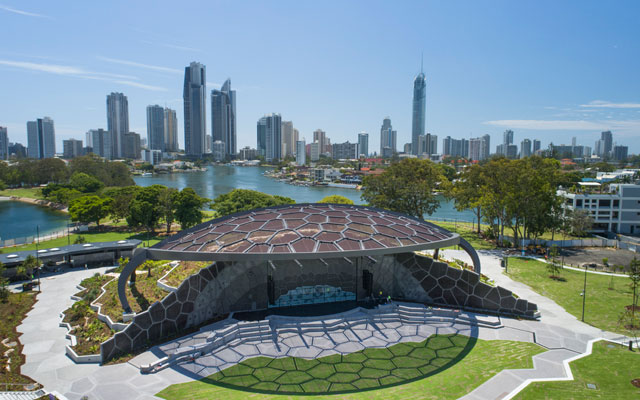
Gold Coast is moving forward after an unprecedented year of challenges and we’re buoyed by the continued interest and confidence from associations choosing the Gold Coast for future conferences.
Gold Coast has won the bid to host the World Federation of Chiropractic Biennial Congress in March 2023.
Come 2023, the Gold Coast Convention and Exhibition Centre will welcome more than 1,000 chiropractic association leaders and executives to its shores, and the event expected to inject A$2.4 million (US$1.9 million) into the economy.
Securing the event is a milestone after the city endured months of hardship impacting both tourism and business events as a result of Covid-19 shutdowns and travel restrictions.
Destination Gold Coast’s CEO Patricia O’Callaghan said kickstarting the recovery of business events is a priority for the Gold Coast as interconnected industries are set to benefit from a pipeline of upcoming domestic and international conferences.
“Prior to the pandemic, Gold Coast’s business events market share increased by five per cent to generate a staggering A$570 million in economic impact,” she said.
The bid was secured by Destination Gold Coast in partnership with Tourism Australia support by the Business Events Bid Fund Program (BFP), and Tourism and Events Queensland
Gold Coast is buoyed by the interest and confidence from associations for future conferences
Tourism Australia’s managing director Phillipa Harrison said securing the conference on the Gold Coast provides the local business events industry with some confidence in the pipeline of future events as it recovers from the impacts of the global Covid-19 pandemic.
“Lucrative business events require significant planning and by winning events such as this one, we are helping to drive the long-term recovery of our visitor economy while also ensuring Australia remains front of mind among decision-makers as a world-class events destination,” Harrison said.
The original World Federation of Chiropractic was established at the World Chiropractic Congress in Sydney in 1988 and represents members and the chiropractic profession in the international community, encompassing 90 national associations of chiropractors in 95 nations.
Global convention industry consulting firm, GainingEdge, now has a new internal unit, GainingEdge Analysis & Research (GEAR), where its mission is to expand and improve the quality of research available to international convention destinations.
GEAR will focus on issues of destination competitiveness, new forms of market intelligence, and new insights into the dynamics of the global meetings industry.
GainingEdge hopes GEAR can make a difference for the meetings industry and associations
GainingEdge CEO, Jon Sivertson, said the vision for GEAR is to fill a research gap in relation to both the convention industry and the association community.
“Our industry has never really had a dedicated research unit. We were struck by the lack of real quantitative analysis available to support quality decision-making processes.
“We want GEAR to be the go-to when people are focused on facts-based decision making,” Sivertson said.
Long-time GainingEdge consultant, Milos Milovanovic, has been tapped to helm GEAR. Milovanovic further shared that GEAR came out of a journey that began in 2018 with the publishing of the first annual International Convention Destination Competitive Index, the 3rd edition of which was released in December 2020.
He added GEAR’s next contribution will be “cutting-edge” research into the “intellectual capital” of convention destinations around the world. For instance, the next report will have a big impact on destinations, and how they go about pursuing international conventions.
“We’ve done a deep dive on the leadership of 3,500 international associations and developed a database of association board members and the cities where they live. From this research, we will be helping cities to understand how well they are doing in terms of the number of their local leaders who are active members in governing bodies of international associations.”
Milovanovic said the upcoming report would also help cities understand how well they are leveraging their influencers to secure conventions.
“We want to help them in their recovery strategies as they pursue future growth. Intellectual capital is a main driver of how conventions decide where to meet. We want to help destinations to understand how well they are harnessing that intellectual capital and to find quick pathways to the people they need to engage in the process of securing conventions.”
The newly-opened Ritz-Carlton, Bangkok anchors the One Bangkok development with cosmopolitan elegance. Featuring the city's largest ballroom and a spectacular new penthouse suite, it delivers exceptional hardware and deeply authentic, soulful service for business and leisure travellers alike
Behind the imposing, Brutalist concrete that defines Zurich’s Oerlikon district lies a surprising secret. While its exterior honours the neighbourhood’s industrial roots, stepping inside Mama Shelter reveals a vibrant, neon-soaked world that is a far cry from its rigid shell
A polished urban retreat designed for business travellers, Hyatt Regency Kuala Lumpur at KL Midtown combines thoughtful design, seamless service, and exceptional facilities.