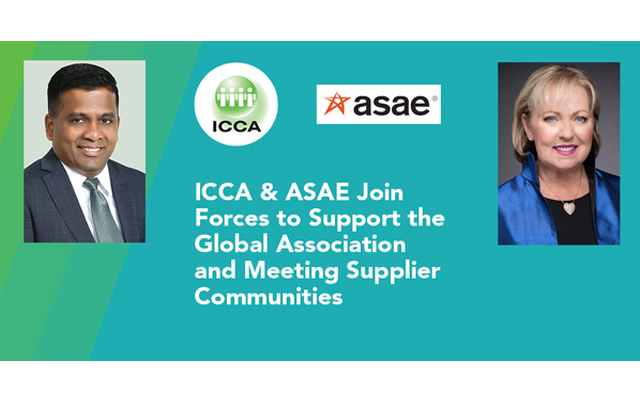
ICCA and American Society of Association Executives (ASAE) have agreed to collaborate, to explore the possibility of new global projects, as well as provide education at each other’s events and tradeshows.
This link-up between the two associations will increase association and meeting supplier engagement in both organisation’s communities.Examples include a joint ASAE/ICCA Association Roundtables in conjunction with ASAE International Associations Advisory Council Meetings in Washington, DC; ICCA Participation in ASAE Association Fly In, a new ASAE/ICCA Webinar Series; ASAE participation at ICCA North American Chapter activities at the ICCA Congress; and new Congress Destination Workshops for associations.
This partnership also includes joint educational and advocacy activities at tradeshows worldwide and at events like the ASAE Association Leadership Forum, Asia Pacific.
ICCA and ASAE will also collaborate to submit Association Executive candidates to qualify for inclusion in ICCA Hosted Buyer Groups for international tradeshows.
ICCA CEO, Senthil Gopinath, said in a statement: “We have been working with ASAE for many years on various projects and are pleased to have an official collaboration agreement to deepen and extend our relationship and including many activities over the next 18 months.”
President and CEO of ASAE, Susan Robertson, said: “The international association community is strong and growing. These initiatives will provide additional opportunities for association executives to learn, engage with each other and the meeting supplier community, and increase the impact of their contribution to their respective societies.”
Up to 11 per cent of member companies of the Global Business Travel Association (GBTA) polled between May 13 and 15 say they plan to resume corporate travel to China, Hong Kong, Taiwan and other Asia-Pacific countries in the near future.
In addition, between 34 and 36 per cent of the 1,705 respondents polled indicate they are considering resuming travel in the near future, but had no definite plans.
Health and safety are top of mind for companies sending their staff on essential business trips
For member companies committed to resuming travel, China and Asia-Pacific had an 11 per cent score, while it was nine per cent each for Hong Kong and Taiwan.
According to GBTA, 62 per cent of member companies polled “believe most or some employees will be willing to travel after restrictions are lifted”.
Health and safety “are now of significant importance as the industry tries to gain momentum for recovery,” GBTA CEO Scott Solombrino said, adding that the new research showed “member companies want to see several health and safety steps taken at every stage of the travel process”.
As to the top action that would make member companies feel more comfortable about traveller health and safety, 76 per cent said it was an increase in the cleaning and sanitation protocols of airlines, and 80 per cent and 70 per cent respectively said it was an increase in the cleaning standards of hotels and ground transportation.
According to the poll, the second top action was the wearing of masks and providing hand sanitiser and disinfectant wipes; with 60 per cent and 55 per cent respectively saying it was necessary for airline travel and hotel staff to do so, while 68 per cent said ground transportation services need to provide hand sanitisers and disinfectant wipes.
As for the third top action, 59 per cent of member companies wanted the middle seat empty, 53 per cent wanted to see hotels provide staff additional Covid-19 sanitary training, and 58 per cent required drivers to wear masks and gloves.
With 54 per cent of companies “considering resuming all travel in the future”, Solombrino commented that it was “a positive, albeit small, sign that we are finally heading in the right direction”.
GBTA, the world’s largest business travel and meetings trade organisation, has a global membership of 9,000-plus member companies and a network of 28,000 travel professionals and 125,000 active contacts.
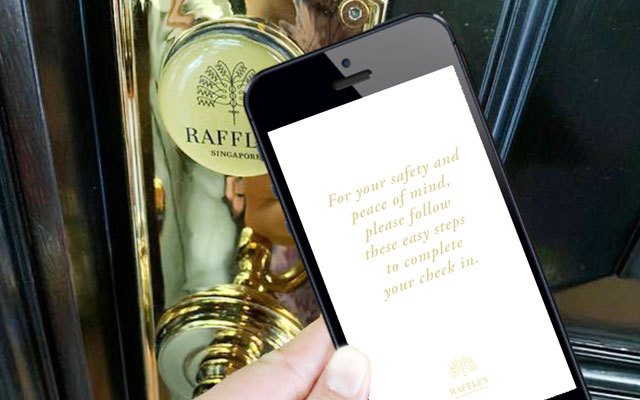
Accor’s new partnership with AXA will allow its guests to enjoy free medical teleconsultations
Accor has teamed up with insurer AXA to provide medical support to guests at its 5,000 hotels across 110 destinations worldwide.
From July, the hospitality giant’s guests will be able to enjoy free medical teleconsultations, as well as access to AXA’s medical networks with “tens of thousands of vetted medical professionals”, which will allow hotels to make the most relevant referrals to their guests, in terms of language, speciality, and more.
Accor’s new partnership with AXA will allow its guests to enjoy free medical teleconsultations
The medical service complements Accor’s overall Covid-19 recovery plan, and is part of the group’s enhanced hygiene protocols put in place across its properties through its ALLSAFE Cleanliness label, the companies said in a statement.
Sébastien Bazin, chairman and CEO of Accor, said: “This distinctive partnership with AXA which we have been working on for several months makes even more sense in today’s context.
“In an increasingly complex environment, our 300,000 team members on the ground will be able to assist our guests and ensure their safety during their stays, turning our hotels into shelters.”
Virtual events are the only way for the industry to move forward for now
The need for virtual or hybrid experience has never been so critical for the event industry as it is now, with a global slowdown of the MICE and travel business. There is a sudden exponential growth in the demand for virtual or hybrid events to replace or extend their physical counterparts.
The technology for virtual meetings has also existed for the last decade, albeit improving in efficiency and functionality.
But before we dive into the technology, these are some of planning considerations for a virtual event:
What are the objectives and programme format of your virtual/hybrid event?
Having a clear understanding of your goals and programme will help decide the technology platforms that would be most appropriate for your event, e.g. no. of single-session tracks, multi-session tracks, need for a virtual networking lounge or business matching, the need for a tradeshow and virtual booths, etc.
What is the revenue strategy for your virtual or hybrid event?
Creating a list of digital inventories for sponsorship sales and the entitlements for the virtual attendees. For a hybrid event, how would you position your pricing strategy to avoid cannibalising on your onsite attendance? And would you consider extending the content beyond the physical event?
How would you create a seamless virtual onboarding experience for your stakeholders (attendees, exhibitors and sponsors, speakers and VIPs)?
Create clear user journeys that determine how each stakeholder can easily confirm their participation and attendance at the virtual/hybrid event. This would assist in understanding the level of integration between the digital platforms that would be required.
Did you modify your marketing plan to optimise your audience engagement for the virtual/hybrid event at pre-event, at-event and post-event phases?
Develop an integrated marketing strategy that utilises the virtual content and opportunities of your event, to enhance your outreach to the right target audience with the most effective channels. For example, a flash sale, literally, of a popular keynote session on live-video that is offered only in the last 15 minutes before the session starts.
What level of insights will you be able to retrieve from the experience?
This is critical for every event, but even more so for a virtual event with no physical experiences or interaction. The benefit of a virtual event is that everything digital can be easily tracked and monitored; the structured insights that can be obtained through polls and surveys and the unstructured data that can be obtained for analysis, e.g. dwell times, registration logs, check-in and out logs, etc. The insights will help you evaluate, reassess and develop an even better virtual/hybrid experience for your attendees in the next edition.
The key to a successful virtual event lies in the ability to connect-the-dots on the overall strategy and considerations mentioned, coupled with the use of the appropriate technologies to enable the event. As the Covid-19 situation normalises globally, the new normal of hybrid events will slowly but surely become more evident as the market embraces its potential benefits.
Vincent Yap is the director, integrated marketing solutions, at Pico Art International. The seasoned MICE profession has close to 25 years of experience in marketing and project management across the corporate and agency landscape. He has worked with major US and European associations to develop and execute strategic marketing initiatives to increase their brand presence and expand their business objectives in Asia; and managed a host of tradeshows, conferences and high-level government meetings globally.
Who are some of your clients that have hosted or are planning a virtual event of some sort?
Yes, many; SAS, Genesys, BHP, Google and Herbalife, to name a few. Our core focus was in-person events; bringing people together from across the region and breaking down language barriers by using remote interpretation.
The first quarter of 2020 saw our pipeline obliterated, due to the impact of Covid-19 on the industry. But every cloud has a silver lining, because in order to provide remote interpreting we were taking events online anyway. And with event organisers going virtual nowadays, the only way to remove language barriers is through remote interpretation.
What are some benefits you’ve seen with hosting virtual events that supersede those of in-person events?
Analytics will be the major plus, providing valuable insight to what your audience finds most engaging.
What are some of the challenges to look out for in hosting virtual events and how have you helped clients overcome them?
We have found that live-streaming lots of content to huge audiences can be very expensive. Many of our partners advise clients to keep a percentage of the event live while having pre-recorded sessions available on-demand, which helps reduce costs significantly. In essence, the live part of the event can be hours, while the amount of content delivered can be as much as you need to put out there.
What’s the difference in costs and revenue when hosting an offline vs online event?
This is a difficult one. With remote interpreting for events with several languages, customers can save 40 per cent on average. This is just one part of the overall event cost and usually, these savings are spent elsewhere to enhance the event experience.
Going virtual, I’ve heard clients spending what they would have done offline while going online, to give the virtual event a fighting chance of success. I’ve also seen organisers do much smaller or scaled-down versions to get by in the meantime.
At the end of the day, event organisers will work within the budget they have available to achieve the best experience for their audience whether that be online or offline.
What tools can event planners use to better their virtual event?
There are a number of systems on the market that have developed key features for filling such voids. Interprefy’s strength is removing language barriers, and we are technology agnostic, so if clients decide to use Intrado InXpo, Chime Live or other All-in-One Events (AIO) platforms such as those by Imavox, we simply support them by providing the language layer.
There is nothing stopping event organisers using various tools to achieve their goals, and we have a partner network to support them with doing exactly that. Tools include multilingual options, Q&A, polling, and the ability to provide feedback.
How have you seen hosting a virtual event, or using virtual provider options like Interprefy benefitting your clients?
In the short term, hosting virtual equivalents will provide businesses with continuity during these disruptive times. Having said that, once forced to embrace such technologies for the execution of events throughout 2020, I do believe that when things settle, event organisers should take a blended approach and keep the virtual audience in mind for greater reach. Virtual events could well be a powerful marketing extension to attract delegates to join in person in future years to come.
Siam Sindhorn has announced its executive team for Sindhorn Midtown, a new, Thai-born hospitality brand in Bangkok’s Langsuan neighbourhood.
The team is lead by general manager Jee Hoong Tan, who brings with him 25 years of hospitality experience, with particular expertise in launching and marketing new hotel properties and brands.
Jee Hoong Tan
Tan has worked with several established brands across South-east Asia, including Renaissance, Sheraton, Kempinski, Le Meridien, Westin and Mandarin Oriental.
Meanwhile, hotel manager Nawin Pakwattanakarn boasts 18 years of experience in the hospitality industry, and has served on the opening team for Sindhorn Midtown since 2017.
Nawin joins Sindhorn from The Dhara Dhevi, a boutique resort in Chiang Mai, where he served as director of rooms and manager. Prior to that, he was rooms manager at the Mandarin Oriental Dhara Dhevi.
Lastly, director of sales & marketing Nicha Ruenthip brings 15 years of experience, most recently with SO/ Bangkok. Nicha has broad experience developing corporate, leisure and MICE business, and is very familiar with the Bangkok market.
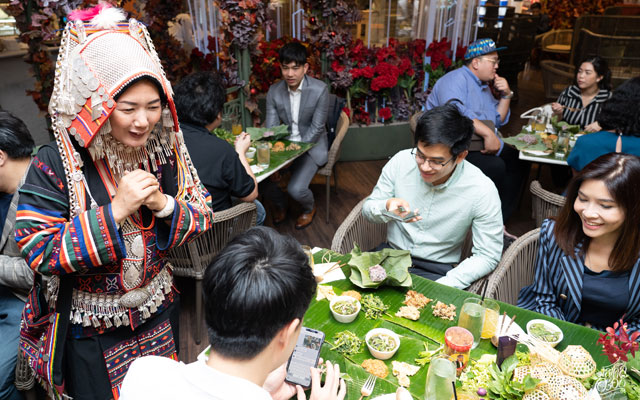
An Akha woman hosts the Local Aroi experience, where guests are served a Thai meal inside a local community
As a well-known destination with a mature travel industry and a geographical advantage, Thailand has consistently worked towards improving itself when it comes to business events.
Take for example the country’s involvement in developing both the ASEAN MICE Venue Standard and Thailand Mice Venue Standard – the latter certifying 453 of its own venues – as a benchmark for the industry.
An Akha woman hosts the Local Aroi experience, where guests are served a Thai meal inside a local community
Before Covid-19 happened, TCEB was targeting 4Ms, or four meetings categories for 2020: groups travelling to potential cities (Meet Now); large-sized groups (Meet Mega); groups that conform to Thailand’s 4.0 policy (Meet Smart); and groups with sustainable activities (Meet Sustainable 2020) in 12 key industries ranging from Medical & Wellness Tourism to Smart Electronics.
The country is ready to hand out special perks and privileges, such as a dedicated MICE Lane at the airport, cultural performances, souvenirs and a conditional supporting budget of up to one million baht (US$30,497).
For the incentives market, Thailand released the APAC MaxiMICE in partnership with THAI Air and THAI Smile at the end of 2019.
Exhibitions are not forgotten, as Thailand has also trained its eye on the sector through its Exhibition Redefined; 360 Exhibition Success programme, with TCEB bidding for 18 conventions by 2026.
Despite events getting the boot due to the coronavirus outbreak, Thai CVBs and DMCs are optimistic their sector will be one of the first in the travel industry to bounce back, and that Thailand will continue on its previously buoyant trajectory once the situation is back to normal.
“Before Covid-19, we had a fantastic pick up on Thailand’s inbound business events performance throughout 2019. We were actually expecting 2020 to exceed what we had achieved for 2019 as we had already secured a few events in 2020. We were also receiving enquiries on 2020 events even before 2019 had ended,” shared Max Boontawee Jantasuwan, founding CEO of Events Travel Asia Group and president, SITE Thailand Chapter.
Anthony Lark, president of Phuket Hotels Association also described Phuket’s inbound business events as growing well, particularly for the Indian market due to an increase of direct flights. There is also strong demand from major markets like China and Australia.
“We expect this to continue after travel restrictions are lifted,” he noted, adding that Phuket hotels have been increasing the capacity of their event venues to cope with the influx.
Nooch Homrossukhon, director, meetings and incentives, TCEB, shared that TCEB – in conjunction with SITE and other local organisations such as PHA – is working on new marketing messages to help the market recover faster post-crisis, buoyed by the Thai government’s 200 million baht (US$6.1 million) relief funding for the business events sector.
The main target will remain Thailand’s primary markets – corporate travellers from ASEAN+6 group (China, India, Japan, South Korea, Australia and New Zealand) and the US, with Europe remaining as a secondary market.
Nooch also shared that a reduction of Thailand’s reliance on China’s meetings and incentives market has led the bureau to invest more in India, and diversify to roadshows in tier-two and tier-three Indian cities such as Hyderabad and Jayapura.
An expanding Thai MICE Cities network
Previously, Thailand was heavily promoting the former secondary MICE Cities of Chiang Mai, Pattaya, Khon Kaen and Phuket alongside Bangkok. In total, these cities welcomed around 34.7 million domestic and international MICE travellers in 2018.
During the Thai MICE Forum in August 2019, TCEB president Chiruit Isarangkun Na Ayuthaya shared new second-tier MICE destinations will include Chiang Rai, Phitsanulok, Udon Thani, Hua Hin, Cha-am, Rayong, Songkhla, Nakhon Ratchasima and Surat Thani.
Max sees this as a positive development for the industry, stating: “This is one of the developments we are most excited about. An incentive is about experiences, so more development and promotion of (new) cities will (lead to us being able to offer) more products and destinations (to groups).”
Sustainable horizons
In early 2019, TCEB introduced 25 new routes for delegates visiting the country’s top five destinations, Bangkok, Pattaya, Phuket, Chiang Mai and Khon Kaen.
Working closely with the public and private sectors, as well as educational institutions, the new routes enhance travel experiences through the bureau’s Thailand 7 MICE Magnificent Themes. TCEB has also joined with entrepreneurs in the above-mentioned five cities to campaign for zero plastic events, aiming to turn them into environmentally sustainable cities by cutting waste volume by 50 per cent.
Grassroots connections
In recent years, local operators and hotels have committed to injecting local flavour into business event experiences.
One innovative example is Local Aroi in Bangkok, which hosts eight-course fine-dining events with menus featuring local cuisine and served by local communities of different regions of Thailand, including hilltribes.
There is also a cooking, garland-making and market hunt for up to 150 people. Hosted by Market Experience, participants can learn to cook authentic Thai dishes overlooking the Pak Khlong Talad Flower Market, and enjoy their own culinary creations by the riverside at the nearby Mango Tree.
In the north, HiveSters showcases disappearing culture at Huen Chom Chan, a cultural space and school for art and folk music, by enlisting local masters to teach guests how to write the Lanna alphabet. Guests may also learn about soap nut tree carvings, try their hand at cooking local dishes, and visit the Tham Luang–Khun Nam Nang Non Forest Park.
Several local operators also offer more customisable CSR projects. For instance, Trunk Travel enlists corporate volunteers to help build camps for rescued elephants to retire in. Volunteers also get to reside in a homestay and partake in cooking, and tribal arts and craft classes.
Asia's business events is most likely to recover faster than other continents, experts predict
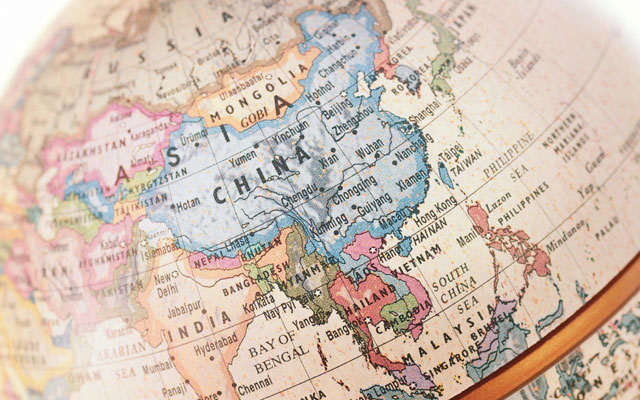
Asia’s business events industry has the potential to rebound faster than other continents, but being able to conduct business safely is important, highlighted panellists at the Global MICE Situation in the Time of the Pandemic webinar for Philippine business events stakeholders.
Green shoots can already be seen, according to UFI’s Asia Pacific regional manager Mark Cochrane. He related the example of China, which had zero exhibitions in February, is “slowly, and cautiously getting back into business”.
Asia’s business events sector is most likely to recover faster than other continents, experts predict
Although international travel is at a standstill, China’s massive economy has presented a lot of potential for domestic activities, Cochrane noted.
Noor Ahmad Hamid, ICCA’s regional director Asia Pacific, agreed, and pointed out that business events are starting to begin in smaller Chinese cities such as Qingdao, Chengdu, Shanghai, Hangzhou and Xiamen.
Some domestic activity is also happening in parts of Japan, Taiwan, and Malaysia, as well as New Zealand – which is slowly easing local travel restrictions – and Australia, according to Noor.
Cochrane added that Asian countries with domestic markets such as South Korea and Japan will open up first, while Hong Kong and Singapore will take longer as these cities rely primarily on foreign participation.
Asian destinations are observed to be on the path to recovery, with Singapore and Thailand announcing recovery packages and Hong Kong offering rental-free venues. These moves bode well for the exhibition sector.
“We have to tell governments that MICE is important for economic growth, and they have to open up,” said Noor, highlighting that it was important for local stakeholders to come together to push for it as well.
Jennifer Glynn, SITE president, pointed out that incentive travel “will come back regionally”, but will likely be with tighter budgets due to weak corporate performance during the Covid-19 crisis. As such, incentive groups will favour destinations closer to home.
To help planners stick to the budget, Glynn suggested that a programme to remote regions, emerging destinations, or the countryside would work, since a majority of incentive programmes usually number from 25 to 50 people.
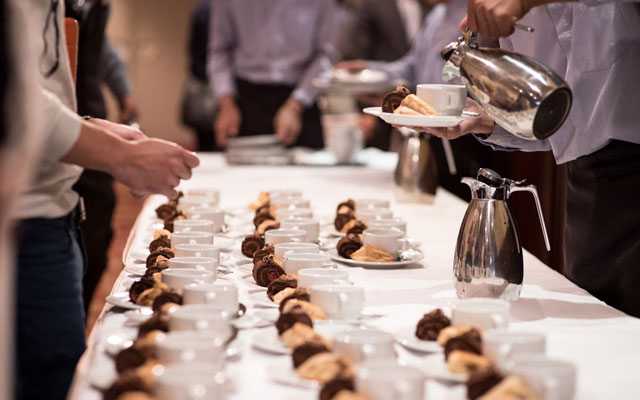
Coffee breaks and cocktail events need to be rethinked to adhere to social distancing measures
Attendees of business events held within hotels can expect different formats around dining and social functions as gatherings are once again allowed.
Taking into consideration physical distancing needs and heightened hygiene and safety measures, buffet lines will have to give way to pre-packed food boxes or served set meals, hoteliers told TTGmice.
Coffee breaks and cocktail events need to be rethinked to adhere to social distancing measures
Tim Alpe, Ovolo Group’s chief operating officer, Hong Kong and Indonesia, noted that buffet dinners would likely be less popular among event planners, and set menus would be offered instead.
“We will also use larger event spaces for smaller events to ensure the appropriate distance between tables,” Alpe added.
Frequency and size of social functions during events, such as coffee breaks, will have to be kept to a minimum.
Javier Pardo, vice president of operations for Avani Hotels & Resorts, said coffee breaks at his properties in the near-term would probably be “shielded or served from behind a Plexiglass screen by a certified kitchen team to reduce contamination”.
There will be markings on the floor to help delegates adhere to social distancing.
Over at Accor, Kerry Healy, vice president sales Asia-Pacific, predicts “staggered break times for smaller groups or more use of outdoor space to provide the opportunity for fresh air”.
“We also think that cocktail events will see stricter handling of food items with less sharing plates and more individually-served items. There will also be greater use of local ingredients and freshly-sourced produce as people are looking to support their domestic markets even more,” she added.
The new requirements around dining formats will necessitate greater empathy and flexibility from venues, opined Alpe, who said his properties may lower or even get rid of minimum spending for smaller events, as a way to encourage gatherings with fewer people.
Charles Yap, Onyx Hospitality Group’s vice president, marketing communications, said a collaborative approach between hotel representatives and meeting planners would be taken for discussions on preferred dining formats as well as safety and hygiene enhancements, “such as capacity guidance, seating layouts and the deployment of protective shields on food presentation area”.
Even though hoteliers expect to see smaller meetings, reduced banqueting and conferencing demand in the coming months, they are confident that the sector will eventually rebound once travel restrictions are lifted.
Healy said: “We are confident that when it’s safe to do so, people will return to meetings, events and conferences because these are essential to teambuilding, to celebrating, and to creating a corporate culture.”
“It is in our human nature to meet, interact and reunite,” remarked Yap, adding that he is anticipating increased demand for hybrid events which combine physical meetings and video conferencing.
“Venues with superior technology and connectivity will be more sought after than older establishments (which have not renovated),” Yap noted.
For this reason, Onyx is making use of this downtime to renovate all the meeting and event venues at Amari Watergate Bangkok, as part of a larger refurbishment programme that includes guestrooms and the water, plumbing, air-conditioning and boiler systems for the entire building.
The business events industry has been through it all: financial crisis, terrorist attacks, and SARS, so what is the reference point for planning post-Covid-19? Is there one?
The truth is that each of these events caused panic, huge uncertainty, and each was described – with some justification – as unprecedented. But we recovered. Remember that, even as you look at the awful news each day: we came back. People learned to adapt to new circumstances, businesses invested and grew, and the world continued to turn. That will be the case this time too, however hard to think that way when the news coming at us each day is so bleak.
Rewards and incentives will make a comeback, but will take on a different meaning in a post-Covid world
A lot of what we took for granted – even simple things like going out to dinner, going for a walk – have been taken from us, and this is forcing us all to consider what really matters, what defines our lives and our happiness. As the peak of this virus passes, and some of the things that have gone are restored, we will need to have a new understanding of what we mean by “incentive” as well.
I suspect that will evolve over time, as different companies and industries start up again, and different possibilities emerge to reward and incentivise staff, clients, and other stakeholders.
The one thing I am absolutely certain about is that we will see a return in demand for rewards and incentives. It will be up to those of us who work in the industry to understand how much things have changed, and adapt our ideas to the new, evolving post-Covid world.
Just as we did after 9/11 and SARS, we will ensure we have in place the measures to make any incentive, especially travel, not just safe and rewarding, but appropriate. That word appropriate is going to be front and centre for this industry.
With so many communities and small businesses hit by Covid-19, it may be that we work with some of those communities or towns and their businesses so that incentive travel has a double impact, on attendees, yet also on those who desperately need the business to start their lives again.
That may involve more local travel, to support local communities and put money in local pockets and show solidarity with customers or suppliers. That would not be a bad thing at all.
Too often, we think travel has to be exotic and long-distance, but I have always marvelled at how many people in Australia would just love to come to a Greek island, and how many Greeks who live on these islands have always wanted to go to Australia. Maybe that is one other positive lesson to come from all this: we have so much that is beautiful and inspirational all around us. We should learn to enjoy it and appreciate it more than we have in the past.
The sudden shutdown of travel and business also has a profound effect on the natural environment, and I don’t think that is lost on people. I expect that we will see more awareness of the need and opportunity for travel to have a different environmental impact, maybe even a positive one, as the world opens up again. That, certainly, is on our minds, and I think many companies will welcome an approach that draws positive lessons from all this.
Even the word “incentive” will most certainly have a slightly new meaning, for some considerable time to come. Many businesses will want to find ways to thank customers and suppliers and other stakeholders who have stood by them, who did not demand refunds or even monthly payments.
One way of thinking about “incentive” may simply be “thank you for standing by us when we needed you”. That is a powerful and valuable message to send. Loyalty in business is everything. There are many ways to send that message, but it will need to be tailored to post-Covid-19 budgets, markets, and sensitivities.
But how will it work, post-Covid-19? Will people even want to travel, or will they be too afraid?
The short answer is that yes, people will want to travel, but only if their fears are eased, only if they can be certain that the risks are minuscule. Just as we worked with all our travel partners on new security measures post-9/11 – and the list of those precautions was a very long and diverse one – we will do the same after Covid-19.
We will need to ensure that all health guidelines are met and exceeded, so people will know that they are as safe, maybe even safer, on a planned and tightly managed incentive trip than they would be at home.
That means a lot more than a few masks and a pamphlet on social distancing. It means knowing everything we can and controlling everything we can, from seating in a restaurant to the cleaning and sanitising in a hotel, and a hundred other details. This would hold true until the eradication of Covid-19 though the effects will reshape an enduring way of living.
It may feel a bit premature to say these things right now, obviously, but we are certainly thinking and preparing for that day, because it will come, and probably sooner than we expect. Even now, even in these tough days, we need to be planning. We need to be ready. Our clients will need us more than ever when this is over and our contribution will be an integral element in the recovery of business, client interaction and reshaping the incentive and travel industry.
Damion Breust is currently the senior vice president, commercial at Andria Mitsakos Public Relations. For more than 25 years, Breust has created incentives and events in Australia, the Asia-Pacific region, Europe, Africa, South America and the US. He has led teams at such global organisations as Barclays Bank, ANA Hotel, The Park Lane Hotel, BI Worldwide, and Sabre (formerly Abacus). He left a CEO role in Australia overseeing global incentive and travel operations to relocate to Athens, Greece, but remains a chapter co-president of SITE (Society of Incentive Travel Experts) ANZ.
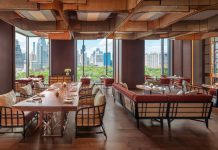
The newly-opened Ritz-Carlton, Bangkok anchors the One Bangkok development with cosmopolitan elegance. Featuring the city's largest ballroom and a spectacular new penthouse suite, it delivers exceptional hardware and deeply authentic, soulful service for business and leisure travellers alike
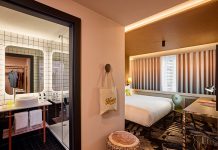
Behind the imposing, Brutalist concrete that defines Zurich’s Oerlikon district lies a surprising secret. While its exterior honours the neighbourhood’s industrial roots, stepping inside Mama Shelter reveals a vibrant, neon-soaked world that is a far cry from its rigid shell
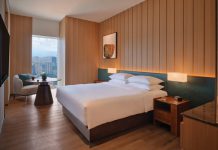
A polished urban retreat designed for business travellers, Hyatt Regency Kuala Lumpur at KL Midtown combines thoughtful design, seamless service, and exceptional facilities.



 Examples include a joint ASAE/ICCA Association Roundtables in conjunction with ASAE International Associations Advisory Council Meetings in Washington, DC; ICCA Participation in ASAE Association Fly In, a new ASAE/ICCA Webinar Series; ASAE participation at ICCA North American Chapter activities at the ICCA Congress; and new Congress Destination Workshops for associations.



 Vincent Yap is the director, integrated marketing solutions, at Pico Art International. The seasoned MICE profession has close to 25 years of experience in marketing and project management across the corporate and agency landscape. He has worked with major US and European associations to develop and execute strategic marketing initiatives to increase their brand presence and expand their business objectives in Asia; and managed a host of tradeshows, conferences and high-level government meetings globally.


 Damion Breust is currently the senior vice president, commercial at Andria Mitsakos Public Relations. For more than 25 years, Breust has created incentives and events in Australia, the Asia-Pacific region, Europe, Africa, South America and the US. He has led teams at such global organisations as Barclays Bank, ANA Hotel, The Park Lane Hotel, BI Worldwide, and Sabre (formerly Abacus). He left a CEO role in Australia overseeing global incentive and travel operations to relocate to Athens, Greece, but remains a chapter co-president of SITE (Society of Incentive Travel Experts) ANZ.