Millennial travellers are driving corporate travel towards a post-digital era in Asia-Pacific, as their exceptionally high use of digital channels is being met by mounting frustrations with existing offerings, according to a new report by Travelport.
Under the report, millennials are defined as those between the ages of 18 and 34.
A high number of APAC’s millennial business travellers use their mobile devices to book and pay for trips
More millennial business travellers in Asia-Pacific use a mobile device when researching (68%) and booking (67%) a trip than in any other region worldwide, found the study. Use is second highest in North America (64% and 55%, respectively) and lowest in Europe (54% and 45%, respectively).
Furthermore, one third (36%) of millennial business travellers in Asia-Pacific claim that they now use mobile devices to both book and pay for “every trip”.
In addition, the research revealed that more millennial business travellers in Asia-Pacific are turning to travel booking sites to help them discover “bleisure” experiences (45%) than in any other region. Once again, North America (41%) ranks second and use is lowest in Europe (26%).
The study also revealed, however, that millennial business travellers in Asia-Pacific have a growing list of pain points with current digital offerings.
Around half said that they are still left frustrated by companies not giving them access to their booking information on all their mobile devices (53%), not using data to remember their preferences (45%), and not giving them the option of booking everything in one place (48%).
Mark Meehan, group vice president and managing director of APACMEA at Travelport, said: “Millennial travellers in Asia-Pacific are now heavily using digital channels in all stages of business travel. This high use, however, is being matched by increasing frustrations with existing offerings, which indicates corporate travel in the region is on the verge of leaving the digital age and entering the post-digital era.”
The notion of a post-digital era was recently addressed by Accenture, which posited that digital is simply the price of admission for doing business, and that it is no longer a differentiation advantage. In the post-digital world, it argued, differentiation comes from applying digital in powerful new ways.
Meehan added: “In this new era, sellers of corporate travel need to use digital channels to deliver value in more modern and sophisticated ways. This could be by solving more complex problems, enhancing personalisation or more proactively meeting millennials’ needs for memorable bleisure experiences.”
Sydney venue operator The Venues Collection has launched a new campaign offering six new deals for organisers hosting events at two of its venues – harbourside dining precinct Campbell’s Stores at The Rocks; and contemporary venue 12-Micron in Barangaroo.
The updated pricing model is available for new bookings for events held before August 30, 2020, with breakfast, lunch and dinner costing between A$40 (US$26) and A$75 per pax respectively. There is also the option of a day conference or cocktail reception, both priced at A$70 per pax.
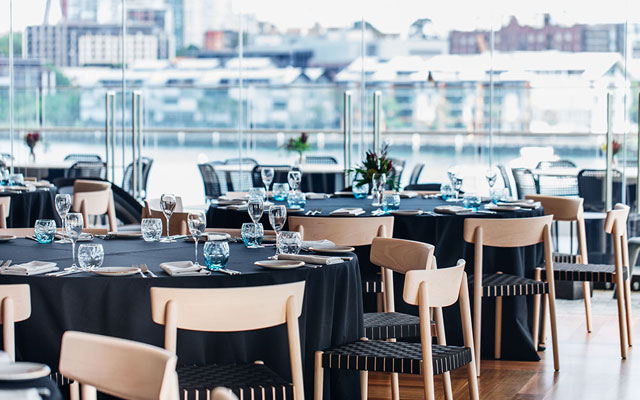
Private dining can be arranged at 12 Micron Watermans
One highlight among the deals offered is a four-hour, seven-course degustation experience in 12-Micron’s dining room, located on the western end of Sydney Harbour.
Event organisers keen on the dishes being paired with wine will be charged A$220 per pax; while food alone will cost A$140 per pax. Menu items include Paroo Kangaroo tartare with pickled egg yolk puree and sweet potato crisps, pan-seared Albhoros scallops, and Tajima Wagyu striploin with fondant potato.
Taking into account the diverse palates of attendees, a vegan degustation menu featuring dishes such as a portobello tartare with sweet potato puree, as well as a puffed amaranth, raspberry, coconut and dark chocolate mousse, can also be ordered.
Philip Beauchamp, director, The Venues Collection, said the purpose of the campaign was to encourage organisers to continue holding events amid Covid-19, while following the government’s health and safety protocols.
For example, the venue operator has put in place more stringent sanitation measures at its venues, such as requesting for additional servicing from contracted cleaners.
Additionally, event organisers concerned with the uncertainty surrounding Covid-19 are being assured that their deposits will not be forfeited if their event has to postponed to later date in 2020.
Qatar Airways has opened its new premium lounge serving business class passengers at Singapore Changi Airport Terminal 1, operating daily from 07.30 to 02.00.
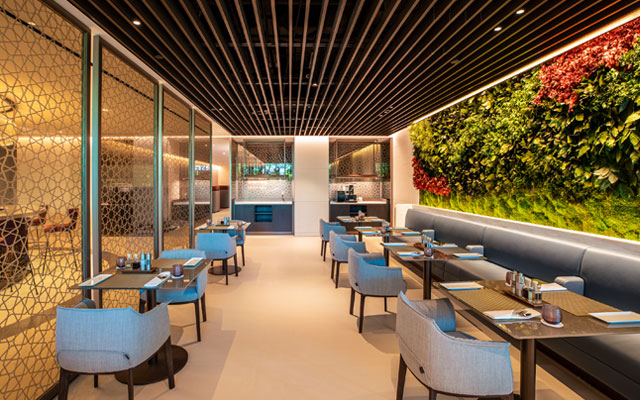
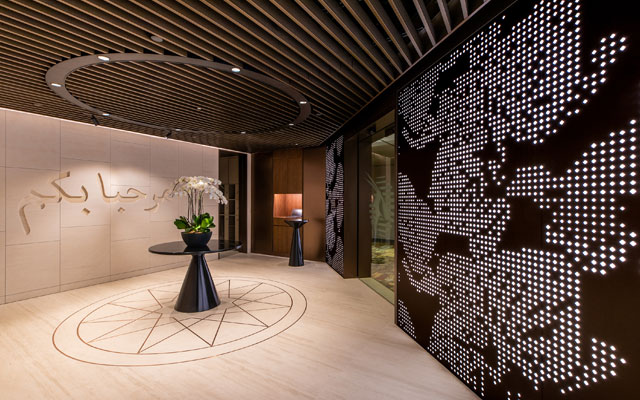
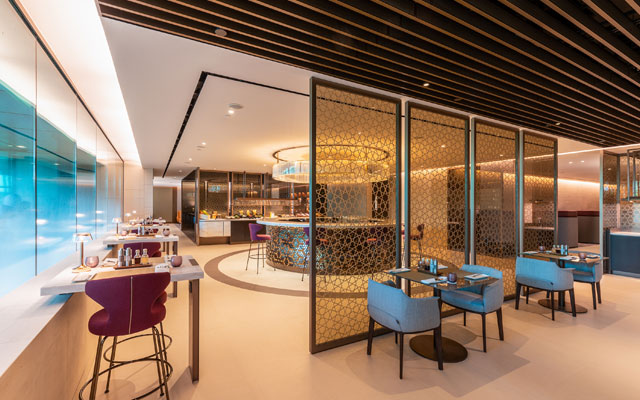
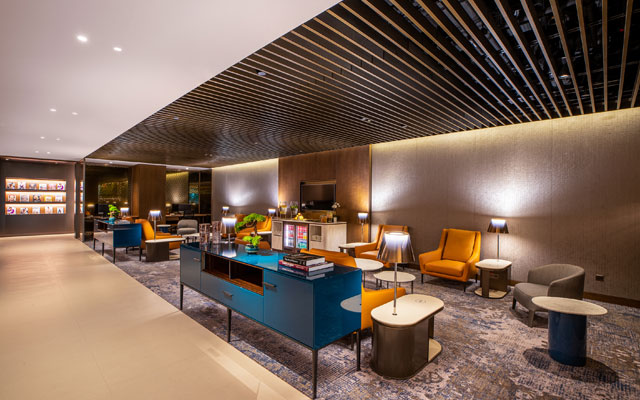
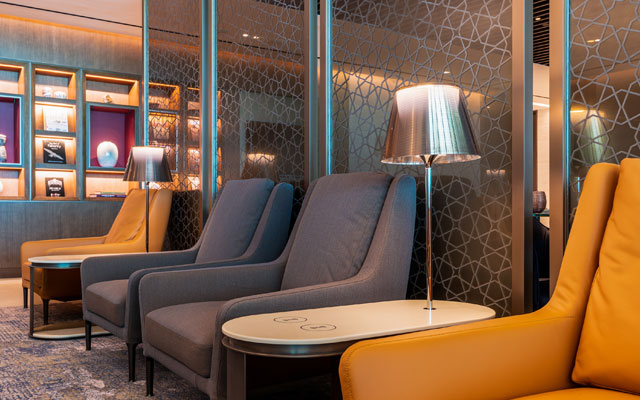
Designed with the aim of narrowing the gap between business and first-class lounges, the lounge features contemporary Arabic design elements, ultra-luxurious interiors and custom furniture pieces.
Qatar Airways Premium Lounge Singapore
1 of 5
The 700m2 lounge can host 85 passengers at any given time. Guests can relax in one the lounge’s seven different seating areas – including sound-proof, semi-private spaces known as quiet pods – have a tipple at the centrepiece martini bar, where a dedicated mixologist is at hand.
The lounge is also equipped with a full kitchen to prepare food orders on demand, on top of an existing buffet spread offering an international menu.
With the addition of the new Singapore lounge, the airline now operates five international premium lounges with others located in London, Paris, Beirut and Bangkok.
Qatar Airways connects Singapore and Doha with three flights a day on an Airbus A350-1000 aircraft, with each flight offering 46 business class and 281 economy seats.
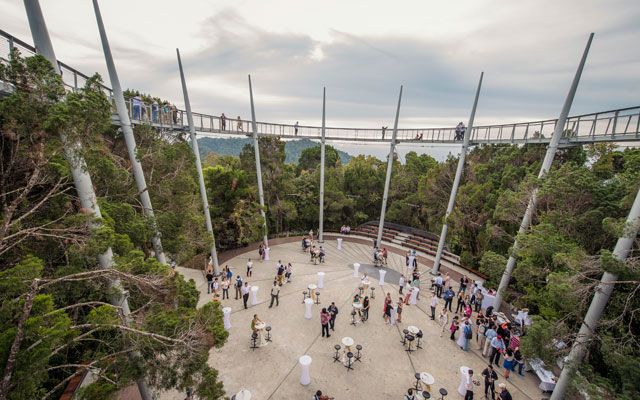
The Curtis Crest Tree Top Walk is the highest public viewing platform on Penang Hill and offers 360-degree views of the island
Smaller cities that are easily accessible and which can provide authentic, immersive experiences are growing in popularity among business event planners.
Sharing how trends have changed over the years, Koe Peng Kang, senior executive vice president of S P Setia, noted: “Business tourism is no longer just about people going to a destination to attend a conference. It has become a convergence of business events and leisure experiences.”
The Curtis Crest Tree Top Walk is the highest public viewing platform on Penang Hill and offers 360-degree views of the island
And one such destination that is benefiting from such a convergence is Penang, the business hub of Northern Malaysia. Its capital, George Town, was awarded UNESCO heritage site status in 2008, as it was one of the two “most complete surviving historic city centres on the Straits of Malacca with a multicultural living heritage originating from the trade routes from Great Britain and Europe through the Middle East, Indian subcontinent and Malay Archipelago to China”.
And Koe strongly believes in Penang’s lure, adding that the Malaysian city is able to fulfil the different interests of international delegates because of its varied product offerings.
Sadie Yeoh, general manager, Destination Asia (Malaysia), concurred: “International delegates want to be able to take home memorable experiences of the local culture, local cuisine and recreational activities that are unique to the destination. And Penang has all of that. It is a modern city, with elements of yesteryear that can be incorporated into a programme.”
Some examples Yeoh gave include a trishaw ride around George Town, learning to make joss sticks, or enjoying a pre-dinner cocktail while watching the sunset at The Habitat Penang Hill – a prehistoric rainforest dating back 130 million years old that is located a 45-minute drive from the city.
In fact, because Penang has so many experiences to offer, Yeoh’s company is seeing repeat business, especially from clients in Asia-Pacific.
Yeoh believes that planners are also “spoilt for choice” as the city offers several tiers of business hotels, and modern convention centres. A wide-ranging selection of venues and spaces add to Penang’s shine; from clan houses and restored colonial bungalows, to heritage buildings such as Penang’s first theatre circa 1926, the Majestic Theatre, to the Suffolk House, a Georgian mansion built in the 1800s.
Presanth Chandra, managing director of Apollo Conferences, agreed that Penang is “blessed with many unique venues that can be tapped for business events purposes”, and possibilities were only limited to a planner’s imagination.
He recalled: “At the recent Penang International Travel Exchange in October 2019, invitees enjoyed a welcome dinner we organised on Rapid Ferry, where they saw the sights of Penang onboard a moving ferry and watched the sun set over the horizon.”
Moreover, Penang is a year-round destination for business events, opined Presanth.
“Penang is also rich in festivals and there is something interesting happening every month. Some organisers take into account the local festivals when choosing event dates, (so as to allow) delegates to experience the local scene,” Presanth shared.
A local festival worth noting is the annual George Town Literary Festival which is organised by the Penang Convention & Exhibition Bureau (PCEB) for the past four years. The event is said to be the largest world literature festival in Malaysia, and the first literary event in South-east Asia to receive the Literary Festival Award at the London Book Fair International Excellence Awards.
Arokia Das Anthony, director, Luxury Tours Malaysia, pointed out that the event is good for visitors who are interested in literary works and would like to meet renowned authors. Last year, Luxury Tours Malaysia sent two groups to Penang as part of a post-conference tour.
For Yeoh, she has noticed a growing interest in groups asking for Instagrammable sights – such as Penang’s street art and murals – and sustainable eco-tourism experiences.
Sharul Madi, director of sales at Shangri-La’s Rasa Sayang Resort & Spa and Golden Sands Resort, Penang, has also noticed a growing interest in corporate social responsibility (CSR) programmes. As such, both properties have developed nature and community-based programmes to cater to multinational corporations seeking to incorporate CSR as part of their teambuilding activities.
PCEB is also providing an avenue for business events to fulfil their CSR dreams when meeting in Penang. Penang Turtle Cares was launched in December, providing corporate groups an opportunity to assist with turtle conservation efforts at the Penang Turtle Sanctuary – home to the Green and Olive Ridley turtles – on Pantai Kerachut. Study tours of the work done at the sanctuary, planting of Ambung-Ambung trees as shelter for turtles to lay their eggs under, and contributions in kind are some ways to contribute.
With so many points of appeal, Yeoh intends to market Penang to European clients, in particular those in Amsterdam, Belgium and the UK.
Aside from Qatar Airways’ four-times-weekly flights from Doha to Penang making the destination convenient for European groups, Yeoh said: “With a weaker pound, I think there is potential to obtain more incentive business from the UK because of our competitive pricing, as well as our strong ties dating back to colonial times.”
As for Presanth, he has seen increasing interest from the Indian Subcontinent for events in Penang.
He revealed: “Indian organisers who have already held events in Kuala Lumpur and its surrounds are looking for new destinations, and Penang fits their requirements. The destination is easily accessible, and within 30 minutes’ drive from the airport, one can visit The Habitat Penang Hill, enjoy the scenic Batu Ferringhi beach, or visit George Town.”
To help with business conversion, PCEB is dangling curated exclusive support and perks for planners who choose Penang for meetings, conferences or incentives. The bureau has also developed the BE Penang mobile app which packs in a meeting planners guide and calendar showing upcoming events and other supported business events occurring in the city.
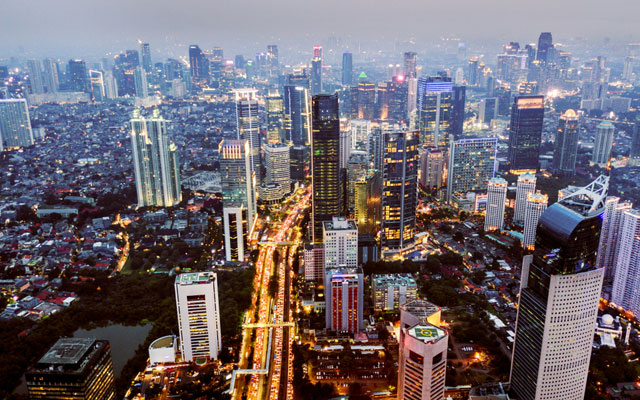
Indonesia appoints deputy of tourism products and events to help bring bid and win more international events for Indonesia; Jakarta city pictured
With the new organisational structure of Indonesia’s ministry of tourism and creative economy in place, the country has turned its focus towards attracting business events to bolster its tourism performance this year.
Rizki Handayani, who now helms the Tourism and Creative Economy (TCE) Board as deputy of tourism products and events, shared with TTGmice that the ministry is “expected to improve foreign earnings by increasing the number of business events in Indonesia”.
Indonesia appoints deputy of tourism products and events to help bring bid and win more international events for Indonesia; Jakarta city pictured
As a start, the ministry will compile a database of events and associations, and they will collaborate with trade associations such as the Indonesia Convention & Exhibition Bureau (INACEB) to create a “bidding factory”.
The “bidding factory” will be a team, whose job is to curate potential events, as well as elevate the sector by educating Indonesian stakeholders through short courses on how to bid for events, explained Rizki. The “bidding factory” will also oversee the bidding process, starting from the preparation of documents to assistance during the presentation.
“We want to send a clear message that the government fully supports the bidding and the destination is serious in its intention to host the event,” she stressed.
The ministry will also intensify its networking with both local and international associations, as part of efforts to find out what potential events can be brought to Indonesia, as well as understand bidding patterns so that Indonesia has a higher chance of being chosen as a host.
Furthermore, Ritzky added that the ministry aims to help value add to the bids and support them by sponsoring an event reception, or providing tour packages for delegates. This is as government regulation does not allow the ministry to give organisers or associations cash.
“One of the reasons why the number of events in Indonesia is still small is the (lack of) desire or willingness of our associations to attract international events to Indonesia (as doing so can be expensive). The government will increase their support (in kind),” Rizki explained.
Rizki: Government in full support of attracting international events to the country
In the meantime, to extend their outreach, the tourism authority will embark on a roadshow to reach out to ministries and associations to list any potential international events.
Panca Sarungu, chairman of Prista Indonesia, is hopeful that the appointment of a dedicated deputy for events at the TCE Board will bode well for the sector.
He added that among a variety of business events that Indonesia can attract are incentives, as the country is not seen as such. Panca also hopes that the TCE Board will revive Indonesia Convention & Exhibition Bureau (INACEB) – as it was unable “to run effectively due to funding” – which will, in turn, promote Indonesian cities as business events destinations to the overseas market.
Jim Tehusirajana, chief of mission of Alcor MICE, expressed hopes that the business events industry will be better coordinated under the TCE Board, and that both can work together when it comes to marketing, media promotion, and facility development.
“(The dissemination of) information about bidding, for example, is still carried out by an association,” he said. The lack of promotion and information about facilities that Jakarta offers is also a problem that Jim wants to solve.
“When I met with officials from the Indonesian NTO in Singapore last year, they asked me for information about venues. They told me that there were (companies) that approached them to ask where to hold corporate events in Jakarta, but they (NTO officials) were unable to give them information about buildings or facilities like what we (Alcor MICE) have right now,” Jim recalled.
And while government conferences are still a key target of the ministry, Jim hopes that more attention will be given to B2B corporate events.
“The IMF annual meeting, for example, drew over 10,000 people to Indonesia, but it is not held in Indonesia every year. However, corporate events can be held regularly or routinely as long as the city is interesting for (international companies). And while corporate events draw around 3,000 people to Indonesia, if there are at least 10 corporate events held in Indonesia in a year, that will make it 30,000 people,” he elaborated. – Additional reporting by Kurniawan Ulung
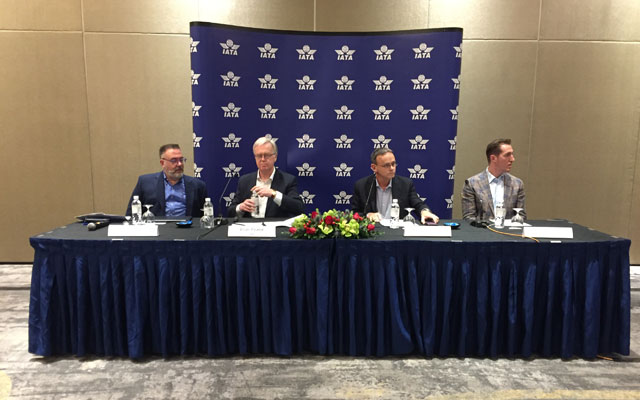
From left: IATA's Anthony Council, Brian Pearce, David Powell, and Isaac Bogoch at the workshop
A two-day Aviation Resilience & Health Workshop was organised by IATA in Singapore last week (March 4-5), where the association’s medical advisor and an infectious diseases specialist reassured attendees that catching Covid-19 on a flight was “extraordinarily low”.
The closed-door workshop, attended by more than 100 members and partners from 50 organisations in 20 countries and territories, focused on meeting the medical and regulatory aspects of the Covid-19 outbreak and working with governments.
From left: IATA’s Anthony Council, Brian Pearce, David Powell, and Isaac Bogoch at the media briefing
David Powell, IATA’s medical advisor, told the media that airline medical advisers around the world are “in touch” with virus outbreaks dating back to SARS, and the workshop confirmed that existing procedures and suitable solutions for the current challenge required no changes.
Powell added there was no evidence of a passenger catching Covid-19 from a sick passenger on the same flight.
IATA, in following WHO’s guidance for the aviation industry, is not advising travel bans and with Powell adding that bans “tend to be ineffective and have significant disadvantages”. He advised each traveller “to do his own risk assessment” instead.
Powell said IATA’s messages have to be reinforced and rational messages need to get out.
While IATA respects the right of countries to issue travel bans, Anthony Council, IATA vice president, corporate communication, commented that “there needs to be consistency and clarity” – something that is very difficult right now – and called for “collaboration” for the industry and life to “return to normalcy”.
By holding the workshop, which was organised in 10 days, IATA is trying to reassure people the travel process is safe, Council added.
Isaac Bogoch, University of Toronto’s infectious diseases faculty member, reiterated it was pointless to keep adding countries to the travel ban list, pointing out that it would slow down, but not stop the spread of Covid-19.
As such, Bogoch advised travellers to consider factors such as the destination, how to get there and back from the home country, and the rules and regulations of the respective countries.
“The risk is extremely small,” Bogoch stressed. “Remember to practise good hand hygiene and try not to touch the face, the same as during flu season.”
Meanwhile, IATA revealed two scenarios in its analysis update of the financial impact of Covid-19 on 2020 global revenue losses – it is US$63 billion where it is contained in current markets, and US$113 billion with a broader spread, said chief economist Brian Pearce.
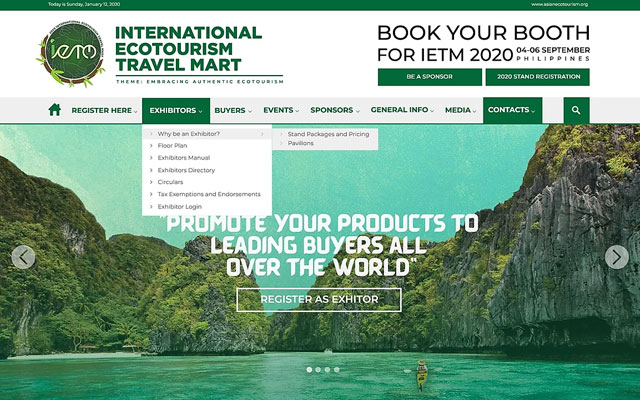
A screenshot of the soon-to-launch website for International Ecotourism Travel Mart which will take place in Manila this September
The Philippines’ International School of Sustainable Tourism (ISST) will host the Asian Ecotourism Network’s (AEN) first International Ecotourism Travel Mart (IETM) in September.
IETM was hatched during last year’s AEN conference in Vietnam when it was noted that despite the many global travel marts and exhibitions for general tourism such as ITB Berlin, World Travel Mart and ASEAN Tourism Forum, there were none for ecotourism.
A screenshot of the soon-to-launch website for International Ecotourism Travel Mart which will take place in Manila this September
ISST bagged the hosting as there were no other bidders, its president and founder, and former tourism secretary, Mina Gabor told TTG Asia.
AEN is the regional initiative of Global Ecotourism Network (GEN).
The IETM is slated to be held from August 31 to September 6 at the Philippine International Convention Center Forum, coinciding with 2020 as the year of celebrating biodiversity.
Gabor said the 18 AEN member countries have confirmed their participation, while other countries have also indicated interest.
With the theme Enhancing Authentic Ecotourism, IETM will have a strong focus on international ecotourism buyers and sellers, while exhibitors will showcase a strong ecotourism component, green technology and sustainable green practices.
The travel mart will also host an Ecotourism Training course component where 36 speakers and trainers from around the world will tackle wide-ranging topics from disaster risk control and management to climate change and community development.
PATA Philippine Chapter chairman Bob Zozobrado said that as the chosen partner for IETM, they will be campaigning for the participation of local and overseas schools, while details are being finalised in their role in organising tours and accommodations and possibly, transport and transfers.
With a deluge of travel mart cancellations in 1H2020 due to the Covid-19 scare, buyers and sellers are requesting to be accommodated at IETM. Priority will be given to those with a portfolio of adventure, nature and ecotourism, and those primarily in ecotourism areas and destinations, Gabor said.
She added that IETM will be poised to deal with the evolving Covid-19 situation, with a strong emphasis placed on health and safety.
Gabor further shared that the first day of the IETM, which will be open to the public, will showcase the natural environment with demos on jungle survival course, special vegan and drinks preparation, and daily performances in native costumes.
To drum up public awareness, they are working with the Department of Education to run an ecotourism essay competition for students, as well as organising an eco-run along Roxas Boulevard in Manila.
IETM will also showcase the ASEAN Centre for Biodiversity, including major ecotourism sites; four indigenous villages in Indonesia, and the Philippines, among others; as well as four villages in the Pacific islands.
The Covid-19 outbreak has brought about a significant impact to business meetings and events globally, but the impact is most keenly felt in and around Asia.
This is according to the recently-conducted Global Business Travel Association (GBTA) poll, which revealed 95 per cent of the respondents reported that their companies had cancelled or suspended most or all business trips to China, 73 per cent for events in Hong Kong, 54 per cent for Taiwan, and 45 per cent have also cancelled or suspended travel to other Asian-Pacific countries like Japan, South Korea, and Malaysia.
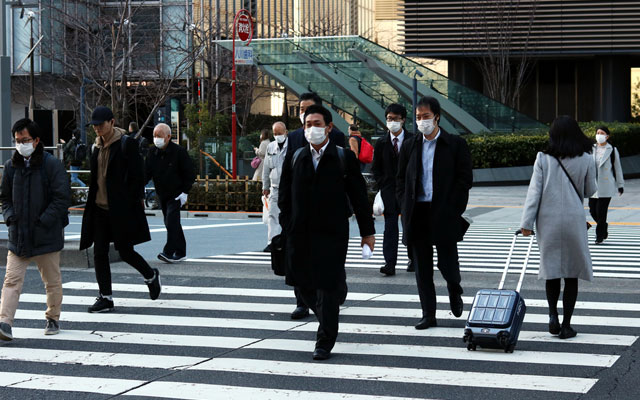
Japanese businessmen wearing masks
Corporate travel managers in Asia report that business travel is still continuing, but with “additional restrictions” and high levels of approval and monitoring.
For one Delhi-based IT company, all travel from to and from Asia and travel within Asia is prohibited. Italy has now been included in the ban, the corporate travel manager said, while travel to other countries was permitted only with management approval.
Florence Robert, regional travel manager, Asia-Pacific, reported that Ericsson was one of the first companies to set larger restrictions, which has been in place for three weeks now.
“All non-business critical travel is banned and any business-critical trip has to be approved by the executive team, i.e. the CEO and his direct reports only. That being said, we still have a substantial part of travel remaining due to business-critical project executions. Trips already planned have to be approved too, or would be automatically cancelled after one notification from the TMC,” Robert elaborated.
All travel, including personal trips, had to be made known to the manager and HR to ensure self-quarantine or work-from-home where required, she added, and both a daily crisis email and instructions were being sent to all employees.
Adriana Nainggolan, travel programme manager, Asia-Pacific, Autodesk, said: “We have restrictions for business travel to Italy, South Korea, all of China and where travel is discouraged for all Asia-Pacific regions. Discouraged means business travel is not recommended to/from/around the region or country, and staff have to use caution when travelling.”
GBTA added that the Covid-19 outbreak could potentially cost the industry US$46.6 billion per month, or 37 per cent of the total 2020 forecasted global spend.
The meetings sector did well for 2019, but 2020 will most likely bring about a decrease
According to the 29th Meetings Market Survey by PCMA’s Convene magazine, meeting attendance continued to increase in 2019, as the business events industry experienced yet another year of consecutive growth.
“Most survey participants expected continued growth in 2020,” said Convene editor in chief Michelle Russell. “However, when they responded to the survey in November of 2019, there was no hint of the Covid-19 epidemic, the effects of which are now being felt by the global business events industry.”
The meetings sector did well for 2019, but 2020 will most likely see a decrease
“While nearly nine out of 10 respondents reported that it was more difficult for potential registrants to obtain visas in 2019 than 2018,” Russell said, “that might not be the greatest of their challenges when it comes to international attendance in 2020.”
Consider the results of the survey as a snapshot of the business events industry at a point in time before the coronavirus outbreak:
Meeting professionals who participated in the survey reported attendance at their largest meeting grew by four per cent in 2019.
Meeting budgets in 2019 grew on average by nearly two per cent and 40% of respondents said they expected to plan more meetings in 2020.
In spite of the difficulty in obtaining visas for potential registrants, 16% of respondents reported that the number of international attendees at their meetings increased. 63% reported no change.
24% reported a nett profit from conventions and meetings of at least US$1 million. 15% reported a net loss or broke even.
Budgets topped the list of job challenges with 63% reporting they have been asked to cut back on F&B spending, the same as in last year’s survey, and 43% said they’ve been asked to reduce AV expenses.
This survey’s responses were collected from 867 association, corporate and independent meeting planners.
As I sit in my office this morning the coronavirus hysteria has hit fever-pitch. I see it on all channels: news, web, emails, Linkedin, Facebook, WhatsApp, phone calls and text messages. In my 20 years in the industry, I’ve never experienced such a phenomenon. It is all-consuming and the global travel industry truly is in a period of disarray right now.
So what happens next? How do we as an industry get through this? I definitely don’t have the answer to that, but I believe there are some actions we can take collectively that hopefully will restore some sanity and reduce the levels of panic we are currently witnessing.
Try to postpone events instead of cancelling them, for the coronavirus situation is temporary
But first I’d like to establish some facts and face up to the reality of the situation:
The damage is done. If your region/sector hasn’t been affected yet, it is highly likely that in the coming weeks and possibly months it most probably will be in some form or another. It is highly unlikely that any country, city or industry will not be affected by the fallout from the virus.
Corporate clients and event planners have no choice but to exercise caution and a duty of care, therefore any decisions relating to travel or large-scale events will be handled with the utmost conservatism.
The situation is temporary. The virus will not last forever. A vaccination will eventually be found and/or the spread will be contained eventually. The unknown at this stage is how long that will take or when it will be: it could be a few weeks or months.
So what can we do to restore calm and limit the damage? I believe that the simplest course of action, albeit a difficult one, is the following:
Don’t Cancel, Postpone #Dontcancelpostpone
As an industry, we should be doing everything in our power to convince and assist clients not to cancel travel incentives, meetings and events. Instead, encourage a wait-and-see attitude, work with suppliers and partners to honour deposits paid for use on future dates, check future availability, and work on moving programmes and events to six or nine months from now. Help gain commitment for future dates.
My message to the MICE industry – whether you are the hotel, supplier, event planner, end client or the DMC providing the programme – is to communicate with your clients.
Sell the benefits of travelling at a later stage, focus on the positives, offer more time to plan and more time to research and make programmes better. Why not highlight the fact that buyers will soon have tremendous buying power if they are willing to commit to future operations? Discounts will be found everywhere instead of incurring cancellations fees that in reality are a lose-lose situation.
Our mindset should be one of how do we make our programmes happen, rather than just accepting cancellations, never to be seen again.
My positive thought and message to counter all the gloom we’re currently experiencing:
Don’t Cancel, Postpone #Dontcancelpostpone
Huw Tuckett is the executive director of Euromic, a non-profit association of 52 of the world’s leading DMCs. He has been in the incentive travel industry for over 20 years, and was last COO of a leading incentive house, a company he spent 15 years with. Tuckett first started his career with British Airways, before moving to Abercrombie & Kent where he was an inbound incentive manager for southern Africa.
Just 10 minutes from Phuket International Airport on the serene northern coast, this 178-key, Bill Bensley-designed resort offers delegates a quiet, tropical paradise steeped in Phuket’s tin-mining heritage
The newly-opened Ritz-Carlton, Bangkok anchors the One Bangkok development with cosmopolitan elegance. Featuring the city's largest ballroom and a spectacular new penthouse suite, it delivers exceptional hardware and deeply authentic, soulful service for business and leisure travellers alike
Behind the imposing, Brutalist concrete that defines Zurich’s Oerlikon district lies a surprising secret. While its exterior honours the neighbourhood’s industrial roots, stepping inside Mama Shelter reveals a vibrant, neon-soaked world that is a far cry from its rigid shell







 Huw Tuckett is the executive director of Euromic, a non-profit association of 52 of the world’s leading DMCs. He has been in the incentive travel industry for over 20 years, and was last COO of a leading incentive house, a company he spent 15 years with. Tuckett first started his career with British Airways, before moving to Abercrombie & Kent where he was an inbound incentive manager for southern Africa.