Asia/Singapore Thursday, 25th December 2025
Page 635

CINZ reappoints Tony Gardner as board chair

0

Tony Gardner has been reappointed as board chair of Conventions and Incentives New Zealand (CINZ) for another three years.

The CINZ board includes chief executive Sue Sullivan, Tourism New Zealand and Air New Zealand representatives, and nine CINZ members who appoint an independent chair.

Gardner has significant industry association governance experience, and brings a strong international background to the sector and the CINZ Board.

He is the managing partner of Catapult Auckland, a management consultancy company.

From 2012 to 2015, Gardner was chief executive of Orange Group, a conventions and incentives industry operator; and he served on the CINZ Board from 2013 to 2015 contributing to strategic and digital planning; before being appointed chair in May 2016.

Food for the soul

0

A heavier focus on more nourishing dishes, unique meeting spaces, and a spoonful of CSR commitment, are now among several F&B trends that event planners, venues and chefs have identified as the necessary ingredients in making a dining event successful.

Quest for healthy eating
The most noticeable trend in recent years – not just for the events industry – is the significant change in the way we consume food, as more and more people are becoming concerned about health and wellness.

“Over the years we’ve seen a lot more people with dietary restrictions or dietary requirements. In a 100 pax event, it’s very easy to see 20 to 30 per cent who have dietary preferences, and another 20 to 30 per cent who have dietary restrictions.

“Being an event planner you have to take both into consideration,” said CWT Meetings & Events (M&E), director meetings & events Singapore, Petrina Goh.

Mohd Kamaruddin Adnin, corporate executive chef, MAS Awana Services, concurred: “There have been more requests for healthy food over the last three years and this includes less sugar, less salt and less use of oil in food preparation.”

MAS Awana Services provides private catering throughout Malaysia, and counts Malaysia Airlines, Bank Rakyat and KPJ Healthcare among its clients.

Michelin-star chef Jérémy Gillon of Restaurant JAG in Singapore – which offers private dining and a corporate event space – shared that more of his diners are asking for lighter and more plant-based menus due to the raised awareness around healthier and cleaner eating.

The Melbourne Convention and Exhibition Centre’s atrium was transformed into an attractive and interactive dining showcase for AIME delegates this year. Photo by stewiedonn

“Requests for more vegetarian and vegan menus at Restaurant JAG also come from traditional meat-eaters who still want a luxurious meal, while taking a small break from meat or seafood. This gives us a chance to show that vegan or vegetarian menus can be luxurious and substantial,” Gillon noted.

And as a chef, Gillon relishes the challenge of transforming vegetables into a hero ingredient on a plate, for instance, his creation of a button mushroom ice-cream as a starter.

All these views are backed by IACC’s 2018 Meeting Room of the Future report, where meeting planners around the globe have noted a significant increase in conference delegates expressing dietary and allergen requirements during event registration.

Food as interaction enablers
Another hot F&B trend has emerged on the back of increased importance placed on event networking opportunities. Event planners are now leaning towards more interactive and free-flowing dining arrangements.

Mike Lee, vice president of sales, Marina Bay Sands (MBS), said: “As networking plays a pivotal role in every meeting, we see a growing demand for easy grab-and-go snack items that are convenient for meeting delegates.”

As such, MBS’ MICE and banquet teams are offering pop-up cafes within function venues.

Goh shares the same observation. She said: “Increasingly, we see clients pushing away from traditional sit-down dinners or lunches, and one of the social functions will have networking taken into consideration.”

The desire for a more social dining setting appears stronger with events involving mostly millennials, noted Adam Kamal, general manager, Tour East Malaysia.

“(For such events), there are more requests for finger food or stand-up dinners which encourage delegates to mingle. This results in better networking opportunities as compared with sit-down dinners,” said Adam.

Restaurant JAG

It’s showtime with a bite
In addition, having an F&B theme or an eye-catching set-up with a sprinkle of showmanship, is becoming a hot thing to do at events.

Peter Haycroft, executive chef at the Melbourne Convention and Exhibition Centre (MCEC), said: “Food experiences now need to be brought to life. Our EAT Stations are our way of bringing the outside in. When you visit the stations, suddenly you’re not in a convention centre, you’re transported to Chinatown or exploring the hidden gems of Melbourne’s laneways.”

During AIME – held at the MCEC earlier this year –, the venue executed a showcase that included an Asian hawker dumpling bar, a Bloody Mary hanging garden, and a raining charcuterie that “literally falls on your plate”.

“(It’s about) elevating food on platters to visually striking stands that people can interact with,” said Haycroft.

Stewart Manson, general manager – hotel, F&B and convention centre at Crowne Plaza Alice Springs Lasseters, has also seen more requests for food stations and live action presentations.

“(The) number of events that traditionally would have had sit down dinners have now moved to market stall layouts with some ‘theatre’ included,” Manson told TTGmice.

Live sushi preparation, barbecue stations and interactive dessert stations are most popular, he noted, especially among business events that are less formal and more focused on networking opportunities.

Setting unique scenes
The growing hunger for dining innovation has impacted the choice of F&B venues, noted planners who said the usual hotel ballrooms are falling out of favour.

Jerry Sim, director of sales, Singapore-based catering specialist Purple Sage Group, shared that event delegates who visit Singapore usually “look for something different, and would prefer incorporating local touches in their food and event set-ups”.

There is also a keenness for dining events at unique venues such as Gardens by the Bay.

According to CWT’s Goh, some 10 to 15 per cent of clients look for unique spaces outside of hotels.

“They want to transform art galleries, container tanks and farms into event venues. It allows us a lot more flexibility to deal with their F&B requirements as well, because we’re not restricted to the hotel kitchen,” she pointed out.

Goh added that places like Open Farm Community and Kranji Farm Resort are hidden gems, as it is interesting for overseas delegates to discover that such green places exist in an urban city like Singapore.

“While corporate events cannot avoid hotel ballrooms because of the need for breakout sessions and plenaries, the social function – such as off-site dinners – can be taken out of the hotel,” she said.

Meanwhile, Arokia Das Anthony, director of Luxury Tours Malaysia, has observed an increase in requests for offsite events, where at least one dining event is held outside of a hotel. The shift is good, as this allows the Malaysian culture to shine, “be it (through) the food or the architecture of the venue”, he said.

For MAS Awana Services’ Mohd, he noticed that company retreats held offsite tended to stick with packed meals.

Tracing origins
A final F&B trend to have surfaced is the increased interest in the origins of the ingredients used in what event delegates are served. If there is an element of CSR in play, it is a bonus.

“People want to know where their produce comes from,” said Haycroft. “(To that end) our 100 mile lunch menu is inspired by Melbourne. We source all major ingredients from local farms and markets within a 100-mile radius of MCEC.”

Haycroft added that customers also value opportunities to contribute to socially responsible actions undertaken by event venues. For instance, event attendees dining at MCEC contribute to the venue’s support of local food producers.

Singapore’s Restaurant JAG is responding to the sustainable dining desire by partnering small batch producers and farmers to obtain the freshest ingredients for their menus.

No stranger to sustainable food sources, MBS’s Harvest Menu has been offered to events for years. The programme uses fresh and high quality ingredients that are locally and regionally sourced.

“We also continue to push boundaries and help clients raise the bar by creating ‘Earth-friendly’ menus featuring dishes made from products that are either organic-certified, Fair Trade or Rainforest Alliance-certified, responsibly produced or locally-sourced,” Lee added.

Purple Sage Group brings the farm-to-table concept through sustainable seafood (locally-farmed barramundi) and-locally grown produce in its menus.

“This allows clients to enjoy food at its freshest and least modified state,” Sim said.

The company also takes a step farther by eliminating disposables, and uses chinaware and fully compostable dining ware to minimise trash.

Regardless of the numerous trends that may exist, CWT’s Goh said one must not overlook the taste of the food, as a delicious feast will leave the biggest impression on the attendee.

Additional reporting from S Puvaneswary and Adelaine Ng

Joseph Karam rejoins Amari Bangkok as GM

0

Onyx Hospitality Group has appointed Joseph Karam as general manager of Amari Watergate Bangkok.

The hospitality veteran rejoins the property, where he was previously the hotel manager from 2015 to 2017.

In total, Karam holds over two decades of experience, having honed his skills at hotels and resorts across Thailand and the Middle East. Prior to rejoining Amari, Karam held a managerial role at the InterContinental Hotel & Crowne Plaza Dubai.

A welcome fit for everyone

0

A partnership involving BestCities Global Alliance, GainingEdge and Rehabilitation International has given birth to an 89-page tome, Universal Accessibility in Meetings, which contains recommendations for convention bureaux, tourism and event suppliers and meeting planners to make business events more accessible and inclusive for all people.

The research looks at the needs of disabled and special needs people across a broad range, from physical mobility and senses (vision and hearing impairment), to cognitive/developmental (autism, Down Syndrome, dyslexia) and medical (autoimmune, allergies/diet, cancer, arthritis, etc.).

The authors emphasised the importance of understanding universal accessibility within the business events industry as the prevalence of disability is growing due to population ageing and the global increase in non-communicable conditions including NCDs (non-communicable diseases), road traffic injuries and mental health problems.

Jane Vong Holmes, senior manager Asia with GainingEdge, said: “Around the world there is a call for universal accessibility in tourism, but for the business events industry this is still fairly unexplored territory, resulting in missed opportunities (for destinations and conference planners looking to win global meetings with disabled/special needs attendees).”

Ajit Singh Sikand, president and CEO of HBC Luxury MICE Consulting, noted that physically-challenged persons “have been excluded” from most business events although they “want to be as independent as other delegates – to be able to move around freely (in hotels, convention centres and airports), with signs and infrastructure that allow them to do so”.

He opined that little was being done by hotels, convention centres and destinations, especially for the visually-impaired.

Most of the time destinations are not ready, lamented Rahul Bharadwaj, director technology & operations, of Malaysia-based PCO Anderes Fourdy.

For instance, the PCO handled the Rare Disease Asia Conference in 2016 in Kuala Lumpur, where out of the 500 attendees – comprising companies working on rare disease medical solutions, doctors and the patients – were some 100 wheelchair users.

Rahul shared: “For us, the challenge was to find and get hotels and venues ready for delegates with special needs – such as the setting up of ramps for wheelchair users to get onto stage, have the hotel remove some furniture to allow guests to move around more easily, and modify the seats on vans.”

He added that the company had made bids for a few similar association meetings from Europe, one of them with blind participants but lost it to France because there were no hotels in Malaysia that had braille signs for its facilities and on room doors. Moreover, no hotel or convention centre in Malaysia allowed guide dogs indoors.

Believing that Malaysia was still not ready, Rahul’s company has stopped bidding for such meetings.

He opined that the tourism boards or event venues should resolve universal accessibility issues at business events, as they have the resources to do so.

Ajit suggested that the “community, government and cities” take the lead in starting the conversation on universal accessibility, and that governments enact laws that ensure transport modes are made easily accessible for physically-challenged travellers.

Holmes agrees, saying that destinations with strong universal accessibility often have supportive legislation in place.

“The stronger the legislation, the more numbers of accessible venues. The US, UK, Canada and Australia are some good examples. Although there are some venues that comply (because of the laws), there are others that go beyond their legal obligations, such as the Edinburgh International Conference Centre,” Holmes said.

The Edinburgh International Conference Centre works with the Scottish Association of Sign Language Interpreters to provide interpreters during conferences when required, and partners with The National Autistic Society to train its staff and cater to guests with autism spectrum conditions and sensory disabilities.

For attendees with autism spectrum conditions (ASC), sensory or additional needs, attending an event can be a daunting experience. The venue allocates quiet areas which can be used by delegates during the event, as well as seats outside the rooms if these guests need a break. Public address announcements can be preceded with a soft tune so that sound-sensitive guests are alerted that an announcement is upcoming. Slides are placed on monitor screens for a longer time – about seven to 12 seconds longer than usual – for delegates to read and absorb the information.

In Singapore, multiple stakeholders such as the Building & Construction Authority, Land Transport Authority, Disabled People’s Association Singapore as well as building owners, attractions and places of interests are taking steps to make the island nation more accessible for all. There is even a S$40 million (US$29.3 million) Accessibility Fund available up to FY2021 which will provide for accessibility features for the visually and hearing-impaired. Owners of private buildings, especially those constructed almost 30 years ago, can apply for the fund to upgrade their properties. Seventy per cent of commercial and industrial buildings in Singapore are expected to be barrier-free by 2030.

One recommendation by the Universal Accessibility in Meetings study was that future venues should be designed with universal accessibility in mind, while existing venues can be made more accessible for persons with disabilities (PWDs) by adding facilities such as accessible rest rooms, hotel rooms with doors wide enough for a wheelchair, and a ramp on the podium.

Venus Ilagan, Rehabilitation International’s secretary-general, said: “If people with disabilities have to pay more to attend events or to get a hotel that has the right facilities, then that is not good. It should be one standard for all.”

Ilagan further suggested that destinations look into the concept of universal design and go through the process of creating products from scratch, so that they do not have to make changes later.

She elaborated: “It would only be one per cent additional cost at the start when integrated at the planning stage of building, but if they have to have a post-build audit to analyse where the gaps are, the cost could be 35 to 40 per cent more to retrofit. Universal design should be looked at from the beginning, and not be an afterthought.”

Octavio B Peralta: The association man

0

You hold many titles: secretary-general for Association of Development Financing Institutions in Asia and the Pacific (ADFIAP); founder, president and CEO of the Philippine Council of Associations and Association Executives (PCAAE); and pro-tem head of secretariat, Asia-Pacific Federation of Association Organizers (APFAO). How did you enter the world of associations?
I’m a mechanical engineer by education and training. I worked for two years as a quality control engineer and then production engineer at the now-defunct Delta Motor Corp., which was the assembler of Toyota cars, Daikin air-conditioners and Sharp refrigerators.

Attracted by a development mission, better pay, and an opportunity to travel around the country, I moved to the Development Bank of the Philippines (DBP) and worked there for 15 years in various capacities, starting as a technical (engineering) analyst and moving on to loan officer. I was then put in charge of training for loan officers, a role that exposed me to the sphere of education – design and delivery of training courses – which became handy when I eventually entered the world of associations.

I also worked for almost a year as a training officer of a learning institution in Washington, D.C. run by retired World Bank officers. One of them connected me to Orlando Pena, then secretary general of ADFIAP, an international membership organisation for development banks. In March 1991, he recruited me as his deputy and I succeeded him in 2005, a position I still hold today.

That’s 28 years with ADFIAP, half of it as its head. How was it learning the ropes of association management which was then – and still is – quite a novel concept in the Philippines?
I found early in ADFIAP that working in an association is not at all a walk in the park. I tried in vain to get knowledge resources here on association management so I can self-learn. Having found none, I joined as a member of the American Society of Association Executives (ASAE) whose headquarters is in Washington, D.C. and every time I had the opportunity to travel to D.C. as part of my work in ADFIAP, I bought books on association management.

Up till today, I am still an active member of ASAE and currently a member of its advisory task force for the Association Leadership Forum Asia-Pacific.

How did PCAAE come about? Guide us through its gestation.
Against this backdrop and with my experience on having to learn association management the hard way, I have always toyed with the idea of someday sharing my experience in association management and helping associations here in the Philippines by forming an “association of associations”.

Fate has it that as part of my work in ADFIAP, I get invited to attend fully-hosted business events which I found very relevant to my work as an association executive.

In these events, I met many contacts, and two of them were the Philippine International Convention Center (PICC) general manager, Rene Padilla, and the late Stanie Soriano of the Tourism Promotions Board (TPB). Although I met them on separate occasions and at different times, I proposed that they support my idea of putting together associations and association executives in the country. Luck has also been on my side when both expressed interest in supporting the idea and were also thinking along the same line.

After two years, in 2013, the three organisations – ADFIAP, PICC and TPB – finally moved the idea forward, with the understanding the ADFIAP will be the secretariat, PICC will provide its facility, and TPB will give institutional backing and financial support.

From my end, I have convinced my colleagues in ADFIAP to help me do the paperwork and shell out seed money from their own pockets for the registration fee with the Securities and Exchange Commission (SEC) of a non-profit association modelled out of the ASAE.

Interestingly, after at least 40 suggested names, the SEC finally accepted the name of the association as, the Philippine Council for the Advancement of Association Executives. We finally registered as such on October 23, 2013.

It’s the first association of associations in the Philippines. Where is it now?
On November 19 to 20, 2013, ADFIAP, PICC and TPB held the first Association Executives Summit at PICC. It was attended by over 200 participants from the association community here in the Philippines. On the second day, I facilitated a town hall meeting and announced the existence of the PCAAE. Those attending the Summit agreed to be constituted as the founding members of PCAAE.

On January 30 a year later, PCAAE held its first general council of members meeting (GCMM) and started its programmes in earnest. At the second GCMM, having found out that most associations in the country are entirely run by volunteers (board and management) and the ASAE model of having a volunteer board and paid professional management staff are less than expected, PCAAE changed its name to the Philippine Council of Associations and Association Executives (still having the same acronym, PCAAE) to serve the interests of both the associations and the professionals that work in associations.

You didn’t stop with PCAAE. You also brought the concept to Asia.
At first, my initial thought, because of my experience in ADFIAP and my contacts with ASAE, was to form an Asia-Pacific federation of association of associations. Because of its pan Asia-Pacific nature, it turned out to be more challenging than I expected so I settled for organising first a national association in PCAAE.

At about this time, ASAE is also making inroads in Asia and planning to organise its Great Ideas Conference, which is held successfully in the US. Because of my long-standing membership in ASAE and having met its global development officer, Greta Kotler, who was tasked to organise the event in Hong Kong, I was invited to be a member of the ASAE advisory task force to provide content idea for the conference.

There I met, among others, fellow task force members, John Peacock, CEO of Associations Forum (AF) in Australia, Glynn Cho who was at that time organising the Korean Society of Association Executives (KSAE), and Noor Ahmad Hamid, regional director for Asia-Pacific of the International Congress and Convention Association (ICCA).

Having known that there are already national associations of associations in Australia and Korea, I conceptualised the setting up of an Asia-Pacific federation.

On March 24, 2015 in Hong Kong, at the sidelines of the Great Ideas Conference, members of the ASAE task force plus other invitees favourably endorsed the forming of the Asia-Pacific Federation of Association Organizations (APFAO) with the signing of the Hong Kong Charter with four APFAO founding members, namely, AF, KSAE, PCAAE and Australasian Society of Association Executives.

That’s a big leap.
I always believed that as an association executive, you need to be global in mind, heart and skill-sets. By going international, you meet many of your peers, learn more things, get and create great ideas, and be innovative in your offerings. One cannot stay local for long. There are many opportunities beyond your local boundaries.

PCAAE’s engagement with APFAO was relatively straightforward since I have already built credibility and rapport with association peers over the years. In the association world, relationship is a valued asset and brings many benefits for the long-term.

And you did it within a short period.
It may seem relatively easy and in a short span of time, but behind this journey are like-minded people and supporting partners ready to help out.

I’m also blessed with colleagues in ADFIAP who are dedicated, passionate and selfless to help out a noble mission of advancing the association management profession and making associations well-governed and sustainable.

I share this with many people and institutions close to me, have met, and worked with. There’s my supportive family which at first I had difficulty explaining my job to as an association man.

Then there’s ADFIAP which provided me the hands-on experience of managing an association, and the ASAE which gave me the toolkit to do it well.

And there’s the PCAAE which I founded as a way of giving back to a profession I dearly love.

Your colleagues said you are always prompt, replies emails and phone calls within the day, well-attired for the occasion and have a good memory even for difficult names like Indonesian ones which helps in dealing with people.
I grew up with my grandmother who nurtured me with the discipline of a leader. I am blessed, too, to have good faculties that put me in the top of my class from grade school to high school. My collegiate record was remarkable, too.

I also have a knack for seeing opportunities presented before me before others could see them, if at all.

With these attributes, I have developed a management style which I refer to as an acronym, CEO. C for consensus-builder; E for engaging with people; O for open to ideas from others.

I am a leader that tolerate failures and even encourages them because for me, failures present opportunities to succeed in the end. In the office, I maintain an open-door policy so everyone is welcome to see me in my workplace at any time. I also prefer to be called on with my first name, Bobby.

What’s the setup between ADFIAP and PCAAE? To what extent is the support of ADFIAP as the PCAAE secretariat?
I’m a volunteer leader of the PCAAE but we now have a paid professional staff to run its day-to-day operations. I am supported by a 15-person Board representing different non-profit member-associations and two from the private sector to get a balanced perspective of running PCAAE.

We walk the talk with our advocacy, a volunteer Board and a professional management team, working together but with clearly defined roles which delineated functions for the interest of our members.

The Board provides strategic direction, oversight, policymaking and fundraising campaigns. The management team operates the secretariat on a daily basis.

I believe that associations need to be run like a business enterprise, with a Board and management team working in tandem and with clearly delineated tasks as above-mentioned. While associations are not-for-profit organisations, they are certainly not-for-loss organisations either. Enough financial reserves are needed to sustain an association.

What’s next now that APFAO is operational?
APFAO is evolving. From an informal network when it started in 2015, AFPAO is now slowly moving to formalise its organisation and structure by having its constitution and office bearers. This was decided by the general assembly of members who met in Singapore on October 29, 2018 at the sidelines of ASAE’s Association Leadership Forum held there.

There is also more collaboration among APFAO members in terms of programming and information exchanges. APFAO and ASAE, which supported the founding of APFAO, are in constant touch to determine how best to maximise their relationship going forward.

What are the broader issues impacting Asian associations and association executives?
AFPAO’s vision is to be the hub of excellence in association leadership.The biggest challenge is the fact that the “children” (being the member national associations of associations) had come first before the “mother” (being APFAO).

While national members have their hands full in their own respective countries, will they still have the time and energy to do more and beyond their borders?

I believe, however, that there is scope for cooperation and collaboration among national associations in terms of knowledge exchanges for the betterment of their respective members.

PCAAE’s vision is for a Philippines where associations and other member-serving organisations are professionally governed and managed. The biggest challenge is how to engage and involve associations in PCAAE where most are volunteer-governed and managed. We find there is not much compulsion for these associations to learn more about association management and governance which are sciences in themselves and which PCAAE advocates for.

Most of these associations believe that their organisations can be sustainable despite their short-term view and ad-hocism. We think that the solution to this challenge is for the Professional Regulation Commission, the government agency tasked with registering professionals, to make the association executive or manager to be recognised as a full-fledged and licensed profession like real estate brokers, for example, and a career like engineers, nurses, etc.

The impact I wish to see for my contribution to the association community is continuing knowledge through collaboration. Perhaps, in more concrete terms is as much as possible a harmonised global professional training standard and curriculum so association executives in one country can work in another with little contextual aspects to add such as legal and cultural dimensions.

The association man

0

You hold many titles: secretary-general for Association of Development Financing Institutions in Asia and the Pacific (ADFIAP); founder, president and CEO of the Philippine Council of Associations and Association Executives (PCAAE); and pro-tem head of secretariat, Asia-Pacific Federation of Association Organizers (APFAO). How did you enter the world of associations?
I’m a mechanical engineer by education and training. I worked for two years as a quality control engineer and then production engineer at the now-defunct Delta Motor Corp., which was the assembler of Toyota cars, Daikin air-conditioners and Sharp refrigerators.

Attracted by a development mission, better pay, and an opportunity to travel around the country, I moved to the Development Bank of the Philippines (DBP) and worked there for 15 years in various capacities, starting as a technical (engineering) analyst and moving on to loan officer. I was then put in charge of training for loan officers, a role that exposed me to the sphere of education – design and delivery of training courses – which became handy when I eventually entered the world of associations.

I also worked for almost a year as a training officer of a learning institution in Washington, D.C. run by retired World Bank officers. One of them connected me to Orlando Pena, then secretary general of ADFIAP, an international membership organisation for development banks. In March 1991, he recruited me as his deputy and I succeeded him in 2005, a position I still hold today.

That’s 28 years with ADFIAP, half of it as its head. How was it learning the ropes of association management which was then – and still is – quite a novel concept in the Philippines?
I found early in ADFIAP that working in an association is not at all a walk in the park. I tried in vain to get knowledge resources here on association management so I can self-learn. Having found none, I joined as a member of the American Society of Association Executives (ASAE) whose headquarters is in Washington, D.C. and every time I had the opportunity to travel to D.C. as part of my work in ADFIAP, I bought books on association management.

Up till today, I am still an active member of ASAE and currently a member of its advisory task force for the Association Leadership Forum Asia-Pacific.

How did PCAAE come about? Guide us through its gestation.
Against this backdrop and with my experience on having to learn association management the hard way, I have always toyed with the idea of someday sharing my experience in association management and helping associations here in the Philippines by forming an “association of associations”.

Fate has it that as part of my work in ADFIAP, I get invited to attend fully-hosted business events which I found very relevant to my work as an association executive.

In these events, I met many contacts, and two of them were the Philippine International Convention Center (PICC) general manager, Rene Padilla, and the late Stanie Soriano of the Tourism Promotions Board (TPB). Although I met them on separate occasions and at different times, I proposed that they support my idea of putting together associations and association executives in the country. Luck has also been on my side when both expressed interest in supporting the idea and were also thinking along the same line.

After two years, in 2013, the three organisations – ADFIAP, PICC and TPB – finally moved the idea forward, with the understanding the ADFIAP will be the secretariat, PICC will provide its facility, and TPB will give institutional backing and financial support.

From my end, I have convinced my colleagues in ADFIAP to help me do the paperwork and shell out seed money from their own pockets for the registration fee with the Securities and Exchange Commission (SEC) of a non-profit association modelled out of the ASAE.

Interestingly, after at least 40 suggested names, the SEC finally accepted the name of the association as, the Philippine Council for the Advancement of Association Executives. We finally registered as such on October 23, 2013.

It’s the first association of associations in the Philippines. Where is it now?
On November 19 to 20, 2013, ADFIAP, PICC and TPB held the first Association Executives Summit at PICC. It was attended by over 200 participants from the association community here in the Philippines. On the second day, I facilitated a town hall meeting and announced the existence of the PCAAE. Those attending the Summit agreed to be constituted as the founding members of PCAAE.

On January 30 a year later, PCAAE held its first general council of members meeting (GCMM) and started its programmes in earnest. At the second GCMM, having found out that most associations in the country are entirely run by volunteers (board and management) and the ASAE model of having a volunteer board and paid professional management staff are less than expected, PCAAE changed its name to the Philippine Council of Associations and Association Executives (still having the same acronym, PCAAE) to serve the interests of both the associations and the professionals that work in associations.

You didn’t stop with PCAAE. You also brought the concept to Asia.
At first, my initial thought, because of my experience in ADFIAP and my contacts with ASAE, was to form an Asia-Pacific federation of association of associations. Because of its pan Asia-Pacific nature, it turned out to be more challenging than I expected so I settled for organising first a national association in PCAAE.

At about this time, ASAE is also making inroads in Asia and planning to organise its Great Ideas Conference, which is held successfully in the US. Because of my long-standing membership in ASAE and having met its global development officer, Greta Kotler, who was tasked to organise the event in Hong Kong, I was invited to be a member of the ASAE advisory task force to provide content idea for the conference.

There I met, among others, fellow task force members, John Peacock, CEO of Associations Forum (AF) in Australia, Glynn Cho who was at that time organising the Korean Society of Association Executives (KSAE), and Noor Ahmad Hamid, regional director for Asia-Pacific of the International Congress and Convention Association (ICCA).

Having known that there are already national associations of associations in Australia and Korea, I conceptualised the setting up of an Asia-Pacific federation.

On March 24, 2015 in Hong Kong, at the sidelines of the Great Ideas Conference, members of the ASAE task force plus other invitees favourably endorsed the forming of the Asia-Pacific Federation of Association Organizations (APFAO) with the signing of the Hong Kong Charter with four APFAO founding members, namely, AF, KSAE, PCAAE and Australasian Society of Association Executives.

That’s a big leap.
I always believed that as an association executive, you need to be global in mind, heart and skill-sets. By going international, you meet many of your peers, learn more things, get and create great ideas, and be innovative in your offerings. One cannot stay local for long. There are many opportunities beyond your local boundaries.

PCAAE’s engagement with APFAO was relatively straightforward since I have already built credibility and rapport with association peers over the years. In the association world, relationship is a valued asset and brings many benefits for the long-term.

And you did it within a short period.
It may seem relatively easy and in a short span of time, but behind this journey are like-minded people and supporting partners ready to help out.

I’m also blessed with colleagues in ADFIAP who are dedicated, passionate and selfless to help out a noble mission of advancing the association management profession and making associations well-governed and sustainable.

I share this with many people and institutions close to me, have met, and worked with. There’s my supportive family which at first I had difficulty explaining my job to as an association man.

Then there’s ADFIAP which provided me the hands-on experience of managing an association, and the ASAE which gave me the toolkit to do it well.

And there’s the PCAAE which I founded as a way of giving back to a profession I dearly love.

Your colleagues said you are always prompt, replies emails and phone calls within the day, well-attired for the occasion and have a good memory even for difficult names like Indonesian ones which helps in dealing with people.
I grew up with my grandmother who nurtured me with the discipline of a leader. I am blessed, too, to have good faculties that put me in the top of my class from grade school to high school. My collegiate record was remarkable, too.

I also have a knack for seeing opportunities presented before me before others could see them, if at all.

With these attributes, I have developed a management style which I refer to as an acronym, CEO. C for consensus-builder; E for engaging with people; O for open to ideas from others.

I am a leader that tolerate failures and even encourages them because for me, failures present opportunities to succeed in the end. In the office, I maintain an open-door policy so everyone is welcome to see me in my workplace at any time. I also prefer to be called on with my first name, Bobby.

What’s the setup between ADFIAP and PCAAE? To what extent is the support of ADFIAP as the PCAAE secretariat?
I’m a volunteer leader of the PCAAE but we now have a paid professional staff to run its day-to-day operations. I am supported by a 15-person Board representing different non-profit member-associations and two from the private sector to get a balanced perspective of running PCAAE.

We walk the talk with our advocacy, a volunteer Board and a professional management team, working together but with clearly defined roles which delineated functions for the interest of our members.

The Board provides strategic direction, oversight, policymaking and fundraising campaigns. The management team operates the secretariat on a daily basis.

I believe that associations need to be run like a business enterprise, with a Board and management team working in tandem and with clearly delineated tasks as above-mentioned. While associations are not-for-profit organisations, they are certainly not-for-loss organisations either. Enough financial reserves are needed to sustain an association.

What’s next now that APFAO is operational?
APFAO is evolving. From an informal network when it started in 2015, AFPAO is now slowly moving to formalise its organisation and structure by having its constitution and office bearers. This was decided by the general assembly of members who met in Singapore on October 29, 2018 at the sidelines of ASAE’s Association Leadership Forum held there.

There is also more collaboration among APFAO members in terms of programming and information exchanges. APFAO and ASAE, which supported the founding of APFAO, are in constant touch to determine how best to maximise their relationship going forward.

What are the broader issues impacting Asian associations and association executives?
AFPAO’s vision is to be the hub of excellence in association leadership.The biggest challenge is the fact that the “children” (being the member national associations of associations) had come first before the “mother” (being APFAO).

While national members have their hands full in their own respective countries, will they still have the time and energy to do more and beyond their borders?

I believe, however, that there is scope for cooperation and collaboration among national associations in terms of knowledge exchanges for the betterment of their respective members.

PCAAE’s vision is for a Philippines where associations and other member-serving organisations are professionally governed and managed. The biggest challenge is how to engage and involve associations in PCAAE where most are volunteer-governed and managed. We find there is not much compulsion for these associations to learn more about association management and governance which are sciences in themselves and which PCAAE advocates for.

Most of these associations believe that their organisations can be sustainable despite their short-term view and ad-hocism. We think that the solution to this challenge is for the Professional Regulation Commission, the government agency tasked with registering professionals, to make the association executive or manager to be recognised as a full-fledged and licensed profession like real estate brokers, for example, and a career like engineers, nurses, etc.

The impact I wish to see for my contribution to the association community is continuing knowledge through collaboration. Perhaps, in more concrete terms is as much as possible a harmonised global professional training standard and curriculum so association executives in one country can work in another with little contextual aspects to add such as legal and cultural dimensions.

A culture of care

0

Brought to you by Tourism New Zealand

New Zealand is home to some of the most stunning landscapes in the world. Combined with its welcoming hospitality and new venue infrastructure, it is becoming an increasingly attractive destination for international business events. As such, it is taking steps to ensure its event programmes have maximum impact – but not on the environment.

Leading organisations including Tourism New Zealand and the Department of Conservation have joined together to create the Tiaki Promise. Tiaki means to care for people and place in Te Reo Māori. Visiting delegates are encouraged to follow its guiding principles. These include: Caring for land, sea and nature; travelling safely, and respecting culture.

Tourism New Zealand’s Global Manager Business Events, Anna Fennessy, says: “In New Zealand, we feel a duty of care to protect the country we love. We know our international delegates will love it, too, and encourage them to be guardians of our country as they travel here.”

This special connection to the land has ensured New Zealand is a hub of knowledge in primary industry and earth sciences. New Zealand’s clean, green ethos drives sustainable production and innovation across its world-leading agriculture, aquaculture and forestry industries. A pride in understanding the land, harnessing its energy, and caring for its natural resources results in expertise ranging from renewable energy sources to environmental research.

These skill sets provide an added boost for conference content, with New Zealand able to deliver speakers, knowledge, and research in these sectors.

On an operational level, New Zealand’s business events providers are leading by example in efforts to improve sustainability.

The New Zealand International Convention Centre (NZICC) in Auckland will operate as a carbon neutral venue when it opens in 2020. An internal carbon levy on all emissions will be used to both offset the NZICC’s carbon footprint and invest in further emission-reducing projects. The NZICC will be part of the wider, carbon-neutral SkyCity entertainment precinct, which includes three hotels, restaurants, the Skytower, and the soon-to-be-opened Weta Workshop, and All Blacks Experience.

Convention centre Te Pae Christchurch, also opening in 2020, is being built to New Zealand Green Building Council (NZGBC) Green 5-Star Rating.

Meanwhile, flagship airline Air New Zealand is committed to targets including carbon neutral growth from 2020, and a reduction of 50% in net emissions by 2050 compared to 2005 levels.

Incentive activities not only make the most of New Zealand’s stunning scenery, but increasingly allow visiting delegates to ‘give back’ to nature. Nomad Safaris, a 4WD experience through Queenstown’s breathtaking Southern Lakes region, runs CSR activities where delegates cull the wilding pines that can negatively impact native plants and animals.

Camp Glenorchy, in the heart of the South Island’s soaring mountains, is New Zealand’s first Net Zero Energy accommodations.

Rotorua Canopy Tours runs a pest-trapping programme in the beautiful native forest it operates in which has helped restore native bird and lizard populations.

For more information on holding a business event that feels good and does good, visit businessevents.newzealand.com

AIPC, ICCA and UFI launch Global Alliance effort

0
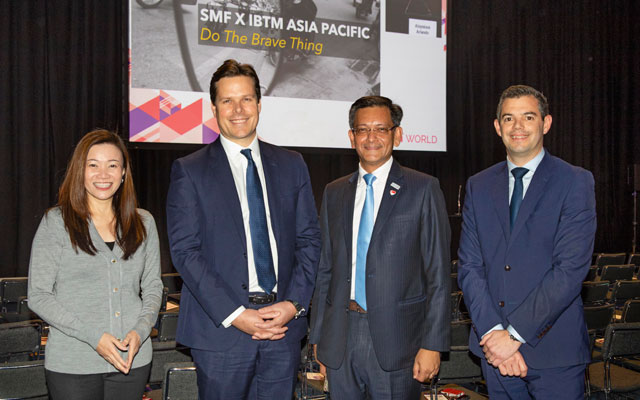
PHOTO CAPTION From left: ICCA's James Rees; UFI's Craig Newman; and AIPC's Aloysius Arlando

Three global associations serving the international meetings Industry – AIPC (The International Association of Convention Centres), ICCA (The International Congress and Convention Association), and UFI (The Global Association of the Exhibition Industry) – have launched a Global Alliance.

All three associations will be collaborating more closely in the future, and generate more comprehensive and better aligned benefits for their respective members.

From left: ICCA’s James Rees; UFI’s Craig Newman; and AIPC’s Aloysius Arlando

The alliance has agreed to begin a programme of exploring exchange and reciprocity in four areas: educational content, research, standards and advocacy.

The three partners will begin by engaging in a series of educational exchanges incorporating each other’s knowledge content into their respective conferences, and align approaches taken to areas of common practice such as research and advocacy activities, immediately. At the same time they are initiating a regular exchange between their respective leaderships to align interests on issues like standards, terminology and best practices.

“We are all organisations with a global membership and perspective and already complement each other’s activities in various ways”, said Aloysius Arlando, AIPC’s president. “However, as the business models of exhibitions, congresses, conferences, and other types of business meetings evolve, the overlap of global associations servicing the industry is growing even further.”

“This carries the risk of competition replacing collaboration as the driving force for industry associations. With our Global Alliance, the three of us choose value for our members, choose collaboration over competition,” added Craig Newman, UFI’s president.

In addition to the immediate practical outcomes, the partners believe the Alliance also offers potential to enhance the credibility of the industry as a whole by providing a vehicle for development of greater consistency within a mutually agreed industry framework.

CWT: Business travellers from various countries want varying hotel experiences

0
XX

According to research commissioned by RoomIt by CWT, the hotel distribution division of travel management platform CWT, business travellers want different hotel experiences based on their country of origin.

The results revealed that globally, having access to Wi-Fi (84%), room rate (81%), distance from business site (81%) and breakfast (79%) are the most important influences. A few of the key differences between countries were also revealed, such as business travellers from the UK and Germany are the most swayed by having access to a health club (44%), while loyalty programmes are the most important to those from Mexico and Germany (46%).

Several other notable takeaways from the results – business travellers from Germany are most likely to be persuaded by photos (56%), compared to other countries while travellers from France are the least likely to experiment with new hotel brands (26%).

Travellers from Mexico are less likely to use their company’s booking tools (24%), compared with those from Canada (35%). German travellers rely most on having someone else book their travel (41%) or going offline to speak with a travel agent (40%) compared to US travellers (27% and 22%, respectively).

Overall, business travellers are more likely to stay at upper midscale to upper upscale properties, but there are key regional differences. Travellers from India and Australia are more likely to stay in luxury properties (35% and 25%), while Mexico, the US and Italy travellers are more likely to stay in upper midscale properties (35%, 32% and 27%).

Globally, when asked what attributes best describe the ideal hotel accommodation, results show that the hotel and service are stronger drivers than amenities, image or location. Quality (44%), trustworthiness (38%), convenience (40%), quietness (30%), affordability (28%) and coziness (28%) resonate the strongest. Regionally, quality is most important to India (63%), the US (44%), Canada (40%), and the UK (39%). France prefers coziness and quiet the most (49% and 39%), while Mexico ranks trustworthiness the highest (54%).

The RoomIt by CWT survey was conducted through a web-based survey of 660 business travellers between November 28 and December 14, 2018. Survey data was collected from more than 660 business travellers from the US, Canada, UK, India, France, Italy, Germany, Australia, and Mexico.

Bali, Sentosa and India next in line for Raffles’s APAC expansion

0
Private Pool Villa

Hot on the heels of recent openings in Maldives and Shenzhen, Singapore’s Sentosa island, Bali and India will be among the next destinations to welcome Accor’s luxury hospitality brand Raffles.

Set to open next to Sofitel Sentosa Resort & Spa in 2022, the Raffles Sentosa Resort & Spa will be the brand’s second property in Singapore. The resort will feature 61 keys, ranging from the 260m2 one-bedroom villa to the 450m2 four-bedroom villa, each sporting its own private pool and garden terrace area. Other facilities on the 100,000m2 resort site include a bar, restaurants, fitness centre, three function rooms, the Raffles Spa, as well as butler service.

The hotel will be the outcome of a partnership with property investment and development company Royal Group and global design studio Yabu Pushelberg.

When asked about the room rate at Raffles Sentosa, Michael Issenberg, Accor’s chairman and CEO Asia-Pacific, said it was too premature to disclose, but added that introductory rates for a suite at the soon-to-open Raffles Hotel Singapore will start from US$875.

Similar to the Sentosa property, Raffles Bali will boast 32 private pool villas across 23ha of land in the Jimbaran area. The resort, set to open in 2020, will also feature a Writers Bar, spa, and restaurant.

Raffles Udaipur will also open next year, marking the brand’s first foray into India. The 101-suite property will occupy its own private island in the middle of Udai Sagar Lake in Rajasthan, and will also feature the 1,100m2 Raffles Spa, rooftop restaurant, swimming pool, and the Raffles Long Bar and Writers Bar.

After which, the second Raffles property in India will open in 2022 in Jaipur, part of a larger complex that currently houses the Fairmont Jaipur. The hotel will have 50 suites with private pools.

Raffles currently boasts a collection of 14 properties worldwide, with Accor aiming to reach 20 by 2025. There are currently another eight to 10 Raffles properties in the pipeline, of which 50 per cent will be located in Asia-Pacific.

Flagships for Europe, the US and Middle East are also in the pipeline, including the Raffles London (2020) in the former War Office, Raffles Boston Back Bay Hotel & Residences (2021), and Raffles Palm360 Resort Hotel & Residences (2021), respectively.

Reviews

Hyatt Regency Kuala Lumpur at KL Midtown

A polished urban retreat designed for business travellers, Hyatt Regency Kuala Lumpur at KL Midtown combines thoughtful design, seamless service, and exceptional facilities.

A versatile powerhouse

Arena @ Expo, a multipurpose concert hall at the Singapore Expo is a flexible space for high octane concerts and lifestyle events.

Amari Bangkok

The five-star property excels in backing its expansive facilities with seamless service and personalised attention, setting the benchmark for luxury in Bangkok.