A new Wyndham Grand hotel has opened in downtown Yangon, the second property of Wyndham Hotels & Resorts in Myanmar.
The 20-storey luxury hotel forms part of Kantharyar Centre, a new mixed-use project comprising office spaces, serviced apartments and retail outlets.
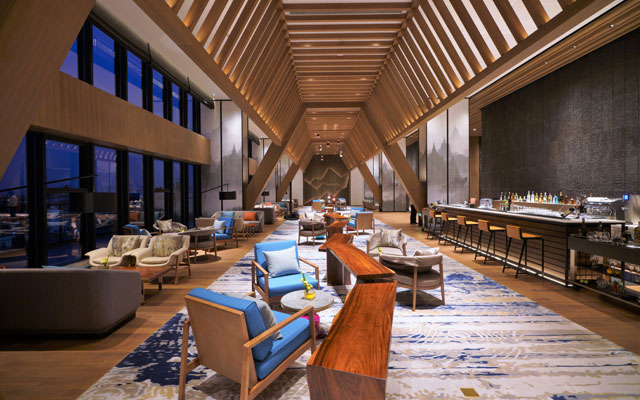
Wyndham Grand Yangon
1 of 5
Lobby Bar
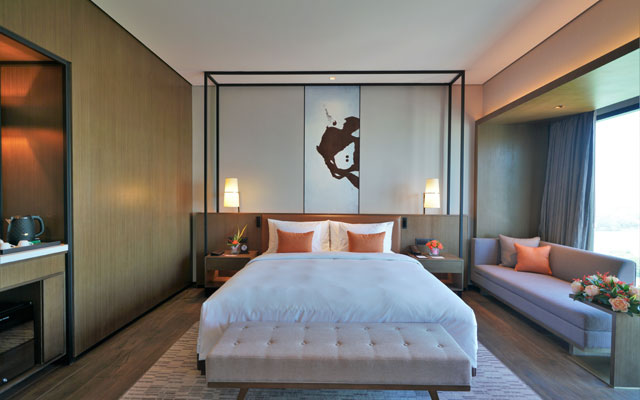
Club King Room
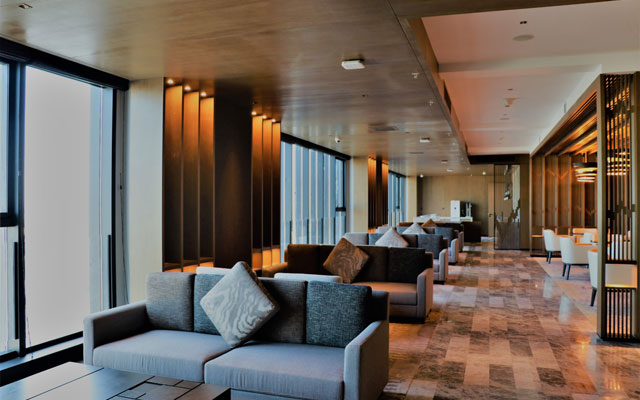
Club Lounge
Kandawgyi
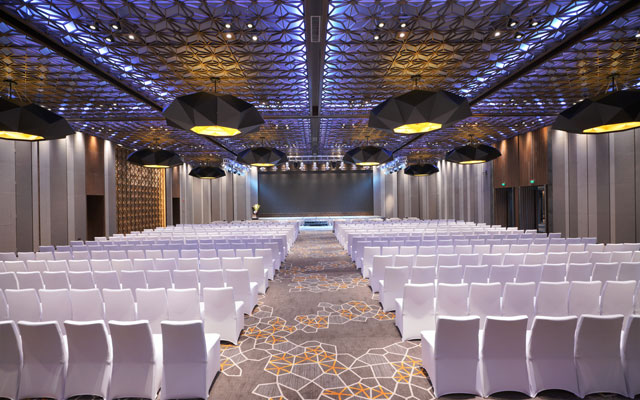
Amarapura Grand Ballroom
Wyndham Grand Yangon features 291 rooms and suites, with floor-to-ceiling windows that overlook Kandawgyi Lake and Shwedagon Pagoda. The 320m2 Presidential Suite, on the topmost 20th floor, boasts a separate meeting area, dining room and private bar, plus a sauna and an eight-person Jacuzzi.
Guests staying on the Executive Club Floors will enjoy exclusive access to the Executive Lounge, which offers extra services such as daily buffet breakfast and evening cocktails, plus free use of a meeting room for two hours.
Aside from the five F&B venues, facilities include a fitness centre, spa and outdoor pool with views over Kandawgyi Lake. Guests who want to visit Yangon’s downtown landmarks, such as Sule Pagoda and Bogyoke Market, can utilise the hotel’s daily shuttle service.
For corporate guests and event planners, the hotel’s portfolio includes a 500-delegate Grand Ballroom with a huge LED screen, five meeting rooms with a large pre-function space for cocktail receptions, as well as an outdoor garden for al fresco events.
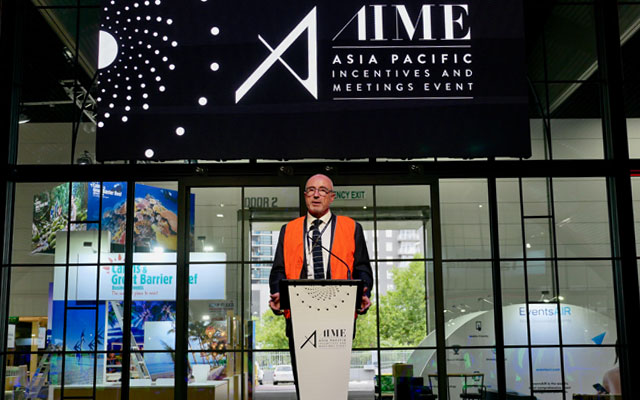
Matt Pearce, CEO of Talk2Me Media and Events launches AIME 2019 at Monday's press conference
This year’s Asia Pacific Incentives and Meetings Event (AIME) in Melbourne has kicked things off with a greater focus on getting international buyers, and the creation of more networking opportunities for stakeholders.
AIME’s new organisers, Talk2 Media and Events, say they believe what they have on offer this year provides more value for both its Australasian and Asian participants, with 50 per cent more hosted buyers than last year and more than half of all buyers new to AIME.
Matt Pearce launches AIME 2019 at Monday’s press conference. Photo: Adelaine Ng
Also, 65 per cent of buyers represented are from overseas, compared to just 18 per cent last year, thanks to a more thorough vetting process. And out of the 65 per cent, 70 per cent hailed from Asia.
“There is a greater focus on the quantity, quality and geographic range of (these buyers),” Matt Pearce, CEO of Talk2Media and Events told TTGmice. “We’ve also vetted all the hosted buyers to make sure they fit the bill, (ensured) they have money to spend in the next five years, and that they are looking to spend that money in the region”.
Pearce also added new structures have been adopted to encourage the right business meetings to take place. For instance, technology using algorithms have been employed to match buyers and suppliers, although manual interventions have also been used to get better outcomes.
“For instance, the Northern Territory in the past may not have been as interested in Chinese visitors, but they now have a direct service to Guangzhou from Darwin, so China now becomes more important and more interesting to them. So we’ve worked with them to match (the right buyers),” elaborated Pearce.
Networking opportunities have also been given more priority with meeting spaces redesigned, and the welcome party adjusted for more food and less music to encourage talking.
Australian Podiatry Association’s events manager Pauline Taylor, who has attended more than 10 AIMEs, shared with TTGmice she appreciated the more personalised attention from organisers this year.
“(The organisers also recognised) that there were many international buyers who didn’t get taken out by local suppliers… so they’ve put on this whole new eat street, food truck-esque event on Tuesday evening. That was a nice touch,” she said.
Talk2Media and Events were tasked in 2017 to take over and rejuvenate AIME beginning in 2019, and halt the slide in attendance numbers over recent years. This year, more than 2,000 delegates have registered to attend the three-day event which ends on Wednesday (February 20).
The Taiwan Tourism Bureau (TTB) is working to promote Taiwan as a top-of-mind destination to incentive groups from India, as part of its overall aim to grow the Indian inbound market by 20 per cent by 2020.
“Taiwan and India have a close business relationship in fields like IT and technology. We want to promote Taiwan as an incentive destination among Indian businesses. Previously, we received an incentive group of 200 pax from India’s TATA group,” said Trust Lin, director, TTB Singapore Branch.
The country’s tourism bureau hopes to attract more Indian incentive groups; Taipei pictured
To lure incentive groups, TTB is promising help in the form of monetary offset, as well as its willingness to collaborate with private stakeholders, in a bid to “project Taiwan as a new incentive destination” to Indians.
“If one is handling a group of more than 50 pax staying in Taiwan for more than three nights, they qualify (for an incentive of) US$26 per pax. In addition, we can cooperate with PCOs for joint marketing,” revealed Lin.
This is part of Taiwan’s New Southbound Policy, which focuses on 18 international markets such as India, Australia, Singapore, Thailand, Malaysia and Vietnam. In total, these markets are 25 per cent of all overall international arrivals to Taiwan.
Among these countries, India holds the most potential for growth coming from its low base of 38,000 arrivals, Lin pointed out.
As such, the Taiwan External Trade Development Council has taken steps to court Indian outbound travellers by organising a Taiwan Expo in New Delhi for the first time last year. The expo was a key event aimed at enhancing economic and trade cooperation between the two countries.
Furthermore, TTB believes that growth in the Indian incentive market, apart from helping to increase overall tourist arrivals, will eventually result in more direct flights between the two countries. Currently, there is only a thrice-weekly service linking New Delhi and Taipei by China Airlines.
“We want to have direct flights from other Indian cities like Mumbai as well. However, the current traffic is restricting airlines to operate direct connections,” Lin lamented. “If segments like incentive travel can grow significantly from India, it will be a stronger case for more direct connections.”
The growing interest in courting the Indian market comes at a time as tourist arrivals from Mainland China – Taiwan’s traditional main source market – continues to dwindle.
The Indonesian business events industry has lost one of its veteran players with the passing of Rocky Kalalo, former managing director of Panorama Convex and board member of the Indonesia Congress and Convention Association (INCCA).
Rocky died in Jakarta last Sunday morning after suffering from stroke last year. He will be cremated this morning.
Rocky Kalalo
The respected industry professional has more than 35 years of experience in the business events industry. He first started out at the Jakarta Hilton International (now The Sultan Hotel & Residence Jakarta), before moving to the Jakarta Convention Centre. He then joined Panorama Group in 2000 to spearhead the Panorama Convex.
Satrijanto Tirtawisata, commissioner of Panorama Group, said: “Rocky was a great guy. With his long experience working at Jakarta Convention Centre and through his (business) trips overseas, he understood the needs of the industry and the opportunities available in the market. (With that knowledge he) created homegrown exhibitions at Panorama Convex.”
The Renovation and Construction Expo, for example, was a brainchild of Rocky, who was inspired by the severe flooding in Jakarta in early 2002 which caused widespread damage to the city. The same year, he created the expo, which has lived on till today as part of Reed Panorama Exhibition’s Megabuild annual programme .
In addition, the Franchise & Licence Expo, Indonesia Maternity Baby and Kids Expo, and the Indonesia Maritime Expo were also his creations, events which are now annual staples on the country’s events calendar.
Rocky also played role in the development of Indonesia’s business events industry with his active participation in trade associations, such as the Indonesia Exhibition Companies Association and INCCA.
Iqbal Alan Abdullah, chairman of INCCA, shared with TTGmice: “I have known and worked alongside with Rocky for 40 years, and he was very consistent in his efforts to contribute to the development of business events (in Indonesia).”
For example, INCCA pioneered the idea of a business events school in the country by joining forces with Jakarta Polytechnics. Eventually, business events became a full-fledged department at National Polytechnic Jakarta in 2003.
“It took years of work for this to materialise and during those years, Rocky contributed his ideas, thoughts, time and energy to form the first formal school of MICE,” Iqbal shared.
Rocky was also part of the team that formed the Indonesia Convention and Exhibition Bureau, and held the role of acting executive director when it launched in 2016.
Iqbal added Rocky’s open-hearted personality made him an unofficial mentor to so many younger professionals. Iqbal said: “People could just approach him and ask him any question, and he would happily share his knowledge.”
The value of business events secured with the help of Tourism Australia’s Business Events Bid Fund Program (BFP) has almost doubled from A$97 million (US$69 million) to reach a record A$187 million in the past three months.
Tourism Australia’s managing director John O’Sullivan said the results demonstrated the fund’s effectiveness in improving Australia’s competitiveness in the global business events market by helping to offset event costs.
MICE buyers in Sydney, Australia
He added that this was a “direct result of the combined efforts of the Australian business events industry in securing these events”.
The effectiveness of the BFP is also reflected in the number of applications received, with applications now having reached 79 since the launch. A majority of applications are for international health and direct selling business events.
On average, every dollar invested by Tourism Australia and industry in securing events through the programme has generated A$19 for the Australian economy.
Fourteen events have been secured for Australia since the commencement of the BFP in July 2018, with six of the events publicly announced. They include:
UITP 2021 Global Public Transport Summit, Melbourne (A$4.6 million in economic value for Australia)
2019 SportAccord World Sport and Business Summit, Gold Coast (A$6.7 million in economic value for Australia)
145th IATA Slot Conference, Brisbane (A$3.2 million in economic value for Australia
13th Congress of International Plant Molecular Biology 2021, Cairns (A$4.2 million) in economic value for Australia
Society for Freshwater Science Annual Meeting 2021, Brisbane (A$2 million in economic value for Australia)
IEEE Symposium Series on Computational Intelligence SSCI 2020, Canberra (A$2.2 million in economic value for Australia)
Business events remains one of the most significant sectors of Australia’s visitor economy, and the sector is the second largest contributor to overnight international visitor expenditure after China.
Total expenditure by international business events visitors in the year ending September 2018 was worth A$4.9 billion, an increase of 16 per cent over the previous year.
Global travel management company Carlson Wagonlit Travel has announced the official adoption of CWT as its new name and identity.
The three-letter classification honours the company’s heritage and its digital leadership ambitions, and reflects its focused value proposition in corporate travel, CWT said in a press release.
The evolution of CWT over the years
Three of CWT’s four specialist services, CWT Energy Resources & Marine, CWT Meetings & Events and CWT Solutions Group are expected to benefit from the rebrand with new logos, while its global hotel distribution division, RoomIt by CWT, will only see minor changes in the colour palette.
“This identity change is the latest phase in our digital development plan to combine the power of technology and innovation with the expert know-how of our people,” said CWT’s president and CEO Kurt Ekert.
“There’s a romantic link with the Wagons-Lit era, and we are justifiably proud of our 150 year-heritage – however, today’s developments reinforce our intention to continue to lead our industry for the next century and a half.”
Pullman Luang Prabang has launched a Meet and Play MICE package that blends outdoor experiences, socially-responsible events and corporate meetings together.
The package, bookable from now until August 31, 2019, enables groups to create their own customised corporate retreat, including full- or half-day meetings, one free room night for every 15 paid rooms, round-trip airport transfers for one VIP guest, discounts on group cocktails and dinners, and more.
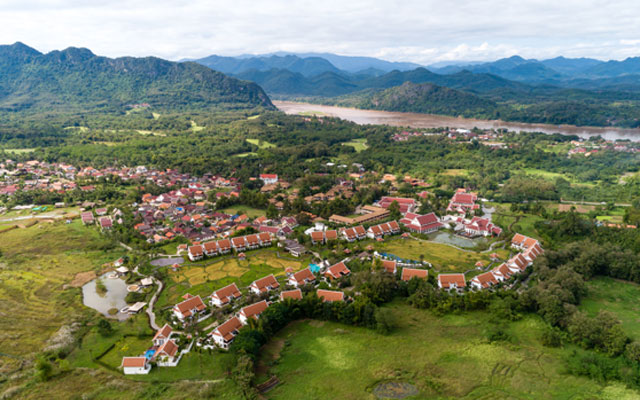
Pullman Luang Prabang
1 of 5
Event organisers can choose from the 368m2 Nam Khong Ballroom and 116m2 Nam Khan function room, both of which can be divided into smaller spaces, and Le Salon, the boardroom. This trio of flexible venues creates options for events of all sizes, accommodating up to 300 delegates.
The property has also teamed up with a series of local partners to create unique off-site activities that help corporate groups strengthen their bonds and give back to the local community.
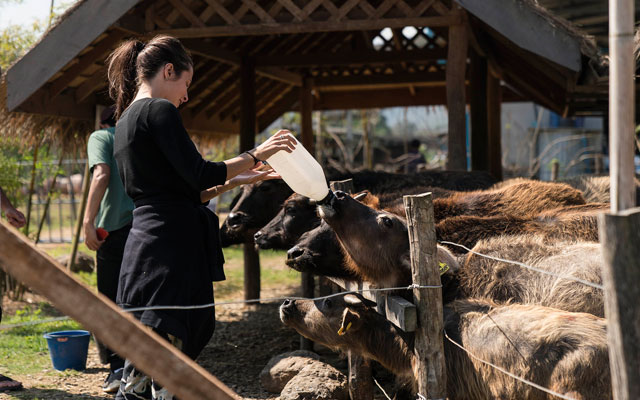
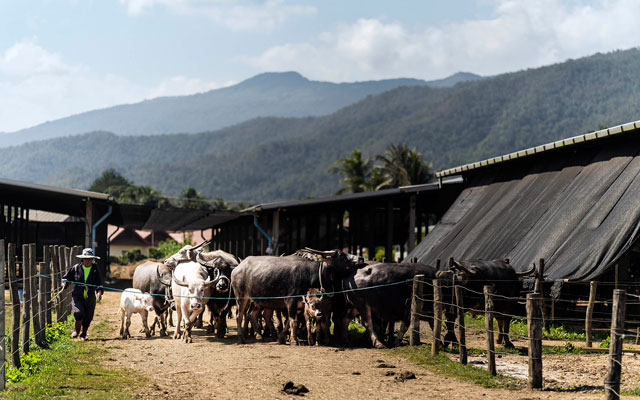
For example, corporate guests can visit the Laos Buffalo Dairy, the first dairy farm in Laos which supplies local products including buffalo mozzarella to Pullman Luang Prabang. Delegates will learn how this social enterprise is working with Lao farmers and diversifying the local agricultural industry. Guests will be able to meet the owners, Susie Martin and Rachel O’Shea, enjoy close encounters with their 150-plus buffalos, visit the dairy and taste their products first-hand.
Alternatively, groups can head to Ock Pop Tok, a sustainable textiles business that empowers the women of Laos. Launched in 2000 by local weaver Veo Douangdala and British photographer Jo Smith, the organisation works with more than 500 artisans throughout the country. Event planners can arrange for their delegates to visit the textile factory, or take part in a group weaving class.
At Pullman Luang Prabang, groups can head out into the paddy fields, where rice for the hotel’s all-day dining restaurant L’Atelier is harvested from. Seasonal rice cultivation classes can be organised for corporate groups, allowing delegates to discover this ancient Asian occupation. Further enhancing the resort’s environmental ethos, the unused rice husks are donated to MandaLao Elephant Conservation Camp, which cares for rescued elephants.
In addition, Pullman Luang Prabang’s events team can create inspirational activities tailored to the specific requirements of each group.
For more information, email H9112@accor.com or contact (856) 71 21 1112.
Andy Watson has been promoted to senior vice president and general manager for SAP Concur, Asia Pacific Japan (APJ) and Greater China, succeeding Nick Evered who will be retiring.
In his new role, Watson will be responsible for accelerating the growth of SAP Concur’s business in APJ and Greater China.
An SAP veteran, he has held global and regional leadership roles across several board areas since joining SAP in 2003. He was most recently COO of SAP Cloud APJ, and prior to that, led the APJ business for SAP SuccessFactors, a global provider of cloud-based Human Capital Management software.
Watson has also held the role of chief financial officer for SAP Field Services and SAP HANA Enterprise Cloud at SAP’s global headquarters in Walldorf, Germany.
Before SAP, Watson held finance, operations and business leadership roles at Compaq, Siebel and Fujitsu.
Australia is expecting to see robust activity for business events in 2019, with most event segments seeing strong growth and Asia source markets regarded as a key contributor.
Penny Lion, executive general manager events at Tourism Australia, said: “(We have) overall growth of six per cent for business events arrivals and five per cent for business events expenditure in the year ending March 2018. In particular however, we are seeing strong growth out of China, with an 11 per cent increase in business events arrivals during this time, and 12 per cent growth in expenditure…so we expect a robust 2019 and beyond.”
Lion’s vote of confidence is echoed by Association of Australian Convention Bureaux’s (AACB) CEO Andrew Hiebl, who projects that the number of international delegates travelling to Australia to attend almost 400 business events in 2019 will break the quarter-million mark for the first time since AACB reporting, contributing to a total delegate spend of more than A$1 billion (US$722.9 million).
“Association meetings and conventions will continue to be Australia’s strongest performing international segments,” said Hiebl. “(But) international corporate meetings and incentives won dropped by 18 per cent (suggesting these may prove the weakest areas next year)”.
However, corporates are where convention centres like ICC Sydney are banking on for the strongest growth, with CEO Geoff Donaghy seeing incentives and product launches increasingly booking Australia.
“Our close proximity to Asia provides us with an enormous advantage and opportunity,” he said. – Adelaine Ng
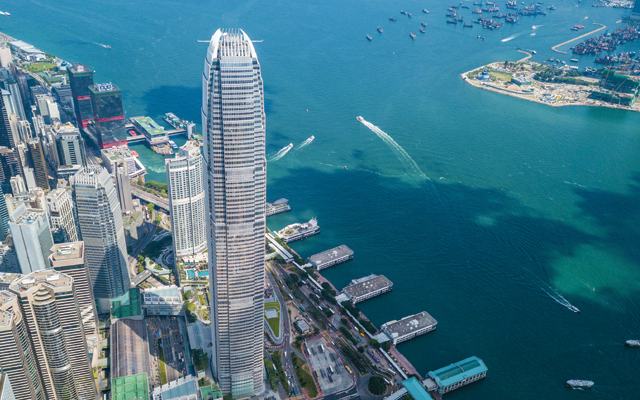
Hong Kong is leveraging improved cross-border access via the new High Speed Rail and the Hong Kong-Zhuhai-Macao Bridge to grow business travel and events traffic.
Nicholas Chan, director of sales with Kerry Hotel, Hong Kong, foresees an increase in business arrivals in 2019, driven by global interest in the new international transport link to support international meetings.
Chan expects the US to be Hong Kong’s strongest geographical market for business travel and events, while IT will be the top performing industry sector.
Other industry sectors slated “to shine” in 2019 are medical and healthcare, he said.
At Hong Kong Convention and Exhibition Centre (HKCEC), exhibitions remain the venue’s key business segment, with most events specialising in luxury products and services. The HKCEC spokesperson added that niche exhibitions on diving & resorts and technology for elderly people are growing.
HKCEC found that clients were also paying more attention to environmental issues, and expects this trend to continue.
Wellness and sustainability concerns are increasingly common among delegates attending events at Grand Hyatt Hong Kong, with planners now eager to find new ways to appeal to their participants through these aspects.
When asked about major business concerns for the new year, industry players pointed to uncertainty in the global economy and the trade war between China and the US. – Prudence Lui
India’s growing reputation as a knowledge powerhouse is expected to encourage a rise in exhibitions and conferences held on her soil in the new year, while positive international business ties will drive inbound business travel.
Business verticals such as medical, finance, IT and engineering are predicted to be strong drivers of business travel and events demand.
Chander Mansharamani, managing director at Alpcord Network Travel & Conferences, added that the “stability of the Indian economy means that inbound MICE demand will grow 10 to 15 per cent in 2019”.
Swadesh Kumar, founder of Shikhar Group of Companies, identified the US, Europe and Japan as key source markets for inbound business events and corporate traffic, as “they have strong business ties with India”.
With the Indian tourism ministry stepping up destination marketing efforts in the past year, some industry players are also expecting corporate incentive interest to rise in 2019.
Meanwhile, Sanzeev Bhatia, vice president, The Metropolitan Hotel & Spa New Delhi, is betting on a rosy second half of the year.
He explained: “The Indian union elections are scheduled in the first half of 2019, so a lot of companies have planned their (events in India) for the later part of the year.” – Rohit Kaul
Indonesian business event players are predicting a slow 1H2019 due to the country’s general and presidential elections, as well as the Ramadhan Muslim fasting month following soon after.
The Jakarta Convention Center, for one, is feeling the effects acutely. While the venue’s books at year-end typically show strong advance bookings until the following mid-year, this time round it isn’t so.
Hosea Andreas Runkat, director of convention services with the venue, explained: “Unlike in 2018, the next January-February period is quiet for us. March will be busy, but April bookings are down 50 per cent year-on-year because of the elections.”
Arya Seta Wiriadipoera, managing director of Napindo Media Ashatama, noted that elections always made for uncertain political situations which could bring about travel advisories against Indonesia.
Despite that, Arya remains optimistic that the seven exhibitions Napindo had planned for 2019 would be successful. “The Indonesian market is (highly regarded) and businesses want to profit from it. As such, trade exhibitions here are less vulnerable to economic (and political) issues,” he added.
While Muhammad Reza Abdullah, president director of Royalindo Expoduta, is seeing weaker business in 2019 compared to 2018, he remains encouraged of good business ahead leading from Indonesia’s successful hosting of the Annual Meeting of the IMF-World Bank in Bali last October.
Adding to Indonesia’s inbound business events woes is a cocktail of rising costs and destination competition, said Ida Bagus Lolec Surakusuma, managing director of Pacific World Nusantara, who believes that these will hurt inbound incentives in 2019.
“Companies are now tightening budgets while being offered more destination choices. Some budget-conscious clients farther afield are choosing to conduct their incentive programmes closer to home (instead of here in Asia),” he explained.
To get around this, he said the Indonesian Ministry of Tourism should focus on developing stronger business event arrivals from nearby Asian source markets. – Tiara Maharani
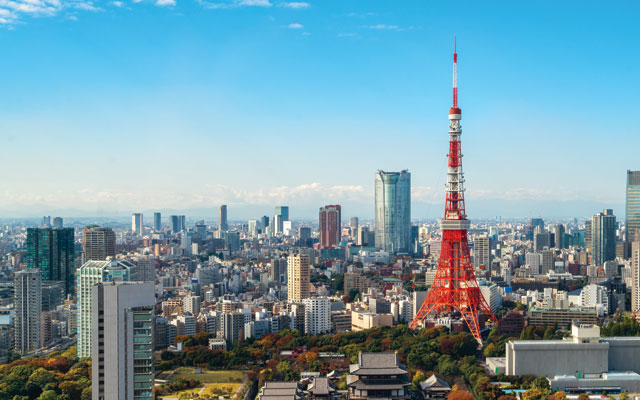
On the back of a solid business events performance in 2018 and thanks to a raised profile due to the upcoming Rugby World Cup and Olympic Games in 2020, Japan’s outlook for business events in 2019 is very positive.
“Interest in corporate meetings and incentives in Japan is increasing because of the Rugby World Cup next year, particularly among European markets – most notably the UK – as well as Australia and New Zealand,” said Etsuko Kawasaki, executive director of the Japan Convention Bureau.
The Japan National Tourism Organization has recently opened offices in Malaysia, Vietnam, Thailand and India, which has also had a positive impact on business event visitors to Japan, Kawasaki said. The Indian market has in particular been focusing on Japan, she also added.
Lucky Morimoto, president of Tokyo-based Event Services, anticipates continued strong interest from buyers representing large multinational life insurance companies and direct sales firms with operations in Hong Kong, Singapore, Malaysia, Thailand and China.
The positivity surrounding the inbound business events sector is encouraging the New Otani Hotel to cast its eyes beyond the domestic market.
“We are particularly interested in attracting MICE visitors from Europe and North America as those travellers (tend to stay in) Japan for a longer period of time,” said Mika Ikegami, senior sales manager for the Tokyo property. – Julian Ryall
With the majority (80.7 per cent) of subvention applications coming from Asia-Pacific, the Macao Trade and Investment Promotion Institute (IPIM) concluded that global issues such as the China-US trade dispute or BREXIT have little impact on Macau’s inbound MICE performance.
Corporate meetings was the strongest performing segment in 2018, followed by association meetings.
An IPIM spokesman expects to see the same picture in 2019, but said the organisation will “constantly monitor the situation”. He added: “If the trade dispute turns long-term, it may affect who does business with who although it may not lead to major downturn in B2B events.”
In Macau’s favour is the inauguration of the Hong Kong-Zhuhai-Macao Bridge which is boosting B2B traffic within the Pearl River Delta region as well as “the desire for the cities (there) to work together and explore business opportunities”. “Accessibility to Macau from Hong Kong airport is now 24/7 with the link bridge in place. This enhances our capacity to stage large-scale events,” said the spokesman.
Stakeholders like Sands China is projecting a buoyant 2019 for meetings and events. Vice president of sales, Stephanie Tanpure, noted that the average size of events is growing.

“At Sands Resorts Macao, we are particularly optimistic about the anticipated growth in MICE over the next two years and we remain hopeful to increase our market share across key source markets including China, Taiwan, Japan, Korea, South-east Asia, the US and Australia. In 2019, Sands Resorts Macao will undertake an intensive global roadshow which will cover over 25 cities commencing with the US in March 2019,” she detailed.
To encourage continued growth, particularly in inbound incentive trips, the Macao Government Tourism Office is maintaining its support scheme for this segment of events as well as its presence at various relevant tradeshows worldwide to promote the destination. – Prudence Lui
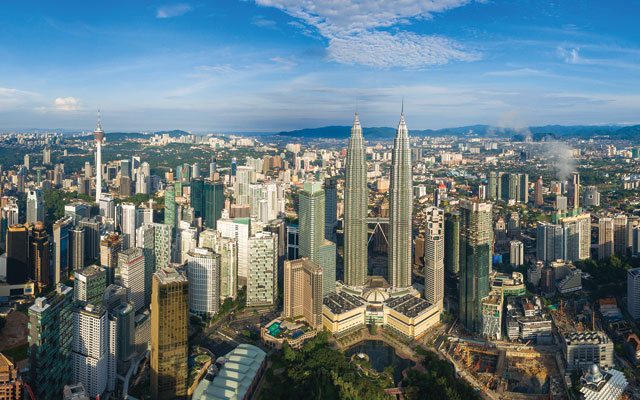
Malaysia has a healthy forecast for this year, citing new attractions and confirmed venue bookings as reasons for jubilation.
Arokia Das Anthony, director, Luxury Tours Malaysia, said: “Desaru Coast in Johor is shaping up and this will be a new destination for us to promote in 2019. Our main markets, Indonesia and India, performed well in 2018 and we expect the growth to continue in 2019.”
Adam Kamal, general manager, Tour East Malaysia, is optimistic as the company has confirmed forward bookings for incentives from Australia and Russia for 1H2019. Tour East Malaysia has also ventured to US and South America in search for new business.
Over in Penang, a fast-rising destination for business events, Setia SPICE Convention Centre is enjoying full venue occupancy from Fridays to Sundays throughout 2019, and will be busier in the new year than it was in 2018.
Yeoh Kheng Ho, senior manager, said advance bookings came mostly (70 per cent) from local companies planning meetings, annual dinners and exhibitions.
Ashwin Gunasekeran, CEO, Penang Convention & Exhibition Bureau, summed up that 2019 will be a busy year for Penang, with many national and international conference bids won in 2016 and 2017 materialising in 2019, including the World Seafood Congress 2019 which will take place in September.
However, Alan Pryor, general manager of Kuala Lumpur Convention Centre, is cautiously optimistic. Describing 2019 as a “moderate international meetings year for the centre”, he explained that clients are taking a wait-and-see approach to their event planning against a backdrop of uncertainties in geo-politics and a new government in Malaysia. – S Puvaneswary
Inbound business events are expected to fare better in 2019 than the previous year, emboldened by agile business from China, devaluing local currency that makes travel in the Philippines much more affordable, and renewed importance being given to this oft-neglected tourism segment.
“Business travel has grown exponentially and demand for corporate events has equally increased. This growth has seen China as the single strongest feeder market,” said Agnes Pacis, vice president sales and marketing, SMX Convention Center.
Marco Polo Ortigas Hotel’s general manager Frank Reichenbach said that based on tourism figures in 2018, China and Taiwan are expected to bring in more corporate guests. Conventions will continue to grow, he added, due to the “continuous development of infrastructure and facilities” while others said corporate meetings are another growth sector.
Another booster is the continued weakening of the Philippine peso, which fell 53.3 pesos to the US greenback in June 2018 – the weakest in 12 years – as experts predict that it will reach the 55 peso mark in 2019.
Factoring in inflation, currency fluctuations and other global macro issues, Marisa Nallana, president of the Philippines Exhibits and Themeparks, said the industry should take heed of the growing trend for “cost savings, fewer delegates for meetings, shorter meetings and events, and transfer to smaller/less costly venues”.
Joel Pascual, president of PACEOS (Philippine Association of Convention/Exhibition Organizers and Suppliers), said 2019 augured well as the MICE roadmap over the next nine years is already in place and the new COO of Tourism Promotions Board, Marie Venus Tan, has adopted the “bid, bid, bid” policy for international events while the government has the “build, build, build” infrastructure policy. – Rosa Ocampo
While inbound business events performance is expected to hold strong for Singapore, industry players are keeping a cautious eye on the ripple effect of international relations.
Jeannie Lim, executive director, conventions, meetings and incentive travel, Singapore Exhibition & Convention Bureau, is keeping an eye on “ongoing global tariff war and potential geopolitical tensions that might affect consumer confidence and business travel sentiments”.
Pan Pacific Hotels Group’s chief, sales & marketing officer, Cinn Tan, reflected similar sentiments. She projected that the “mounting trade tensions between the US and China will pose the biggest risk to global economic growth in 2019”.

The resulting climate may affect suppliers who are reliant on traffic from Central and South America as well as around Asia-Pacific, said Kerry Healy, vice president of sales Asia Pacific, AccorHotels. These markets “consider economic and political safety as their main issue when selecting a meeting destination,” she explained.
Geopolitical tensions could also affect air connectivity, which is a “top factor influencing meeting location” for planners in North America and Europe, Healy added.
Still, business is proceeding as usual in Singapore, as “the global economic outlook for 2019 and Asia-Pacific travel growth seems favourable,” forecasted Lim.
Tan added: “There is a silver lining in the clouds as the longer-term outlook by GBTA is more positive, as business travel-related spending is forecast to increase by 7.1 per cent in 2018 over 2017 (which totalled US$1.3 trillion globally). 2019 will also see more bleisure travel across all regions worldwide, particularly for top destinations such as Singapore, Tokyo and Shanghai.”
Singapore looks forward to a strong pipeline of conventions and large meetings from technology, innovation and direct selling companies. Growth momentum in the exhibitions and conferences sector is also expected to continue, according to Lim, driven by emerging clusters, such as advanced manufacturing, fintech, smart logistics and lifestyle. – Pamela Chow
While MICE performance data for 2018 had yet to be compiled at press time, the Korea Tourism Organization (KTO) revealed that corporate meeting and incentive arrivals to the country as of November 2018 had risen 21 per cent year-on-year.
Baeho Kim, KTO’s director of MICE planning & management team, believes that the figure will rise further by the year’s end.
Cyril Constantino, Asia Pacific supplier management lead, CWT Meetings & Events, reports stronger interest in the country too.
“We’ve seen an increase in the number of clients enquiring about hosting their events in South Korea and we organised a few large events here in 2018,” he shared, adding that Seoul and Jeju were a hit while Pyeongchang might gain more adventurous corporate groups in the new year due to publicity surrounding the 2018 Winter Olympics.
Constantino projects a brighter future for the country in 2019, “helped by the easing of tensions with the North”.
Various factors have also led to more intense interest in South Korea, he opined.
“South Korean culture has gained tremendous popularity across the globe. This is a major draw not just for incentive trips, but also for corporate events that are becoming increasingly ‘festivalised’ and incorporating K-pop elements into their concepts. Coupled with new creative spaces and experiences, these factors will continue to drive demand for South Korea moving forward,” he said.
Kim, too, anticipates continued “positive growth” in incentive arrivals thanks to the recovery of the Chinese market and strong economic developments in South-east Asia. KTO will maintain its focus on growing the corporate meeting and incentive segments.
Escalating competition with Thailand, Singapore and Japan will see KTO intensifying its promotional activities. In 2018, KTO moved to incorporate Hallyu elements into business event programmes by way of sponsorship of K-pop concerts, souvenirs, and more.
Kim added: “We recently signed an MOU with global hotel chains to conduct partner marketing and create new demand.”
Source markets that will get KTO’s attention in 2019 are Vietnam, Thailand and Indonesia, as well as Russia and Western Europe farther afield. – Karen Yue
Wat Phra Kaew, Temple of the Emerald Buddha Wat Phra Kaew is one of Bangkok’s most famous tourist sites
The Thailand Convention and Exhibition Bureau (TCEB) recorded 1,255,985 overseas MICE arrivals in 2018, which for Nichapa Yoswee, senior vice president – business, is a “remarkable increase” of 19.9 per cent. These travellers generated revenue of around 95.6 billion baht (US$2.9 billion) – an 8.1 per cent rise over 2017’s performance.
TCEB secured 14 conference bids, 10 mega meeting and incentive groups (each with 2,000 to 20,000 pax), and eight new tradeshows in 2018.
Clearly, the corporate incentive sector continues to be Thailand’s strongest performer, growing by 35.9 per cent in 2018, with China being the prime source market.
Nichapa attributed the robust corporate incentive performance to Thailand’s introduction of fast-entry online visa system for travellers from 20 countries, including China, as well as a slew of new tourism products. In late-2018, Bangkok debuted the ultra-glamorous shopping complex ICONSIAM along the Chao Phraya River, and King Power Mahanakhon tower which houses Thailand’s highest observation deck at 314m above ground.
In Pattaya, Nongnooch International Convention and Exhibition Center was launched in 2017 and showed off its capability in 2018 by hosting a 10,000-pax Chinese incentive group, and the Miss Universe 2018 national costume competition.
Further boosting Thailand’s appeal for business events is TCEB’s Thailand: REDEFINE Your Business Events campaign, launched in 3Q2018 to strengthen collaboration with global event strategists to make their events in Thailand exceptional, noted Nichapa.
Also turning in a good performance report is IMPACT Exhibition Management, the company behind Bangkok’s massive IMPACT Muang Thong Thani convention and exhibition venue. Loy Joon How, IMPACT general manager, said the venue hosted over 100 international business and entertainment events in 2018, including the widely-covered Miss Universe 2018 finals.
Loy is optimistic about 2019’s performance, encouraged by Thailand’s relative affordability compared to other destinations, easy access, availability of first-class venues and strong government support.
Several international trade exhibitions and incentive groups have been confirmed for the venue in 2019, including the 35th ASEAN Summit. For the new year, TCEB is expecting a five per cent increase in overseas MICE arrivals and a similar five per cent increase in revenue. – Karen Yue
The Golden Bridge is lifted by two giant hands in the tourist resort on Ba Na Hill in Danang, Vietnam.
Minister of Culture, Sports and Tourism, Nguyen Ngoc Thien, said developing the country’s business events industry is a main priority for 2019 as investments into improved infrastructure and new products start to pay off. The ministry will focus on further developing business events capability mainly in Ho Chi Minh City, Hanoi, Danang and Nha Trang.
The incentive and conference sectors are expected to be the strongest performing in 2019, with meetings and exhibitions now booked directly through hotels.
Sandor Leinwand recte Rein, general manager of EXO Travel Vietnam, said incentive travel makes up about 70 per cent of the agency’s business events bookings, with the remainder being group meetings.
Linh Le, ASIA DMC group director, added: “MICE is no longer limited to meetings and conferences. Several corporates are now requesting DMCs plan meetings in locations where guests can extend to enjoy a well-earned holiday with their spouse or family.”
While regional markets continue to dominate, Le said there is potential for growth from India, Australia, Turkey, Russia and China. Brexit is expected to impact business from the UK, while the Spanish market is projected to be sluggish due to increased competition from Europe and Africa.
Sheraton Danang Resort general manager Frank Bochmann noted a rise in regional demand, such as from Thailand, Singapore and Hong Kong. He said: “People are now looking for somewhere new and Vietnam is an attractive alternative. They are tired of Phuket and Koh Samui.” – Marissa Carruthers
Dusit Thani Hua Hin has appointed Nunnapat Wongpipit as director of sales and marketing to lead the sales team, drive revenue and contribute to the hotel’s business plan and strategy.
The Thai national has nearly 20 years of sales experience in the hotel industry, including experience at international chains.
The newly-opened Ritz-Carlton, Bangkok anchors the One Bangkok development with cosmopolitan elegance. Featuring the city's largest ballroom and a spectacular new penthouse suite, it delivers exceptional hardware and deeply authentic, soulful service for business and leisure travellers alike
Behind the imposing, Brutalist concrete that defines Zurich’s Oerlikon district lies a surprising secret. While its exterior honours the neighbourhood’s industrial roots, stepping inside Mama Shelter reveals a vibrant, neon-soaked world that is a far cry from its rigid shell
A polished urban retreat designed for business travellers, Hyatt Regency Kuala Lumpur at KL Midtown combines thoughtful design, seamless service, and exceptional facilities.