The Star Gold Coast, Australia
Along with a new name and identity from March 30 last year, The Star Grand boasts a collection of bright and elegant guestrooms, refreshed public spaces, new dining experiences and more events spaces.

Rooms Room types range from superior deluxe to the penthouse, all dressed in varying shades of cream and blue, with the interior décor kept tastefully simple and classic.
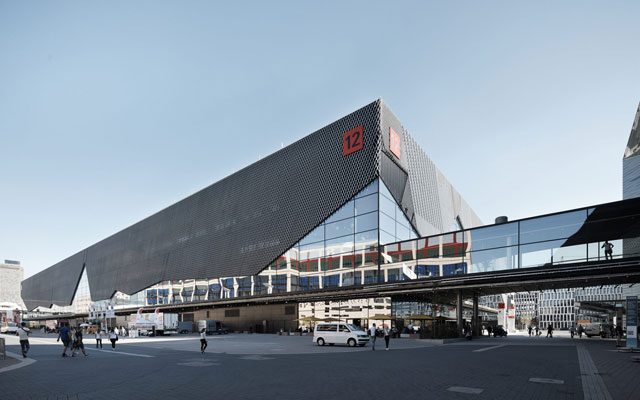
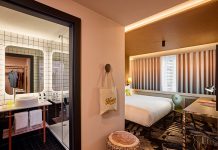
My superior deluxe room granted me unobstructed views of the city, looking towards Gold Coast Convention and Exhibition Centre, and clear, blue skies. I adored most the king bed which I didn’t want to leave every morning, and the provision of accessible USB charging points for all my electronic devices.
Meeting facilities Event planners have a variety of spaces to choose from at The Star complex, all of which are accessible from The Star Grand.

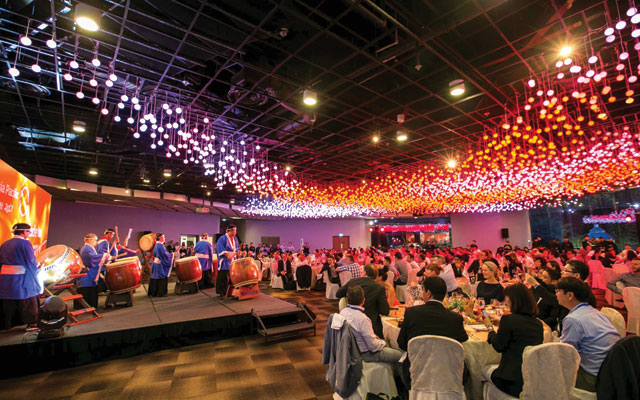
The renovated Event Centre houses the Ballroom, a 1,628m2 pillarless venue that can host a cocktail party for up to 1,800 guests or a 1,100-pax gala dinner.
During my stay at the start of the Gold Coast 2018 Commonwealth Games, the Ballroom was transformed into a spectacular garden with stylish seatings, food stalls offering gourmet bites and a bar serving up everything including bubblies. This wondrous venue was the Corporate Hospitality Suite, reserved for Games sponsors and Australian athletes.
Steps beyond the Ballroom is the Marquee, a versatile space that is perfect for exhibitions, product launches, parties and event gala dinners. It can accommodate up to 52 booths, an 800-pax cocktail party of 600 guests for a sit-down dinner.
For planners favouring outdoor options, there is the 750m2 Garden Events Lawn. While I was there, the lawn was a pumping party ground for the Games, aptly called Celebration Lawn. Massive screens broadcasted sports events to guests who lounged around in colourful deck chairs. There were live music, roving entertainment and food stalls that served up wagyu burgers, fish and chips and all sorts of beverages.
New facilities for planners’ picking include a poolside lawn and poolside meeting rooms.
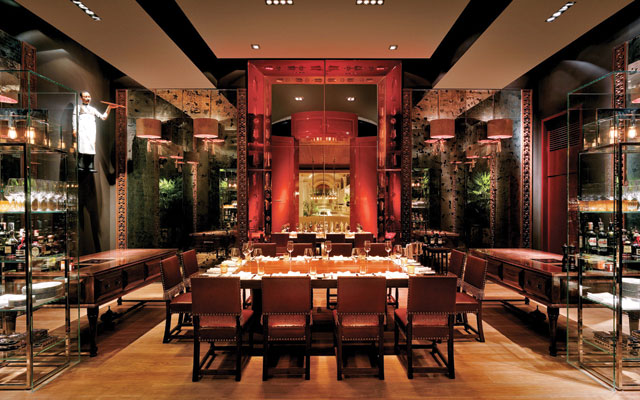
Other facilities The Star Grand features many dining establishments: award-winning Kiyomi Japanese restaurant, Cucina Vivo Italian restaurant, the tropical garden-esque Garden Kitchen & Bar, and Imperial at The Star Chinese restaurant. All welcome private dining groups.
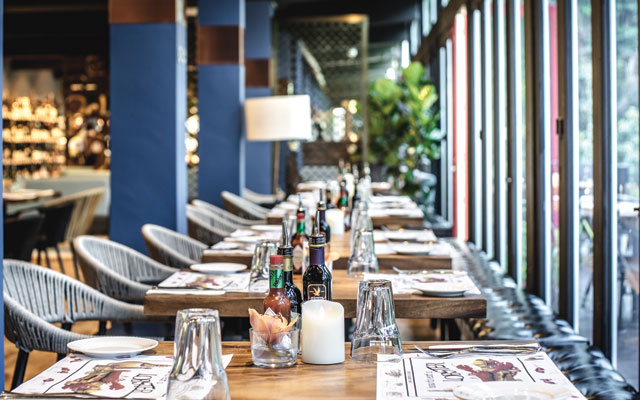
At Cucina Vivo, dining events can be hosted on the open deck or in a 14-seat private room.

The photogenic Garden Kitchen & Bar is also a great private dining venue option, and planners can choose to begin the party with a cocktail at the bar outside before flowing indoors for dinner.
Relaxed dining options are Mei Wei Dumplings, M&G Café and Bar, and Food Quarter cafeteria. According to the hotel spokesperson, The Star could work with conference planners to issue food vouchers to delegates for use at Food Quarter.
Two bars – Atrium and Cherry – offer event delegates a place to wind down, while the latter boasts cosy VIP booths for special get-togethers. When musicals and shows are not scheduled at The Theatre, the two-deck auditorium can be used for business events.
Service Every staff here is generous with smiles, friendly nods and directions. The concierge walked me to the elevator I needed to get to my room. The hostess at Garden Kitchen & Bar gladly showed me how to use the Moët & Chandon champagne vending machine (it exists!) placed at the restaurant’s entrance.
Room count 596
Star rating Five
Contact
Tel: (61 7) 5592 8100
Email: salesgc@star.com.au
Over coffee with Geoff Donaghy
The ASEAN-Australia Special Summit was held at your centre in March, and must be a great addition to ICC Sydney’s track record.
Something like that, at that high political level, will put incredible focus on the city and the venue because the ability to host such an event requires a high level of security, and this sends an important signal to the South-east Asian market about the capabilities of ICC Sydney.

How extensively was ICC Sydney used for the Summit?
There’s a lot of it that we can’t talk about, but we can say that the Summit took up the majority of our spaces. We planned it for about 12 months with various agencies, state authorities and federal government. It was a very important event for Australia, for Sydney and for the Centre.
Prior to the opening of ICC Sydney, a lot of mega-sized events were not able to be held in Sydney due to space limitations at the temporary venue. Now that you are open, and for a little more than a year, what’s happening?
Yes, Sydney went without a major venue for three years.
It was a very brave decision by the New South Wales government to let a private consortium build the new facility and operate it. I think people are now seeing that it was a very small price to pay to get this quality facility which is putting Sydney back on the world map.
The events we ran in our first year of operations, such as the 8,000-pax incentive out of China, demonstrated clearly that Sydney and the centre could host that level of (gatherings).
That’s the message we are taking to the market now.
Do you foresee the capabilities of ICC Sydney being the game-changer for the city as a business events venue?
Certainly, in terms of capacity. But it isn’t all about capacity. The fact that we’ve got three great theatres (for) 8,000 pax, 2,500 pax and 1,000 pax allows so many types of events to take place here.
Then there is also the great technology that we’ve been able to build into the facility, made possible since we designed the centre right from scratch. That technology is instrumental in winning us those larger events.
The building was designed to host concurrent events that are very well separated, so we have been able to also get multiple events of various sizes too.
What are some of the notable events coming into ICC Sydney?
For the balance of this year, probably the most high profile event is Sibos which will get us 6,000-plus delegates from the financial industry from all around the world.
The fact that Sydney has established a very important financial services hub in Barangaroo (sends) a very strong message that we are one of the world’s leading cities in that (specialisation).
(Sibos is especially important for us)as it made the decision to come to Sydney and to use ICC Sydney when the centre was still under construction.
We will also have the World Congress of Accountants later this year (in November) for 4,500 attendees.
The big events that we did in the first year, and will do this year and the next, were decided when the centre was still under construction. We had no word-of-mouth, no track record, yet people were still confident in us.
That track record and word-of-mouth is building up strongly, along with the work we do with Business Events Sydney, such as this roadshow (in March, covering Beijing, Shanghai, Hong Kong and Singapore).
Some very large global events have decided to come and visit us, and we are going to see that interest grow, particularly when the track record and testimonials (go out).
In fact, a lot of IT business events that used to be held in Singapore are already moving over to Sydney.
A lot of your peers in Singapore must be worried!
(Laughs) As well as we are competitors, we are good friends. As you know, all venues know each other.
The client makes the choice, really. All we can do is to build the best possible venue, run it the best possible way and locate it in the best possible city. The client will make the choice on what works best for them.
ICC Sydney is part of AEG Ogden. Do you think the strong name of AEG Ogden had a part to play in instilling early confidence among your clients, even before they got to review the hardware?
Oh, most definitely. That was incredibly important for us in the pre-opening period in particular. The fact that so many events have been to other venues under AEG Ogden took the risk out of clients’ decision to hold their event at an untested venue like ours.
The AEG Ogden name has been instrumental in us getting so much business for the first year of operations.
Normally it takes three, four or five years for a new convention centre to build up that level of business that we had in our first year of operations.
Saurabh Prakash appointed as Radisson’s commercial VP for APAC
Radisson Hotel Group has appointed Saurabh Prakash as its new vice president, commercial, Asia Pacific.
Based at the company’s Asia-Pacific headquarters in Singapore, Prakash will oversee all aspects of the region’s commercial activities, including sales, revenue optimisation, distribution, marketing and loyalty.
The veteran hotelier has over 15 years of experience, and has worked for numerous hotels across the Asia-Pacific. He spent a majority of his career with Marriott International, where he worked in India, Malaysia, China and Singapore.
Prior to this role, he was general manager & vice president, Asia-Pacific of TSA Solutions in Singapore.
The complete package
Chiang Mai, one of Thailand’s five MICE-designated cities, is heavily marketing its international-standard conference facilities, unique experiences and cultural immersion programmes to attract more medium-sized corporate groups from South-east Asia.

Nooch Homrossukhon, director meetings and incentives department, Thailand Convention & Exhibition Bureau (TCEB), told TTGmice that one of Chiang Mai’s key selling points is the city’s Lanna heritage and ethnic tribes that reside in the mountainous areas. Moreover, Chiang Mai’s natural landscapes and eco-tourism sites allow for “fun, educational, and adventurous teambuilding and incentive activities”.
Vorapong Muchaotai, deputy managing director, DMC & Event Thailand, agreed: “Chiang Mai has many DIY and culturally immersive activities such as making paper from elephant poop and umbrella painting. This is why I believe Chiang Mai is one of the best locations in South-east Asia to combine both CSR activities and meetings.”
He added: “Many Singaporean clients have moved (their meetings) to Chiang Mai after the volcano eruption in Bali, as the city is good value for money and its jungle welcomes adventurous types.”
“For clients that are looking for something traditional and like the mountains and natural atmosphere, I’ll recommend Chiang Mai. Where budget is concerned, Chiang Mai is cheaper than Bangkok and Phuket for medium-sized groups of around 200 pax,” said Kanes Bunlaksananusorn, managing director of Pheonix Events Group.
Meanwhile, for Horizon Village & Resort, teambuilding programmes on the property are interwoven with local culture, such as Thai dancing class, Thai cooking class, or the making of herbal candles that guests can bring home as a souvenir. If so desired, clients can even grow rice, as the property has its own four padi fields. The 46.5-hectare Chiang Mai Horizon Village sits 10km from the city centre, and bills itself as a one-stop shop for corporate groups.
Nantanittaya Sesaweech, its assistant managing director, enthused: “Chiang Mai is so different (in terms of culture) from Bangkok – there are padi fields, buffaloes and cows. Similarly, we target to provide experiences that are unique (and can only be found in Chiang Mai) to groups.”
Aside from organising teambuilding activities, Horizon Village & Resort boasts its own Lanna-style convention hall named Hor Kum Twee. The 640m2 function space has capacity for 500 pax theatre-style, and 400 pax for banquet seating. The property also offers a Grand Ballroom which can hold up to 800 pax theatre-style, as well as 12 other smaller function rooms that can hold between 10 and 300 pax.
Nantanittaya shared: “We prefer to host medium-sized groups of between 200 to 300 pax. This is because we only have 209 rooms, and if there are more than 400 guests for example, some of them would have to stay in the city centre and travel (to the village).”
To grow the property’s business events revenue, Nantanittaya will be conducting more of her own sales calls as well as participate in more of TCEB-led roadshows.
When asked how much she thinks the market will grow by, she confidently replied: “Probably 10 per cent, as I have received a lot of enquires from China and Hong Kong.”
Since the debut of Chiang Mai Exhibition and Convention International Convention (CMECC) in 2013, the city has hosted a total of 20 international conferences as of 2016.
CMECC has 521,600m2 of exhibition space across several halls, and 29 various meeting rooms. The largest hall – made up of three interconnected halls – offers 8,000m2 of space which can accommodate more than 10,000 people. Besides CMECC, Chiang Mai has at least 10 hotels, mostly in the city centre, that can hold events for up 1,200 delegates.
For instance, the Le Meridien Chiang Mai has its own convention centre for up to 1,400 attendees.
Kulthida Pimol, the hotel’s assistant director of sales, told TTGmice: “We welcomed our biggest group so far in February 2018 – it had 1,200 pax. We’ve also hosted medical and IT companies, and in just January and February alone, MICE business has grown by 15 per cent year-on-year.”
Within South-east Asia, Singapore is the top business events market for the hotel; China tops the overall market. Kulthida explained that this was because “Singaporeans are familiar with Thailand, and there’s been more interest in Chiang Mai thanks to better facilities, myriad activities and easier logistics”.
The property is also targeting companies based in Kuala Lumpur, and as such has stationed a representative in both destinations.
To grow the city’s reputation farther among South-east Asian corporate groups, DMC & Event Thailand’s Vorapong indicated that there was a need for more direct regional flights, as South-east Asians could conduct meetings or incentive trips without taking up too many work days.
He is currently targeting groups from Singapore, Malaysia, Vietnam and Indonesia, and hopes to do business with the Philippines in the future. Vorapong also works closely with industry partners such as SilkAir and Shangri-La to bring agents on fam trips to Chiang Mai.
“Chiang Mai has risen in popularity. The city is a new destination for meetings, particularly for groups that have already been to Bangkok,” Vorapong concluded.
New GM for JW Marriott Phuket Resort & Spa
JW Marriott Phuket Resort & Spa has appointed Matthias Sutter as general manager.
Sutter first joined the company in 2011 as hotel manager at the St Regis Sanya, before taking up his first general manager appointment at Sheraton D Cube City, Seoul in 2014.

He brings with him over 18 years of experience with some of the world’s leading luxury properties including Peninsula and Hyatt.
Oriol Montal at the helm of The Westin Resort Nusa Dua, Bali
Oriol Montal has been appointed as general manager of The Westin Resort Nusa Dua, Bali and the adjacent Bali International Convention Centre.
A seasoned hotelier with over 20 years of experience, he was most recently the general manager for JW Marriott Phuket Resort & Spa.

The Spanish national first entered the hospitality sector in 1994 as assistant F&B manager with Hotel Barcelona Sants, before joining The Ritz-Carlton Hotel Arts in Barcelona.
An extensive career with the Ritz-Carlton brand then followed, which saw Montal taking up various positions at Ritz-Carlton properties in Dubai, Portugal, Japan, Puerto Rico, Germany, Turkey and the US.
Snoop around Bangkok in this game
Detecting a market gap in outdoor detective games in Asia, Marie Botella and Pochara Amatasin, two friends with common interests in travel and entrepreneurship, established GoSnoop in Bangkok in July 2017.

“I was always snooping around for new experiences in Bangkok,” said Botella, a French transplant who moved to the Thai capital four years ago. “A lot of visiting friends were always asking for recommendations in Bangkok, so I saw something missing (in the tours & activities landscape).”
The two co-founders spent six months researching and designing the unique game, which aims to get competing teams to explore Bangkok’s hidden gems while picking up clues à la Sherlock Holmes along a specific route to crack the riddle and unravel a mystery.
The game is ideal as a corporate teambuilding activity as it’s designed to promote teamwork, communication, and out-of-the-box thinking among players.
GoSnoop has already found popularity as a teambuilding activity for companies and associations based in Bangkok, and its corporate clients include Agoda, Anantara, Lazada, Financial Times and Phillips so far.
Played in the Old Bangkok area, teams of two to six people will go around on foot with a real map to search for particular items and pick up clues that will enable them to solve the mystery at the end.
The game can be played as designed or customised as a “corporate rally”, with corporate visions embedded within the questions. Professional photographers can also be included in the package to capture the fun and action along the way. Drinks, social events or after-parties following the game can also be added.
A group size of 30 people will be optimal although the game can be played by up to 60 participants, advised Botella. She added that she’s currently developing a second game in the capital.
Fees start from 1,600 baht (US$51.30) per head. Email contact@gosnoop.co for more information.
Old soul, new Seoul
Seoul has the advantage of being an ancient city, whose history goes back to 18BC, as well as a modern global city, thanks to an emergence of landmarks that have gained worldwide attention for their outstanding architectural design, such as Lotte World Tower – a 123-floor skyscraper – and Dongdaemun Design Plaza – designed by the late architect Zaha Hadid.

For the well-travelled, Seoul is loved for its elaborate ancient palaces, shopping and food, and for being South Korea’s K-pop capital.
To ensure Seoul remains top of mind among planners, especially those crafting repeat events in the South Korean capital, and to attract event delegates who increasingly favour experiential activities, the Seoul Convention Bureau (SCB) has developed new and unique ways to experience what the destination has been gifted with.
Jin Hyeok Park, SCB’s director, pointed to the 2017 Special Support programme as an example.
It offered financial subsidies for groups that subscribed to any of five experiential programmes – Seoullo 7017 Walking Tour, Han River Cycling Tour, Seoul Trekking Excursion, Hallyu Makeup Experience, and K-Pop Dance Experience.
Park said: “Because of our promotions, the experience programmes have been used by several corporate incentive groups. One of them was a group of 178 people from Taiwan’s Vina Chang Tai Underwear Co who participated in a Seoullo 7017 Walking Tour on July 25. We sponsored meals and refreshments.
“And on April 26, we had a group of 100 participants from AXA Indonesia that chose the Han River Cycling Tour with Tarreungyi, Seoul’s Public Bike rental programme, in which Seoul’s mayor Park Won Soon partook. Participants very much enjoyed this particular occasion.”
The 2017 Special Support programme has been extended into 2018, although details on benefits are not available at press time in early-March.
Beyond the programme, SCB has demonstrated a willingness to pull out all stops to make unique destination experiences possible for private event groups.
In May 2016 when the city welcomed its biggest incentive group ever – 8,000 participants from the healthcare unit of the China-based Zhongmai Group, Joy Main Science & Technology – the bureau arranged an unusual programme that featured two special dinners and concerts by the Han River.
Park reminisced: “The group was able to enjoy samgyetang (ginseng chicken soup) while the concerts featured popular Korean singers who sang the soundtrack of Descendants of the Sun, a Korean drama that enjoyed immense popularity in China.”
The bureau’s involvement was particularly critical in this example, as “cooking anything (outdoors) near the Han River is illegal for safety reasons”, revealed Park, who added that approval was eventually obtained for the use of gas stoves instead of fire.
In yet another example, SCB brought an event group down to Cheonggyecheon stream, a historical waterway in the heart of the city, where delegates penned their deepest wishes on paper, folded it into an origami boat, and set it adrift in hopes of fulfilment.
Park believes that pushing experiential activities for corporate groups allows the bureau to not only promote the local culture but also raise awareness of the Seoul City brand.
Supporting SCB’s experiential programme push is the Team Building with Seoul booklet, available both in print and online, which lists fun, customisable teambuilding ideas.
Food&HotelAsia expands to two shows come 2020

Food&HotelAsia (FHA), an international food and hospitality biennial trade event, will return to the Singapore Expo in 2020 as two dedicated shows – FHA-HoReCa (March 3-6) and FHA-Food & Beverage (March 31 to April 3).
In the next iteration of FHA, the show will aim to address some of the most significant changes the industry has faced – the widespread penetration of technology that has driven innovations at industry level while impacting how consumers consume today; and the evolution in tastes – driven both by greater affluence and a move to healthier eating.

FHA-HoReCa gathers global stakeholders from the food service industry to showcase new to market innovations hotel, hospitality technology and style, and share best practices.
Meanwhile, to address the more discerning and health-conscious consumer, FHA-Food & Beverage will bring together the best of food ingredients, drinks and fresh produces among others in a focused way to encourage connections and facilitate trade in Asia and beyond.
While the shows will have two distinct identities and differentiated offerings, they will share a unified goal of enabling businesses.
“The food and hospitality industry in Asia-Pacific is expected to continue its rapid growth trajectory and FHA has long been the business platform driving the industry. In order to address the fast-paced changes, and support the industry as it continues to grow, we believe that the expansion is not only timely but a crucial one, enabling us to both better anticipate and deliver the desired results for the food and hospitality industry through two dedicated shows,” said Rodolphe Lameyse, project director, food & hospitality, UBM.
It is predicted that the 2018 edition (April 24-27) will surpass past records, boasting its largest ever showing with 3,500 exhibitors from 76 countries/regions, including 71 international pavilions, with 78,000 trade attendees from over 100 countries/regions expected


![Hor-Kum-Twee[2]](https://ttgmice.2017.ttgasia.com/wp-content/uploads/sites/3/2018/05/Hor-Kum-Twee2.jpg)


Will Hyatt Regency Bangkok Sukhumvit open on time as scheduled in 3Q2018? What’s the state of construction now, and how are you prepping your team for the opening?
Absolutely. We are still on schedule. As for the state of construction, we are doing fitting-out work and systems installation at present. Our newest team members are undergoing our “onboarding” programme. One of the programmes is training to ensure that all our team members understand and embrace our main purpose, which is to care for everyone including one another so they can be at their absolute best.
How will Hyatt Regency Bangkok Sukhumvit differ from its big sister, Grand Hyatt Erawan Bangkok, in terms of hardware and brand positioning?
We are fortunate that we will be the fourth Hyatt brand in Bangkok after Grand Hyatt Erawan Bangkok (1991), Park Hyatt Bangkok (May 2017) and Hyatt Place Bangkok (October 2017). Grand Hyatt hotel guests are seekers of celebratory moments. That’s why there’s such a strong emphasis on MICE and grand events. The one here in Bangkok has amazing event venues, including a grand ballroom, the residence, campus, etc. And it’s located in Bangkok’s most coveted address.
Hyatt Regency is located in a really vibrant part of Bangkok, which has a real sense of place. It’s in a strong neighborhood that is home to the city’s original, multicultural marketplace. This hotel will be about facilitating connection and social interaction for our hardworking professional guests who like to combine business and leisure. Therefore we have to be energetic, clever and confident in ensuring we meet and exceed their needs.
Will you give my readers a sneak preview of your hotel’s meeting event facilities and capabilities?
All of our event rooms will be located on the same floor and feature natural light, making them feel very bright and airy. The Regency Ballroom and four meeting suites offer 1,300m2 of event space. Each of the meeting suites can accommodate up to 75 people for a standing cocktail reception. We can also connect the suites and create larger meeting rooms.
The ballroom has a capacity of 600 people in a round-table setting and a six-meter-high ceiling. In the pre-function area, there are two loft kitchens with a la minute food as well as cluster seating space and a smoking room.
Are there any features of the hotel that you think will particularly charm meeting planners? What are they and why?
We’ll have a new kind of multipurpose residential event venue on Level 29. It was designed by Japan’s Super Potato and it is like a big penthouse. It consists of private dining, a study room, living room, library bar and outdoor terrace that can cater up to 120 people – perfect for wedding receptions or engagement parties, press conferences, product launches and VIP events. It is cleverly done in that it feels like a kind of interactive and self-contained event space. Our roof bar – on levels 30 and 31 – will be where we’ll have a DJ spinning high energy music most evenings. But it will also be a venue that can be booked for private events.
Do you foresee fans of other Hyatt hotels in Bangkok – particularly business travellers and meeting planners – skipping over to your baby, drawn by the novelty of a new property?
As with any new hotel in town, it will of course attract all manner of people, including those who are loyal to even non-Hyatt brands. It’s natural for people to want to see and experience what is new. We would prefer to build our own type of customer base, and maybe convert or appeal to those who are currently patronising non-Hyatt hotels.
Will your team be working with the other Hyatt hotels in Bangkok for cross-selling efforts aimed at business event groups?
Absolutely. Our team has worked very closely with other Hyatt hotels in Thailand. The goal is to ensure that we all deliver distinctive experiences to our guests and create value for all our stakeholders.
There are so many hotels in Bangkok. How do you plan on keeping your beds warm with guests during the opening fanfare and long after the novelty wears off?
The great thing about Bangkok is there is never a dull moment for us hoteliers. However, the trends over the past few years have been extremely positive as a result of great initiatives by and partnerships between the government, TAT and private tourism industries to boost the quantity and quality of tourists to Thailand.
Keeping beds warm with guests is not a challenge exclusive to us, but the way we’ll address it is by upholding our values at all times so that we are continually enhancing the brand’s promise of caring for every person who comes through our doors, whether it be a local, tourist, employee or whoever.