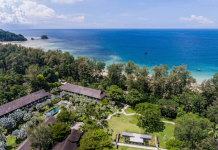
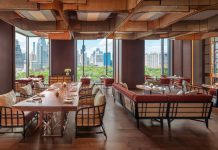
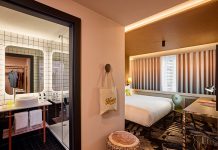
Six Marco Polo Hotels in Hong Kong and the Philippines are offering a triple meeting rewards package entitled Thrice as Nice.
To qualify, event organisers and meeting planners have to book at least 15 rooms and one meeting or banquet room, with a minimum spend of HK$70,000 (US$8,976) in Hong Kong or 200,000 pesos (US$4,004) in the Philippines. The booking period is until June 30, 2017, for stays until December 30, 2017.
Marco Polo Plaza, Cebu’s Grand Ballroom
Thrice as Nice rewards include an overnight stay with breakfast buffet at the participating hotel of choice in Hong Kong or the Philippines, and a one room category upgrade for one delegate during the event.
A dining discount would be the third perk. For Marco Polo hotels in Hong Kong, event organisers can enjoy a 10 per cent F&B discount at participating restaurants. In the Philippines, a 1,000 pesos value voucher will be offered, valid in any of the participating Philippine hotel’s restaurants and bars. Other terms and conditions may apply.
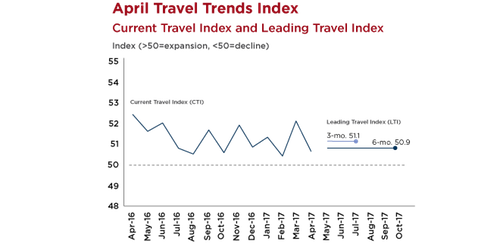
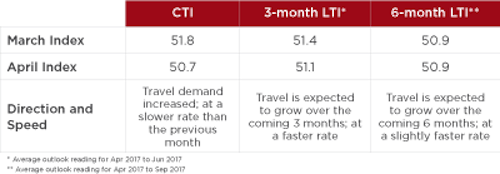
More international visitors came to the US than expected in April 2017, according to the U.S. Travel Association’s latest Travel Trends Index (TTI) – defying expectations of slowed growth or outright decline in reaction to president Trump’s controversial executive orders on travel and immigration, first issued January 27.
In fact, international travel grew by about four per cent year-over-year in April.
Because the average international visitor embarks on a trip to the US 56.9 days after their initial travel search, any fallout from president Trump’s controversial orders in January and February 2017 would only begin to register in April travel data.
“Are we surprised by this data? The honest answer is yes,” said U.S. Travel Association president and CEO Roger Dow. “There have been many claims that the administration’s actions on travel have tarnished America’s brand abroad, but we’re seeing hard economic evidence of the US travel sector’s remarkable resilience.
“Even though we’re encouraged by these strong figures, we’ll continue to urge the administration to more publicly send the message that while the US is closed to terror, it remains open for business. We should not take it for granted that this trend will sustain, and the 15.3 million American jobs that depend on travel are not worth putting at risk. A simple and clear welcome message will go a long way in that regard.”
Dow pointed to remarks by US commerce secretary Wilbur Ross at U.S. Travel’s IPW trade show as evidence that the administration well understands the importance of international travel to the US, and the role that it plays in boosting the American economy, growing exports and supporting jobs.
Despite strong international travel growth in April, travel overall grew at a slower year-over-year rate in April 2017 than in March 2017. Domestic leisure travel growth remained strong, while domestic business travel growth tapered, due in part to the timing of holidays like Easter and Passover this year.
As with many economic indicators, a TTI reading of 50 or more indicates positive growth, while a reading below 50 indicates decline.
The U.S. Travel Association developed the TTI in partnership with Oxford Economics, and draws from multiple data sources to develop these monthly readings. In order to compile both the CTI and LTI readings, the organisation’s research team utilises multiple unique non-personally identifiable data sets, including:
– Advance search and bookings data from ADARA and nSight;
– Passenger enplanement data from Airlines for America (A4A);
– Airline bookings data from the Airlines Reporting Corporation (ARC); and
Finnair has integrated Blacklane, a global professional driver service, as its preferred airport transfer provider.
After booking a round-trip flight with Finnair, travellers now see Blacklane’s all-inclusive, guaranteed fares for four rides: transfers to and from departure and arrival airports. They can then book ground transportation between airports and hotels, offices or homes. Blacklane instantly confirms booked rides and sends travellers their pick-up details.
Rides with Blacklane will be available for cities that Finnair serves directly and through oneworld airline partners.
Moreover, both companies will display the rides using the Amadeus Transfers solution. Amadeus links flights and rides with the Passenger Name Record to allow flyers a user-friendly and quick booking process.
Following the recent announcement of a controversial tourism tax coming into effect on July 1, hoteliers and agents in Malaysia say the short notice given, lack of official documentation and confusing information are putting them in a difficult situation.
Anthony Wong, managing director at The Frangipani Langkawi Resort & Spa said: “The messages on implementation are confusing. According to the tourism and culture minister it will start on July 1. However, the Royal Malaysian Customs Department website stated August 1.”
In a report published by Free Malaysia Today dated June 12, Malaysia’s minister of Tourism and Culture Nazri Abdul Aziz was quoted to have said: “The ministry is flexible on the date. If hotel operators cannot make it on July 1, we will defer it to August instead. It depends.”
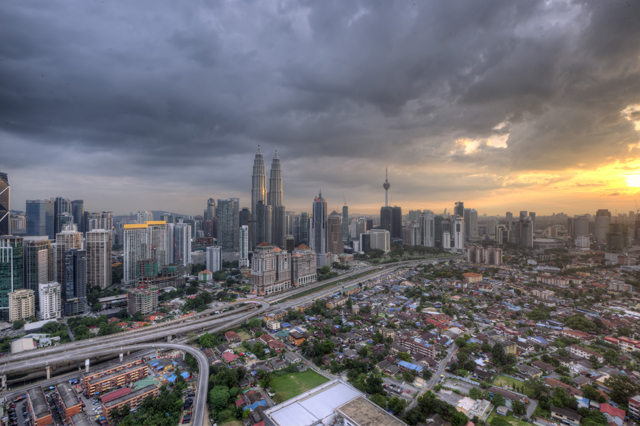
Kuala Lumpur
The short notice was a common grievance for Wong and others interviewed. Arokia Das, senior manager at Luxury Tours Malaysia, said agent partners in India are expecting the company to absorb the taxes as groups have been confirmed and deposits accepted.
“We are in a Catch-22 situation. If we absorb, we lose money as our mark-ups are slightly higher than the room rates. If we say no, we may lose future business. This tax should not have been sprung on us with less than a month’s notice. It should have been better planned.”
Ally Bhoonee, executive director at World Avenues, shared similar sentiments.
“Without a circular by the Malaysian government and contradictory statements in the press on when this tax will be introduced, we face difficulty in explaining it to our Middle East partners overseas. There is so much confusion now. What happens to the state tourism taxes in Penang, Melaka and Langkawi? Will the new taxes over-ride the existing taxes in these states? Because of this, we lose our credibility and reputation, and we also risk losing these clients,” Ally stressed.
And while the tax has been likened to one introduced in Dubai, at least a year’s notice was given in the latter case.
Wong added there has been no information on the payment procedures. “We need to know before we can upgrade our software, and this will not come cheap.”
Saini Vermeulen, Within Earth Holidays’ executive director, opined that Tourism Malaysia’s overseas offices should take the lead in informing the travel trade on the new tourism tax.
Moreover, he said: “It is also the wrong time to implement this tax as the business environment is soft, and this makes Malaysia less competitive when compared to Indonesia and Thailand.”
The tourism tax rate is fixed at RM20 (US$4.70) per room per night for five-star accommodation; RM10 per room per night on four-star accommodation; RM5 per room per night on one-, two- and three star accommodation; RM2.50 per room per night on one-, two- and three- Orchid as well as non-rated accommodation premises.
According to tourism officials, the tax revenue will be used to develop the industry, such as through enhancing tourism infrastructure and facilities, supporting tourism promotional activities and campaigns, and the protection and preservation of the earth, and Malaysia’s culture and heritage.
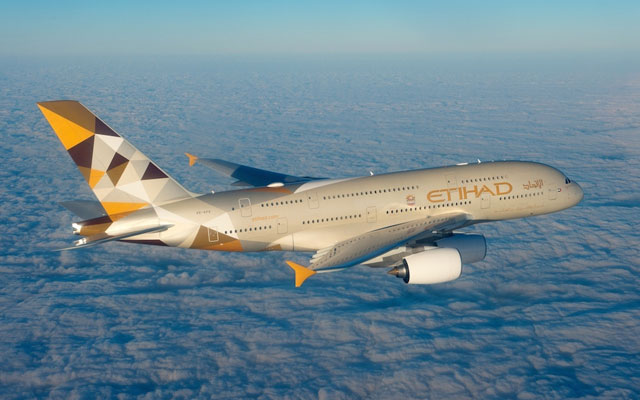
Etihad Airways’ second daily service between Abu Dhabi and New York is now serviced by an A380, replacing a three-class Boeing 777-300ER.
All 14 weekly flights between the two cities are now being serviced by the double-decker aircraft. The airline’s A380 can carry 496 guests in a four-class configuration: The Residence, First Apartments (First Class), Business Studios (Business Class), and Economy Smart Seats (Economy Class).
A380 Ⓒ AIRBUS S.A.S 2014 – photo by master films/P.Masclet
The first daily flight departs Abu Dhabi at 03.35 and arrives in New York’s JFK Airport at 09.40, and will depart New York JFK at 15.00 and land in Abu Dhabi at 12.05 the following day. The second flight departs Abu Dhabi at 10.15 and lands in New York JFK at 16.20. The return leg will depart New York JFK at 22.45, and land in Abu Dhabi at 19.50 the following day.
Guests flying on all Etihad Airways flights from Abu Dhabi to the airline’s six US ports of entry – New York JFK, Washington, DC, Chicago, Dallas, Los Angeles and San Francisco – are processed through the US Customs and Border Protection (CBP) Preclearance facility available at Abu Dhabi International Airport. This means that they pass through all US immigration and customs checks in Abu Dhabi and arrive at their US destination as domestic passengers.
Etihad Airways first launched daily non-stop flights to New York JFK on October 26, 2006, and introduced the second daily service in March 2014. It subsequently upgraded one of the daily flights to an A380 aircraft in November 2015.
Marriott International has opened Fairfield by Marriott Kathmandu in Nepal, marking the group’s debut in the country.
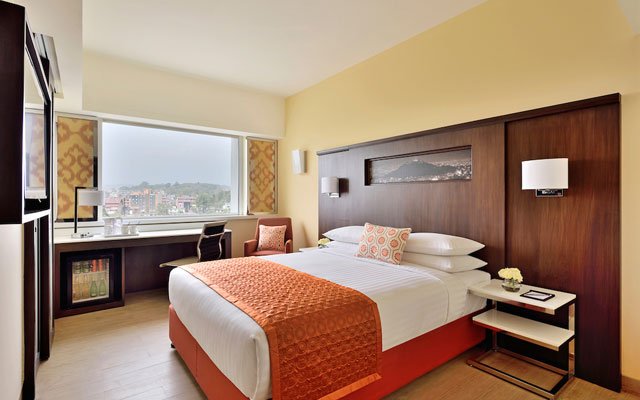
Located in Thamel, a district in the capital’s central commercial hub, the 115-room property sits close to attractions such as the Narayanhiti Palace Museum, Garden of Dreams and Kathmandu Durbar Square. Facilities on-site include an all-day dining restaurant, a bar and lobby lounge, fitness centre, a 24/7 convenience store, and two meeting rooms.
Fairfield by Marriott Kathmandu
Fairfield by Marriott Kathmandu is the latest addition to the brand’s footprint in South Asia, with four hotels in India currently open including Fairfield by Marriott Bengaluru Rajajinagar, Fairfield by Marriott Bengaluru Outer Ring Road, Fairfield by Marriott Lucknow and Fairfield by Marriott Belagavi.
To celebrate its 120th anniversary, Kempinski Hotels is offering value-added benefits and an exclusive bonus for all meetings and events booked at any of their hotels around the globe by October 30, 2017, with a stay period until the end of the year.
Meeting planners can choose from two benefits such as a one-hour-long 120th anniversary welcome cocktail with gourmet bites, one complimentary room for every 12 paid rooms, or a complimentary permanent coffee and tea station during the meeting day.
Siam Kempinski Hotel Bangkok’s ballroom
As well, Kempinski will be rewarding any booker who spends a minimum of 20,000 euros (US$22,429) or 40,000 euros with a Fitbit watch or iphone 7 respectively.
For a minimum spend of 60,000 euros, the reward will be a two-night stay for two people including limousine transfer, buffet breakfast and suite accommodation in the hotel receiving the event. In addition, those spending 120,000 euros or more will be entitled to an upgrade to the most luxurious suite in the hotel.
Detailed terms and conditions for the 120th anniversary offer are listed in the MICE section of each hotel’s website. Please visit www.kempinski.com/en/hotels/meetings-and-events for more information.
Six InterContinental Hotels Group (IHG) hotels and resorts in Singapore and Batam have launched a Meet For Free package.
The package is valid with a minimum booking of 10 guestrooms per night for new bookings by August 1, 2017 and event materialisation by September 30, 2017.
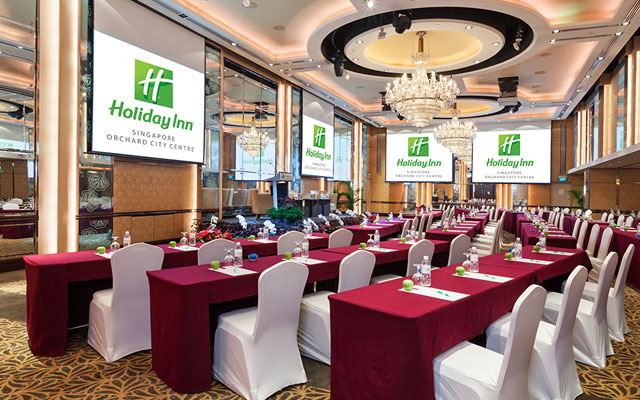
Holiday Inn Singapore Orchard City Centre’s Crystal Ballroom
It includes perks such as breakfast, lunch, complimentary Wi-Fi, a morning welcome reception, two meeting breaks with three snack items, unlimited coffee and tea for the duration of the event, and the assistance of experienced on-site event planners.
Meeting spaces will come complete with whiteboards, flip charts, markers, LCD projectors, audio-visual equipment and on-site technical support.
The participating hotels are InterContinental Singapore, Crowne Plaza Changi Airport, Hotel Indigo Singapore Katong, Holiday Inn Singapore Atrium, Holiday Inn Singapore Orchard City Centre and Holiday Inn Resort Batam. In total, the six hotels have 50 meeting rooms and almost 2,000 guestrooms.
This offer is subject to availability of rooms and meeting space, and not valid in conjunction with other negotiated rates, offers, discounts or promotions. Second occupancy rates with or without meeting package inclusions are available.
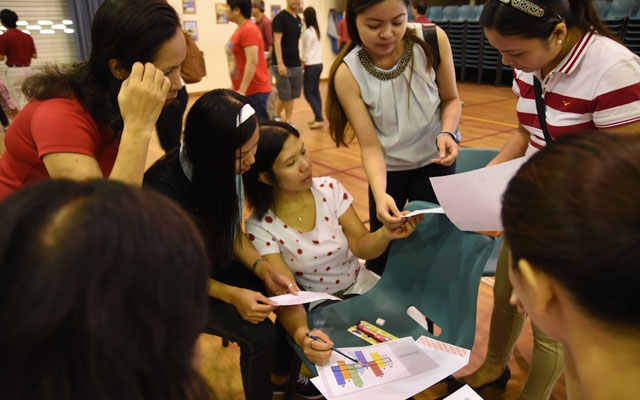
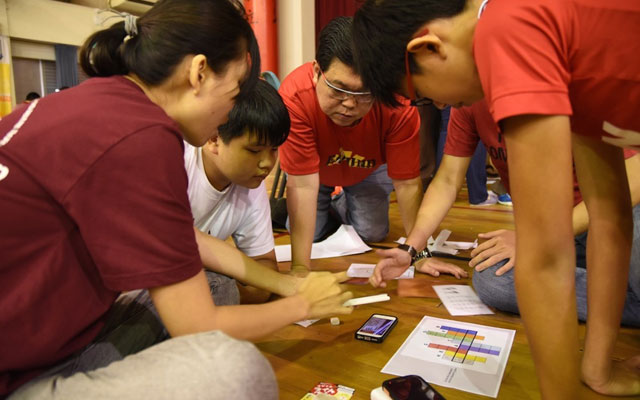
Enigma – Quest for the Code Book is Nomis Piy’s latest product, a puzzle-solving escape game with a World War II theme. This indoor activity involves pitting teams against the clock to solve a series of puzzles, where the objective is to retrieve a codebook in order to decipher an intercepted enemy transmission.
Concept: This 1.5-hour escape game gets teams of participants to communicate with each other and put their heads together to decipher clues, and find sensible answers to confusing puzzles and mind-boggling riddles. Each successfully solved answer will lead them to the next clue, so on and so forth, until the objective of the game is achieved.
The rigorous brain activity involves a large amount of associative skills, lateral-thinking and creativity, where participants have to think way outside the box in order to see things from a different perspective.
MICE application: Nomis Piy can arrange this teambuilding activity for group sizes ranging from 40 to 600 people.
The game’s portability is what makes it attractive – as it can be done in air-conditioned comfort within a function room, ballroom or even in an office. The duration of the game can also be tailored to a company’s preference.
Moreover, it can be customised according to a company’s core values, mission and vision statement. For instance, Nomis Piy conducted one such escape game for a company’s workplace safety awareness week.
While a game usually ranges from one to two hours, game durations can also be tweaked accordingly. For companies with less experienced escape game players, more time is usually given. Currently, Nomis Piy has a stable of more than 10 escape games with various themes. To keep things fresh, they also design a new game every few months.
Rates range from S$15 (US$11) to S$50 per participant, but this amount depends on factors such as the size of the event, number of players, and whether venue booking or food catering is required.
Service: I was blown away by the intricacies of the puzzles. I was also partially annoyed at my own inability to solve them, and gaped at how foreign and complex each one seemed to me. Regardless, my colleague Yixin and I were fully engaged as we attempted some of the puzzles, even though we didn’t manage to successfully break the code. It also helped that Yixin was more determined than I was.
For teams that managed to achieve the objective, the sense of achievement they felt was obvious through their beaming smiles. I believe that for companies, this escape game will be an excellent indoor alternative to traditional teambuilding events.
Following the attack of a lone gunman at the Resorts World Manila (RWM) casino on June 2, Marriott Grand Ballroom (MGB) and Marriott Hotel Manila – both located within the RWM complex – initially saw some booking cancellations.
Michelle Garcia, Marriott Hotel Manila’s director of marketing communications, said while no events took place at MGB on the day of the attack, there have been “rooms cancellations from last Friday until last week”.
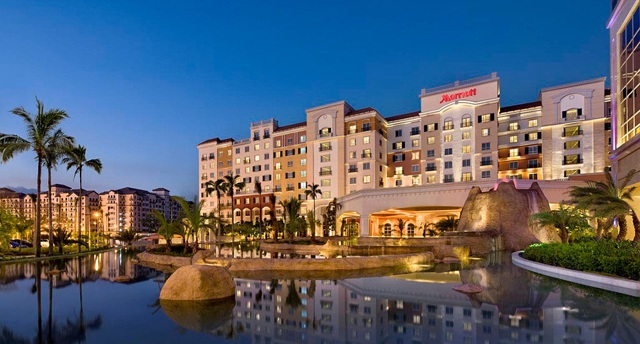
Marriott Hotel Manila
Currently it’s back to business as usual for the hotels, and Garcia expects the situation to improve. She is confident that MGB and Marriott Hotel Manila will still be chosen for events due to the tight security, and since the incident did not take place on those properties.
Makati-based Travelexperts’ consultant Analiza Misa said some clients heading to MGB and Marriott Hotel Manila were considering cancelling their bookings.
As a show of confidence, Misa assured clients that they would be escorted by an agency representative in Manila to all destinations.
A DMC head, who requested anonymity, believes that the Marriott properties will recover quickly, given that MGB is the most advanced venue in the country while Marriott Hotel Manila has one of the highest occupancies in the metro.
As well, Garcia pointed out that they were on top of the situation and offered regular social media updates to the public, as well as their clients, since the unfortunate event.
Just 10 minutes from Phuket International Airport on the serene northern coast, this 178-key, Bill Bensley-designed resort offers delegates a quiet, tropical paradise steeped in Phuket’s tin-mining heritage
The newly-opened Ritz-Carlton, Bangkok anchors the One Bangkok development with cosmopolitan elegance. Featuring the city's largest ballroom and a spectacular new penthouse suite, it delivers exceptional hardware and deeply authentic, soulful service for business and leisure travellers alike
Behind the imposing, Brutalist concrete that defines Zurich’s Oerlikon district lies a surprising secret. While its exterior honours the neighbourhood’s industrial roots, stepping inside Mama Shelter reveals a vibrant, neon-soaked world that is a far cry from its rigid shell








 Marriott Hotel Manila