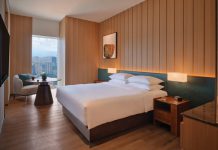
Budiman is now general manager of the luxury hotel, Shinta Mani Siem Reap. He joins from Hansar Hotels, where he held the dual role of CEO/general manager for six years.
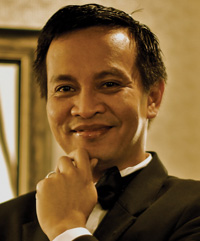
Budiman is now general manager of the luxury hotel, Shinta Mani Siem Reap. He joins from Hansar Hotels, where he held the dual role of CEO/general manager for six years.
Dusit International has appointed Antepli as general manager of the upcoming Dusit Hotel & Suites Doha. He has over 18 years of experience working in various hospitality positions for well-known hotel chains across the Middle East and Eastern Europe.

FCM Travel Solutions has appointed Bezoari as director of sales, South-east Asia. He joins FCM from Rosetta Stone, where he was responsible for the corporate sales division across EMEA and Japan.
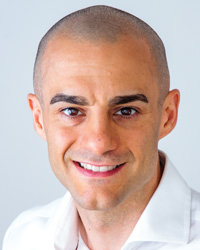

The CEO of International Convention Centre (ICC) Sydney tells Rebecca Elliott why the venue is pivitol to the city’s success in the MICE business
ICC Sydney opened to the public on October 22. What was the vibe among your staff in the lead up to the big day?
There was sheer excitement. All three years of planning and preparation had obviously paid off for us. They realised, even those new to the industry and that are very early on in their career, that it was an incredible privilege to be involved in the opening of one of the world’s major projects in our business.
How is the business pipeline looking?
We have around about 45 international conventions locked in from now till 2022. Some are as large as 8,000 and across all fields and industries. Working with our Bureau in Sydney, we have a pipeline of about 100 bids and expressions of interest.
International business is very strong. We’ve been working on this since we commenced the project in 2014 because of the lead-time and the intense competition. We started establishing awareness, confidence and trust that this building would open on time, and right from day one we’d be a world-class venue.
National business is very strong, more than we had expected. There’s a lot of pent up demand among national rotational business to come back to Sydney.
What impact will your venue have on Sydney’s MICE performance?
The marketplace has told us in our international marketing that if ICC Sydney was not the most exciting project happening anywhere in the world at the moment, it was certainly among the top three. That’s for a number of reasons. We have the privileged position of being the (venue) with all the latest innovations and technologies and the opportunity to be right downtown on Sydney’s spectacular Harbour and within walking distance of 7,000 to 8,000 hotel rooms.
You recently said at an Australian Tourism Export Council event that a visitor shouldn’t be siloed into any one segment. What did you mean by that?
We went through a period in our industry where we tried to establish that (business events) wasn’t part of tourism. But I always felt that was a shallow and immature argument because we share a whole lot of things with visitors. While our delegates are with us, they consider themselves on business, but their accompanying partners and families are here as leisure visitors and quite often delegates participate in pre- and post-tours, so we’d be far better served in taking a (single) visitor industry approach to the interests we share.
So how can the two industries work better together to increase visitation and spend?
The very first thing is to eliminate constraints like visas, investment policy at a state and federal level, and aviation policy. All these things would potentially affect anyone coming to Sydney (whether as an event delegate or as a holidaymaker). I think the business event industry needs to work closely with the broader visitor industry in that regard. This is where we collaborate with Destination NSW (New South Wales); being able to offer all the activities that people can undertake before and after a visit here (ICC Sydney). That really drives the incremental spending and economic impact.
Is there a particular destination that does this well?
Singapore has always been up there. It has the enormous advantage of being a sovereign city-state and it does this seamless attraction of visitors effectively and strategically. Kuala Lumpur is probably learning from Singapore and is really successful in that area too. A couple of the European cities do it well but they tend to have older infrastructure.
But ask anyone in the world that same question in the first six months of 2017 and the name that will spring to their lips will be Sydney. We’re already getting that. We think the world will be very much looking to Sydney (for benchmarks) in the future.
What role can your venue play in this?
You can’t be serious in this business until you build proper convention and exhibition facilities. You can’t be partly in this business just as you can’t be partly pregnant. So we have built one of the leading venues in the world in terms of capacity, innovation and capabilities, and combined that with the fact that Sydney is already Australia’s global city and the major gateway.
How do you think the Australian MICE market is faring compared to the rest of the world?
Australia is well served with first class infrastructure and it has always had a good understanding of the need for collective and collaborative marketing, as well as individual competition. The best measure is the annual ICCA rankings. Australia’s ranking has gone down over the years but that’s not because we’ve been doing worse – most of the numbers are growing. It’s just that so many other places are doing much better.
So many emerging destinations in Asia, the Middle East and India have invested significantly in new-builds or expansions. Australia needs to maintain its competitiveness and its active and aggressive marketing efforts.
The Malaysian Association of Convention and Exhibition Organisers and Suppliers (MACEOS) is in discussions with the government to make it compulsory for new organisations to be members of MACEOS before they can be licensed to operate.
MACEOS CEO, Amos Wong, said: “This is to ensure that the companies are of good character and it will be a means to regulate the Business Events industry.”
Wong: MACEOS as gatekeeper
This could also serve as a means to grow membership. MACEOS currently has over 100 members, a majority of which are from the exhibitions sector.
“Growing our membership is one of our main focus as this will enable us to have a bigger voice in the business events industry in Malaysia. This is a continuous effort. Our subcommittee has expanded its wings in the northern region and Sarawak and soon we will expand further to the southern region and Sabah,” MACEOS president, Vincent Lim, said.
Meanwhile, MACEOS is also focusing on grooming the labour force, having recently rolled out its first Professional Exhibition Management and Professional Conference Management course in Kuala Lumpur and Kuching. Similar training programmes will soon be organised in Penang and Sabah.
Ong Hong Peng, secretary-general of the Ministry of Tourism and Culture Malaysia, said: “MACEOS’ keen focus on training and education is in line with the government’s Vision 2020 to enhance the capacity and capability of the industry to remain competitive. This way, we will be able to take on our regional competitors and boost the growth of the convention and exhibition industry in Malaysia.”

An International SOS survey revealed that while sharing economy services are becoming more commonplace in corporate travel, 75 per cent of organisations lack policies that address their travellers’ use of such services.
According to the survey, which polled business travellers and travel managers, 40 per cent of respondents used services like Uber and Airbnb when travelling abroad for business and almost half of respondents anticipated their use of shared transport services would grow.

The study further found that 40 per cent of travellers did not know if their organisation considered such services to be safe.
Tim Daniel, executive vice president at International SOS, said: “While there are many benefits to using these types of services, it’s important that organisations realise that using sharing economy services for business-related travel creates new risks and challenges that need to be managed and mitigated.”
Meanwhile, more than half of the respondents indicated they didn’t know whether their organisation had considered the legality of sharing services in certain countries.
Steve Bell, partner Herbert Smith Freehills, said: “Employers sending workers overseas should understand the laws in their destination country, the relative risk profile of sharing economy services compared with traditional services, and above all be guided by their duty of care to their workers.”
Adding that sharing economy services may be more appropriate in some locations than others, Rob Walker of International SOS and Control Risks cautioned against a “a one-size-fits-all policy”, which he said is “unlikely to meet duty of care obligations to travellers”.

CWT’s latest 2017 Meetings & Events Forecast states that the industry will see overall growth, despite decreased client meeting expenditure in some regions.
“Heading into 2017, our forecast predicts significant growth in meetings and events for regions around the world,” said Cindy Fisher, vice president and global head, CWT Meetings & Events. “By being flexible with timing and destinations, planners can take full advantage of the current market to optimise their meetings and events and produce better results.”
Fischer: good outlook for 2017
Globally, analysts predict that GDP growth will be slightly lower in 2017, making it the time for planners to get the best value for money and to reduce the cost per attendee.
Here are the key takeaways for the Asia-Pacific region:
Meanwhile, the study has also noted that while Strategic Meetings Management (SMM) is expanding in Asia-Pacific, it remains one of the least mature regions. This is because the region consists of many highly-fragmented emerging markets, and processes tend to be highly manual and may not fit a global technology framework.
Regardless, SMM continues to gain ground in China and Singapore as meeting buyers who have implemented end-to-end meetings solutions are realising 12-20 per cent cost savings on average.
The Qatar Tourism Authority (QTA) is making inroads into China, where it intends to “first target leisure travellers and then aim for MICE”, now that a number of visitor-friendly factors are falling into place.
A trade mission to Shanghai and Beijing was organised in July this year and (at press time) Qatar was about to sign the Approved Destination Status agreement with China, according to QTA chief marketing and promotion officer, Rashed Saeed Al-Qurese.
Changes in visa regulations could also encourage visits from China. Said Rashed: “Qatar Airways and the QTA have announced a new transit visa scheme and as of November, the new system allows transiting passengers of all nationalities to enter Qatar for up to 96 hours in between flights (without visa).
“In addition, online visa applications will be available to all visitors from next year and VFS Global, which manages visa application centres, will be operating in three China gateway locations, Shanghai, Beijing and Guangzhou.”
Moreover, there are reasons to anticipate even greater ease of access between Greater China and Qatar. Qatar Airways which flies to Shanghai, Beijing, Hangzhou, Guangzhou, Chengdu, Chongqing and Hong Kong, is entering a codeshare agreement with one world member Cathay Pacific, Rashed shared.
Further to that, Qatar Airways is entering a cosdeshare agreement with Cathay Pacific. The latter’s CX code will be affixed to Qatar Airways flights between Doha and Hong Kong, while Qatar Airways’ QR code will be added to selected Cathay Pacific flights from Hong Kong to Australia, New Zealand, South Korea and Japan.

Two UNESCO World Heritage Sites in Japan have joined Kyoto’s Nijo Castle in welcoming private events in a bid to offer MICE planners a greater variety of unique spaces.
Kagoshima’s Sengan-en traditional gardens, which is attached to a former Shimazu clan residence, set up a MICE office in April to reach out to MICE buyers. The gardens are ideal for small-szied events. On its grounds are a traditional teahouse that can accommodate 100 guests for a tea ceremony and a 400-seat restaurant specialising in dishes using Kagoshima ingredients.

Katsuren Castle ruins
Sengan-en also lends itself to demonstrations of Japanese culture, ranging from traditional dance and martial arts through music recitals. It once hosted a Louis Vuitton event, with a runway laid down for a fashion show.
Okinawa’s 13th-century Katsuren Castle has been made available as a MICE venue through Uruma City Tourism and Products Association. By coordinating the use of the site as a MICE venue, the local association aims to offer experiences tailored to each group’s needs, as well as protect the site’s historical and cultural assets.
Kentaro Suzuki, executive director of the Uruma City Tourism Association, said “the historic spot touches visitors’ hearts as a unique venue.”
Groups of up to 200 people can enjoy dining and entertainment in the third enclosure, the inner part of the castle. Performances on offer include the Eisa, Lion and Ryukyu dances, which honour ancestors, drive away evil spirits and express love, respectively. Another option for event planners is the musical, Kimutaka no Amawari, which is performed by local junior and high school students as part of a project to support youth, promote cross-generational work and revitalise the area, according to Suzuki.
Meanwhile, Nijo Castle which began welcoming MICE groups in 2014 is looking to make more venues within, such as Ninomaru Palace, available to event planners.
An advisory panel to the Kyoto city government has recommended that more effective use be made of the castle, particularly given the expense of protecting the castle and conducting restoration work.
The city has committed 10 billion yen (S$97 million) over the next 24 years to restoration works but needs to find new revenue sources to cover those costs.
“We are considering opening other parts of the castle to promote understanding of our cultural properties and to provide a source of income for renovation works,” said Masahiro Hirade, who is with the MICE division of the Kyoto City Culture and Citizens Affairs Bureau.
Nijo Castle’s Ninomaru Palace was used in mid-October to host an exhibition related to the World Forum on Sport and Culture. Hirade hopes the history and design of the palace would attract MICE buyers as soon as the proposal is approved.
It is likely that rooms in the palace can be used for concerts and demonstrations of traditional Japanese culture, as well as banquets or parties, Hirade opined.
“But we do need to hold discussions before we open the palace to MICE users because it is the most important building in the castle,” he added.
Experts have said that priceless ceiling paintings will likely have to be replaced with replicas to protect the originals.
This article is written by Julian Ryall and Kathryn Wortley

Image Asia Events has launched what is said to be Thailand’s first and only in-depth, interactive online portal for the MICE industry, a platform that promotes the country for business events, connects suppliers with buyers, and aggregates MICE news content from other sources.
According to Grenville Fordham, Image Asia Event’s founder and managing director, the meetinthailand.com portal will debut first with Phuket. Work has started on phase two which covers Koh Samui, Krabi and Khao Lak, before moving on to Bangkok.

Fordham said: “The trial Phuket content is representative of what this website can be, to both buyers and suppliers in the MICE and wedding sectors.”
MICE suppliers can access and update their product information in a secure back-end environment, while buyers can search for and contact suppliers using an automated RFP feature while being guided by an interactive checklist to ensure no detail is forgotten in the event planning process.
“I’ve seen event buyers waste time and money on inspection trips to Thailand, armed with inadequate information – often a local DMC’s interpretation of what they might want,” said Fordham.
“The idea behind meetinthailand.com is that no buyer should need to leave the office and travel to Thailand without a meaningful shortlist of venues, suppliers and opportunities preselected on the basis of comprehensive, up-to-date information.”