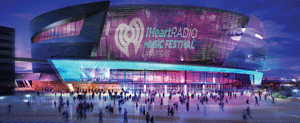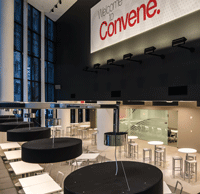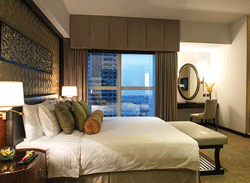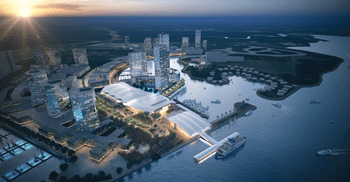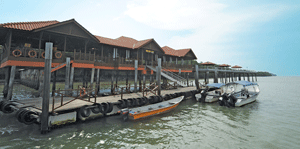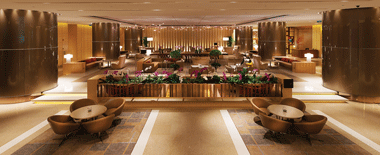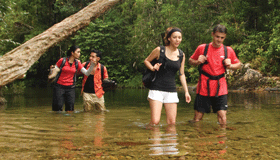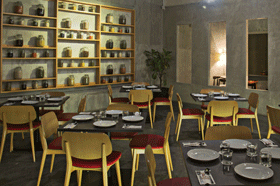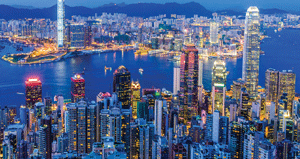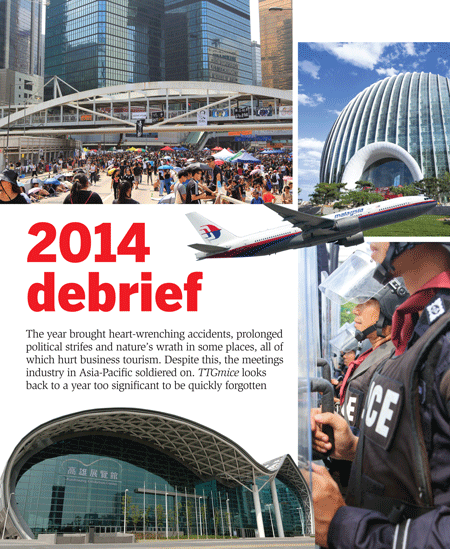
 Clockwise from left: Occupy Central in Hong Kong, APEC in Beijing, Malaysia Airlines’ mysterious disappearance, military coup in Thailand and the new Kaohsiung Exhibition Center
The year brought heart-wrenching accidents, prolonged political strifes and nature’s wrath in some places, all of which hurt business tourism. Despite this, the meetings industry in Asia-Pacific soldiered on. TTGmice looks back to a year too significant to be quickly forgotten


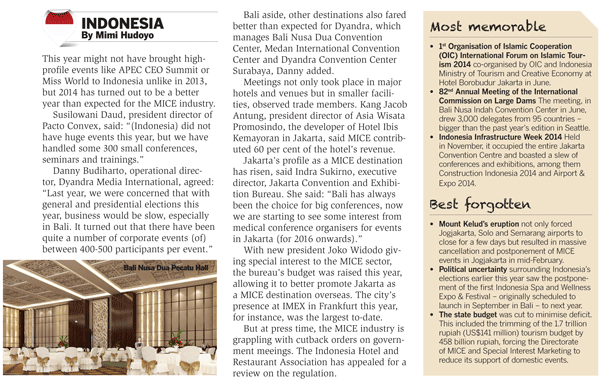
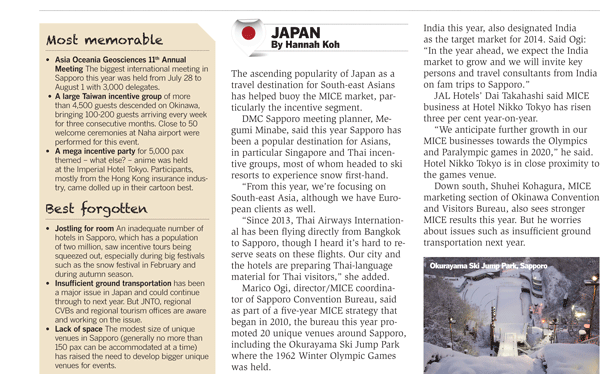
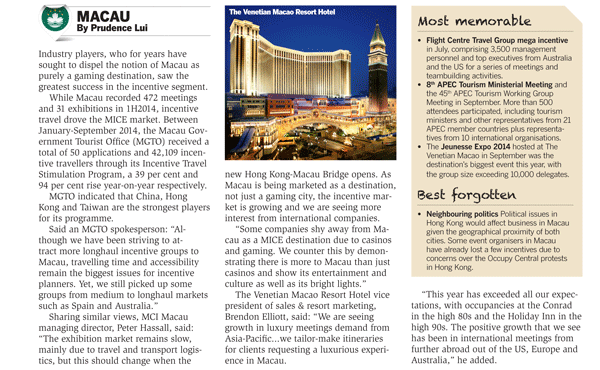
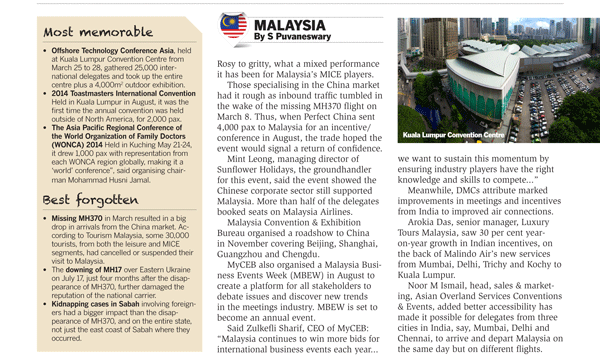
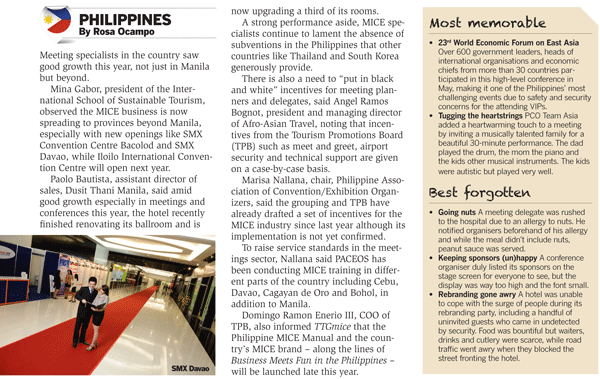


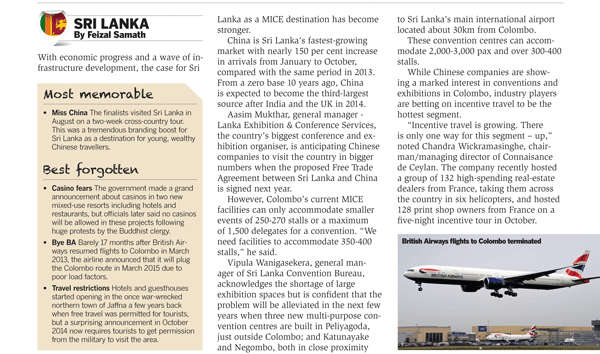
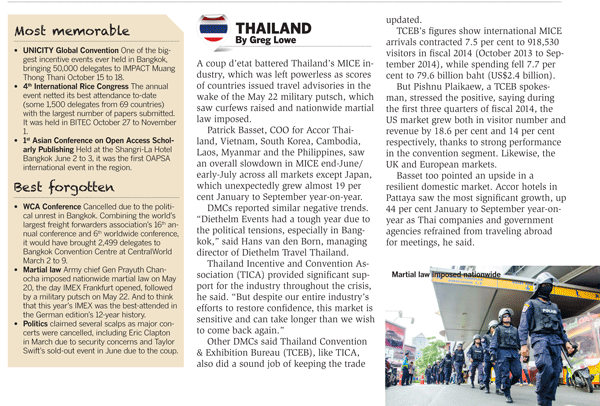
Welcome additions
Here’s a recap of new infrastructure additions in the region this year that can only be good for the MICE industry
AUSTRALIA
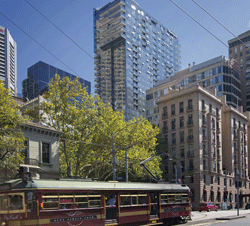
Sheraton Melbourne Hotel
Dockside Pavilion an anchored floating pontoon at Darling Harbour, opened mid-year to cater for up to 1,440 pax banquet-style and 2,000 pax standing.
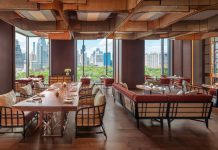
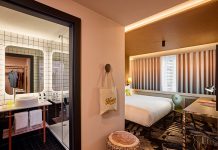
Melbourne this year welcomed more business hotels, including Quest Melbourne Airport, Sheraton Melbourne Hotel and DoubleTree by Hilton Melbourne.
HONG KONG
PMQ, heritage site of the former Hollywood Road Police Married Quarters, provides two events spaces including the 600m2 Qube and 1,000m2 Aberdeen Courtyard and Marketplace, as well as pop-up stores on different floors.
Kai Tak Cruise Terminal offers a picturesque location with four flexible indoor venues totalling over 3,000m2 that can accommodate up to 3,000pax each. Tenants include the Federal Restaurant Group, which opened a production kitchen and banquet facility for 80 tables.
Hong Kong Maritime Museum has relocated from Stanley to Victoria Harbour at Central Pier No. 8. It comprises 15 galleries, an exhibition and events space, and a rooftop café, catering for different MICE events.
INDONESIA
The expanded Sepinggan Airport opened in Balikpapan, East Kalimantan and can now accommodate 10 million passengers a year, up from 1.7 million previously. Balikpapan is an important industrial city in Indonesia with many multinational companies, especially the oil and gas sectors.
Ciputra Artpreneur opened in August in Jakarta. It is a 10,000m2 art-dedicated space comprising a museum, a theatre, exhibition galleries and multi-function rooms, with capacity for 300 to 1,500pax, theatre-style.
MACAU
Macpro Gallery and Macpro Business Center located in a commercial building at the heart of Macau Peninsula opened early this year. Both offer affordable venues within a non-gaming environment. The business centre offers rooms for small meetings of seven pax or larger gatherings of 20 to 40pax, theatre-style. The gallery has a chic design and is suitable for small- to medium-sized events.
MALAYSIA
klia2 opened in May as the largest low-cost carrier terminal in the world. MICE planners can organise a half-day shopping programme at its four-level mall comprising 225 commercial outlets on the day of departure, or make arrangements with Malaysia Airports Holdings to have special lanes at the immigration for international meeting delegates, avoiding long queues.
Skytrex@Perdana Quay Langkawi opened in August and is great for holding corporate events and team-building activities. The park offers challenges for different levels of fitness. Customised programmes can also be organised to suit organisational needs.
The new four-star Imperial Hotel Kuching offers 339 guestrooms and suites, including two executive floors. Its pillarless Imperial Grand Ballroom can hold up to 1,400 pax for banquets, while the Boulevard Grand Ballroom can accommodate up to 500 pax for receptions. There are nine multi-function meeting rooms of varying sizes.
SINGAPORE

Singapore Sports Hub opened in June, boasting a 55,000-seat stadium capped with the world’s largest free-spanning dome roof. It also houses two restaurants, a multi-purpose indoor area able to hold up to 3,000 seats, and the Sports Information Resource Centre, intended for exhibitions.
Victoria Theatre and Concert Hall, the grand dame of Singapore’s performing arts scene, opened its doors in June, following a S$158 million (US$127.1 million) refurbishment. The concert hall, which can seat 600pax, has foyer spaces to accommodate standing events of up to 150 guests. Perfectly suited for cocktail events seeking to inject elegance and style, this venue, which is also known as Singapore’s oldest performing arts centre, will be sure to impress both foreign and local guests.
Nestled in the relaxing surrounds of a rainforest, Faber Peak Singapore has undergone a revamp with three new restaurants: Spuds & Aprons, Faber Bistro and Moonstone – all with a view. Two new event spaces, The Ballroom and The Private Dining Room, can be used for a 30pax meeting or a 300pax product launch.
SOUTH KOREA
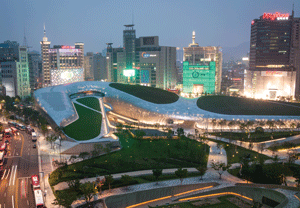
Dongdaemun Design Plaza opened in March in Seoul and has been billed as the world’s largest freestanding asymmetrical building. It offers a total floor space of 86,574m², as well as five meeting halls for a wide array of events.
South Korea’s first man-made island complex Some Sevit opened in April on the Hangang River in central Seoul, ahead of a major new MICE Zone currently being developed in the Gangnam district. It comprises three islets that include a convention hall, restaurants, water sports facilities and a floating stage.
WE Hotel, Jeju, launched in February, boasts a beautiful primeval forest as well as facilities for medical treatments and plastic surgery. There is also an events/banquet hall for up to 220pax theatre-style and 200pax for banquet. There are 82 hotel rooms and 30 patient rooms.
TAIWAN

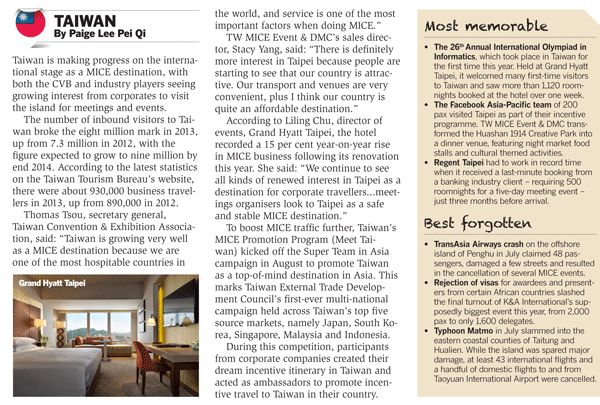
The 853-key Grand Hyatt Taipei completed its first phase of renovation in July. It has 13 well-equipped meeting rooms, including the pillarless grand ballroom which can fit up to 840 guests for banquets and 1,400 pax for conventions. Wi-Fi is available throughout the hotel.
The newly opened 303-key Mandarin Oriental Taipei features a range of event spaces, including the 960m2 Grand Ballroom for up to 1,200 guests. Wi-Fi is available throughout the hotel, and meeting packages offer well-equipped function rooms.
Newly opened in April, Kaohsiung Exhibition Center offers space for 1,500 standard booths and a conference hall for 2,000 pax, two conference halls for 800 pax each and 10 conference rooms for 20 to 40 pax. The facility has the potential to host marine-related trade events as it is located along a deep, natural harbour, allowing boats to be brought into the exhibition space.
THAILAND
Queen Sirikit National Convention Center became Asia’s first events space to achieve ISO 20121: Event Sustainability Management Systems accreditation, enabling the venue to compete more effectively for international events from organisations like the UN.
CentralFestival Samui opened in March adding 90,000m2 of retail and lifestyle space to the island’s offering with around 200 international branded stores, a bowling alley and cinema. The Port, when it opens, is set to become one of Samui’s key clusters of gastro bars and chic restaurants.
The North Pattaya Alliance was officially launched in June, with seven hotels pooling together almost 3,700 rooms and a host of meetings facilities in a bid to change the area’s sleazy image to one of a high-end MICE destination. Additional support is provided by Thailand Convention & Exhibition Bureau, Tourism Authority of Thailand and City Hall.
VIETNAM
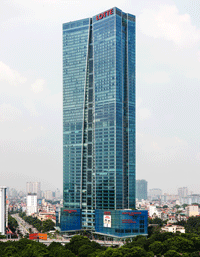
The five-star Lotte Hotel Hanoi opened in September, offering 318 guestrooms with complimentary high-speed Internet access, three F&B outlets, a spa and three large function rooms, including the Crystal Ballroom for up to 1,200 pax. The Hanoi National Convention Centre is only 15 minutes away by taxi.
Hai Au Aviation kicked off its seaplane service in September with the launch of a Hanoi-Halong Bay route. This high-end sightseeing of Halong Bay via a 12-seater Cessna Caravan C208 EX is an alternative to skip the three- to four-hour overland drive from Hanoi to Halong Bay.
Luxury Travel Vietnam and cruise company Huong Hai Ha Long launched Emperor Cruises in September, which will start its first cruises in Nha Trang by mid-2015. MICE groups can sail the clear waters and lush islets of Nha Trang Bay on board a junk boat or a 32-pax cruise boat.
Reporter’s notebook
As is the tradition, TTGmice editors and reporters share
their best and worst moments when on duty during the year
 Raini Hamdi
Senior editor
Best
My best interview this year was with Kwek Leng Beng, executive chairman, Singapore-based City Developments Ltd. I could not believe my luck that he spent nearly three hours with me for the interview and that I could ask him anything. I was even more delighted when he answered each question freely and frankly, and nothing was off-the-record. Look out for his South Beach Hotel project which is opening next year; it is linked to Suntec International via an overhead bridge. ‘Chairman Kwek’, as his men addressed him, was particularly happy about that MICE opportunity.
Worst
My worst experience was when I was harangued by a tourism official at ITB Berlin this year after we ran a factual account of how the country’s bad image was affecting bookings. I also could not believe how one of the industry players from that destination, whom my reporter interviewed for views on the issue, stoop so low so as to turn around and deny he was interviewed after the article was published.
 Karen Yue
Group editor
Best
This has been a glorious year, largely because TTGmice underwent a transformation to give it a fresher, more vibrant look, with new sections. The magazine is always looking to make itself more relevant to its readers and to consistently deliver the quality content it is known for, so it gave me great joy to see this dedication being acknowledged through yet another award. The cover story in the November 2013 issue won the PATA Gold Award Travel Journalism – Business Article. It was the fourth PATA Gold Award TTGmice has won to-date. Adding to the excitement, we unveiled TTGassociations, a quarterly publication for association secretariats and event planners.
Worst
It takes a lot to get me down and I have no terrible work experiences this year to share. However, I do wish more marketing and communications officers would understand that editorial coverage is not for sale and that TTGmice – or any respectable publication – owes it to its readers to run objective and relevant content.
 Gracia Chiang
Deputy group editor
Best
I had such a great first-time cruise experience on an Oceania fam trip to Greece and Turkey that I am already dreaming of my next voyage. Being the restless traveller that I am, I was pleasantly surprised that I actually enjoyed spending seven days onboard. I saw for myself why cruising’s appeal for leisure and MICE is growing among Asian travellers. What did I like? Waking up to a different gorgeous view every day, no transportation and packing hassle, and the all-inclusive fine cuisine!
Worst
Being stuck in Sanya’s airport for over eight hours and almost missing my connecting flight back home from Guangzhou. Despite being a VIP guest of China Southern Airlines for the WTTC Global Summit, I had great difficulty securing a seat on the next available flight out of Hainan after my original one was delayed.
Strangely, I also found the logistics for such a high-profile event was not well-executed. I was told that I would be able to make it for the half-day city tour the morning of my departure, but on site, I was told there would not be enough time. Wrong information was also given out about the airport pickup timings. It was a harrowing trip, plus it was not particularly productive as it was hard to arrange for interviews or get face time with top executives.
 Hannah Koh
Assistant editor,
TTG Asia Online
Best
Prague, right after ITB Berlin. Is there a place as magical? Long the site of political and ideological clashes, none of this was obvious during the extremely photogenic violet hour when the setting sun cast a golden glow on medieval buildings and the magnificent Charles Bridge.
Worst
There’s a casual cruelty in this industry I sometimes feel, amid all the wining, dining, boozing and schmoozing. A particular five-star hotel unveiled its refurbished meeting spaces this year with a rooftop party and I aimed to get a story out of it. The sales director and comms folk were wonderful: kind and considerate, they helped me locate the marketing director who was best positioned to comment. Said marketing director agreed to meet for a quick quote at a certain hour and location, but failed to turn up, despite repeated reassurances from the sales and comms folk, who had run off to look for him. I surrendered after 20 minutes and headed home for the night, later sending in follow-up questions that earned pretty dissatisfactory answers. I regret when courtesy is so clearly lacking from the other side.
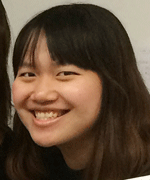 Paige Lee Pei Qi
Assistant editor-Singapore
Best I will bestow this honour to Tourism Australia for the VIP treatment rendered to all guests during the Australian Tourism Exchange in Cairns this year. Just imagine: upon arrival at the airport, we were taken by surprise as the traditional Gimuy Walubara Yidinji dancers spontaneously danced around us as we collected our luggage. But it didn’t stop there. We were even greeted by helicopters and ships cruising along the harbour that rolled out welcome banners! Now, how’s that for a warm welcome?
Worst
Staying in one of the hotels in Cambodia which was undergoing renovation works. Word of advice to all hotels: It does not go well with guests to welcome their mornings with drilling and hammering noises at 7am.
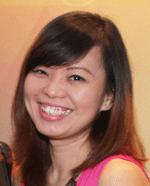 Xinyi Liang-Pholsena
Assistant editor-Thailand/Indochina
Best
Attending AIBTM in Orlando this year was quite an eye-opening experience for me. Besides it being my virgin trip to the US, what was also interesting for me was to mingle among trade reporters from around the world and observe the greater importance that American consultants placed on education and the faster adoption of technology (think Google Glass) in the US’ MICE industry. Asia is a diverse continent, no doubt, but I would like to see a stronger spirit of being nimble and adapting to technology among event and exhibition planners, especially in the more advanced economies in the region.
Worst
Following a press conference, I approached the head of a CVB to request for more information and comments. After introducing myself and presenting my business card, I posed my questions to him and asked if he could share his namecard too. His reply was quite unexpected though: “If you already know who I am, why do you need my namecard?”
 Kathy Neo
Copy editor
Best
My five-day fam trip to Okinawa. The sponsor, Okinawa Convention & Visitor Bureau, customised my itinerary well and responded readily to my interview requests. It was also my first trip to Japan, making it doubly memorable.
Worst
Fortunately, none.
 S Puvaneswary
Editor-Malaysia/Brunei
Best
Malaysia Convention & Exhibition Bureau’s Business Events Week in August was the best MICE conference I attended this year. I enjoyed the interactive sessions and it was also a great opportunity to network with MICE players from all over the country.
Worst
The Malaysia Tourism Exchange 2014 conference, jointly co-organised by Malaysian Inbound Tourism Association and Kris Destination Management in Kuala Lumpur. The programme was not updated so I was hugely disappointed when the invited VIP from the Ministry of Tourism and Culture was not present to give the keynote address. Tourism Malaysia’s director-general, Mirza Mohammad Taiyab, was also not present to deliver the country’s marketing plans. In fact, there was no keynote address and no representative from Tourism Malaysia to present the marketing plans. The event started late and after a brief introduction of all the speakers, the MC immediately held a press conference. I reluctantly went, out of politeness, and as expected, the media had no questions to ask as the sessions had not started. So, to kill time, the MC gave us a lengthy briefing about himself and the different companies he had worked for in the past, and his achievements.
 Mimi Hudoyo
Editor-Indonesia
Best
The best travel mart and fam trip I had this year was New Zealand’s TRENZ. The show was well organised and the breakfast talks were interesting and informative. The participation of all stakeholders – government, airlines, hotels, attractions, airports and ground handling operators enabled me to complete the various assignments I was given.
Worst
I was assigned to interview and attend a destination presentation by a visiting NTO but I had already accepted an invitation to a media conference by a cruise company at around the same time. To honour both, I interviewed the NTO 30 minutes before his presentation, then rushed to the next appointment, as the PR company said the cruise executive’s time was also limited. Turned out that not only was he 90 minutes’ late, he did not seem to be in a hurry at all.
 Greg Lowe
Correspondent-Thailand
Best
Covering the Euromic AGM in Cairo in January was without a doubt the highlight of my year. Organised as an incentive, after three days of visiting sites in and around the Egyptian capital, and attending a few meetings, we were treated to a five-day/four-night post-event cruise of the Nile, taking in the archaeological wonders of Karnak, Luxor, Valley of the Kings, Philae and Aswan.
Worst
Trying to get believable occupancy figures from a centrally located business hotel in Bangkok. After weeks of delays, panic set in when it unintentionally disclosed occupancy figures that could still only be best described as wildly optimistic. Back-pedalling ensued, along with claims that the data couldn’t be used as it was inaccurate.
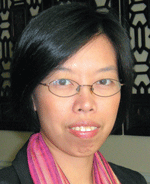 Prudence Lui
Correspondent-Hong Kong
Best
Hong Kong Disneyland Resort’s Celebration of Sales Excellence event which took place in Adventureland. The queue area outside Theater in the Wild was transformed into a cocktail and dinner venue for the first time. I was impressed by the creative décor and music, coupled with the provision of straw safari hats and animal print scarves to guests, which set the mood for adventure and exploration.
Worst I requested for two media interviews at the 3rd Global Tourism Economy Forum but the PR informed me on the day that only one materialised. During the group interview session, we the English media were mixed with the mainland Chinese reporters and simultaneous translation was needed for all questions raised. This wasted a lot of our time.
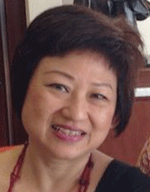 Caroline Boey
Senior correspondent-China & Special Projects
Best
I’m so happy whenever industry officials in China reply to my emails and questions. I give two thumbs up to the Shanghai International Conference Management Organization, and the MICE Department of the Hangzhou Tourism Promotion Centre. Both organisations provide insightful comments, and the same-day reply is an unexpected bonus.
Worst
I can’t recall any!
 Rosa Ocampo
Correspondent-Philippines
Best
The Philippine-India Travel Exchange stood out because it was well organised with well-chosen buyers and sellers. Organiser Glen Agustin and his team from the Department of Tourism were helpful. Buyers from India were Philippine specialists and were also approachable, open and easy to talk to. Plus, the venue was great: Sunset Pavilion tent at Sofitel Philippine Plaza’s landscaped garden on the edge of Manila Bay.
Worst
Several trips of mine were marred by flight delays either on takeoff or touchdown or both due to runway overcapacity in Ninoy Aquino International Airport (NAIA). Once, the plane was already in Manila but had to delay landing by 15 minutes. On another occasion, the aircraft had to stay an extra 90 minutes in Bangkok due to busy traffic in NAIA’s runway.
 Feizal Samath
Correspondent-Sri Lanka/Maldives
Best
My best MICE event was visiting the newly renovated Bandaranaike Memorial International Hall, the country’s biggest convention centre in Colombo, for a musical performance and witnessing the new changes. With its modern facilities, convention rooms and halls, it is the best location for business meetings, exhibitions or conventions. It can accommodate 1,000-1,500 pax in the main conference hall, has large break-out rooms (some with the capability to accommodate 200 pax) and an exhibition centre that can accommodate 200-250 booths.
Worst
When a top travel consultant pulled out of a last-minute interview and I had to rush to get a replacement story to meet an urgent deadline. No apologies from the man – won’t contact him again!
Natasha Dragun
Correspondent-Australia
Best My best fam trip was to Chicago for IPW 2014. I was blown away by the creativity of the city’s MICE sector and its ability to deal with thousands of extremely demanding travel journalists and travel trade members. A good range of pre- and post-fams were on offer, as well as dozens of trips to take in everything from the city’s architecture to its craft distilling scene.
Worst An evening event hosted on board a boat carrying guests around Sydney’s harbour. There were way too many people on board, which meant I was crammed in a corner with food and drinks flung at me. The speeches lasted the whole event, which meant no time for networking. And to make it worse, they were in multiple languages, which slowed everything down. The worst part? Being on board meant people could not escape.
– Other team members: Marianne Carandang, Shekhar Niyogi, Rohit Kaul, KC Sim, Redmond Sia, Goh Meng Yong and Lina Tan