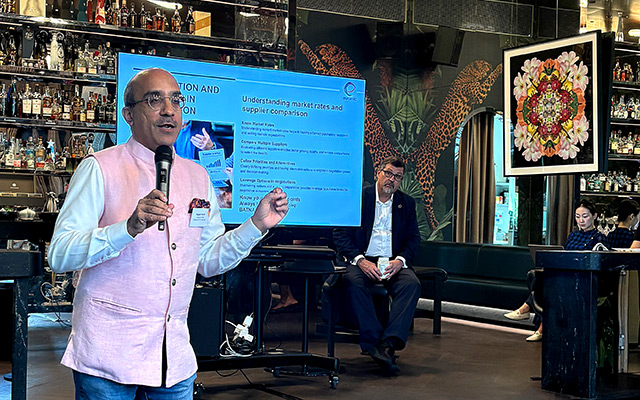
Meeting planners in Singapore, attending the half-day seminar organised by non-profit DMC marketing association euromic, were reminded they must be able and know how to negotiate contract changes in a market where supplier flexibility has dropped.
Addressing this at the April 23 training, Rajeev Kohli, joint managing director, Creative Travel – representing India and the Maldives for euromic – said: “Price is always a discussion, but what is more important is value.”
Kohli, who was euromic’s president for two terms, also spoke on knowing rates, comparing multiple suppliers, defining priorities and alternatives, and leveraging options in negotiations.
“Prices today are tighter, supply is smaller, especially in 2026, where there is a surprise every week,” he observed.
Buyers must understand price is not the only consideration, the importance of negotiating respectfully, and developing a deeper relationship instead of being transactional.
The foundation of negotiation is “win-win”, whereas the ongoing Middle East conflict is based on “win-lose”, he quipped.
A force majeure clause in a contract will only work if there is a deeper relationship as “nobody wants to give money back”, he opined.
According to Michael Kater, managing director of CTI, euromic’s member representing Germany and Austria, there were no questions on safety during the Asia roadshow which also covered Kuala Lumpur and Hong Kong.
Malaysian participants, for example, wanted general information on hospitality in the European Union, where since the start of 2026, most countries have implemented a two-tier VAT (value-added tax) system.
Kater said: “There is a lower level of between five and seven per cent, and a high level with most countries charging 20 per cent for non-essentials like luxury items.”
During his presentation, Kater explained that non-EU businesses claiming VAT paid on business-related expenses, for example, for accommodation, transport, or conferences, must have original, compliant invoices showing the VAT amount.
Companies outside the EU must meet specific requirements, such as filing within deadlines, usually by 30 June of the following year, he added.