Singapore’s business events industry demonstrated exceptional momentum last year, with 2025 tourism receipts surging over 35 per cent from the previous year to reach S$2.3 billion (US$1.8 billion).
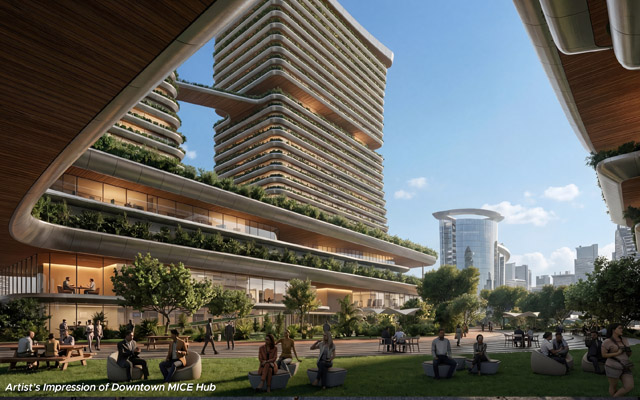
To capitalise on this growth, Grace Fu, minister for sustainability and the environment and minister-in-charge of trade relations, announced at the annual Tourism Industry Conference last Friday, that the Straits View area near Marina Bay has been earmarked as a potential location for the Downtown MICE Hub (DMH).
Fu elaborated: “The DMH will complement other MICE venues in the city such as Raffles City, Suntec City, and Marina Bay Sands, all located within a three-kilometre radius, creating a vibrant MICE cluster that blends work and play, encouraging more bleisure travellers to extend their stay.”
To move the project forward, Singapore Tourism Board’s (STB) chief executive Melissa Ow confirmed that an industry engagement session is scheduled for May 15, followed by a Request for Information exercise and a formal Request for Proposal in 2027.
The city’s appeal for extended bleisure stays will be further bolstered by upcoming lifestyle landmarks, including the Therme Singapore wellness attraction at Marina South (opening by 2030), and a new five-hectare wetlands precinct at Gardens by the Bay, which will house a teamLab museum.
Singapore’s business events sector continues to navigate recent global geopolitical volatility. According to Ow, while the onset of conflict triggered initial flight adjustments, the industry has “remained largely resilient”.
This year, the city has successfully hosted several high-profile gatherings, including ITMA ASIA + CITME Singapore, which attracted over 26,000 international visitors. Other record-breaking events included Asia Pacific Maritime (20,000 attendees), and Milipol TechX.
Looking ahead, the pipeline is secured with numerous “first-in-Asia” fixtures, such as Passenger Terminal Expo Asia 2026, Breakbulk Asia 2026, and major sustainability forums like the World Hydrogen Energy Conference.
To ensure long-term competitiveness, STB is focusing on attendance building with a new S$5 million fund designed to help event organisers market to secondary cities and new markets.
Ow explained: “We hope to encourage tourism stakeholders to diversify and go into new secondary cities. It may not immediately yield results, but it’s critical as they build resilience and competitiveness in the mid-to-long term.”
Additionally, the INSPIRE Global 3.0 and SMAP 5.0 programmes have been refreshed to offer more diverse lifestyle options and deeper digital integration with partners like Expedia, Grab, and Klook.
The industry is also seeing unprecedented private-sector synergy. Twenty-two hotels, representing 25 per cent of Singapore’s total room stock, have launched the Singapore Hotels Incentives for Business Events (SHINE) initiative.
“These hotels are not concentrated in one area, but are all over Singapore such as Chinatown and Sentosa. We believe that the industry can benefit from this synergy,” noted Ong Huey Hong, assistant chief executive, industry development group, STB.
She emphasised that the strategy is built on the country’s long-term vision. “Our aim is to triple our MICE receipts by 2040, so we need to ensure that our infrastructure is future proof.”