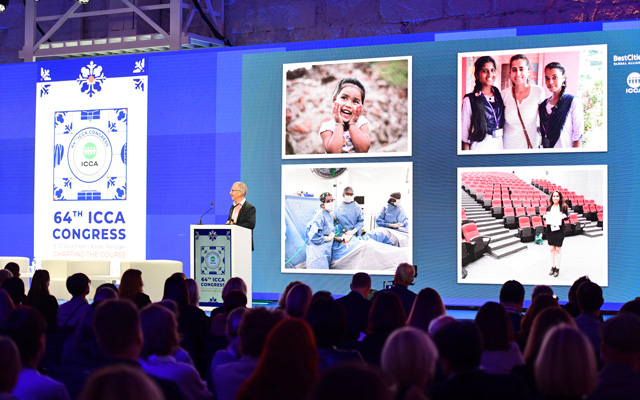
ICCA’s 2025 ICCA GlobeWatch report – which studies global meetings and events performance – has identified a transformed landscape where the number of meetings has increased, new meeting segments have been created, more congresses are being hosted in smaller, emerging cities.
Key findings from 2025 ICCA GlobeWatch were shared at a press conference during IMEX 2026 in Frankfurt on May 19.
The report, which tracked global meetings and events performance in 2025, notes 1,339 more international and regional association meetings last year over 2024, with the bulk of gatherings being held in Europe (53 per cent), followed by Asia-Pacific (22 per cent), North America (10 per cent), Latin America (nine per cent), Africa (four per cent), and the Middle East (two per cent).
Most gatherings in 2025 were related to medical sciences, technology, and science. Safety & security (208 meetings in 2025) and library & information (168 meetings in 2025) rebounded strongly despite their smaller base, with each growing nearly 3.9 times from their 2021 lows, ahead of larger sectors such as industry (3.5 times) and economics (3.6 times). ICCA said this reflected intensifying institutional focus on information governance and risk management.
In terms of meeting sizes, congresses with fewer than 1,000 participants were the majority. Those involving 50 to 249 participants represented the largest share of total global meeting volume, at 60.4 per cent; those with 250 to 999 attendees made up 31.8 per cent.
However, ICCA notes that large congresses involving upwards of 1,000 attendees proved the most impactful for the host destination, despite accounting for just 2.8 per cent of global meeting volume. They generated almost 52 per cent of total estimated spending.
The scope of regions participating in associations’ global knowledge exchange is also broadening, find ICCA researchers.
In Europe, second-tier and emerging destinations, such as Vilnius (Lithuania), Reykjavik (Iceland), and Porto (Portugal), are rapidly gaining ground with sharper upward movements, while top-tier cities like Lisbon (Portugal), Paris (France), Copenhagen (Denmark), and Berlin (Germany) continue to consolidate their leadership.
In Asia-Pacific, 14 countries and territories as well as 14 cities are now ranked among the world’s Top 50, accounting for nearly 30 per cent of the global total and underscoring the region’s growing weight and competitiveness.
Non-mainstream congress cities like China’s Hangzhou and Xi’an, South Korea’s Daejeon and Goyang, Japan’s Nagoya and Fukui, and more now stand alongside popular Asian capital cities.
Accessibility from an expanding aviation network, sector depth, and sustained investment, along with meetings that are aligned with economic activities and long-term development priorities are credited for the strong growth and spread of Asia-Pacific’s association meeting activities beyond major cities.
Across North America, top tier cities in the US, Canada and Mexico are joined by many other sister cities on the global ranking, indicating strong regional competition for association meetings. In Canada, for example, 32 cities are on the global ranking. While Toronto, Montréal, and Vancouver lead nationally, Calgary, Banff, and Edmonton together account for nearly a fifth of Canada’s total delegate volume.
In the Middle East, more destinations are updating their infrastructure and building market knowledge, ready to compete with top performers Dubai and Abu Dhabi.
Commenting on the importance of the spread of association meetings across countries and into smaller cities, ICCA CEO Senthil Gopinath told TTGmice: “Association meetings are a catalyst for local economic growth. They also help to drive whole industries and lift societies in emerging and developing cities.”
He added that it was “very common” for second- and third-tier cities in larger countries to get their share of international and regional association meetings. Small and emerging destinations have an opportunity to compete, even if they did not have their own convention bureau.
“Furthermore, in our report that there are many meetings that utilise smaller venues, such as hotel function rooms. And since mid-sized meetings are the largest contributor to total meeting volume, they can be held anywhere, not just the large capital cities,” Gopinath stated.
Venue investments as a meetings catalyst
ICCA has added a new venue analysis to the annual report. Data shows that 36 per cent of meetings are held on university grounds, followed by hotel venues (28 per cent), convention and exhibition centres (27 per cent), and other venues (nine per cent).
However, the report underscores convention and exhibition centres as the anchor of any destination serious about pursuing association congresses. These facilities contribute to lasting relationships with international association decision-makers, and many operate their city’s ambassador programme directly, connecting and supporting local academic and professional champions with international bid opportunities.
ICCA notes that cities like Barcelona, Dubai, Seoul, and Vancouver have made generational investments in their convention facilities because the returns are proven. Purpose-built venues attract more meetings, longer delegate stays, and greater economic returns across all sectors in the city.
Consequently, public-private investment in convention infrastructure is accelerating worldwide. ICCA tracks 78 convention and exhibition centre projects across 36 countries – these are worth a combined investment of more than US$30 billion.