Corporate travel managers are facing a tougher reality heading into 2H2026 as geopolitical disruptions, astronomical fuel prices, and airline capacity constraints triggers a major surge in travel costs.
During The Road Ahead: Corporate Travel Trends & Market Outlook webinar by FCM Consulting last week, speakers warned that the pricing power remains firmly in the hands of suppliers, obliterating corporate budgets that were benchmarked against last year’s figures.
The pressure on travel departments is reaching a boiling point, with polling during the webinar revealing that 40 per cent of the noise regarding travel spend is coming directly from CEOs, CFOs, and corporate finance teams, while 70 per cent of participants identified ongoing airfare volatility as their primary concern.
The underlying catalyst for the current pricing surge is a prolonged capacity constraint, exacerbated by Middle East airspace disruptions that began earlier this year.
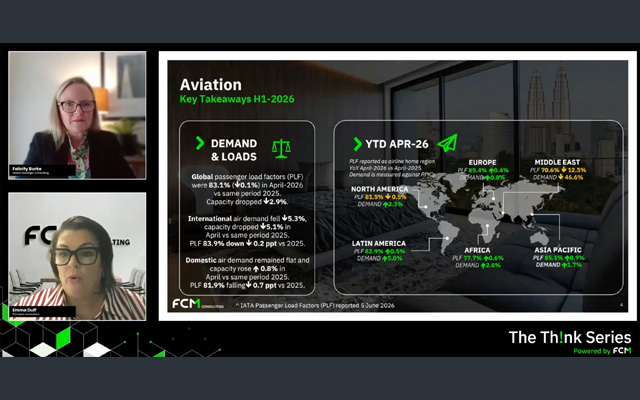
According to Emma Duff, principal consultant APAC at FCM Consulting, global airline schedules have taken a massive hit, with global capacity projections slashed by 53 million seats in May 2026 alone compared to February forecasts, marking the sharpest single-month downward revision of the year.
Duff emphasised the severity of the market conditions, and stated: “It is not a recovery story, it is a capacity constraint story at the moment, and has direct implications on availability and pricing.”
Reduced supply paired with sustained international demand has created a fare pressure scenario, especially as global airlines manage capacity so tightly that passenger load factors have hit historic highs, with the Asia-Pacific region leading the world at an unprecedented 85.1 per cent.
Compounding the capacity crisis is an enormous fuel shock that is reshaping base airfares. While the International Air Transport Association originally forecast jet fuel at US$88 per barrel for 2026, real-world costs have plummeted corporate expectations by sitting at around US$141 dollars per barrel – a staggering 60 per cent above forecast.
Duff noted that this massive cost will not “simply disappear” when regional conflicts ease because 22 airlines skipped transparent fuel surcharges altogether, and went straight into increasing their base fares.
“The cost is now baked into every published fare, every corporate rate, and every GDS display, and it is going to stay there until the airline chooses to refile,” Duff pointed out. As a result, global economy fares have surged nearly 19 per cent year-on-year to March, while business class tickets are up six per cent off an already elevated base.
The pricing pressure is equally severe on the ground, with corporate hotel programmes experiencing widespread inflation across the board.
Felicity Burke, general manager at FCM Consulting, revealed that for the first time in years, every single global region posted an average room rate increase simultaneously during 1Q2026, driving the global average room rate to US$212. High-occupancy markets like Tokyo, Sydney, and Hong Kong continue to see climbing rates, while major global hotel companies – including Hilton, Marriott, and Accor – are leveraging strong demand to report RevPAR increases of between five and 10 per cent to cover their own rising operational costs.
Burke and Duff advised travel managers that benchmarking against previous budget assumptions is no longer a valid strategy, and companies must immediately rest-test their travel policies, adjust budget expectations with the C-suite, and review rate caps. To mitigate these hikes, they urged organisations to utilise NDC channels for exclusive airline content, enforce advanced-purchase behaviours, and audit their travel risk frameworks to ensure traveller safety under sudden market disruptions.