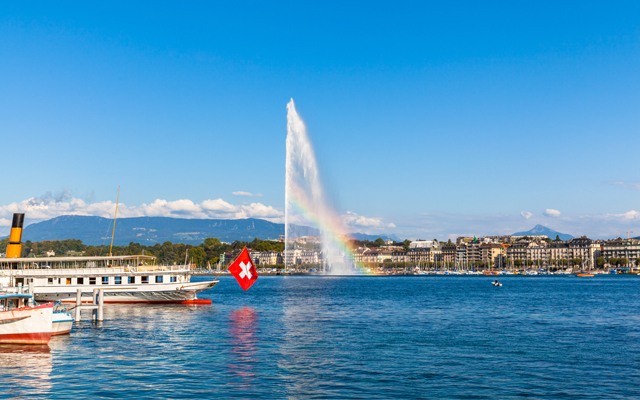
Jet d'Eau fountain is one of the most famous landmarks in Geneva, Switzerland, with its powerful spray reaching 140m into the sky
In an ongoing rebranding exercise, Switzerland Tourism has retired its iconic golden edelweiss logo and replaced it with the word Switzerland, with the Swiss cross taking the place of the letter ‘t’, set against a colour gradient backdrop of five shades of red.
Jet d’Eau fountain is one of the most famous landmarks in Geneva, Switzerland, with its powerful spray reaching 140m into the sky
The new brand identity was developed with Zurich-based branding specialist, Made Identity. According to the agency’s case study on the rebranding exercise, the new logo allows a stronger reflection of the Swiss flag through the inclusion of the Swiss cross in the wordmark while the five tones of red convey energy and the alpine glow of Swiss mountains.
While the new brand image was unveiled in Geneva on May 1, the full exercise will be implemented globally in stages. Switzerland Tourism, which the Switzerland Convention & Incentive Bureau is part of, told TTGmice that more information would be shared with the Asian travel trade community at ILTM Asia Pacific 2024.
For event planners looking for something different, Topgolf Megacity may offer what they need.
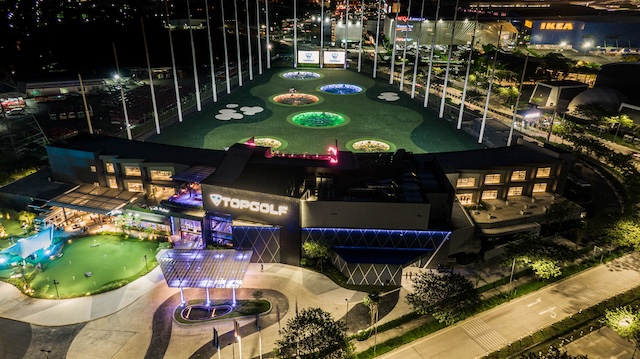
A sports and entertainment complex in Bangkok, 35 minutes from the Central Business District, Topgolf Megacity offers a unique concept that blends sports, leisure and business in a dynamic setting.
Opened in August 2022, Topgolf offers a variety of game formats that cater to all ages and skill levels, from first timers to seasoned players, regardless whether they know the sport or not.
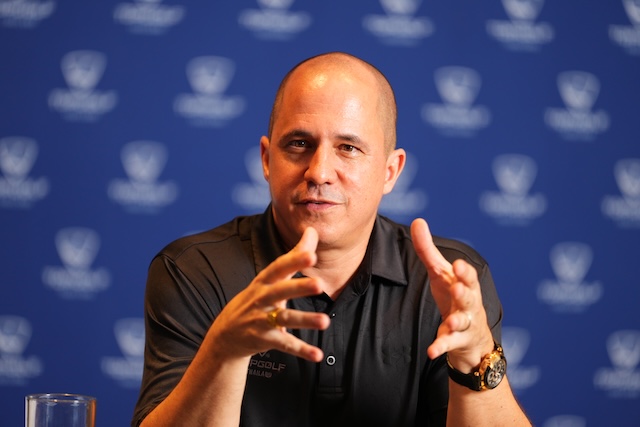
Tim Boda, managing director, Topgolf Thailand
“Bringing the joy of golf to everyone is at the heart of Topgolf,” said Tim Boda, Managing Director Topgolf Thailand. “Our mission is to revolutionise the game, making it accessible and enjoyable for all skill levels. In our first year, over two-thirds of players identified as non-golfers, with an equal split between female and male players. At Topgolf, our diverse range of technology-supported game formats is crafted to captivate players of all ages, drawing in newcomers and seasoned pros alike.”
Versatile spaces for play and business
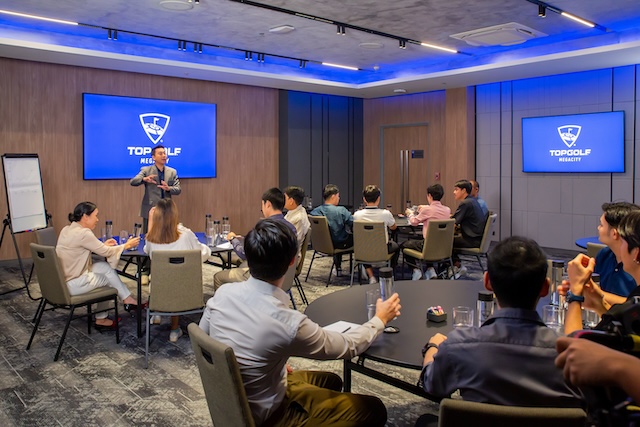
Fully equipped meeting rooms are available for corporate groups
At Topgolf Megacity, corporate events are taken to the next level. Its event spaces are nothing short of extraordinary, catering to groups ranging from a cozy 12 to a large group of up to 2,000 guests.
With a whopping 102 hitting bays, each accommodating up to six players, the excitement never stops.
Take your pick from the array of interactive games, engage in friendly competition and rack up points with the state-of-the-art microchipped golf balls.
There’s no need to worry about food and drinks either. Topgolf delivers both right up to the hitting bays.
Venture into the Puttyard, a challenging 18-hole par 55 course. Perfect for social gatherings or family outings, it’s a thrill for both amateurs and seasoned pros alike.
Need a space for those important business discussions? Topgolf Megacity has got that covered with a fully equipped 186m² function room, easily dividable into two separate spaces, and conveniently connected to the hitting bays.
Boda recognises the vital role corporate events play in introducing new faces to the Topgolf experience. From team-building days to product launches, Topgolf Megacity aims to be a full service provider for corporate event excellence.
Over the years, Topgolf has proudly hosted corporate events for a multitude of industries, including automotive, pharmaceutical, finance, and manufacturing to name a few.
“We’ve handled it all with our one-stop shop approach. Our largest corporate group boasted an impressive 5,000 participants over four action-packed days, and all of them were non-golfers. So whether you’re planning team-building adventures, important meetings, or unforgettable year-end parties, let Topgolf Megacity set the stage for your corporate success,” added Boda.
Variety of food and beverage concepts
1 of 3
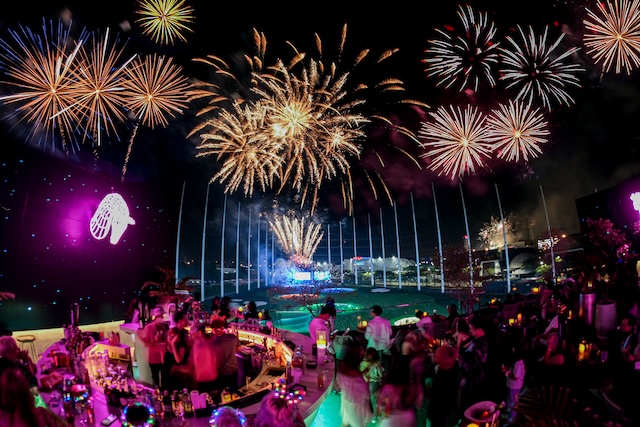
Enjoy the cityscape at the Pink Giraffe rooftop bar
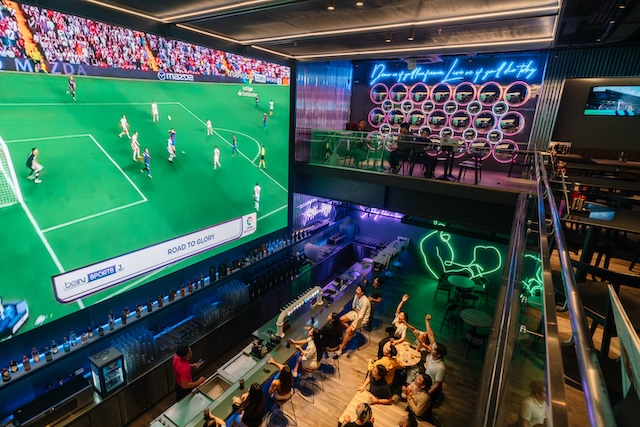
Watch live matches in the convivial Sports Bar
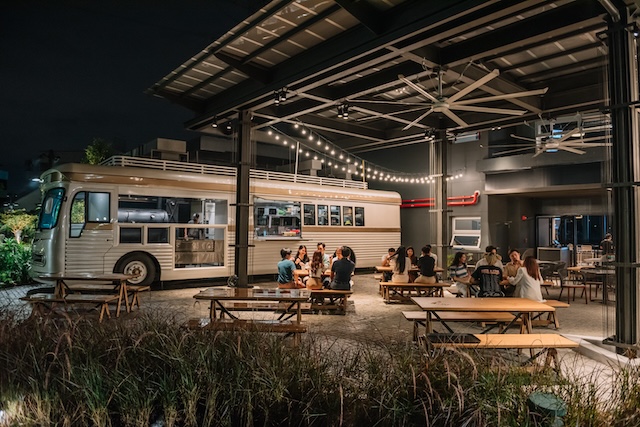
Savour local dishes served right from the food bus, BUSTED!
With five bars and restaurants to choose from, Topgolf Megacity is equipped with sufficient food options to ensure that guests can fill up as they play.
Patio is its casual all-day dining restaurant that transforms into a vibrant beer garden at night. Guests can enjoy comfortable indoor and outdoor seating amidst greenery from The Puttyard while savoring bold Thai dishes, healthy comfort food, and international classics. Also at the Patio is Topgolf’s own food bus, BUSTED!, which serves vibrant Thai dishes prepared with American BBQ techniques that give the food an extra smoky punch.
On its fourth floor is Pink Giraffe, Topgolf Megacity’s open air rooftop bar that offers all-round views of the surrounding landscape. Other bars include Devil’s Lounge, which offers 65 types of wines and whiskeys, as well as the two-storey Topgolf Sports Bar which has large screens for an enjoyable viewing experience.
Topgolf offers several meeting packages designed for various event needs. Visit Topgolf Megacity to plan your next corporate outing, call +66 (0)2 114 1289, or email onestopservice@topgolfthailand.com.
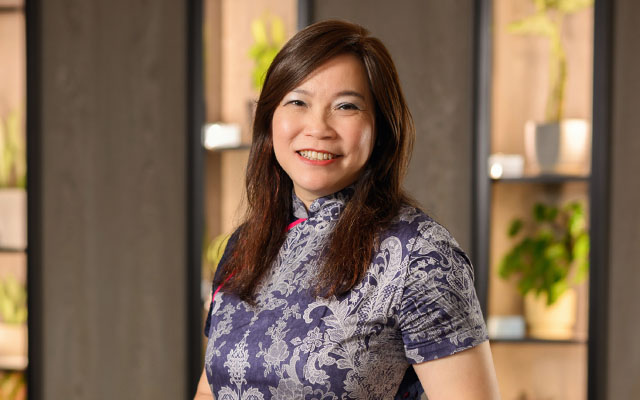
Dao by Dorsett has appointed Jessie Khoo-Gan as its new general manager.
She joins the team with a wealth of knowledge and expertise, and has amassed over 30 years of extensive experience in the hospitality industry.
Prior to joining Dao by Dorsett, she has held leadership roles at Paradox Singapore Merchant Court, as well as at Pan Pacific Hotels Group and the Shangri-La Group.
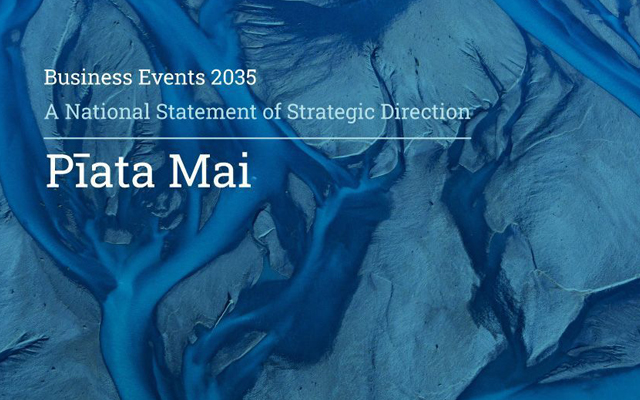
New Zealand’s business events sector has come together to launch Pīata Mai, a national statement of strategic direction outlining a focused vision for the industry over the next decade.
The strategy emphasises storytelling about the sector’s community impacts, its foundational values of people and place, and the economic and legacy benefits of business events.
Pīata Mai cover image
The 10-year aims and immediate objectives of Pīata Mai include commissioning credible domestic and international spend data, ensuring 95 per cent of the sector has taken action to measure and reduce environmental impact, and supporting the development of an enduring and equitable funding system for the visitor economy.
This initiative, guided by an industry stakeholder group and shaped through extensive consultations, is under the stewardship of the industry body, Business Events Industry Aotearoa (BEIA). It aims to amplify the sector’s positive impact on culture, society, the environment, and the economy through to 2035.
Susan Sawbridge, former head of Major Events New Zealand led the consultation and delivery of the direction.
BEIA chair, Martin Snedden, said that Pīata Mai is a first for New Zealand’s business events sector. “It means ‘to shine bright,’ and symbolises the industry’s readiness to excel domestically and globally, driven by its commitment to resilience and sustainability.
The name was bestowed by New Zealand Māori Tourism, and illuminates the critical role and contributions of business events to communities throughout New Zealand, he added.
Lisa Hopkins, BEIA’s chief executive, added that Pīata Mai aligns with the broader goals of Tourism 2050, a vision set out by Tourism Industry Aotearoa in 2023.
“With increased international and domestic conferences anticipated, it’s timely to emphasise our strategic position and collaborate with our whanau (family) in tourism and hospitality…
“Our vision is a dynamic business events sector with a thriving community, environmental stewardship, and engaged individuals who are recognised for their contributions. Pīata Mai lays the groundwork for any organisation within the business events network to embark on a strategic journey aligned with this vision,” Hopkins concluded.
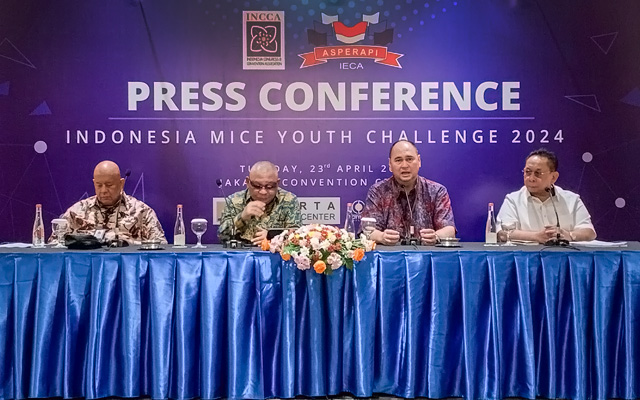
From left: LSP MICE's Ajat Sudrajat; MoTCE's Vincensius Jemadu; IECA's Hosea Andreas Runkat; and INCCA's Iqbal Abdullah announcing the MICE Youth Challenge
The Indonesia Exhibition Companies Association (IECA), in collaboration with the Indonesia Congress and Convention Association (INCCA), is set to host the inaugural Indonesia MICE Youth Challenge 2024 on July 29-30, 2024, at the Jakarta Convention Center (JCC).
This competition provides a platform for students in the business events and tourism sectors to showcase their creativity and showcase innovative ideas to the industry, while gaining valuable industry experience by conceptualising and organising business events.
From left: LSP MICE’s Ajat Sudrajat; MoTCE’s Vincensius Jemadu; IECA’s Hosea Andreas Runkat; and INCCA’s Iqbal Abdullah announcing the MICE Youth Challenge
Hosea Andreas Runkat, chairman of IECA, aims for the competition to spark new ideas and perspectives in Indonesia’s business events sector. He said: “We are delighted to provide a platform and opportunity for future Indonesian business events professionals to unleash their creativity while connecting with peers from other regions participating to inspire ideas and share enthusiasm for this business.”
Iqbal Alan Abdullah, chairman of INCCA, echoed the sentiment, stressing the importance of innovative thinking in Indonesia’s business events industry. He encouraged students to contribute their “crazy” ideas to meet industry needs, to help position Indonesia as a leading business events destination.
“Indonesia has 36 MICE study programmes, and we expect each campus to send more than one representative. The winners will be sponsored to participate in competitions at the Asian and global levels,” noted Iqbal.
Vinsensius Jemadu, deputy of tourism product and event management at the Ministry of Tourism and Creative Economy (MoTCE), lauds the MICE Youth Challenge for nurturing competent and professional talent, in line with Kemenparekraf’s focus on adaptability, collaboration, and innovation. The ministry also pledged to bolster the competition’s standards and participation numbers.
“This aligns with the progress at MoTCE, emphasising adaptability, collaboration, and innovation. We will provide support with our available resources and aim to enhance both quality and quantity to send representatives to regional and global levels,” Vinsensius said.
The Indonesia MICE Youth Challenge competition will be judged by a jury consisting of representatives from IECA, INCCA, and MoTCE, as well as PEOs and PCOs.
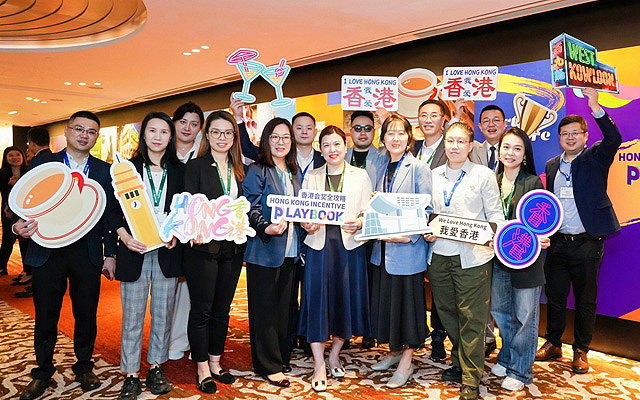
Hong Kong ups their game with its latest Incentive Playbook
The Hong Kong Tourism Board has intensified efforts to boost the meeting and incentive market by organising the largest-ever trade fam trip for some 110 incentive travel trade representatives from Asia Pacific last week.
Trade partners from China (which had the largest delegation), Singapore, Malaysia, Thailand, the Philippines, Indonesia, South Korea, and India gathered in Hong Kong for a 4D3N trip filled with immersive tourism experiences.
Hong Kong ups their game with its latest Incentive Playbook
HKTB’s executive director, Dane Cheng, said, “Travel arrangements like incentive tours are demanding and difficult to arrange. We hope to show the diversity of activities that can add value to their visits, such as art jamming, bar experiences, and food tours.”
Deputy general manager of Hangzhou OTC Travel International, Feng Yi-bo, was one of the agents who were seeking something new for his clientele. He expressed interest in including the West Kowloon Cultural District in future itineraries for his clients, and was excited to experience 11 SKIES – billed as Hong Kong’s largest hub for retail, dining and entertainment – stating that it would suit his market.
President of Philippines-based Ark Travel Express, Maria Paz Alberto, noted that the short flying time to Hong Kong has attracted many incentive groups post-pandemic.
She shared that she had an incentive group of 50 visiting Hong Kong soon, and she would recommend to them to experience Hong Kong’s bar culture, as well as include the Chinese fan painting workshop as a suitable activity for the incentive group.
One of the highlights of the 4D3N fam included the launch of a new campaign, Hong Kong Incentive Playbook: Up the Game for Your Team, at The Regent Hong Kong on April 24.
The Hong Kong Incentive Playbook covers over 100 new and unique incentive ideas under five themes: Arts & Culture, Wellness & Nature, Neighbourhoods”, Nightlife & Parties, and Hong Kong Signatures. Experiences ranged from traditional Tai Chi classes and kayaking to local pastry-baking workshops and temple pilgrimages.
In 2023, Hong Kong welcomed over 1.3 million MICE visitors, with the Meeting and Incentive (M&I) segment accounting for a staggering 65 per cent.
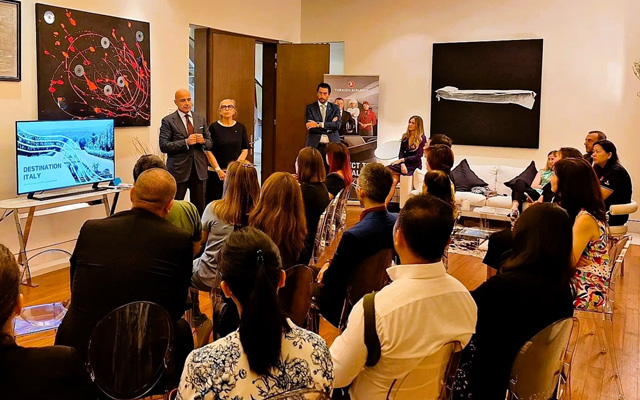
Meeting with business events stakeholders at the Italian Embassy in Singapore
On April 18, 2024, the Italian Embassy in Singapore transformed into a event venue where around 20 travel agents and business events specialists convened to delve into the topic of “Italy as a MICE destination”.
The event, hosted by ambassador Dante Brandi and convention bureau Italia director Tobia Salvadori, showcased Italy’s appeal as an ideal destination for business events.
Meeting with business events stakeholders at the Italian Embassy in Singapore
Three major destinations – Milan, Rome and Sicily – were featured, chosen for their unique venues and significant upcoming events such as the Vatican Jubilee in 2025 and 2026 Winter Olympic Games (in Milan).
And although Sicily has hosted G7 ministerial meetings, event planners may not know about its volcano and archaeology excursions, leisure activities and high-quality accommodation, said Fabio Conte, deputy head of mission, Embassy of Italy.
He added: “Singapore was targeted because it has a market strongly oriented towards MICE tourism, both outbound – owing to a service industry fabric and high per-capita income – and inbound, due to its receptivity, dynamism and connectivity.”
Huang Eu Chai, director of Ergo: Travel, which specialises in the Italian market, described Italy as an “incredibly varied country”.
“Incentive and business trips to Italy make up a small but growing market for us. Corporate groups usually range from around 10 to about 35 persons. Last year, we planned and arranged a trip for a property developer and its customers to visit a marble quarry near Forte dei Marmi in Tuscany,” shared Huang.
With Italy hosting many arts events and trade fairs throughout the year, business delegations and exhibitors can also enjoy pre- and post-event stays.
This Italian outreach was supported by the National Association of Travel Agents Singapore and Turkish Airlines, which has many direct flights to Italy from Istanbul. Triumph Group International, a leading Italian PCO with a Singapore office, was also present.
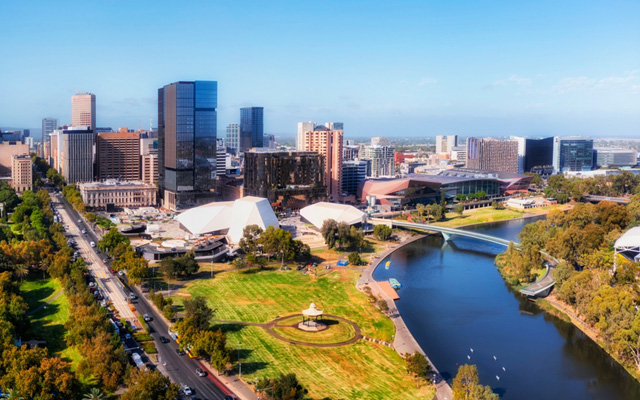
DLG Benelux partners with ASSA to bring people together in the seaweed sector; Adelaide pictured
DLG Benelux, organisers of the Seagriculture Conferences, will debut the inaugural in-person Seagriculture Asia-Pacific in Adelaide from March 18-20, 2025.
This marks a pivotal moment for the Seagriculture Conferences venturing into a new region, bringing together participants from the Asia-Pacific region within the seaweed value chain. The addition of this edition complements the existing European and US conferences.
DLG Benelux partners with ASSA to bring people together in the seaweed sector; Adelaide pictured
The Second International Seaweed Conference Asia- Pacific will provide participants from around the world with a platform to learn about the diverse seaweed industry, and understand innovative approaches that contribute to sustainable development.
In addition to the conference, participants can join the site visit on March 18, 2025, to the South Australian Research and Development Institute (SARDI), an institution dedicated to increasing the productivity, adaptability, and economy of South Australia’s primary industries, enabling sustainable use of natural resources, addressing agricultural barriers and providing applied solutions.
Seagriculture Asia-Pacific made its debut in 2023 as an online edition. The First International Seaweed Conference Asia-Pacific saw over 180 participants from 31 countries joining in over two days of online conferencing.
Australian Sustainable Seaweed Alliance (ASSA) CEO Lindsay Hermes said: “ASSA looks forward to ongoing collaboration with key partners the Fisheries Research and Development Corporation (FRDC), SARDI, the Department of Primary Industries and Regions South Australia, and the Australian Department of Agriculture, Fisheries and Forestry, our 11 ASSA members right around the country and other key stakeholders as we leverage this international opportunity to drive our high-tech, high growth and highly sustainable Australian seaweed industry forward.”
Australia’s southern coast has 1,500 species of seaweed, the second highest number in the world after Japan, with private and government investment in research and development leading to a fast-growing commercial seaweed industry.
The Australian Government has committed A$8 million (US$5.2 million) to the Developing Australia’s Seaweed Farming Program to support investment in the Australian seaweed industry and scale up the production of seaweed as a livestock feed supplement to reduce methane emissions, including funding to support ASSA. The Program is being delivered by the FRDC and ASSA to plan and co-ordinate research and development, biosecurity and the development of a national hatchery network.
Hannover Fairs Australia – part of Deutsche Messe and having operated in Australia since 2000 – will act as official representative for DLG Benelux in Australia. Hannover Fairs Australia and DLG currently have existing partnerships within the region.
The Government of South Australia, along with its Team Adelaide partners Business Events Adelaide and Adelaide Convention Centre, are sponsors of Seagriculture Asia-Pacific 2025.
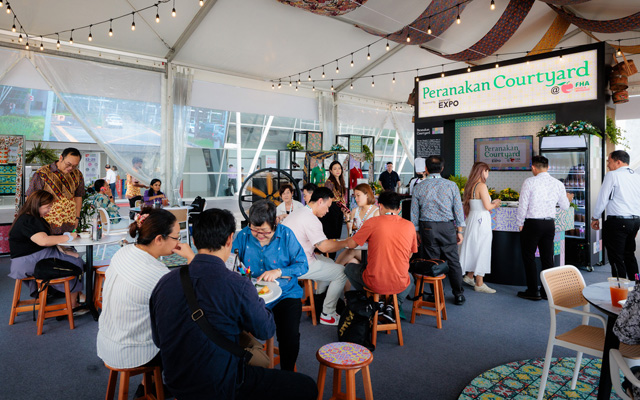
The Singapore Expo introduced a Peranakan Courtyard at the 2024 edition of Food & Hotel Asia – Food & Beverage (FHA-Food & Beverage 2024).
The Peranakan-themed pop-up experience, which ran from April 23-26, welcomed more than 1,700 visitors across the three days – and was a highlight of Singapore Expo’s festivalisation-as-a-service offering, delivering a event experience complete with live music, fun activities, and Peranakan cuisine.
Peranakan Courtyard. Photo credit: Singapore EXPO
Conceptualised with Expo Advantage Program partner, The Intan, the pop-up allowed visitors to enjoy the various antiques on exhibition and learn more about Peranakan history and culture.
This was also the first time visitors were able to get a taste of the Gula Melaka Gateway Nitro beer specially crafted by District Brewers, a local brewery, for the venue’s 25th Year Anniversary – a milestone that the venue is celebrating this year.
The Peranakan Courtyard follows the success of Beer Yard @ FHA-Food & Beverage in 2023, which saw over 1,000 delegates utilising the space for networking outside event halls.
Singapore Expo’s bespoke festivalisation-as-a-service offering allows event organisers to craft a dynamic environment beyond traditional meeting rooms and event halls, enhancing the vibrancy of events like FHA-Food & Beverage and enriching the overall visitor experience.
Just 10 minutes from Phuket International Airport on the serene northern coast, this 178-key, Bill Bensley-designed resort offers delegates a quiet, tropical paradise steeped in Phuket’s tin-mining heritage
The newly-opened Ritz-Carlton, Bangkok anchors the One Bangkok development with cosmopolitan elegance. Featuring the city's largest ballroom and a spectacular new penthouse suite, it delivers exceptional hardware and deeply authentic, soulful service for business and leisure travellers alike
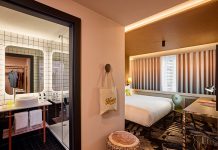
Behind the imposing, Brutalist concrete that defines Zurich’s Oerlikon district lies a surprising secret. While its exterior honours the neighbourhood’s industrial roots, stepping inside Mama Shelter reveals a vibrant, neon-soaked world that is a far cry from its rigid shell





 Prior to joining Dao by Dorsett, she has held leadership roles at Paradox Singapore Merchant Court, as well as at Pan Pacific Hotels Group and the Shangri-La Group.
 With over 20 years of hospitality expertise, the French national was previously the general manager of Lebua Hotel Bangkok.