Ōtautahi Christchurch has won the rights to host the International Play Association (IPA) World Conference 2026, the first time it will be held in the Southern Hemisphere.
A triennial event, the four-day conference at Te Pae Christchurch Convention Centre is expected to attract 1,000 delegates from around the world.
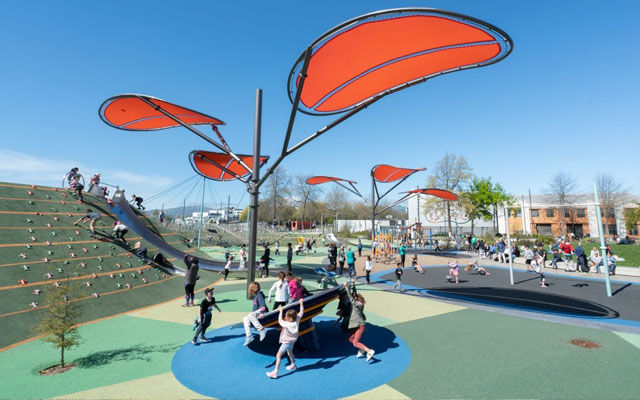
The Margaret Mahy Playground in central Christchurch
Just a block from Te Pae Christchurch, the Margaret Mahy Playground is an award-winning all-ages, all-abilities playground which can also be used to hold outdoor events. At over 16,000m2, it has a capacity for up to 1,000 people.
The Christchurch bid was presented at the 2023 conference in Glasgow by Toni Talijancich, general manager at Play Aotearoa and supported by ChristchurchNZ and Tourism New Zealand Business Events.
Play Aotearoa is the New Zealand branch of IPA World, an international nongovernmental organisation, founded in 1961 to provide a forum to promote and improve opportunities for play, and the development of play environments, leisure time facilities and programmes for all children and youth in all countries, in accordance with the United Nations Convention on the Rights of the Child.
IPA member groups initiate a wide variety of projects that promote the child’s right to play. These include seminars, conferences, study tours, research, publications, playground design, playwork training and the organisation of play programmes and Play Days.
Talijancich highlighted that the IPA is focused on creating a world where all tamariki (children) have the right to play in their own way. Their membership is made up of play practitioners, researchers, educators, and businesses.
“This is a huge opportunity to put Christchurch and New Zealand on the map for the play sector, and to introduce our unique approach to bi-culturalism, diversity, and inclusion to this global audience,” Talijancich added.
Event brief
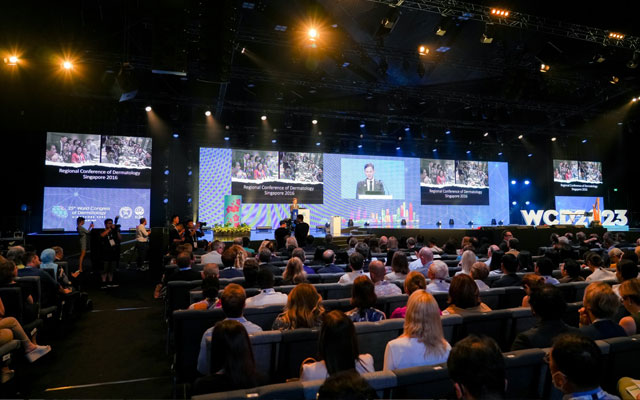
The World Congress of Dermatology (WCD) has been the leading international dermatological conference for over 130 years. Since its inception in 1889, WCD has traversed the globe across 19 cities.
Roy Chan, president of the Singapore National Organising Committee, said the Singapore edition was the first WCD to be held in the tropics focused on migrant and refugee skin health, neglected tropical skin diseases and diseases in skin of colour.
The theme for the 25th WCD 2023 was Dermatology Beyond Borders. Congress sessions highlighted the importance of skin diseases in relation to human suffering and climate change, global skin health, and dermatological care in underserved nations and the global south.
He added: “The aim was to expand the horizons of dermatology, to increase patient and community engagement, to transcend borders, physical and societal, to be an inclusive conference that celebrates diversity.”
This congress was tasked to deliver a comprehensive and diverse scientific programme comprising 208 symposiums, 15 keynote talks, 24 courses and 19 expert forums, among others.
Event highlights
WCD 2023 showcased significant dermatological advances and state-of-the-art medical and scientific knowledge relating to the art and science of dermatology.
Compared to the last congress, which was held in Milan in 2019, this year’s WCD International League of Dermatological Societies (ILDS) region representation featured a bigger number and greater proportion of chairs and speakers – 467 people, up from 265 in 2019 – from Asia-Pacific, Africa and Latin America.
With the aim of thanking and leaving a legacy to the host city, WCD 2023 also demonstrated tangible sustainability measures during the congress.
Chan elaborated: “We created the ’25 nudges’, a list of handy sustainability tips for delegates and exhibitors to adopt to ‘Go Green’ during their stay in Singapore.
“We encouraged exhibitors to join the WCD Green Challenge, and congress participants voted for exhibitors that demonstrated outstanding waste and pollution reduction measures during product packaging and shared these practices in manufacturing and disposal. The winners were announced at the closing session of the congress.”
Other sustainable initiatives included the daily conference newspaper being published on the WCD app this year, participants were advised to bring and refill their own bottles at the many water points, and working with local NGO Divert for 2nd Life to manage the leftover food from the congress’s official events.
Challenges
Global events – such as the Covid-19 pandemic, the Russia-Ukraine war, geopolitical tension, the economic downturn and high inflation rates – made planning the WCD a complicated affair, Chan shared, as attendance was impacted.
He continued: “As a workaround to all these challenges, we had to increase the number of scholarships awarded to assist deserving trainees, dermatologists and others from around the world to attend the congress.
“We also reduced registration fees for attendees from lower- and lower-middle income countries to open the congress to a broader audience.”
Chan also increased the conference’s promotional activities in person at overseas conferences, such as the National Academic Conference on Integrated Medicine of Dermatovenereal Diseases in Kunming, in April; and the International Societies for Investigative Dermatology meeting in Tokyo, in May.
Event 25th World Congress of Dermatology (WCD 2023) Organiser Dermatological Society of Singapore under the auspices of the International League of Dermatological Societies Venue Suntec Singapore Convention & Exhibition Centre Dates July 3-8, 2023 Attendees 12,037 (on-site)
Xiamen Airlines will launch regular flights between Beijing Daxing and Doha on October 20 and between Xiamen and Doha on October 31.
The service commencement will coincide with the 35th anniversary of the establishment of diplomatic relations between China and Qatar. It also marks an important initiative by Xiamen Airlines in supporting China’s Belt and Road initiative, further closing the distance between the two countries.
Xiamen Airline’s latest services will support China’s Belt and Road initiative
The daily Beijing-Doha service will depart from Beijing at 18.30 and arrive in Doha at 22.45; the return service will leave Doha at 02.00 and arrive in Beijing at 15.20.
The Xiamen-Doha service will fly twice a week, departing from Xiamen at 00.05 and arriving in Doha at 05.00; the return flight will leave Doha at 19.30 and arrive in Xiamen at 07.55 the next day.
Both routes will be operated on the Boeing 787 Dreamliner, offering first class, business class and economy class seats.
The brand-new Holiday Inn & Suites Geelong has opened in Geelong, Australia, reinforcing the city as a prime destination for corporate travellers.
Three meeting and event spaces are on offer. From small business meetings to larger presentations, the function rooms can separately cater for 25 attendees each (theatre-style), or for up to 110 people cocktail-style when combined.
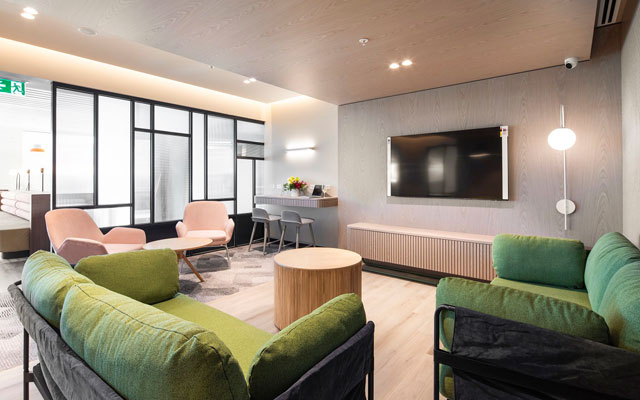
Media Lounge
Guests can make the most of unlimited, free high-speed Wi-Fi and state-of-the-art, built-in AV amenities, complete with a drop-down screen and projector.
With a variety of seating options and an additional media lounge, the Open Lobby could also be ideal for informal meetings or breakout sessions. Meanwhile, the E-bar conveniently provides a space to plug in and stay connected with work.
Tailored F&B selections and packages are available, including breakfast and day-delegation packages, as well as canapés, two or three-course lunches, and dinners.
Full-day delegate packages start from A$95 (US$61) per person, including tea & coffee; morning tea break; chef’s selection buffet lunch; afternoon tea break; AV & Wi-Fi; full-day plenary room hire (subject to minimum numbers) with mints, notepads and pens on tables.
There are a total of 180 rooms, which include 23 suites which come with balconies and kitchenettes targeted at longer-staying guests. Meanwhile, recreational facilities include a fitness centre, and a 20-metre heated indoor swimming pool.
Scott Graf, global president of BCD Meetings & Events (BCD M&E), has retired from the role after 26 years with the organisation.
In 1997, Graf joined McCord Corporate Travel in Chicago to begin its meetings and events division. Through an acquisition, the brand changed to WTMI (WorldTravel Meetings & Incentives) in 2001; and with the acquisition of TQ3 Travel Solutions in Europe and The Travel Company in the UK, BCD M&E was formed in 2006.
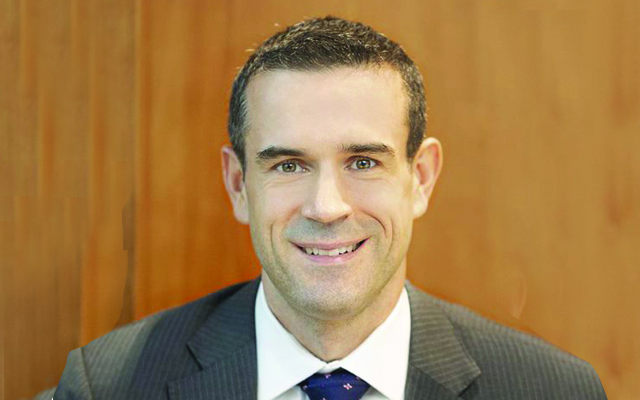
Scott Graf
Graf will continue to support the BCD M&E leadership team and transition plan through the end of 2023, and after some time off, he will move into a new partnership with BCD founder John Fentener van Vlissingen in April 2024.
Bruce Morgan, BCD M&E’s former chief operating officer, has been named global president, effective immediately.
Morgan, based in Chicago but originally from the UK, brings to the role more than 30 years of industry experience across various functions and global regions – with nearly 20 of those years within BCD M&E. BCD M&E’s COO since 2019, Morgan has also held roles throughout his career within sales and marketing management, global event management, sports marketing, performance improvement and regional leadership.
Demand for business events in New Zealand is on the rise and Tourism New Zealand has set itself a record target of 90 international conferences bids worth NZ$135 million (US$83.9 million) for the next financial year.
Instrumental to meeting demand are its new convention venues which now enable New Zealand to bid for events on a bigger scale, including regional and international association conferences from the Asia-Pacific market.
The three new convention centres stand out for their sustainable designs, cutting-edge technological capabilities, flexible function spaces and world-class culinary offerings.
However, each showcases its own identity, leveraging its host city’s knowledge strengths with impressive results.
Te Pae Christchurch Convention Centre hosted 290 events in its first 13 months of operation
Te Pae Christchurch Convention Centre opened in May 2022 in the revitalised city centre of Ōtautahi Christchurch. Offering a 1,400-seat tiered auditorium divisible into two 700-seat venues, it hosted 290 events in its first 13 months of operation, including 13 international conferences.
This year, it will host the ACM VRST Symposium, attracting VR software and technology specialists and showcasing Christchurch’s world-renowned HITLab and tech sector; and the 1000pax-strong APSA Asian Seed Congress, drawing on the Canterbury region’s strong agri-tech sector.
In 2024, Te Pae Christchurch will host the Royal Australasian College of Surgeons (RACS) Annual Scientific Congress; and the Extreme Solar Systems V Conference, aligning with Christchurch’s burgeoning aerospace business cluster.
The International Conference on Geomorphology, set to host 1000 delegates, has also chosen the city for 2026, capitalising on the region’s strong focus on earth science.
Wellington: Aspiring to be a “Science City”
Tākina has more than 50 conferences booked in its first year
Te Whanganui a Tara Wellington officially opened its new conference and exhibition centre, Tākina, in May, with more than 50 conferences booked in its first year. Located opposite Wellington’s waterfront, Tākina is at the heart of the capital’s cultural precinct, with capacity for plenaries of up to 1,600.
This new facility has seen Wellington attract larger international conferences, including the International Council for Traditional Music’s 48th World Conference in 2025, which expects more than 800 delegates.
The city is also attracting more regional conferences, including the Annual Scientific Meetings of The Australasian Society for Infectious Diseases Conference and the Royal Australian and New Zealand College of Obstetricians and Gynaecologists in 2024.
Wellington’s focus on attracting conferences in the science and education sectors recently received a boost with the New Zealand Government’s plans to make Wellington a “Science City”.
Investment in three new research hubs will bring together expertise in oceans, climate and hazards, health and pandemic readiness, advanced manufacturing and materials, energy futures and biotech.
Auckland: Showcasing culture and sustainability on a grand scale
Ahead of its opening, the New Zealand International Convention Centre has already confirmed 11 international conferences
Due to open mid-2025, the New Zealand International Convention Centre (NZICC) will be the largest new venue in the country. Rising in the centre of Tāmaki Makaurau Auckland, it will link directly by air bridges to the new Horizon Hotel and the SkyCity entertainment precinct.
Its flexible space will cater for up to 4,000 people, including a theatre capacity of 2,850.
Ahead of its opening, the NZICC has already confirmed 11 international conferences, including the World Indigenous Peoples Conference on Education (WIPCE) 2025, with an expected turnout of 3000 delegates, showcasing New Zealand’s Indigenous Māori culture and education sector.
Science will take centre stage at the International Symposium on Microbial Ecology (ISME) in 2026 for 1800 delegates, while sustainability and the environment will be at the fore for the International Coral Reef Symposium.
The symposium, as well as the Federation of Asian and Oceania Pest Managers Associations (FAOPMA) Conference, are both expected to bring more than 2,500 delegates in 2026 to NZICC.
Tourism New Zealand provides funding and support to bring international conferences to New Zealand
To learn more about the assistance available, contact: Edward Kwek
Tourism New Zealand
Trade Manager Business Events – Singapore, Southeast Asia Contact: +65 9152 9122
Email: Edward.Kwek@tnz.govt.nz
SITE's past presidents are advocating for members to be more involved this time around
The SITE Past President Council (PPC) wanting to reach more members posted a three-page LinkedIn message on September 6 to give them a wake-up call to be more involved in how the association is run.
Signed by 24 past presidents, the message urges members to consider the council’s opinion and to make an informed decision when they vote for three significant proposed bylaw changes sent out by SITE.
SITE’s past presidents are advocating for members to be more involved
The proposals affect how the board is elected, how it is governed and “moving decisions of finance from the legitimately elected vice president of finance to a staff”.
The council’s message stated: “Without any personal prejudice, we the below Past Presidents, strongly oppose all three motions in the form presented and ask that our members critically assess these proposals themselves and consider the long-term implications for our beloved community.
“We are voting NO to all three proposals as presented. If you find any merit in our opinion, we ask that you please share this message with your fellow members and chapters so that everyone can make an informed decision. Everyone must vote. That is their duty. But vote fully informed. Not voting is also not appropriate.”
An informed source told TTGmice voting closes on September 17 and the PPC message advises members who have voted to write to SITE if they want to express an opinion.
He said the 50-year-old association has some 2,400 individual members globally, and between 10 and 15 per cent were “active internationally and in their local chapters, especially in the UK and the US”.
A two-thirds majority of votes are needed for the proposed bylaws to pass, and the source opined “not voting is an affirmation of what the board wants”.
He continued: If members vote for the changes they “give power to the board to decide who is on the board” instead of the current system which “allows anyone of any level or size of organisation to contest equally”.
SITE, he said, has commented to members that this was an “internal matter”.
Cathay Pacific in South-east Asia is has made changes to key management roles across the region.
Dominic Perret remains the regional general manager South-east Asia, where he is responsible for all commercial, operational and support functions across the seven countries Cathay Pacific flies to in South-east Asia.
Dominic Perret
Next, Jonathan Ng is now regional head of customer Travel and lifestyle, South-east Asia. He replaces Ray Fung, who is now head of lifestyle strategy and partnerships in Hong Kong.
Ng joined Cathay Pacific in 2011 and has worked in several key positions across various markets, including Hong Kong, the Chinese Mainland, Bahrain, Saudi Arabia and UAE. Prior to this move, Ng was seconded to HK Express as general manager, corporate planning; he was part of the transition team following the acquisition of the low-cost carrier by the Cathay Group.
New country managers have also been announced for South-east Asia.
Tony Sham is country manager for Indonesia. Based in Jakarta, he replaces Matthew Choi, who is now general manager corporate planning for HK Express.
Sham has been with Cathay Pacific for 34 years. He has a wealth of experience across several functional departments including airline planning and international affairs, as well as in outports like Japan and Germany. Prior to his current appointment, he worked as regional head of customer travel and lifestyle for North-east Asia in Tokyo.
Based in Manila, Vishnu Rajendran is now country manager for the Philippines. He replaces Donald Morris, who is now country manager, Korea, based in Seoul.
Rajendran joined Cathay Pacific in 2008. Since then, he has taken on roles in marketing, sales and port management, and most recently was area manager, Middle East. He was also acting country manager, South Africa & Indian Ocean, as well as acting country lead for Sri Lanka & Maldives.
Over in Kulala Lumpur, Robbie Blackwood is now country manager, Malaysia and Brunei. He replaces Roger Li, who is now a cadet pilot with Cathay Pacific.
Blackwood joined Cathay Pacific in 2018 and has worked in various departments and key markets, including Hong Kong and Japan.
Nicolas Masse has been appointed country manager, Vietnam & Cambodia. Based in Ho Chi Minh City, he replaces Jason Choi, who is now regional head of customer travel and lifestyle, North-east Asia, based in Tokyo.
Masse has over two decades of experience in the aviation industry. He joined Cathay Pacific in 2007, and has since held several key positions overseeing sales, marketing and communications in both Europe and Asia. Prior to his current appointment, he was Cathay Pacific’s country manager for Korea.
Last but not least, Keri Lui remains the country manager for Thailand, based in Bangkok.
From left: Debanjan Kundu; and Srijith Ravindranath
Marriott International has made two new director of sales and marketing appointments, for The Westin Maldives Miriandhoo Resort and the JW Marriott Maldives Resort & Spa.
Debanjan Kundu joins The Westin Maldives Miriandhoo Resort from his previous position as senior director of sales – India at Amadeus.
However, Kundu is no stranger to Marriott International, as he has worked with various brands within the company including Sheraton, Westin, as well as The Ritz-Carlton in his career journey spanning almost two decades.
From left: Debanjan Kundu; and Srijith Ravindranath
He has also held several director of sales and marketing positions at luxury hotels across India, including hotels in Hyderabad and Bengaluru.
Over at the JW Marriott Maldives Resort & Spa, Srijith Ravindranath brings with him 15 years of experience in hotel sales and marketing.
Ravindranath first commenced his career with Ginger Hotels, and has since held significant roles at IHHR Hospitality, Leela Palaces, Hotels and Resorts, and the St. Regis Goa Resort.
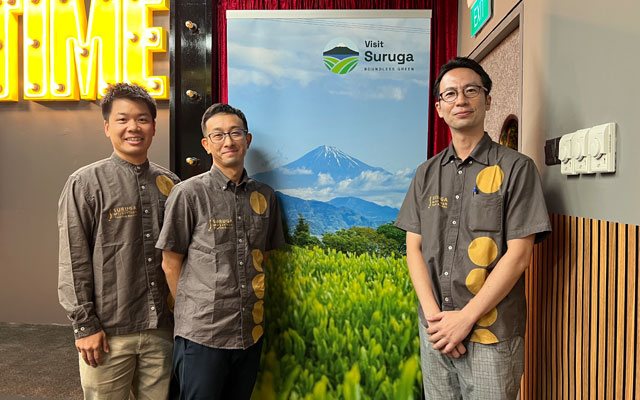
Suruga Market!ng & Tour!sm Bureau’s Sota Setowaki, Taichiro Ishida, and Takahiro Koyota at the seminar for Singapore-based agents. Photo: Rachel AJ Lee
Suruga Market!ng & Tour!sm is now presenting the Japanese destination as one where corporate groups can come through on day trips to experience the quiet local life and learn all about tea culture through workshops and farm visits.
Taichiro Ishida, marketing manager, Suruga Market!ng & Tour!sm Bureau, told TTGmice on the sidelines of the M&I in Suruga Seminar: “We understand that Suruga is not a final destination in Japan, nor is it a big overnight destination. That is why we are positioning ourselves as a stopover between two big cities – Tokyo and Osaka – and opting to show visitors our culture and activities related to tea, such as tea pairings, farm tours, and green tea calligraphy.”
Suruga Market!ng & Tour!sm Bureau’s Sota Setowaki, Taichiro Ishida, and Takahiro Koyota at the seminar for Singapore-based agents. Photo: Rachel AJ Lee
He opined that Suruga would appeal to Singapore event groups, as travellers were already “familiar with Japanese culture, and are ready to explore lesser-known destinations outside the main cities”. Other nationalities, Ishida noted, still opt for well-known parts of the country, like Mount Fuji, Kyoto and Osaka.
“Since we started promoting to the Singapore market in 2017, MICE visitors from Singapore have increased about 20 per cent,” he said.
In South-east Asia, Suruga is also targeting corporates based in Malaysia, Vietnam, and Thailand, and will be making sales calls to these countries before the year is up. Ishida noted that corporate event arrivals from these markets “have been steadily increasing”.
Located an hour from Tokyo via the Shinkansen, Suruga would be apt for an incentive group size of between 20 to 40 pax. Although hosting a group of 100 guests is possible, Ishida said the group would have to be split up for overnight stays, as there is no hotel large enough to accommodate everyone together.
However, Ishida said Suruga would work fine for corporate groups now, as group sizes have shrunk post-lockdown.
He added that now is the best time to take events to Japan, as the yen is weak.
Ishida added: “Aside from incentives, we’re also looking at attracting medium-sized conventions. Although we have a 4,000-seater venue, we do not have enough accommodation to cater to large-scale conferences. This is why we are, instead, looking at conferences at around 400 people, where not everyone will stay overnight in Suruga.”
Just 10 minutes from Phuket International Airport on the serene northern coast, this 178-key, Bill Bensley-designed resort offers delegates a quiet, tropical paradise steeped in Phuket’s tin-mining heritage
The newly-opened Ritz-Carlton, Bangkok anchors the One Bangkok development with cosmopolitan elegance. Featuring the city's largest ballroom and a spectacular new penthouse suite, it delivers exceptional hardware and deeply authentic, soulful service for business and leisure travellers alike
Behind the imposing, Brutalist concrete that defines Zurich’s Oerlikon district lies a surprising secret. While its exterior honours the neighbourhood’s industrial roots, stepping inside Mama Shelter reveals a vibrant, neon-soaked world that is a far cry from its rigid shell