The Symposium of the International Association for Shell and Spatial Structures (SIASS) will return to Australia after 25 years when it gathers next in Melbourne come 2023.
Backed by the Victorian State government and prominent Australian universities RMIT and Swinburne, the event is expected to attract more than 500 delegates and deliver in excess of A$2 million (US$1.5 million) economic contribution to the local economy.
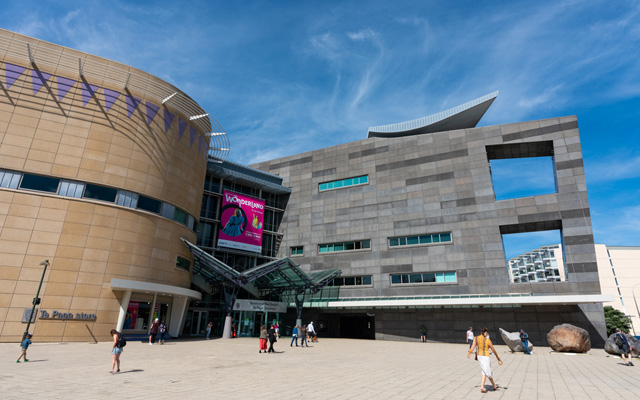
Part of the SIASS programme will involve technical tours showcasing architectural points of interest; Arts Centre Melbourne pictured
Melbourne Convention Bureau’s (MCB) chief executive Julia Swanson said the city has a proud history in the creative integration of structural engineering and architecture.
“Part of the programme will involve technical tours showcasing architectural points of interest, the city is known for.
“Melbourne has been at the forefront of lightweight structural systems such as lattice, membrane, and shell structures – from the famed Sidney Myer Music Bowl the iconic spire at the Arts Centre Melbourne to AAMI Park, to name a few,” Swanson said.
Having worked with MCB previously, bid leader Mike Xie from RMIT University said the strong support from the bureau was most helpful to the bid win.
Melbourne has a strong track record in hosting prestigious conferences, supported by ideal event infrastructure, quality accommodation, accessible public transport and exciting city experiences.
In 2023, Melbourne will host 27 international and national business events, including the 2023 Rotary International Convention which will attract 20,000 delegates and deliver more than A$88 million to the Victorian economy, making it the most valuable convention ever secured for Victoria.
The number of Chinese consumers against the idea of travelling amid a pandemic has fallen, and a majority welcomes destination promotion content, noted Dragon Trail International’s fourth semi-annual China Traveler Sentiment Report.
The study fielded in mid-August found that while willingness to travel remains the same as in March 2021 at 20 per cent of respondents, the number of people who had said they would not travel has decreased by 32 per cent, replaced by people who said they would travel but would do so cautiously – up 43 per cent.
China’s strict enforcement of border controls will likely stay put until after the 2022 Winter Olympics in Beijing (pictured), to ensure a safe environment for athletes
Mengfan Wang, manager of research, Dragon Trail International, in presenting the latest findings on September 24, said: “This means, more Chinese are thinking of taking protective measures, avoiding crowds and monitoring the local pandemic situation at the desired destination before they go.”
Wang said the study has also picked up an encouraging “new sentiment” – many respondents are now looking forward to travelling again as a means to relax.
“This signals that there is a growing frustration and longing for a chance to ease pandemic anxiety (through travels),” she explained, adding that China’s recent domestic outbreaks had led to rising levels of anxiety among people to avoid crowds and to have their mask on at all times.
“Despite that, the willingness to travel has remained the same. That is good news for us,” Wang said.
The latest China Traveler Sentiment Report has also picked up stronger intentions among Chinese consumers to travel farther than they said they would in the last study six months ago.
Cross-provincial travel plans for the Golden Week holidays from October 1 to 7 are heating up. Twenty-seven per cent now said they would travel cross-provincially compared to 17 per cent in March; 44 per cent would travel locally versus 48 per cent in March; and the remaining 28 per cent would remain home or have no travel plans at all, compared to 36 per cent in March.
However, travel desires have outstripped actual plans for the long holidays. Fifty-eight per cent said they would travel cross-provincially if they could, and only four per cent maintained no travel plans at all.
Wang said the study identified stronger preferences for nature trips, visits to islands and beaches, as well as rural tourism that satiated Chinese travellers’ desire for seclusion and relaxation.
“However, traditionally crowded attractions like themed parks and museums will still have a place in the new normal,” she added.
While roadtrips fell out of favour in the March analysis, this form of travel regained interest now, prompting researchers to believe that such trips are seasonal – more popular for summer holidays and less for winter.
“There is also a drop in interest in outdoor and sports activities. This could remain niche, and the Winter Olympics (in Beijing next February) could inspire some growth in the near future,” remarked Wang.
A welcoming Chinese community
With the 2022 Winter Olympics scheduled to take place in Beijing from February 4 to 20, Dragon Trail International took the chance to gauge Chinese consumers’ thoughts on inbound tourism for the first time.
“More than half said the games should be open to visitors from anywhere as long as they are fully vaccinated and have a negative Covid test result to show,” said Sienna Parulis-Cook, director of marketing and communications with the company.
Of the remaining respondents, 23 per cent said the games should open to only domestic spectators, and 25 per cent said it should follow the Tokyo Olympics and play to no spectators at all.
Parulis-Cook said: “Realistically speaking, the games will likely be held under extremely strict safety protocols that would go above and beyond what Tokyo had. But what stands out in our findings is the welcome that the Chinese have for game spectators and international visitors to join in the games festivity.”
“However, openness to inbound travellers does not necessarily means the people want to change China’s very strict quarantine requirements,” she added. “These requirements continue to be at least 14 days in a centralised facility, and in some cases, followed by additional quarantine at home or a period of health monitoring with restricted movements in public.”
When asked for their opinion on quarantine requirements on arrival in China, 30 per cent of respondents said the measures should be relaxed for travellers who are fully vaccinated and have a negative Covid test result; 28 per cent said requirements should remain the same; and 36 per cent said measures should be stricter. Only five per cent wanted the measures to be relaxed for everyone, and an even smaller one per cent wanted exemptions for Chinese citizens.
Parulis-Cook believes that in the short term, or until the Olympic Games is over, travellers arriving in China should expect to have to go through extensive quarantine.
Outbound confidence
China’s strict outbound travel restrictions have locked Chinese consumers away from the outside world, limiting their exposures to online means, such as livestreams, videos, photos or written content.
A majority 81 per cent of respondents said they felt positive when they saw content on outbound travel destinations. According to Parulis-Cook, these respondents said such content fascinated them, inspired them to travel outbound, or helped them to escape from daily anxieties.
“In tracking neutral keywords most associated with outbound travel information, we saw a lot of sentiments around wanting to travel internationally. Words were usually involving gastronomy, lovely scenery, beaches, nature and cravings for novel experiences and relaxation – in line with Mengfan’s analysis that the Chinese are wanting to travel to relax,” reflected Parulis-Cook.
However, she warned that outbound travel information could trigger some negative emotions still, especially as frustrations mount over continued travel restrictions. Indeed, 13 per cent of respondents felt that outbound travel was still dangerous, and outbound travel information at such time was unsuitable and insincere.
Parulis-Cook recommended that destination marketers approach messaging carefully, and to apply content that addresses concerns about safety, such as declining cases of new infections and improving rate of national vaccination.
“When we asked respondents about the prerequisites to travel internationally again, we found that travel advisories have the strongest impact,” she said, adding that zero confirmed cases in the destination as well as absence of quarantine on arrival and upon their return are seen as travel motivators.
Other prerequisites for one to return to international travel included the destination’s high vaccination rate of more than 80 per cent and personal vaccination.
“China has already achieved a high national vaccination rate, with a billion residents – about 75 per cent of China’s population – having been fully vaccinated (as of week of September 13). Vaccination rates are particularly high in big cities like Beijing, where outbound travel is most likely to come from,” said Parulis-Cook.
“However, zero confirmed cases in destinations would have to wait a little longer to be achieved,” she said.
In tracking Chinese consumers’ perception of destinations, more ‘unsafe’ and ‘unsure’ sentiments had surfaced in the new study.
Parulis-Cook said that could have happened due to a new rating scale being used. The March scale used a seven-point rating that went from ‘extremely safe’ to ‘extremely unsafe’, while the August scale provided only three options – ‘relatively safe’, ‘unsure’ and ‘relatively unsafe’.
“Because of the new scale, some respondents who previously marked a destination as ‘somewhat safe’ had now moved that opinion to the ‘unsure’ category,” she said.
“One of things that lead us to believe in this is that, with the exception of Japan, the order of the other countries have remained the same between March and September. For example, Singapore is still regarded as one of the safest destination to visit, while the US is the least safe,” she elaborated.
Japan was an exception in the destination perception ranking. Once regarded as among the safest destinations to visit in March, Japan is now rated ‘unsafe’ by 70 per cent of respondents. Parulis-Cook suggested that this might be due to Japan’s rising case numbers and extensive media coverage on Japan’s Covid-19 infections throughout the 2020 Summer Games in Tokyo.
Dragon Trail International researchers also concluded that rising local infections in many destinations as well as their strategy to live with Covid have impacted destination perceptions, particularly as the latter goes against China’s own stance.
Parulis-Cook concluded that the latest findings have painted an encouraging picture for destination marketers looking at the China market.
“People’s appetite for travel might actually be stronger than their sentiments around safety, and they are happy to receive outbound travel info even though they may feel it is unsafe to travel right now.
“Even if the rating of your destination does not look too good right now, you have time to remedy that,” she said.
In fact, according to ForwardKeys’ China market expert, Nan Dai, a full recovery of Chinese outbound travel could only happen in 2025, and outbound traffic would remain at a standstill until mid-2022.
Her expectation is shaped by China’s zero-case approach and intention to ensure that China remains safe for Olympic athletes. She expects the government to maintain strict travel restrictions until mid-2022 and employ a gradual reopening to international travel after.
Dai also shared that ForwardKeys has downgraded its recovery prediction for 2021, following worsening Covid-19 infections across Asia as new variants emerged. Chinese outbound travel is expected to only recover 12 per cent of 2019’s volume this year. In March, ForwardKeys predicted a 25 per cent recovery by end-2021.
Wide open spaces, manicured lawns and soothing water features are a welcome change from home offices
Rooms
The sprawling resorts offers 215 keys across seven room and suite categories, leading in with the 36m2 Luxury Room and topping the range with four exclusive Villa du Jardin suites, each taking in a private pool, spacious open deck, separate living space and two bedrooms.
My three-day workation here featured restful nights in the Prestige Family Suite. My unit was on the second floor of the Tranquillity Wing, granting me views of one of the resort’s many manicured lawns.
As its name suggests, this room type is built with families in mind. The space is telling – both the sleeping and living quarters are cavernous. The bedroom comes with a king-size bed, with enough space to fit an adorable Farmhouse-themed tent – complete with animal plushies and miniature farmland figurines – for a glampcation that little ones will appreciate. Part of any holiday fun comes from the planning process, and I had plenty of chuckles picking out the glampcation theme for my boys, with options ranging from Under the Sea to Le Petit Guardian of the Galaxy.
The Prestige Family Suite is ideal for work too, as the living quarters are separated from the bedroom by two sets of doors, providing decent soundproofing. The desk is generous, but one can also work on the comfortable sofa bed.
The resort pool was revamped and relaunched on August 11, 2021
Workation facilities
I love that the entire resort is at the disposal of workationing guests. Guests can pick their favourite location of the moment, be it by the pool on a lounger, on the lawn by the fountain, or on the patio of The Cliff restaurant with the sea spilling out before them, and get right to work. Wi-Fi is accessible across the resort, and no troublesome passwords are needed.
My favourite spot to write is at LeBar, on any of the twin seats that are set along a water feature and positioned to take in views of the glimmering swimming pool. The melody of swirling water is soothing, and cocktails are within easy reach. The citrusy Mezcaleria, a concoction of Salamanis Machetazo Mezcal, Cointreau, yuzu and grape juice, is addictive and sets the tropical paradise mood.
When I am done writing drunk and need to sober up for editing work, a dip in the newly-renovated 33m long black pearlescent tiled pool is the perfect remedy. The black beauty made its debut on August 11, along with a refreshed poolside which now comes with ample cushioned loungers and cabanas. The pool has been made children-friendly, with a section going just 1.4m deep and with steps by the side for toddlers to sit on and splash around in.
Sofitel Singapore Sentosa Resort & Spa makes its easy for guests to build their desired workation experience through a highly customisable Dream B-Leisure Lifestyle package, which comes with more than 10 complimentary amenities, such as full-day parking, use of resort bicycles, and pool and gym access (advanced bookings and limited time usage per day due to safe distancing regulations). The package is offered as a DayDream Pass (S$48++; US$35.55) which comes without a guestroom and the DayLifestyle Pass (S$190++ per room per guest) which comes with an overnight stay. Numerous add-ons are available, such as free-flow alcoholic beverages for S$68++, a three-course meal for S$48++, spa access for S$40++, and an hour-long yoga session for S$30++.
That said, the resort has many other attractive deals that workation guests can take, such as the Infinite Family Experiences package (from $458++ per night) that comes with full board, bicycle usage and 45 minutes of activities at Villa des Enfants kids club, or the FurKid Retreat, which throws in a pet amenity basket and pet-friendly inflatable pool upon request. Work conveniences, such as access to co-working spaces and printing facilities, can then be added through the DayDream Pass.
The pavilion-styled LeBar serves afternoon high tea and provides a conducive space for creative thinking
Other facilities
Great dining experiences are a must for any quality vacation, and the resort does not disappoint with The Cliff. Chef Jeremy carries his life in Los Angeles and his Mexican heritage into The Cliff’s Italian menu. Selection is extensive, and the pizzas are especially memorable. I have gathered several favourites across my stay, and am determined to return in the near future to try so many other dishes I never got around to.
On Friday and Saturday evenings, all-day dining Kwee Zeen comes alive with Magnifique Hawker Nights, a themed buffet that features some of Singapore’s most loved casual dishes, such as satay, popiah, bak kut teh, and beef rendang. Iced bandung and chin-chow provide the perfect beverage complement.
Kwee Zeen, which provides the resort’s daily breakfast service, turns out an indulgent brunch every Sunday. The signature Sofitel Sentosa Sunday Brunch serves up over 20 different fresh seafood items as well as hot dishes from 15 live stations including a foie gras station and a carving station.
Other dining establishments include LeBar, where high tea is offered every afternoon alongside artisanal cocktails and a selection of wines and spirits.
One does not have to give up on daily wellness pursuits while on workation. Sofitel Spa offers various rejuvenating treatments and a chance to soak in a private pool loved by regulars for its therapeutic waterfall. The resort also conducts wellness programmes, such as yoga sessions and power workouts with a professional trainer.
For children, interactive activities like storytelling, crafts and games are offered at Villa des Enfants. An indoor playground is available within for smaller children that come accompanied by a guardian. While I had my firstborn booked for an arts and craft class, he skipped out at the last minute in favour of the swimming pool.
Service
Service was never intrusive and help was always at hand when it was needed.
Verdict
The tropical resort setting was a welcome change of environment during my prolonged remote work arrangement and lack of overseas breaks. The relaxing environment recharges the spirit and sparked content ideas, while recreational facilities allowed me to reconnect with my boys. Bonus points for dining conveniences and not having to do the dishes after! I would gladly do this again in a heartbeat.
No. of rooms 215 Contact details
h9474@sofitel.com
www.sofitel-singapore-sentosa.com
Karen Yue checks out the workation trend and finds out what it means for Asia’s hotels and resorts in TTGmice Sep-Oct 2021 issue’s cover feature. Watch for it!
Mandarin Oriental Hotel Group has appointed Richard Langonne as general manager of Mandarin Oriental Wangfujing, Beijing.
In his new role, Langonne oversees all operations at the 73-room luxury boutique hotel in the very centre of China’s capital.
He has nearly two decades of experience in the luxury hotel industry, most recently as hotel manager of Mandarin Oriental, Hong Kong, since 2017. In that position, he supervised daily operations and played a leading role in strengthening the positioning of the group’s flagship property.
The Frenchman began his career with Hotel de Crillon in Paris before moving to South-east Asia where he has held a variety of positions in launching and managing hotels across the region, including in Krabi, Bangkok, Macau and Hanoi. Langonne is no stranger to the China market, where he previously held posts in hotels in Shanghai and Guangzhou.
Australia’s tourism minister said that the federal government plans to reopen its international borders by Christmas “at the latest”.
Under the national reopening plan, Australians will be allowed to travel overseas again once 80 per cent of the eligible population aged 16 and over have been fully vaccinated.
A passenger at Sydney Airport
Local media reported Tehan as having said at a National Press Club of Australia event on Wednesday (September 22) that Australians will be able to “freely travel outside Australia”, with no restrictions on the destination, once that vaccination target in their respective home state is reached. They will also not need to go through hotel quarantine upon their return.
Australia’s border has been closed to all non-citizens and non-residents since March last year.
Tehan also said the government is still in talks with several countries to set up travel bubbles to reduce quarantine time.
The 21st World Travel and Tourism Council (WTTC) Global Summit, initially slated to be held in the Philippines next month, has been postponed to March 2022, tourism secretary Bernadette Romulo-Puyat shared during Philippine Travel Exchange (PHITEX 2021) in Subic.
Planned as a hybrid event, the summit was supposed to draw 650 in-person, with another 30,000 individuals tuning in via the digital platform.
Business events are currently not allowed in Manila (pictured) due to heightened alert levels
Downplaying the impact of the postponed event, Rajah Travel chairman and CEO Aileen Clemente said that “every postponement is always a mutual decision between the WTTC and the host country, so it doesn’t happen that we lose the hosting rights just like that”.
On the other hand, C9 Hotelworks’ managing director Bill Barnett pointed out: “For WTTC, there is merit in a first-mover advantage to return to the stages so it makes sense to stop delaying. If travel is to survive, it has to learn to live with Covid-19.” He further cited the AHIC (Arabian & African Hospitality Investment Conference) that was held in Dubai this week which was “a big success with a large in-person contingent”.
As other international events were similarly postponed or cancelled as the pandemic continues to wreak havoc in the Philippines, Clemente pointed out “there has to be better implementation and consistent implementation of protocols”.
For instance, as business events happen in controlled environments, it is possible to conduct events on a smaller scale, perhaps starting with a 30 per cent capacity, she pointed out.
“What is hurting (the tourism industry) is the inconsistent implementation and lack of attention to the actual causes (of infections). For example, the lack of building ventilation and filters, as well as lack of in-depth statistical requirements in tracking the movement of Covid-19 such as interoperable contact tracing,” she lamented.
Clemente added that alert levels and quarantine parameters have become so confusing that governmental units also run into problems when it comes to implementation.
In the Philippines, event venues, hotels and restaurants are either opened with reduced capacity or closed depending upon the lockdown classification of the destination as determined by the local government every two weeks.
Metro Manila is currently under the second-highest alert, Level 4, until the end of this month, which means that events cannot be held.
ncourage our global community to openly share their experiences and insights so that the Events Industry Council can create the resources and support necessary to drive genuine long-term change
The Events Industry Council (EIC), the global voice of the business events industry on advocacy, research, professional recognition and standards, has launched the first phase of its landmark Equity Acceleration Plan.
This first phase will focus on establishing a benchmark by which to measure progress for the industry through a survey to determine the current state of diversity, equity, and inclusion within the workplace across the events industry.
EIC encourages the global community to openly share their experiences and insights so that they can create the resources and support necessary to drive long-term change
The results of this benchmark will inform the development of tools, resources and recommendations in the subsequent phases on the Equity Acceleration Plan, which aims to provide a framework, and lead the challenge against discrimination and systemic racism in the events industry.
The survey will give respondents the opportunity to share some of their personal experiences and opinions on what is needed to improve the sector.
The findings will be used as the basis for a report and a series of specially created educational courses, tools and resources to support the industry in its shared goal of a more diverse and inclusive future. The Equity Acceleration Plan is part of EIC’s Centre for Sustainability & Social Impact and is a long-term project that will regularly measure the impact of interventions and make recommendations for further work.
Amy Calvert, CEO of EIC, said: “With over 10.3 million direct jobs and over 1.5 billion participants in our sector, and as the industry that at its heart fosters human connection and collaborations, we have the opportunity and responsibility to be a catalyst for meaningful and measurable change.
“The Equity Acceleration Plan will enable us to support event professionals to create more diverse and inclusive environments, develop career pathways, and ensure representation in leadership and supply chains by providing the learning and resources intended to reach and support our community.”
The survey takes just 10 minutes to complete. To take part, click here. The survey will close on October 15, 2021.
Seoul will be serving as the Asia Pacific Regional Hub for the upcoming ICCA (International Congress and Convention Association) Congress, slated to be held in Colombia from October 24-27, 2021, in a multi-hub hybrid format.
The event is expected to draw 1,500 participants from convention bureaus and PCOs attending from 90 countries. The in-person congress will be held at COEX and streamed live for both days, and will comprise of ICCA headquarters’ online programmes from Cartagena de Indias and Seoul’s local programmes.
The 2020 ICCA Congress being held in Seoul
An STO official said that the South Korean city will “utilise last year’s hosting experience to upgrade Seoul’s position as the optimal hosting destination for hybrid MICE events”.
The ICCA Congress pivoted to a hybrid model for the first time last year, and chose hub cities to represent Europe, Africa, the Middle East, and Asia Pacific. In 2020, Sarawak was chosen as regional host for APAC.
Interprefy, a provider of managed interpreting technology and services, has partnered with London-based Grip, an AI-powered matchmaking and networking solution for events.
This partnership will allow Grip to run webinars and virtual events in multiple languages without the administrative overhead.
A screenshot of the Grip website
Grip will be integrated with Interprefy’s Select Solution, which features an array of tools to optimise the user experience and there is no limit to the number of languages that can be provided.
“With the world turning to hybrid events, in the post-Covid-19 world, a large number of events are retaining some part of the virtual experience, for the longer term,” said Richard Roocroft, director of global sales at Interprefy.
“Interprefy makes Grip events multilingual, so that attendees can listen to presenters in a language of their choice, helping to increase engagement and inclusivity for all. We are delighted to partner with Grip, a global leader in hybrid events for networking and lead management”, Roocroft added.
Melia International has rolled out a We Are Back, Meet with Melia campaign, where event planners can choose from some 130 properties to hold their events at.
This promotion is valid for newly confirmed groups before December 31, 2021, with arrival until June 30, 2022, and groups have to contract both accommodation and meeting spaces. Melia has also emphasised its cleanliness, with the Stay Safe With Meliá programme certified by Bureau Veritas in place.
Melia Hanoi
Groups can enjoy maximum flexibility, such as free cancellation and return of deposits up to 60 days before arrival; as well as the possibility to change the dates with no cancellation fees at the 30-day mark.
Event planners will also be rewarded with double Melia Rewards Points for every group booked.
This promotion is not applicable for group buyouts or groups that book more than 80 per cent of the hotel accommodation capacity.
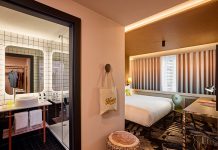
Behind the imposing, Brutalist concrete that defines Zurich’s Oerlikon district lies a surprising secret. While its exterior honours the neighbourhood’s industrial roots, stepping inside Mama Shelter reveals a vibrant, neon-soaked world that is a far cry from its rigid shell
A polished urban retreat designed for business travellers, Hyatt Regency Kuala Lumpur at KL Midtown combines thoughtful design, seamless service, and exceptional facilities.