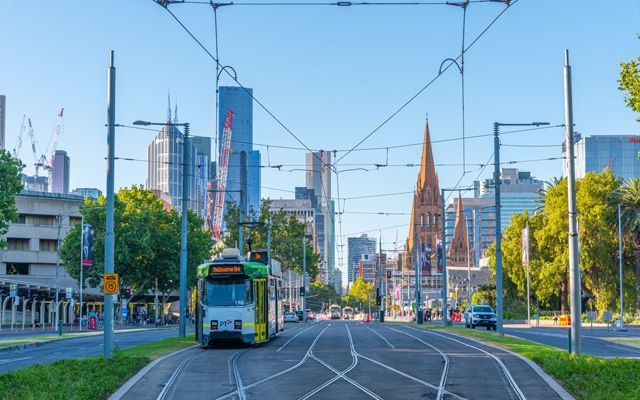
Melbourne (pictured) is confident in its ability to deliver world-class business events
Melbourne has won the hosting rights for two tech conferences – the largest blockchain series in the world, The World Block Chain Summit (WBS) 2022; and the Association for Computing Machinery’s annual international conference on multimedia – The ACM International Conference on Multimedia (ACM MM 2024) in 2024.
WBS takes place in over 16 destinations across the world and brings together an elite gathering of technology leaders, start-ups and enterprises from over 52 countries to share, educate and discuss the latest trends in emerging technologies.
Melbourne (pictured) is confident in its ability to deliver world-class business events
Combined, these events are expected to attract 1,200 blockchain and tech players to the city, deliver A$5.2 million in economic contribution to the Victorian economy, and some 2,850 room nights to the Victorian hotel and accommodation sector.
Both events will be hosted at the Melbourne Convention and Exhibition Centre. WBS 2022 will be held from Setempber 15-16, 2022, while ACM MM 2024 will be held from October 28 to November 1, 2024.
Through a partnership with Victorian State Government, Business Events Australia, Trescon, a global business events and consulting firm, Monash University, as well as expert Local Organizing Committees from across Australia and the Asia Pacific region, MCB steered the proposal to secure these events for Melbourne.
The business model for virtual conferences can take many different shapes and forms
The popular answer must be “no” because they are all very anxious to be able to travel to attend face-to-face conferences.
However, some people may give you a different answer when the question is asked under a different context. For example, a busy accounting professional may prefer to attend a virtual seminar on the latest ESG updates just to satisfy the Continuous Professional Development requirements from the governing body.
The business model for virtual conferences can take many different shapes and forms
Conference organisers need to recognise the fact that virtual events are here to stay because they satisfy the needs of a segment of the conference market. In fact, even before Covid-19, the demand for virtual events was already picking up.
A survey conducted a few years ago (Digitell 2016) asked professionals such as lawyers, accountants and engineers as to why they would prefer to attend a virtual conference instead of attending the event in person, where 72 per cent indicated money was the main reason. It is not cheap to attend a conference, especially if the venue is away from your hometown. Even if you choose to stay in budget hotels or Airbnbs, the expenses can easily be in the thousands (US$).
On the other hand, 60 per cent indicated that taking time away from their busy work schedule was a challenge. Once again, the motivation to attend a conference would be significantly less if the venue is outside of your hometown.
According to a study by Global Business Travel Association, 2020 saw a 290 per cent spike in hosting virtual events as compared to 2019. Some attribute this to the social distancing measures and the travel restrictions.
However, as a member of academia and a former PCO, I am of the view that even without the Covid factor, there would still be handsome growth in the demand for virtual conferences.
Here, I elaborate by using the PESTLE model. PESTLE refers to external factors (Political, Economic, Social, Technological, Legal and or Environmental) influencing the industry landscape.
Environment
Let’s start with environmental factors. Earlier in November, the UK delivered a carbon-neutral COP26 in Glasgow with a certification from the International Standard for Sustainable Events (ISO20121), which encourages a reduction in carbon emission via minimisation of air transport. The Millennials and Gen Z are strong supporters of climate actions. They are also becoming the decision-makers in many organisations. It is not difficult to imagine that they will prefer to organise and attend virtual events over physical ones in the years to come.
Politics
Also at COP26, many business leaders and heads of states were criticised for not taking public transportation to Scotland. A total of 670 private jets were flown to Glasgow and nearby airports, including one from the host, UK’s prime minister Boris Johnson, which collectively emitted over 102,500 tons of CO2.
Many countries have pledged to lower carbon emissions, and government agencies around the world are expected to lead by example. They are also one of the biggest clients of event management services. Hence it is not difficult to predict that more and more government-led conferences will take place in a virtual or hybrid format.
Legal
Although there is no legal provision that directly restricts how conference organisers must or must not plan their conferences. Environmental NGOs around the world have published green-event guidebooks which are widely endorsed by the relevant government agencies. The cost of complying with the new regulations on waste management is also becoming more and more expensive. They are new considerations for conference organisers when deciding whether they should plan more physical or virtual conferences in the future.
Social
Over the past two years, people had no choice but to get used to the online mode of working, socialising and conferencing. While some still prefer face-to-face activities, others may have changed their preference.
According to a survey by Zoom Video Communications earlier this year, only 38 per cent of conference attendees in Singapore will only meet in person (if they were given a choice), 55 per cent will choose both options, and six per cent will only meet virtually. Although more research data is needed to identify whether there is an upward trend on this six per cent, my view is that this number will grow over the next few years.
Technology
Video conferencing is not rocket science. The technology is already there. Prior to Covid-19, organisers did not feel the pressure to fully utilise current technology in managing conferences. After all, it was much easier to make money off the commission and rebates from hotels, MICE facilities and in some cases local tourism bureau.
Since 2020, organisers had no choice but to turn to virtual conferences, hence the spike in demand for new features. According to Fortune Global Insight, the global video conferencing market is projected to grow from US$6.3 billion in 2021 to US$13 billion in 2028 at a CAGR of 10.9 per cent during forecast period.
Zoom alone released over 400 updates in 2020, with new offerings including Zoom App, OnZoom and Zoom for Home. With overwhelming demand for online meeting technologies, the share price of Zoom spiked from January 2020 at US$73 to over US$500 in October 2020.
Economy
Conference producers who are among the Baby Boomers and Gen X were so used to the traditional business model whereby revenue could only come from selling sponsorship packages and admission tickets. Most “traditional” PCOs are of the view that it is very difficult to commercialise online events because sponsors and attendees are generally not willing to pay the same amount of money for events with no human interactions. However, we are living in a digital world. Perhaps we need to ask ourselves this question, “Can online events offer more revenue options?”
While face-to-face conferences are good opportunities to bring people together, online events can, with the right business model, bring in alternative revenue streams. For example, Insider Inc. has been using on-demand content to bring in revenue since moving its events online in 2020.
Although its online events are free, and its virtual sponsorships cost less than its physical ones, the company has generated eight times more revenue than 2019. It has done so by putting on more events, and by implementing on-demand programmes that can be accessed after the events are streamed. This has led to increased ROI for sponsors since this type of content can still generate awareness and engagement long after the event has ended.
The business model for virtual conferences can take many different shapes and forms. Some organisers are frustrated because they feel like they are sitting on a gold mine but unable to come up with the best formula in reaping the best return on their investments.
However, with more and more online events being held, it can be envisaged that newer ways to commercialise online events will emerge in the not-so-distant future. After all, face-to-face events are just not scalable, yet the possibility for online events is yet to be fully exploited.
Conclusion
Virtual and hybrid events are here to stay. In fact, they are expected to grow handsomely in the coming years, but the industry will need to learn how to deliver value to attendees and ROI to organisers.
If anything, the Covid-19 factor only acted as a catalyst in accelerating the growth of this industry over the past 18 months.
With over 25 years of Marcom experience, Roy Ying has managed hundreds of events and conferences globally in his capacities as a trade promotion manager for the Hong Kong Trade Development Council, head of communications for the Royal Institution of Chartered Surveyors, and senior corporate communications manager for MTR Corporation.
In his current role as senior lecturer for the Hang Seng University of Hong Kong, Ying not only devotes his time as the module coordinator for Global Marketing, but also contributes articles and content to various industry publications.
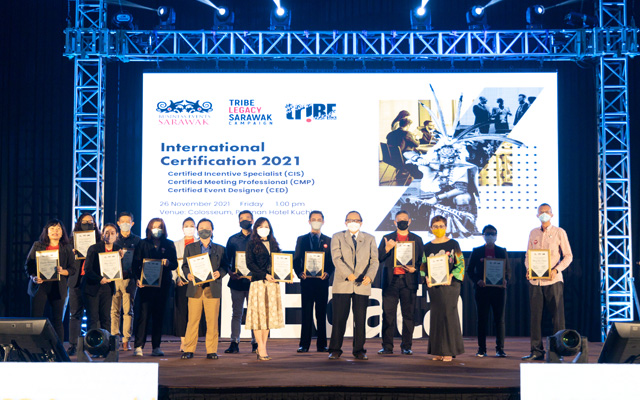
Award recipients at BESarawak’s Tribe Assembly 2021
BESarawak recently launched the BESarawak Centralised Collaboration & Data Sharing Initiative (BEdata), during its Tribe Assembly 2021 event.
Beyond obtaining an overview of Sarawak’s business events sector and its local economic impact, BEdata creates a baseline for data generation concerning meetings, incentives, conventions, and exhibitions, and provides in-depth market analysis to support lead generation and business development. Data contribution will predominantly by the government sector with the aid of private sectors.
Award recipients at BESarawak’s Tribe Assembly 2021
Speaking at Tribe Assembly 2021, assistant minister for Tourism, Arts and Culture Sarawak, Sebastian Ting encouraged both the government and private sectors to contribute to the initiative.
BEdata is expected to support investment decisions made by the government to ensure the sector remains competitive, while assisting in formulating strategic and tactical plans to develop the industry.
Tribe Assembly 2021 was also the opportunity to recognise 12 International Convention Scholarship Award 2018/2019 recipients and 49 industry partners who obtained industry qualifications and designations such as the Certified Meeting Planner, Certified Incentive Specialist, Digital Event Strategist, Certified in Exhibition Management, and Certified Event Designer.
Amelia Roziman, BESarawak’s CEO, noted: “We want Sarawak to be a more competitive destination by focusing on industry education and development. Our goal in mind is to develop the industry in a holistic manner that puts equal focus on developing hard infrastructure as well soft infrastructure and human capital.”
Asia Pacific Incentives and Meetings Event (AIME) has released a list of hospitality companies that will be exhibiting at AIME 2022.
The line-up includes luxury resorts and hotels from Marriott International, Langham Hotels & Resorts, Crown Hotel & Resorts, Hilton Hotels & Resorts, Pan Pacific Hotels Group, TFE Hotels, Minor Hotels and IHG Hotels & Resorts. All will come armed with new announcements and properties to be revealed on the showfloor.
Pan Pacific Melbourne
Furthermore, as official partners, the eight hotel groups will also accommodate domestic and international hosted buyers during the show, with exclusive previews into their latest offerings.
Looking to use AIME as the event to reconnect with the industry, Cinn Tan, chief sales & marketing officer of the Pan Pacific Hotels Group, is excited to supercharge business as the hotel group looks to launch 15 new properties by 2024.
“We’ve been confidently expanding our pipeline, with 15 new properties across 12 cities by 2024. This includes our recent addition of PARKROYAL Monash Melbourne, which opened in April 2021 within the M-City complex.
“We’re thrilled to be a partner of AIME 2022 and look forward to reconnecting with you all, as well as relaunching our face-to-face and hybrid meeting products.”
Delegates attending AIME in-person and online will hear first-hand about new venues and destinations, as well as corporate packages for events and work travel.
AIME’s event director Silke Calder noted: “With four months to go, the countdown is well and truly on for AIME 2022, and we couldn’t be more thrilled with our line-up of hotel partners to date. It’s an exciting taste of what’s to come, and we can’t wait to announce more outstanding hotels and venues that will be showcasing next year.
“There are so many opportunities waiting to be discovered at AIME, with a strong sense of reunification for our community. As more borders begin to open, including our APAC neighbours such as Japan and Korea, we know that business and leisure will evolve into something truly special. We are confident delegates will be blown away with what’s in store for them.”
Next year’s AIME will take place at the Melbourne Convention and Exhibition Centre from March 21–23 in-person and March 28 to April 1 online.
The challenge for event managers is the complexity of a dual affair. One event, two experiences – and they need to be consistent. What’s offered online must be replicated offline as closely as possible.
The past couple of years has forced event managers to rethink how they host global conferences, seminars, workshops, and other meetings.
Safety remains the biggest obstacle to hosting live events, meaning event managers find themselves needing an alternative.
At peak disruption, digital events provided a natural and cost-effective solution, allowing event managers to continue while adhering to social distancing guidelines.
But as lockdown restrictions ease across the globe, more and more event managers (two-thirds, according to research) are adopting hybrid event formats, increasing their onsite presence while taking advantage of online solutions.
The challenge for event managers is the complexity of holding one event with two different experiences
Why hybrid events? Compared to traditional onsite setups, hybrid events are fundamentally more accessible and offer the “best of both worlds”. The online component of hybrid events means that they can be expanded infinitely, allowing event managers to reach previously unreachable audiences.
New audiences speaking different languages can also easily be catered for by bringing in interpreters – both of whom can work remotely as your event is online and there’s no need to pay for visa permits or aeroplane tickets when you can log on online.
Of course, hybrid events can be challenging, from logistical planning, creating new value for exhibitors and sponsors, and catering to different timezones. But the real challenge will be to flip the mindset of whom you’re catering to, as having an onsite event with online access offered as a bolt-on may leave remote participants disappointed.
The key to solving this challenge is to create one event, but two experiences. Here are five tips on how to do exactly that.
1. Cater to both audiences Understanding your audience will help to filter down an extensive list of hybrid event needs, starting with how it’s hosted. Only when you know what your attendees need can you choose the right technology, such as video conference or event management platforms, and define the experience.
Focus on the needs of both of your diverse audiences equally. While one may be tempted to focus on onsite participants slightly more, as they will probably have higher costs associated with participation (travel, visa, tickets, etc.), remote audiences may exceed onsite participation by high numbers.
2. Offline and online hosts To make it easier for your audiences to interact and engage with you and other attendees, have representatives for both the onsite and online experience. These representatives can cater to your guests, providing them with event information and content, as well as direct them to what they are looking for.
Online representatives are especially important, as they can help attendees with any technical issues or problems they may be having, as well as share useful content and help them to connect with other online attendees.
3. Technical support What happens if a microphone fails or connectivity issues appear? For every possible “problem” you need available support, more so than you would with just an offline or online event. What’s more, both online and onsite teams need to have good communication. In the case of Interprefy, we can use our network of onsite AV partners. You can also choose to collaborate with partners the client has.
Ideally, for your hybrid events, you should have technical personnel and partners monitoring closely to remedy any issues – you should also reassure attendees (both online and offline) that normal service will resume relatively soon.
If your online event management solution fails, it’s always worth having a backup option that can be rapidly deployed.
4. The venue No two venues are the same; many will have their own capabilities as standard. Some will be better suited for events than others – i.e. podiums and surround sound already set up – so you’ll have to carefully assess each option to see what’s appropriate for your hybrid event.
Bandwidth capabilities are essential, as you’ll be catering to online audiences and need high-quality video and audio streams. Similarly, the aesthetic of the venue will matter for both those onsite and online, so make sure to choose somewhere that looks good and embodies the “theme” of your event.
As well as finding the right venue, work together with the venue operators to create the “ideal” onsite architecture. You should also try to make it as “safe” as possible, especially in line with social distancing guidelines to reassure attendees.
5. Speak their language As a hybrid event is infinitely more accessible, you should expect people from around the world to attend. With this in mind, you need to ensure that you have translators and interpreters who can accommodate the most “common” language needs. The easiest way to find this information out is to look at your attendee data – what languages do most people speak? Based on that information, find translators and interpreting partners to suit.
Real-time interpretation can ensure a seamless experience for both onsite and online audiences, allowing them to listen to content live while having it interpreted. Solutions like this make it easy for events to be delivered to multinational audiences at scale, while interpreters can work from anywhere at any time.
Hybrid events are here to stay As event managers and attendees continue to realise the benefits of being able to choose how they host and attend events respectively, hybrid events will continue to attract audiences around the globe, both online and offline.
The challenge for event managers is the complexity of a dual affair. One event, two experiences – and they need to be consistent. What’s offered online must be replicated offline as closely as possible. Event managers need to pay close attention to how their events are engaged with by both audiences and use that information to continuously improve what they do.
Four Points by Sheraton has opened the Four Points by Sheraton Desaru, in the heart of Desaru, a popular resort town in Malaysia.
With 12,000m2 of flexible indoor meeting space, the property is an ideal venue for corporate meetings and gala dinners. The pillarless Wave Grand Ballroom can accommodate up to 400 guests, while the Breeze Junior Ballroom with an abundance of natural daylight can comfortably seat up to 300 guests. For more intimate events, the poolside venue can host up to 150 guests.
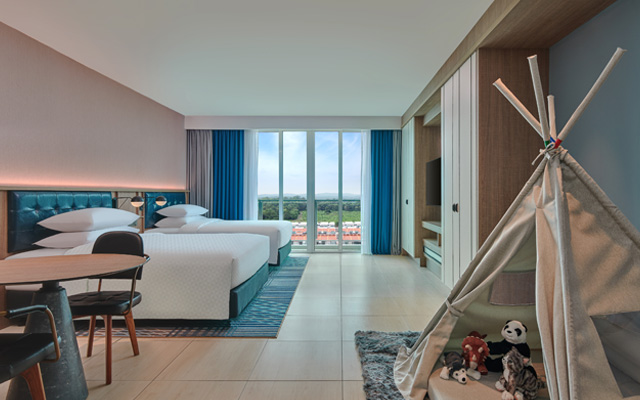
Family Room
Four Points by Sheraton Desaru features 311 spacious rooms, all of which offer complimentary high-speed Wi-Fi, an ergonomic workspace, private balconies and the brand’s signature Four Points by Sheraton Comfort Bed. Business travellers with their young ones in tow can make use of the Family Room featuring a play tent and personalised kid’s welcome amenities.
Facilities include an all-day dining space called The Mesh, an outdoor swimming pool, a state-of-the-art fitness centre, and a children’s playground. Other attractions in the area include the Desaru Coast Adventure Water Park, and The ELS Golf Club, all located within a 10-minute drive.
Marriott Hotels has opened the Melbourne Marriott Hotel Docklands, part of the retail, leisure, and entertainment precinct, The District Docklands on Waterfront Way.
For networking events and gala dinners, the five-star property offers 372m2 across three event spaces, where the largest available room is the 245m2 Promenade, good for 120 pax banquet-style.
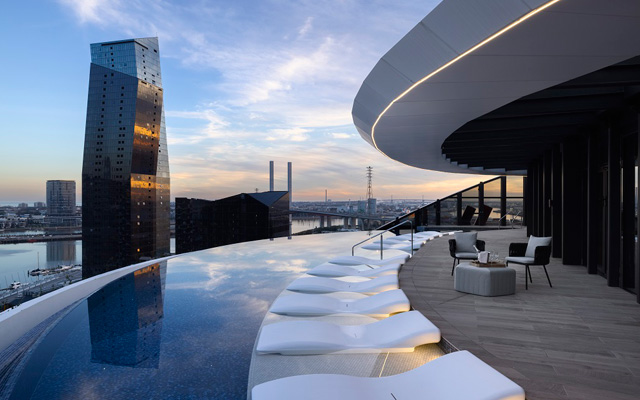
Rooftop pool
Bleisure guests will also be able to make use of the first M Club executive lounge in Australia, designed to emulate a residential-style living room. It is open 24 hours, and is open to Platinum, Titanium, and Ambassador Elite Marriott Bonvoy members and guests who stay on executive floors, offering complimentary breakfast, all-day refreshments, and evening cocktails. The adjoining outdoor terrace offers an al fresco space for guests to take a breather if needed.
Meanwhile, all of the property’s 189 rooms all come decked out with regular mod-cons such as a 55-inch LCD TV, a walk-in-shower, work surface, and a curated ‘Made in Melbourne’ bar fridge.
Recreational facilities include a gym, as well as a heated rooftop infinity pool that is open all year-round and offers panoramic views across Melbourne’s CBD skyline, Bolte Bridge, Port Phillip Bay, and Hobsons Bay.
Aside from the bar – named Sunset House – adjoining the infinity pool, other F&B options include Archer’s, a restaurant serving Australian cuisine with fresh produce from local farms; Ada’s, the hotel lobby bar; Corsia, a laneway-inspired cafe with a European-inspired menu of light meals.
Travellers entering Singapore will have to abide by tightened measures for the next four weeks at least
Travellers entering Singapore will face stricter rules from 23.59 on December 2 as the city-state attempts to buffer against the spread of the new Omicron variant.
The Straits Times reported that while no Omicron cases have been detected locally, the Ministry of Health said the pre-emptive measures are needed for Singapore to assess the implications of the new variant. Such measures will also help to reduce the risk of importation of the virus.
Travellers entering Singapore will have to abide by tightened measures for the next four weeks at least
Under the new requirements, air travellers arriving on the quarantine-free Vaccinated Travel Lane (VTL) scheme must undergo supervised, self-administered antigen rapid tests at a Quick Test Centre on days three and seven of their arrival.
Previously, such travellers would only need to take a Covid-19 swab test prior to their departure for Singapore, and upon arrival.
All air travellers entering, transferring or transiting through Singapore must also have tested negative in a pre-departure test within two days of leaving for Singapore.
Third, all travellers must take a Covid-19 polymerase chain reaction (PCR) test on arrival. This will affect non-VTL travellers entering Singapore who are not from Hong Kong, Macau, China and Taiwan.
These tightened restrictions will be in place for four weeks, and are subjected to review and possible extension.
This announcement follows on the heels of the government’s decision to indefinitely postpone planned VTLs for Qatar, Saudi Arabia and the UAE.
Australians vaccinated against covid19 at melbourne convention centre
Australia has halted border reopening plans to international students and skilled workers, sparked by concerns over the new Omicron variant.
Initially slated to reopen on December 1, the date has been delayed at least two weeks.
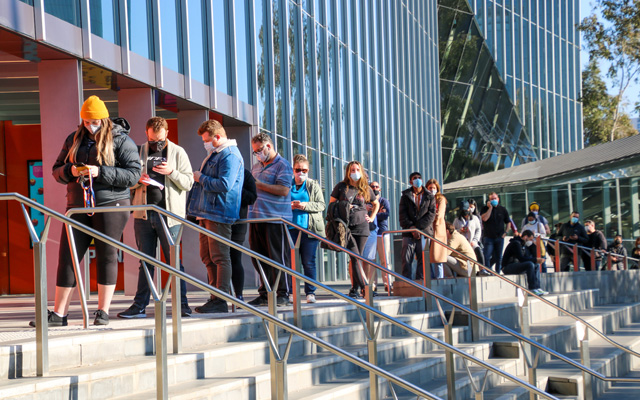
Australians lining up to get vaccinated against Covid-19 at Melbourne Convention Centre
Australia’s borders have been closed to most non-citizens for more than 20 months, with the exception of fully vaccinated Australian citizens, permanent residents and immediate family, as well as fully vaccinated green lane travellers from New Zealand and Singapore.
The reopening to travellers from Japan and the South Korea will also be paused until December 15. The plan was to open borders to visitors from these two countries on December 1.
Australian prime minister Scott Morrison indicated that the temporary pause will allow the country to gather the necessary information to better understand the variant, the efficacy of the vaccine, the range of illness, and the level of transmission.
Australia has so far, detected five cases of the Omicron variant.
Elsewhere in Asia Pacific, Japan has also temporarily suspended entry for all foreign visitors for at least a month.
Japan National Tourism Organization has released a list of 42 ideas for incentives. As the purpose of incentive travel is important in the post-Covid era, the ideas were compiled and published as a collection for organizers promoting qualified incentives. The programmes are not just incentive trips but special, meaningful and fun activities offering a positive impact on the mindfulness, health, teamwork and spiritual well-being of all participants. They have already been well received on the new website that hosts their details.
Highlights include a thoughtful stay in Nara, Zazen meditation in Shiga, a green tea experience in Shizuoka, a running programme around the Imperial Palace, and a hiking and culinary activity in Mie. They are easily accessible, being only a couple of hours’ travel from both Osaka and Tokyo.
Meditate at JW Marriott Hotel Nara
In Nara, 60 to 100 pax can take part in mindfulness exercises while enjoying a luxurious two-night stay at Japan’s first JW Marriott. This programme includes a gala dinner in a unique location normally closed to the public: the private quarters of the head priest of Hasedera, a temple dating from the eighth century with vast scenic grounds unchanged for more than 1,000 years. How about considering this programme as an exclusive incentive event for outstanding achievers?
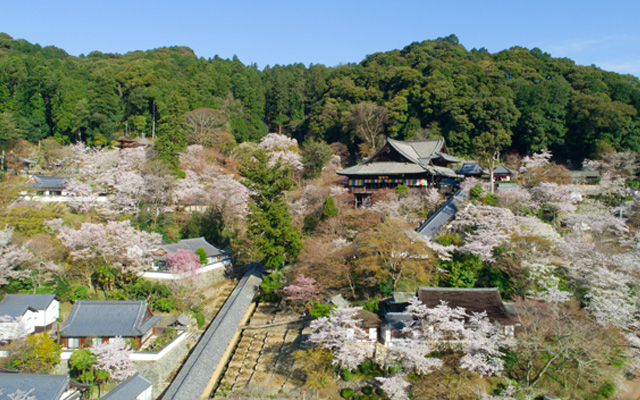
Hieizan Enryakuji Temple in Shiga offers zazen sessions in candlelight
Near Kyoto, in Shiga Prefecture’s Hieizan Enryakuji Temple, monks lead participants in writing a wish on a traditional Japanese candle and watching the flame flicker as part of a Zazen meditation thought to relieve anxiety and stress while improving concentration. The session, which is ideal as part of management training for executive candidates, lasts 90 minutes and is suitable for one to 30 participants.
Mt. Fuji rises majestically in the background, as viewed from Shizuoka’s Suruga, where tea harvests are plentiful
The green tea experience in Shizuoka blends historic Japan and relaxation. The open-air tea room at Kunozan Toshogu Shrine, a renowned national treasure, offers a traditional meal arranged in modern style, with green tea pairings presented by a local tea master. Up to 20 guests can enjoy the various culinary delights while overlooking Mount Fuji, Suruga Bay and tea fields.
Get physically fit in Tokyo, under the guidance of a professional coach from ASICS
For groups preferring something more physical, a professional coach from ASICS, Japan’s leading sportswear manufacturer, can help participants refresh body and mind in a running programme. The route circles Kokyo Gaien National Gardens, a well-loved sanctuary for runners in the heart of Tokyo. The 5km lap offers views of the Imperial Palace, the bustling Marunouchi business district, and Tokyo Station’s historic red-brick façade. Bespoke group T-shirts can be created two months in advance.
Trace the footsteps of Buddhist apprentice monks around the forests of Shirataki Daimyojin in Mie
In yet another outstanding experience, groups of two to 30 can traverse the same paths that Buddhist apprentice monks take in the forests around Shirataki Daimyojin in Mie, where the mountain is enshrined as a deity. Guides introduce aspects of Eastern dietary medicine, such as pickled food, and instruct participants on cooking rice using old, traditional ways during this four-hour programme.
Each of the 42 programmes is designed to offer inspiration to business groups by providing insights into the country’s unique lifestyle. Japan’s additional core strengths as an events host are its knowledge and resources, smooth operations, as well as clean and safe cities. In addition to these strengths, Japan has been preparing a programme suitable for post-Covid while travel has been suspended.
Since the outbreak of Covid-19, Japan’s business events industry has adapted swiftly, offering cutting-edge approaches to online events, and stringent countermeasures against the spread of infections at hotels, conference centres and other facilities.
Now, as the world contemplates recovery, business event specialists in Japan are poised to welcome guests back with events that spark off exciting business opportunities.
New ideas begin in Japan: a country that has been improving its incentive offerings in response to the pandemic. Even if you have already attended an incentive trip here, many more special experiences await you.
To find out how you can create inspiring and meaningful delegate experiences in the destination, visit www.japanmeetings.org.
The newly-opened Ritz-Carlton, Bangkok anchors the One Bangkok development with cosmopolitan elegance. Featuring the city's largest ballroom and a spectacular new penthouse suite, it delivers exceptional hardware and deeply authentic, soulful service for business and leisure travellers alike
Behind the imposing, Brutalist concrete that defines Zurich’s Oerlikon district lies a surprising secret. While its exterior honours the neighbourhood’s industrial roots, stepping inside Mama Shelter reveals a vibrant, neon-soaked world that is a far cry from its rigid shell
A polished urban retreat designed for business travellers, Hyatt Regency Kuala Lumpur at KL Midtown combines thoughtful design, seamless service, and exceptional facilities.




 With over 25 years of Marcom experience, Roy Ying has managed hundreds of events and conferences globally in his capacities as a trade promotion manager for the Hong Kong Trade Development Council, head of communications for the Royal Institution of Chartered Surveyors, and senior corporate communications manager for MTR Corporation.