Hosting the World Congress of Neurology in Korea will contribute greatly to the recovery of not only the domestic MICE industry but also tourism and related businesses
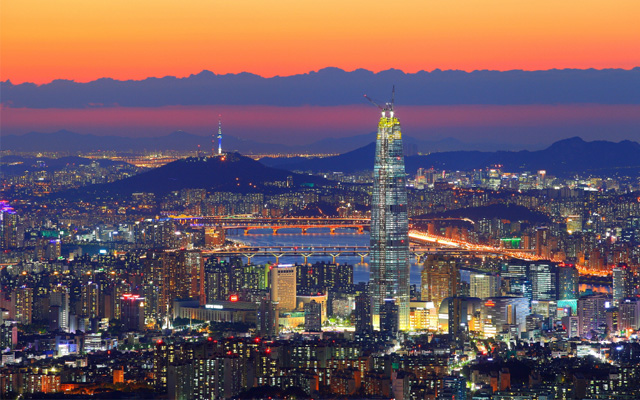
South Korea has won the bid to host the biennial 27th World Congress of Neurology, slated to be held from October 12-16, 2025, at Coex Convention Center in Seoul.
Held by the World Federation of Neurology (WFN), the World Congress of Neurology is a representative conference in the field of neuroscience gathering experts in the field from 120 countries around the world. More than 6,000 delegates are expected to attend.
Hosting the event will help speed up the recovery of South Korea’s domestic MICE industry
For this year’s bidding process, representatives from each member country of WFN voted among bidding countries, which included Australia (Brisbane), China (Beijing), and Turkey (Istanbul).
The success of this bid comes as a result of the preparation of the Korean Neurological Association with active support from The Ministry of Culture, Sports and Tourism and Korea Tourism Organization (KTO).
In preparation for the bid, KTO appointed Jeon Beom-seok, professor of neurology at Seoul National University College of Medicine as a ‘Korea MICE Ambassador’.
KTO also provided support for promotion activities, including the production of a new video and online promotional materials.
Moon Sang-ho, director of MICE marketing team at Korea MICE Bureau said: “Hosting the World Congress of Neurology in Korea will contribute greatly to the recovery of not only the domestic MICE industry but also tourism and related businesses. We plan to invite more international conferences to Korea in the future through close cooperation with related organisations.”
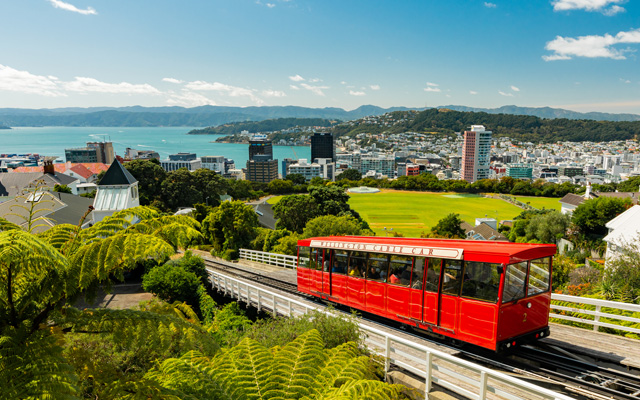
The city of Wellington in New Zealand has won the hosting rights to the 22nd International Sedimentological Congress (ISC) in 2026.
The ISC is one of the largest international conferences dedicated to the study of sedimentary rocks and the processes by which they are formed. The ISC is rarely held in the Southern Hemisphere but in 2026 it will be hosted by Geoscience Society of New Zealand’s Sedimentology Special Interest Group.
Wellington will be hosting the ISC in a few years’ time
The congress is expected to attract up to 1,000 participants to Tākina, Wellington Convention and Exhibition Centre and deliver an estimated NZ$3.4 million (US$2.4 million) to the economy.
The theme for the congress will be ‘Sedimentation on active plate margins through time and space’, and will include field trips across the country covering as broad a range of sedimentary systems in Zealandia as possible. Topics relating to Māori and Pacifica views of the sedimentary process will also be included.
The conference win is testament to both New Zealand’s strengths in earth science and its ability to provide fascinating first-hand experiences in the field, lead organiser and senior geologist at GNS Science, Mark Lawrence, said.
“Geologically New Zealand is very interesting. It has a whole range of geological attributes concentrated in a relatively small geographic area. Then you have the impact of tectonics, and climate change. It’s essentially a neat, small-scale laboratory,” he added.
Lawrence pointed out the congress is an excellent opportunity to engage the next generation of sedimentologists, who will be able to attend with fewer costs since the event is close to home.
“It will be particularly good for students who may otherwise be unlikely to attend such a prestigious event overseas. For those starting out in the field it’s a great opportunity to make these international contacts.”
Plans are also underway to ensure the conference has wider outreach to New Zealanders, through public lectures or learning experiences for school-age children.
Tourism New Zealand general manager domestic & business events, Bjoern, Spreitzer said: “Conferences like this showcase our expertise to the world and help grow our knowledge at home. They also deliver significant economic gains that benefit the New Zealand economy.”
Located on a stretch of Thailand’s Andaman Coast in the province of Phang Nga, the newly-opened Grand Mercure Khao Lak Bangsak is reminiscent of a traditional Thai riverside village.
The property welcomes travellers ‘working from home’ or by the beach, and is equipped with a business corner offering computers, printing and other business services. Meetings and corporate events can also be catered for at the resort’s 260m2 meeting space, which can accommodate up to 100 guests.
There are 195 guestrooms and suites in total, all of which feature private terraces overlooking the canal which winds through the resort, swimming pool, and gardens.
F&B options include a pool bar, all-day dining restaurant Patio, and Southern Thai restaurant Green Mango on the beachfront. In addition, recreational facilities include two swimming pools, gym, and Pran Spa.
The Standard has appointed Amber Asher as CEO of Standard International, parent company of Standard Hotels, Bunkhouse and Peri Hotels.
Asher succeeds Amar Lalvani who has been promoted to executive chairman, after serving as CEO for the past eight years.
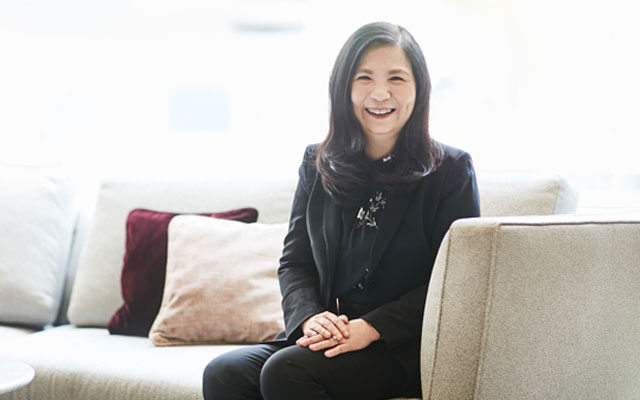
Amber Asher
In her new role, Asher will be responsible for overseeing all aspects of the business. Her priorities include identifying and cultivating talent, building and mentoring successful teams and innovating in the hospitality sector.
Asher started her work with The Standard approximately 10 years ago as executive vice president and general counsel. In 2013, she led the sale of a majority stake in the brand to Standard International which was formed by Lalvani to make the acquisition and grow The Standard brand.
Following the successful closing of that transaction, she became the executive vice president and general counsel of Standard International and went on to be promoted to president in 2017.
Prior to joining The Standard in 2011, Asher served as the associate general counsel and senior vice president of Morgans Hotel Group where she oversaw all legal matters related to development, operations, intellectual property, employment, food and beverage, and financing.
Sofitel Singapore City Centre has appointed Jacqueline Poey as its new general manager effective since October 1.
In her new role, Poey will continue to develop and strengthen the hotel’s successful positioning in the Singapore luxury hospitality market.
Born and raised in Singapore, Poey brings with her over 30 years of industry experience, where she held senior management positions in international hotel brands and groups.
She was previously director, operations support for Asia Pacific for Fairmont Raffles Hotel International, and most recently, hotel manager for Fairmont Singapore and Swissôtel The Stamford for five years.
Asian corporate travel managers (CTM) are cautiously optimistic about 2022, but reiterate international business trips will continue to be restricted despite higher rates of Covid-19 vaccination and the loosening of lockdown measures in some countries.
At press time, they shared that top reasons for the outlook was based on closed borders, quarantine measures that could require travellers to be away from home for up to a month in some instances, and onerous visa and paperwork requirements.
Business travel is resuming where quarantine-free entry is possible
A matter of demand
While most CTMs said that travel budgets were not being cut, one Singapore-based CTM said his 2022 travel budget was “relatively flat” and noted that compared to the past, “allocation and investment were being directed towards new product launches”.
He said: “There was a lot less travel in 2021 than budgeted, and our approach for 2022 is on the expectation that teams are planning for full activity levels, but factoring in quarterly revisions.”
The best-case scenario, he noted, would be more borders reopening and no quarantine for business travellers as Covid-19 vaccination rates continue to climb.
He continued: “More than half of our employees are willing to travel and insurance policies now includes Covid-19 coverage. But it is ultimately up to the employee to decide if he is willing or not to go on a business trip.
“Yes, people want to shake hands and there is a lot of pent-up (travel) demand for sure. But the new breed of traveller – and there is a larger group of them – will travel only when it is really necessary, are conscious of Covid-19, and will think twice because of a growing awareness about sustainability.”
Still, questions about overseas incentive trips are being asked to motivate sales teams and drive revenue, he said, adding that those who will be generating travel demand are in regional and global roles.
In the case of an IT company based in India, its CTM said there was no fixed budget and expected travel spend to be flat next year.
He explained: “I foresee travellers still hesitating to travel and organisations nervous about sending people out in 2022. So, the biggest challenge will be overcoming these psychological issues.
“Overall trip cost will increase due to border restrictions, quarantine requirements, vaccinations, PCR tests, etc, and this will result in a smaller number of trips based on the same budget.”
Travel outlook is more bleak for a global telecommunications company. Its Hong Kong-based regional travel manager revealed that staff would continue to “be under full travel restrictions” at least until early-2022.
Adriana Nainggolan, Autodesk’s travel programme manager, Asia-Pacific, told TTGmice that it was still a “wait-and-see situation” and international travel had not fully started yet for staff.
Nainggolan continued: “But if someone needs to travel internationally, and generally it is for customer engagement, vice president approval is required. It’s not so much about cost, but the approval to travel as a restriction is still in place.
“Our 2022 travel programme remains the same and still refers to our Covid-19 travel guidelines.”
While one Singapore-based pharmaceutical company has reopened its online booking tool in mid-July, its CTM, who attended a recent virtual buyer forum, told TTGmice that less than half of attendees polled had done likewise.
Domestic travel comes first
Commenting on regions that have resumed corporate travel, Nainggolan pointed out that domestic travel in China and the US had resumed, followed by Australia but this was subjected to regional lockdowns.
Challenges for Nainggolan were still safety and security in conjunction with country restrictions on vaccinations, quarantine resulting in travel bubbles that keep on changing, and how much the TMC would be able to support in these areas.
Expressing some optimism, Benson Tang, executive director, corporate travel, Informa Markets, believed 2022 would be a better year, also referencing his outlook on the resumption of domestic business trips in China, the US and intra-regional Europe.
But compared to pre-Covid, Tang noted travel levels next year would still be significantly lower as most international borders were still closed, that only around 30 per cent of the global population have been vaccinated, and new virus variants such as Delta Plus and Mu had emerged.
For Peter Koh, Asia strategic sourcing manager, travel and professional services, Corning, “predicting when international business travel can resume” has stopped.
Koh noted: “It boils down to when borders reopen, so planning an in-person meeting is difficult. However, we can and should be prepared.”
Koh revealed that his company’s 2019/2020 budget was unused, and half of the unutilised 2021 budget would be carried forward into 2022.
He continued: “With what we are seeing with the more contagious Delta variant and the emergence of new strains, the outlook is not very positive. But we can look forward to the end of 2022 and the industry going back to normal in 2023.”
Optimism on the horizon
Following the bulk of interviews completed in September, several Asian governments made much-welcomed announcements to resume travel for fully vaccinated travellers.
Singapore announced 11 quarantine-free Vaccinated Travel Lanes with various countries, two of which – Brunei and Germany – were in force at press time. The others to come include South Korea, Canada and France.
The Vaccinated Travel Lane with Germany has been well received by city-state-based business travellers, who used German cities as a central meeting point with business partners and colleagues from across Europe and the US, according to FCM’s Vicki Parris, vice president for customer success in Asia.
Malaysia restarted interstate travel on October 11, while Indonesia aims to reopen Bali and the Riau Islands to foreign visitors from select countries in late-October, with on-arrival quarantine shortened from eight to five days.
Thailand is working towards unrestricted entry for air travellers from at least 10 low-risk countries, including Singapore, from November 1. – Additional reporting by Karen Yue
Without clarity on endemic plans, large-scale organisers in Singapore will continue to have many hurdles to cross
Before the pandemic, Singapore was the place to meet for regional business, regularly welcoming large-scale tradeshows and exhibitions numbering in the thousands to its shores.
But after close to two years of border closures, due to slow reopenings, ongoing stringent restrictions, and ever-changing rules and regulations, the light at the end of the tunnel is not shining as brightly as it is supposed to.
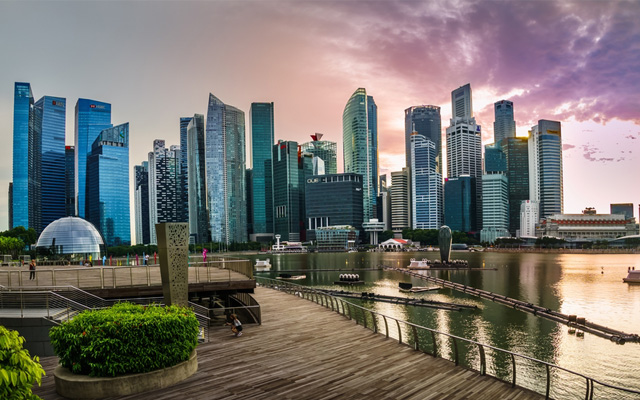
Without clarity on endemic plans, large-scale organisers in Singapore will continue to have many hurdles to cross; Singapore CBD pictured
Potential exits
While larger countries such as Indonesia and China can sustain large-scale events buoyed by its local population, Singapore’s large-scale events sector was hit harder as it is still dependent on foreign delegates and visitors, many of whom are currently not allowed to enter the city-state without a costly quarantine.
At press time, capacity for business events is capped at 1,000 attendees at any one time, if all have been vaccinated. Speakers can also be unmasked.
But for organisers of larger-scale events such as exhibitions, where crowds of between 3,000 to 8,000 people were the norm pre-Covid, the current capacity ceiling is prohibitive.
Kenny Yong, founder and group CEO of Fireworks Trade Media, posited: “Singapore’s domestic market is not attractive enough to exhibitors. Exhibitors join shows in Singapore hoping to reach the region. But if rules stay in place, expos that target the regional audience may feel the heat. The bigger shows in Singapore are mostly regional, especially industrial ones like in the fields of oil and gas, and maritime.”
Managing director, Clarion Events Asia, Richard Ireland, agreed: “Other parts of the world have gone from many restrictions to no restrictions in a very short period of time.”
For instance, domestic tradeshows in China, the US, the UK, and parts of Europe have made a comeback, and are beginning to operate at scale. China, given the scale and depth of the domestic market, is operating between 70 to 90 per cent of pre-pandemic scale.
“Given the size of the domestic market, Singapore needs international attendees, and any restrictions on international travel makes recovery challenging. South-east Asia has been slower to reopen, and the cross-border participation of shows in South-east Asia, and especially Singapore, make this situation even more challenging,” Ireland said.
Yong further pointed out that Singapore’s overly cautious stance could mean she might lose out to other “more daring countries” like Malaysia, Indonesia and soon, Thailand, which are taking a “more calculated approach” towards large-scale events.
A potential competitor to Singapore’s global MICE city status is Dubai, which has reopened borders to business events when its population was 75.2 per cent fully-vaccinated – as opposed to Singapore’s current 80 per cent. An oil and gas event, supposedly meant for Singapore, was moved to Dubai as a result, Yong said.
Yong fears that more organisers may follow suit, especially industrial shows that are dependent on regional visitors. “I see more organisers moving out of Singapore and building bigger events in the region like Indonesia, Thailand and Philippines where the market size is a lot bigger,” he added.
Resetting demand
With Singapore’s slower reopening pace, it brings to question whether business events will still find the city-state an attractive place to meet, and remain top-of-mind when compared with regional options that are fully open for business.
Poh Chi Chuan, executive director, exhibitions & conferences, Singapore Tourism Board (STB), expressed confidence in the city-state’s position as an “important gateway for event organisers and businesses to access the region”.
He related that in recent months, the Singapore government has been actively green-lighting pilot shows such as Bloomberg New Economy Forum and gamescon Asia 2021.
The high-profile Joint Leadership Summit also recently demonstrated Singapore’s persistent appeal for top-level meetings. Supported by STB and co-supported by Singapore Association for Convention & Exhibition Organisers & Suppliers, the event brought key industry leaders from global associations like Association of Event Organisers, Society for Independent Show Organizers and UFI, the Global Association of the Exhibition Industry together to work on an action plan for the safe reopening of the business events industry in the region.
These events build towards the government’s aim of gradually restarting conferences and exhibitions to support Singapore’s hospitality and travel industry, and help Singapore maintain its status as a hub city.
These pilots leave Ireland hopeful that relevant data would be released to facilitate “learning points factored into protocols”, and result in restrictions being removed and audience caps expanded.
Both Ireland, and Dylan Sharma, the co-founder and director of Tricom Events, have also pointed to the recent expansion of Vaccinated Travel Lanes (VTLs) as encouraging and positive signs that Singapore is opening up.
“While the daily number of travellers remain modest, we are confident that these will increase when (the scheme) proves to be safe and secure. (It would also bode well) when more VTLs are added, and are able to operate at higher capacity,” said Ireland.
Sharma stated: “The VTLs with a number of key markets signals a strong commitment by the Singapore government to opening up our borders and economy. This gives a strong confidence boost to the MICE industry here.”
Other grounds for optimism, Sharma added, was an acknowledgement by the Covid multi-ministry taskforce that “large-scale events pose a low risk as a transmission cluster”, inherently attributed to existing Safe Management Measures practiced by event organisers.
Moving forward, Sharma shared that landmark events like the Shangri-La Dialogue have announced plans for a fully in-person event in June 2022, following its cancellation in May 2021.
Poh also pointed out that there is a “strong pipeline of events for 2021 and beyond”. These include the Industrial Transformation Asia Pacific, Milken Institute Asia Summit, and Singapore International Agri-Food Week. Recently, four MoUs were inked to launch and anchor new events in Singapore, such as SILMO Singapore, and the Asia CEO Summit @ Singapore.
“These commitments are a timely boost to our MICE industry and are testament to our strength as a launch pad for regional expansion,” opined Poh.
Calculated optimism
While STB remains confident in the long-term prospects of Singapore’s tourism and business events sectors, industry players see a long road to recovery, with room for improvement.
When asked what support the exhibition industry needs now, Ireland said: “A clear roadmap of reopening, and what data points will support the reopening”. (When it comes to) exhibitions, these timelines are critical to organise the sales, operations and marketing.”
Ireland added: “The last 22 months have been a very difficult period for many. As an exhibition organiser, we are looking and planning for a more positive 2022 and are hopeful that the pace and scale of reopening will help facilitate this.”
Yong said: “We need more clarity. We can’t plan anything in Singapore now as the regulations are still very fluid. This is the main challenge all organisers are facing now when they commit to running a show in Singapore.”
On STB’s part, Poh said the business events sector can expect continued guidance and support, as well as efforts to “build new capabilities and reimagine the future of MICE events”.
“STB will work closely with our industry partners to rebuild and recover together. The virus will continue to evolve, and so will our approach,” concluded Poh.
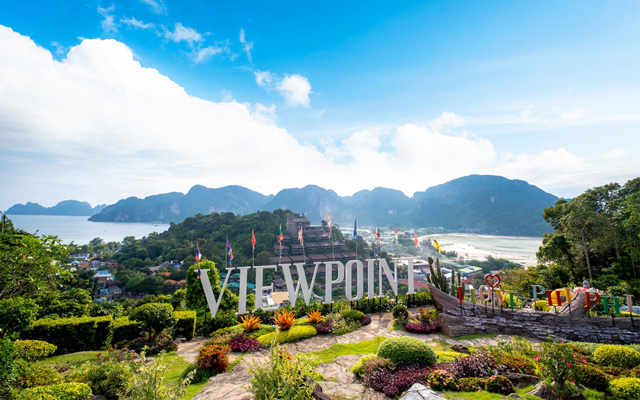
Krabi is one of the 17 designated tourist locations; the Viewpoint on Phi Phi Island, Krabi, pictured
Thailand has relaxed its quarantine free entry requirements by air for travellers from 45 countries and one territory, effective November 1, 2021, onwards.
This easing of restrictions come as Thailand sees an improving rate of recovery, a stable infection situation, and a higher vaccination rate.
Krabi is one of the 17 designated tourist locations; the Viewpoint on Phi Phi Island, Krabi, pictured
Those that have made the list include far-flung countries such as Denmark, Germany, and the US; as well as Asia Pacific countries such as Singapore, South Korea, and China.
Travellers from these destinations must possess proof of entry registration, proof of full vaccination, negative test result, insurance
covering the treatment in line with the required criteria, and proof of accommodation payment as required by the Center for COVID 19 Situation Administration.
Seventeen provinces have currently been designated as pilot tourism destinations. They include popular tourist destinations such as Bangkok, Phuket, Krabi, Hua Hin, and Chiang Mai.
Venues, establishments or activities conducted in these pilot tourism destinations have to close adhere to the terms, conditions, regulations and disease control measures set up by the area’s authorities.
In these pilot tourism destinations, maximum attendance for activities has also been capped at 500, and must comply with all safety and health measures.
The term hybrid has been more than a helpful catch-all, as it conveys an idea full of hope and holds the promise of an in-person future in whatever better state of events came next, opined Anna Patterson, vice president & managing director at George P Johnson (Singapore) Experience Marketing, in her presentation at ITB Asia Virtual 2021.
She noted that “offline things moved online (while) outside things moved in”, thus blurring the boundaries of interaction.
Events of the future will have to consider perspectives of both in-person and remote audiences
“While many things about the future remain elusive and uncertain, one thing is for sure: the new world will not play by the old rules anymore,” she said.
“So, how do you plan for the future when the future is up in the air? A solid and down to earth approach is a great place to start.”
Identify the big picture
Patterson suggested that event planners and producers take a fundamental approach that puts human experience at the core.
She said: “Clients are coming to us, whether in the events or travel industry, to ensure that they can better understand how humans make the difference. As industry professionals, it is up to us to show clients how digital and physical realities do not just coexist, but combine together to create otherwise impossible things.”
To see the big picture, Patterson said one has to understand where their brand stands in the “grand scheme of things” – something which will provide “essential context to make better decisions and take smarter actions” in their events.
“Once you have found your place, you are ready to move on to your why,” she said.
Set sights on event purpose
In explaining the need for brands, businesses and events to stay rooted in their purpose, Patterson related how figure skaters find their balance.
“Figure skaters were taught to find a spot to set their sights on while they were spinning. As long as their focus remained locked in, the skater could keep from getting dizzy no matter how ‘spinny’ things got. For brands, businesses and events, a good reason can have similar grounding effects. If you find your purpose, you can move on and out from there,” she said.
However, in defining the event’s purpose, event planners and producers must put their audience first.
“Of all the channels to consider, your attendee really is the only one that matters. Great experiences use human centricity to connect every what with every why,” she said.
Unify event models
Patterson noted common structures between physical and digital event models, and added that there were many ways that a hybrid event could come together.
She elaborated: “Not all events are hybrid, some of the old things will not be coming back from their online homes. Conversely, when face-to-face returns, there will be plenty of demand for in-person-only events. How do you make that relationship work depends on your brand, your audience and the purpose of your event.”
She suggested that event models could be unified through design and delivery, and reminded her session attendees that the event platform “does not equal the experience; it enables it”.
She recommended that events be imagined from the perspectives of both in-person and remote audiences, and have experiences designed for different times and spaces.
“When we use tools like green screen, motion graphics, broadcast techniques and scripting, these are for the individuals. These experiences will feel very much singular as technology and reality coalesce. For the audience near and far, the distance between in-person and remote will gradually disappear,” she remarked.
She pointed to award shows and professional broadcasts in sports as great sources of inspiration for hybrid events.
Patterson: event organisers should take an approach that puts human experience at the core
Maximise both mediums
Patterson urged events planners and producers to understand the different characteristics of physical and digital media.
For example, a digital medium enables scale, has the breadth and reach, and allows for passive absorption and personalisation, among other attributes. On the other hand, the physical medium enables engagement, has depth and resonance, and allows for active participation and social exchanges, among other attributes.
She said usage should overlap and play up the advantages of both media.
Patterson said: “When we connect, we have to connect with the intentional moments. So when you consider both perspectives and experiences, bring the journeys together to provide an amazing moment of unity.
“We are moving to a new generation of events. Digital and physical realities will not just coexist, but combine to create otherwise impossible things. The new world of experiential is more social, more personal, more local and yet more global, more ambient and yet more in the moment than ever before.
“Without limitation, imagination will be the only constraint.”
An ongoing journey
Patterson emphasised that “connectivity is imperative”, and underlined how “digital and physical experiences will be more interconnected”.
“Audiences and journeys will be woven together in-person and remote. Data is the common golden thread, and stitching it all together will require new roles and new skillsets,” she said.
She also highlighted the need for organisations to recognise that “life-cycle marketing is here to stay” and that companies and brands must be “omnipresent” by prioritising big technology that enables continuous audience engagement.
“I believe we are at the precipice of a new generation of hybrid events. As upside-down as this may feel to all of us, standing still is not an option,” she concluded.
The best way to grow as an industry is to learn from each other
The International Association of Convention Centres (AIPC), and the International Association of Professional Congress Organizers (IAPCO), have signed a Memorandum of Understanding that will focus on research, visibility, and education.
When it comes to research, IAPCO and AIPC will conduct a joint yearly research activity, the results of which are of benefit to the members of both organisations. The first activity will be on the different aspects of hybrid events and the results will be shared with the IAPCO and AIPC members by the time IBTM World takes place.
The best way to grow as an industry is to learn from each other
As for visibility and education, IAPCO and AIPC will create different forums, allowing the exchange of knowledge on specific topics of interest to the member associations. Both organisations will also leverage existing communication channels to facilitate that exchange.
Ori Lahav, President of IAPCO said: “Having clear understanding and an appreciation of stakeholders’ objectives will remain of utmost importance as IAPCO members continue to drive economic recovery of cities and knowledge-exchange between communities.
“The strategic collaboration with AIPC will further enhance the value of services PCOs and Convention Centres deliver to their clients. Research will provide the needs assessment; education will provide us with the tools and visibility across our networks and our own communities will strengthen relationships and drive results. We are thrilled to establish such a valuable partnership with AIPC.”
Just 10 minutes from Phuket International Airport on the serene northern coast, this 178-key, Bill Bensley-designed resort offers delegates a quiet, tropical paradise steeped in Phuket’s tin-mining heritage
The newly-opened Ritz-Carlton, Bangkok anchors the One Bangkok development with cosmopolitan elegance. Featuring the city's largest ballroom and a spectacular new penthouse suite, it delivers exceptional hardware and deeply authentic, soulful service for business and leisure travellers alike
Behind the imposing, Brutalist concrete that defines Zurich’s Oerlikon district lies a surprising secret. While its exterior honours the neighbourhood’s industrial roots, stepping inside Mama Shelter reveals a vibrant, neon-soaked world that is a far cry from its rigid shell



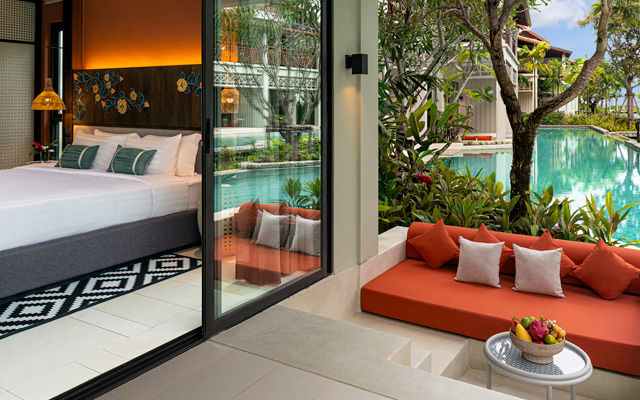
 There are 195 guestrooms and suites in total, all of which feature private terraces overlooking the canal which winds through the resort, swimming pool, and gardens.