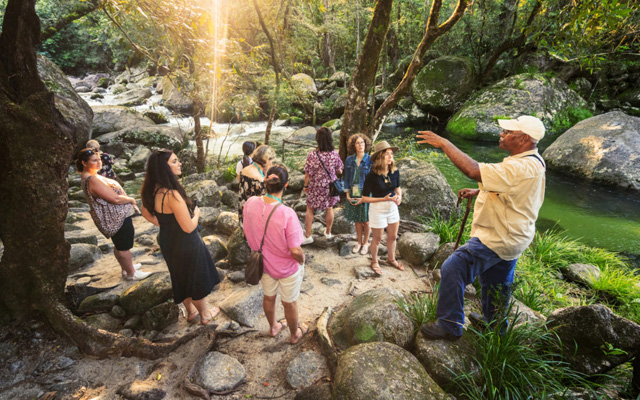
This Mossman Gorge tour takes visitors on a guided walk along private, gentle tracks, visiting special places and culturally significant sites, past traditional bark shelters and over meandering cool rainforest streams.
Nineteen Australian meeting planners, including two media delegates, were immersed in the region undertaking a four-day programme in Cairns and Port Douglas.
The Mossman Gorge tour takes visitors on a guided walk along private tracks to visit culturally significant sites
On Day 1, the group toured the newly refurbished Cairns Convention Centre, nearby hotels and offsite venues and participated in one-on-one appointments with Cairns suppliers before dining under the stars overlooking the marina.
Day 2 started with an aquarium breakfast, hotel site inspections, and soaring above the rainforest canopy aboard a cableway. Drinks during the golden hour of the sun setting in the middle of cane field and dinner in the middle of a disused World War II naval oil storage tank impressed. The evening event saw fire dancers lighting up the sugar cane, silk aerialists performing from the rafters above, and the soulful tunes of AustraNesia telling the stories of their Torres Strait Islander and South Pacific members.
The group then journeyed north on Day 3, met with Port Douglas suppliers and explored business events venues. They also got to hang out with the local wildlife and go for a Dreamtime Walk at Mossman Gorge.
The report further insights in
what the year 2020 has brought the associations meetings industry
Due to the pandemic, the International Congress and Convention Association (ICCA) has had to reinvent how they assess and present the 2020 ICCA Statistics Report on the association meetings market.
This latest iteration of the report reflects the changing needs of the industry. It provides a more accurate representation of the impact of the Covid-19 pandemic on association meetings globally. Furthermore, it is an enhanced tool for guiding the industry out of the current crisis and into an altered, but stronger future.
The report offers further insights in what the year 2020 has brought the associations meetings industry
The 2020 ICCA Statistics Report consists of meetings that were supposed to take place in 2020 and indicate what became of the meetings. The report includes an analysis on the economic impact of meetings in 2020 compared to 2019, revenue loss, and several additional key parameters. New categories have been added to represent the full spectrum of solutions that event planners implemented in 2020; such as virtual and hybrid meetings, postponement, cancellation, and relocation.
Key findings include:
While 44% of meetings were postponed in 2020, the vast majority of those meetings remained loyal to the original destination.
Virtual and hybrid meetings have helped associations attract bigger audiences in 2020, compared to face-to-face meetings in previous years.
Analysis of the economic impact of Covid-19 (total expenditure 2019 vs. 2020) indicates the industry’s strong desire to return to face-to-face meetings. However, in the future, meetings are likely to include elements and best practices from virtual and hybrid events.
ICCA CEO Senthil Gopinath said in a statement: “The 2020 ICCA Statistics Report not only provides a closer look at what was, (but it also) gives a clearer view of what is ahead. It reveals many positive developments that can guide top-level decision-makers within associations, sectors, and local governments. Above all, this report captures the incredible resilience of our community. We at ICCA World steadfastly believe that the global association meetings industry is entering a brighter, stronger future.”
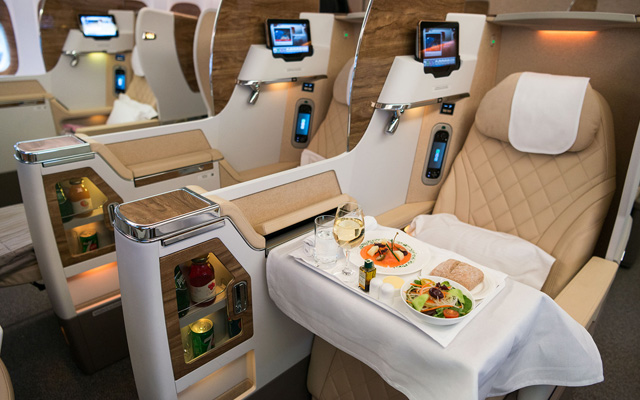
A business class seat onboard an Emirates B777 plane
Business travel will bounce back, but in the interim, airlines need to be adaptable to fill first-class cabins, advises Emirates president Tim Clark.
Speaking at the virtual Arabian Travel Market, Clark rebuked claims that the business travel segment will fail to rebound due to the virtual conferences and Zoom meetings that have dominated in the past year.
A business class seat onboard an Emirates B777 plane
He elaborated: “You can’t get to know someone over Zoom. You can’t understand them or have that tactile human interaction that comes with MICE business. This human aspect is still as important as it was back in the 50s and 60s.”
The evidence, he said, can be seen in the mid-90s when the digital era came of age and the airline industry predicted a slump in business travel. “We got video conferencing and thought that would change everything (but) look what happened. We absolutely rocketed.”
While Clark remains confident business travel will return to pre-covid levels, he predicts it will take time. Meanwhile, the airline industry needs to be adaptable to keep its business class quota full.
During 9/11 and the 2008/09 financial crisis – when the corporate segment temporarily disappeared from travel – prices tumbled, which made business class seats affordable to a portion of leisure travellers which promptly filled them.
Clark said: “We saw that price points fell and the cabins filled up. (This is one way how) the airline community needs to be able to adjust to the changing nature of the market in the short-term.”
In addition, introducing more premium economy seats and measures that make business class flying more affordable is key to keeping the segment afloat.
Prior to the pandemic, Emirates trialled “unbundling” business class packages on select routes, where travellers could choose from an a la carte menu of business travel perks depending on their budget and needs.
As such, the airline will be rolling this initiative out this year, and this will “make business class more accessible”.
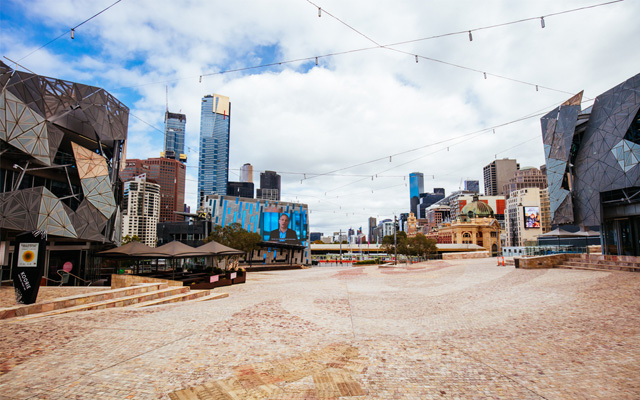
Melbourne's iconic Federation Square quiet and empty during lockdown
Victoria is in the midst of its fourth Covid lockdown, putting the brakes on the momentum that was seeing healthy bookings return for corporate events in the state.
The state government announced a strict seven-day circuit breaker that started at midnight last Thursday in response to a growing number of Covid cases. Rules reintroduced include a five-kilometre limit for essential goods shopping and exercise, no public gatherings, closure of hotels and restaurants restricted to takeaway services.
Melbourne’s iconic Federation Square quiet and empty during lockdown
It’s expected that A$1 billion (US$772,790) in economic activity will be lost over this period. But convention bureau manager at Business Events Geelong, Mark Day, believes industry operators will take the difficult development in their stride.
“Lockdowns are hard on the meetings and events industry but our operators are now experts at mitigating these issues having dealt with this four times already,” Day, who is also chair of Business Events Victoria, told TTGmice.
“Understandably, business events enquiries have slowed in the last 24 hours due to uncertainty surrounding the latest lockdowns. With tour operators, restaurants and venues now facing yet another setback, it is more important than ever that we band together as an industry and support these local businesses, many of which are family-owned and operated,” he continued.
Prior to the latest lockdown, venues in regional Victoria were seeing bookings return in healthy numbers, although group sizes were smaller and had much shorter lead times of two to three weeks rather than months. But that’s not all that has changed.
“What we’re seeing is that although traditionally, most of our operators have been really good at working together, the pandemic has resulted in a lot more camaraderie between them. They’re working with us really closely to sell or pitch the destination, and packaging their offerings (together). Those wins are also being counted as wins to the region,” Day observed.
Day also said that while the latest lockdowns are difficult, they are important for Victorians to do “hard and fast”, to stop any further spread of Covid in the state.
When the pandemic triggered unprecedented border closures across the world, entrepreneur and frequent flyer Philip Man suddenly found himself unable to freely travel anywhere.
That lack of freedom to travel led the digital nomad to set up remote travel platform Port at the height of the pandemic in April 2020. Alongside co-founder and CTO, William Sjahrial, Man came up with the idea of having people around the world show homebound travellers their local places through a video call. “We were working remotely, so we thought, ‘Can we travel remotely?’ That’s how we started,” recalled Man, co-founder and CEO of the company.
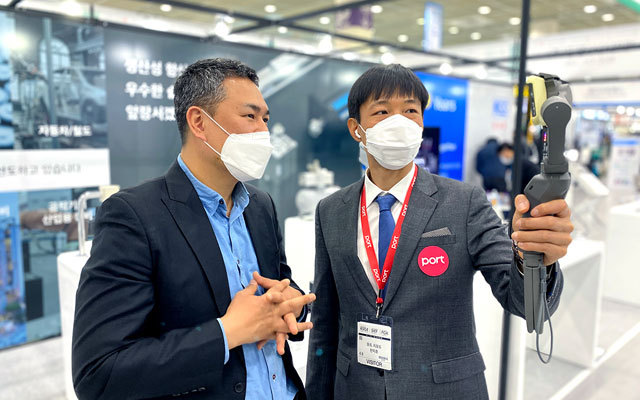
Port allows clients to control the actions of their proxy at trade events, through instructions to the guide
The Singapore-based start-up connects individual professionals and businesses with personal guides from around the world to give them remote tours of tradeshows and exhibitions through live video calls. The client can issue instructions to the guide, and control the camera remotely, taking and saving photos along the way.
Besides being an avenue to gain global market insights, the platform also avails users of an efficient, cost-effective way to meet new business partners and access events remotely.
“Before Port, when you think about international business travel, you either go and spend a few thousand dollars or you don’t go and spend nothing. With Port, we are offering an in-between solution for a few hundred dollars, and it will open up completely new possibilities for people to visit and explore places around the world easily and affordably,” Man said.
“Depending on where you are video-calling into, we also offer guided exhibition tours and interpretation as well, pre-selecting for you the companies that are relevant to you.”
Man believes that Port allows users more efficient use of their time.
A remote visit to a tradeshow with a personal bilingual guide via Port typically charges between US$60 and US$90 per hour, depending on location and guide expertise. The company also works directly with event organisers and venue owners to enable locations to be remotely visited, with customised prices.
Man: Port has served over 1,200 paid users on its remote tours and remote event visits
Man stressed that Port is not designed to replace actual travel and in-person event attendance, but rather, to be a supplement to existing travels.
“Port is not for deep business conversations, but rather, for introductions and connections (at tradeshows and exhibitions),” he said.
Noting how 78 per cent of Port’s trial users say that they would not have gone to that event even if there was no pandemic, Man said that the platform allows business travellers to “reach places that previously were not economically justifiable to go”.
He cited a case study of two buyers from the UK who remotely visited the AI Expo Korea via Port. “In their session, they saw 80 booths, spoke to 12 companies, and had follow-up meetings with three of them. Total cost: two hours and US$120. Now, compare that to the time and cost of two people flying to South Korea for two days and having an interpreter on-site,” he said. “Port costs a fraction of that in time and money.”
Currently, Port is targeting English-speaking countries inbound to South Korea, Taiwan and Dubai – locations where in-person tradeshows are still happening amid the pandemic. The company plans to expand to North American and European cities later this year as “those are big tradeshow markets” said Man, adding that China will follow next year.
To date, Port has served over 1,200 paid users on its remote tours and remote event visits.
To grow its customer base, Port focuses on B2B2C models where it helps events or venues to be remote-visit enabled, so they can lower the bar to visit and tap into a larger audience for their event.
“We provide the entire back office infrastructure to them to make that happen, from booking and video conferencing software to feedback and analysis. Using this B2B2C model will help us reach the end-user,” said Man.
In April, Port secured a pre-seed investment from Japan travel agency H.I.S. Group, a six-figure sum which Man said will go towards “growing the team and product development”.
While the company is currently focused on the business events industry, with offerings in tradeshows and fairs, there are plans to expand its offerings to include corporate site visits, educational field trips, product and workplace inspections, and more.
Post-pandemic, the Port platform will continue to maintain its relevance, said Man. “Once face-to-face events resume, our inventory of locations and events will grow, and our platform will become even more valuable to our users,” he elaborated. “And the great thing is, we will have a generation who has been trained for 18 to 24 months on doing everything through video calls, from meetings and teambuilding to yoga classes and event and location visits.”
The Philippine Tourism Promotions Board (TPB) has found itself having to be more agile and creative in the way it markets the destination and motivates local tourism partners throughout the Covid-19 pandemic, especially as the country weaves through waves of community quarantine requirements implemented by the government, noted Maria Anthonette C Velasco-Allones, chief operating officer.
In this new episode of TTG Conversations: Five Questions video series, Velasco-Allones sheds light on the new responsibilities TPB has to take on to uplift the local tourism industry, bankable tourism products that will facilitate the destination’s tourism recovery, and infrastructure developments that are paving the way to a brighter future for the Philippines’ business events industry.
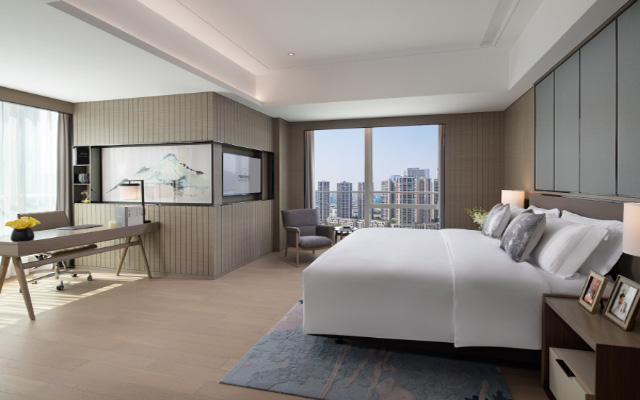
Fraser Residence Chengdu's occupancy rates hit a year-to-date high of 90 per cent
Frasers Hospitality, a member of Frasers Property Group, will be adding seven more properties to its portfolio in China over the next four years.
The properties will be located in first- and second-tier cities and are Modena by Fraser Nanjing; Fraser Residence Nanjing; Fraser Suites Pazhou, Guangzhou; Fraser Residence Shenzhen; Fraser Residence Tianjin; Fraser Place Chengdu; and Fraser Residence Chongqing.
Fraser Residence Chengdu’s occupancy rates hit a year-to-date high of 90 per cent
Frasers Hospitality currently operates 12 properties across 12 key gateway cities. The new signings will bring its total inventory in the country to over 4,500 keys.
“Despite the global economic slowdown caused by the COVID-19 pandemic, China remains the world’s second-largest economy and one of the most-watched inbound and outbound tourist markets.
“Our growth plans in the market are backed by the significant business potential we’re observing in China, which has remained steadfast amid the challenges brought about by Covid-19. China was the only major economy in the world to have expanded in 2020, registering a 2.3 per cent5 GDP growth, and is expected to continue on this upward trajectory in the coming years,” said Mark Chan, chief operating officer of Frasers Hospitality, in a statement.
With international travel halted, Chinese travellers have turned to domestic excursions to satisfy pent-up demand. During the recent Labour Day Holiday in early May, the country reported 230 million domestic trips, up three per cent from pre-pandemic figures.
“Despite the current challenges, our properties in China have remained resilient as they are fuelled by a strong base of long-stay corporate guests. At the same time, demand for our serviced apartments also appeal to shorter-term guests who are showing a preference for larger personal spaces and privacy,” said Chew Hang Song, senior vice president, head of operations – North Asia at Frasers Hospitality.
The company’s most recent opening in June 2020, Fraser Residence Chengdu, has had occupancy rates hitting a year-to-date high of 90 per cent.
The group’s current portfolio in China also includes properties across Beijing, Changsha, Chengdu, Dalian, Guangzhou, Shanghai, Shenzhen, Tianjin, Wuhan, and Wuxi. The new openings bring the hospitality provider’s global portfolio to more than 120 properties in over 70 cities worldwide.
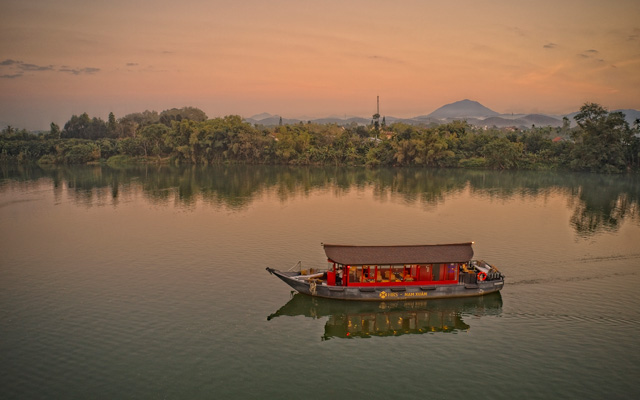
Azerai La Residence, Hue has launched a 17m-long cruise boat, offering small groups an exclusive way to experience the Perfume River in central Vietnam.
The new vessel, locally built and christened “Nam Xuan,” accommodates up to 16 passengers. Private cruises require a minimum of four guests, and is available to anyone in Hue, even non-guests of the hotel. Additional guests will be charged accordingly.
Azerai La Residence, Hue's Nam Xuan
1 of 4
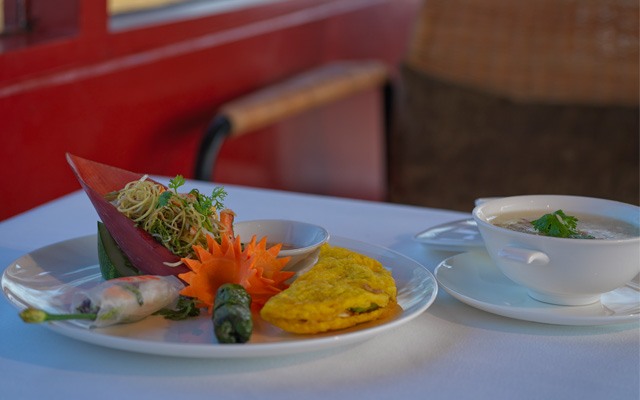
There are three different types of excursions: an afternoon tea cruise, a sunset cocktail cruise and a dinner cruise. The covered middle section of the boat serves as a dining room by night and a sightseeing deck by day.
The afternoon tea cruise takes guests on a scenic 90-minute journey on the Perfume River, with a delicious assortment of sweet and savoury treats, along with a range of teas, coffees and more. The boat departs the resort every Friday, Saturday and Sunday at 15.30 and returns around 17.00. Prices start at VND 320,000 (US$14) per person, up to a maximum of 16.
The sunset cocktail cruise sets sail at 17.30, and guests are served a selection of handcrafted cocktails, mocktails and delicious canapes. The 90-minute sunset cruise is priced at VND 340,000 per person, up to a maximum of 16.
Lastly, the dinner cruise begins with a La Residence cocktail at sunset as the boat pulls away from the resort’s pier and makes its way upriver towards Thien Mu Pagoda, the oldest pagoda in Hue and the city’s foremost landmark. On the return journey, the boat passes underneath the Truong Tien and Phu Xuan bridges. While on board, guests are served their choice of Western or Vietnamese fine cuisine.
The dinner cruise concludes with the release of candle-lit lanterns on the river. The two-hour dinner cruise, priced at VND 580,000 per person, is available for up to a maxmium of 10 people.
Nearly half of event professionals (47%) say better delivery of sponsor and exhibitor ROI metrics is the No. 1 improvement on their virtual event tech wish lists, according to a survey by Aventri released earlier this year.
Economic uncertainties brought on by Covid-19 have led many organisers to let audiences attend online events for free. This reinforces the need to keep satisfied stakeholders coming back.
Here to help are nine tips to add and prove value to virtual event sponsors and exhibitors.
1. Connect partners with attendees in real-time through virtual booths. The interactive booths feature video conferencing, chat, lead-scoring, product demos and sales collateral to optimise monetization.
2. One-on-one and small-group meetings at virtual booths are like live tradeshow booth walk-ups. Leverage them to capture data on event performance, such as traffic statistics, aggregate dwell time, lead generation and sales material downloads.
3. Make sure your platform supports multiple currencies and payment gateways to help drive revenue for exhibitors and a better customer experience for attendees.
4. Empower exhibitors to send push notifications through the mobile event app to reach key audience segments regardless of location.
5. Create interactive sponsorship packages to expand stakeholders’ visibility. For example, invite them to sponsor pre-session digital games, music breaks and swag bags. Provide five-minute speaking slots to partners whose budgets don’t allow them to sponsor full sessions.
6. Let major sponsors follow up speaking sessions with small, ask-the-expert sessions to foster personalized connections with qualified prospects.
7. Invite sponsors to pay registration fees of targeted buyers. They can boost exposure via messaging on confirmation emails, such as: “Admission compliments of our sponsor [company name]. Visit their Virtual Booth #[X].”
8. To quantify ROI, track key metrics, such as virtual booth visits, leads captured, session attendance, dwell time, questions, shares, downloads, languages and geographic locations. Then create customised reports for sponsors and exhibitors that prove value with hard data.
9. Let partners see how their content is consumed, where and by whom. They’ll gain fresh insights into buyer preferences. This business intelligence will help them customize event follow-up and improve future meetings and marketing programs.
For more information on optimising virtual events, download Aventri’s free 2021 Virtual and Hybrid Events Guide here (https://www.aventri.com/strategy/virtual-events).
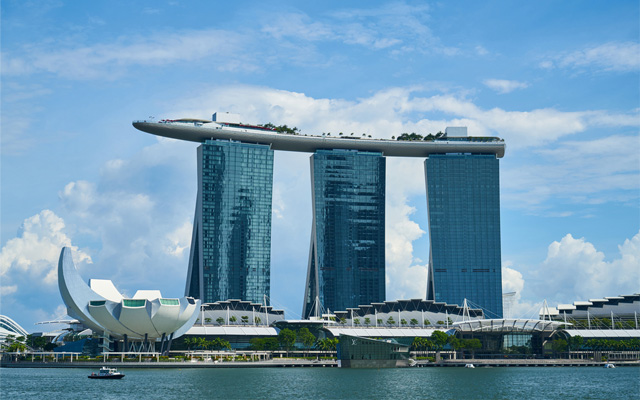
ABS' event venue hasn't changed, and will be held at Marina Bay Sands in November
The 7th Architecture & Building Services (ABS) 2021, originally planned for June 30 to July 2, will be postponed to November 2021 in response to the Singapore government’s announcement of tightened measures and restrictions under Phase 2 (Heightened Alert) to minimise transmission risk of the virus in the community.
This decision to postpone to November was made in consultation with the Singapore Tourism Board, and is the latest in a string of cancellations after World Economic Forum and Shangri-La Dialogue.
ABS’ venue hasn’t changed, and the event will be held at Marina Bay Sands in November
Said Edward Liu, managing director of Conference & Exhibition Management Services (CEMS): “We are hopeful that the situation would have improved by then, and it would be more conducive for conducting our premier exhibitions and conferences, without compromising public health.”
“Singapore remains a first-choice hub for international conferences and exhibitions and its standing is beyond question and beyond doubt. We have world-class infrastructure and expertise and the entire ecosystem to support any event. We are confident that in-person global events could continue to gradually resume, if all necessary Safe Management Measures (SMM) protocols are taken to safeguard the health and safety of all participants and stakeholders involved”, he added.
When the event returns in November this year, it will run on a hybrid format, integrating both on-site and virtual elements across seven tradeshows and 10 conferences in the built environment and related sectors. Themed Design Solutions for The Built Environment, the 7th ABS 2021 will occupy some 11,620m2 of gross exhibit space at the Sands Expo & Convention Centre at Marina Bay Sands.
Just 10 minutes from Phuket International Airport on the serene northern coast, this 178-key, Bill Bensley-designed resort offers delegates a quiet, tropical paradise steeped in Phuket’s tin-mining heritage
The newly-opened Ritz-Carlton, Bangkok anchors the One Bangkok development with cosmopolitan elegance. Featuring the city's largest ballroom and a spectacular new penthouse suite, it delivers exceptional hardware and deeply authentic, soulful service for business and leisure travellers alike
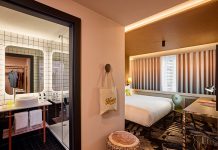
Behind the imposing, Brutalist concrete that defines Zurich’s Oerlikon district lies a surprising secret. While its exterior honours the neighbourhood’s industrial roots, stepping inside Mama Shelter reveals a vibrant, neon-soaked world that is a far cry from its rigid shell