Blythman: a dedicated resource to the health and wellbeing of employees is crucial during this period
Tina Blythman has joined the Melbourne Convention and Exhibition Centre as a health and wellbeing advisor, a newly-created role due to the Covid-19 pandemic.
Some of Blythman’s tasks include leading large-scale and targeted organisational-wide health and wellbeing projects, implementing and assisting the coordination of company-wide health programmes and initiatives, educating leaders on their role in ensuring the health and wellbeing of employees, and actively promoting lifestyle events in and around MCEC.
Blythman: a dedicated resource to the health and wellbeing of employees is crucial during this period
Her first task will involve working with the Peer Support Network, a group of volunteer employees who are trained in mental health first aid, to identify and implement health initiatives across the organisation.
On the heightened emphasis on mental health amid the pandemic, Blythman said: “The world has changed so much in recent times; it has become more and more apparent that a dedicated resource to the health and wellbeing of employees just makes sense.”
“The hope is that my new role will help fill any gaps there may have been previously, like people wondering who the best port of call is for mental health and personal matters.”
Future plans include engaging with external speakers and trainers, as well as utilising her own learning background to facilitate new training and workshop opportunities for MCEC employees. She has also been tasked with delivering a measurement system and supporting framework to support a holistic health and wellbeing programme, as well as functioning as a key point of contact on mental health issues.
MCEC’s CEO Peter King said: “The importance of mental health and wellbeing has never been more apparent, and MCEC is committed to making sure our people feel supported and healthy. We have created a strategy specific to the needs of our employee base and we wanted someone who is 100 per cent committed to living and delivering this important initiative. This is not a part-time obligation.”
“Our desire to have a fully functional, happy and caring environment is critical to our organisation as we rebuild for future prosperity.”
Organisers often ask how they can create compelling exhibitor packages without live expo halls, networking parties or physical areas for branding. The truth is, digital events present countless opportunities to bring attendees and exhibitors together and encourage meaningful connections.
Sponsorships are a crucial part of monetising virtual events
Try these recommendations below to add value to virtual exhibitor packages and keep satisfied partners coming back.
Start by asking exhibitors to share valuable content during speaking sessions. Encourage attendee interaction via real-time chat, Q&A’s, polling and other engagement tools.
Provide opportunities for deeper connections. During exhibitors’ speaking sessions, for instance, they might invite attendees to continue conversations in small-group video chats and one-on-one meetings with experts.
Create immersive showroom experiences, like you have at in-person events. Build a virtual expo hall within your event website. Using the latest digital lead capture solutions, attendees can click on exhibitor booths of interest and connect quickly with experts. Exhibitors capture qualified leads. At the same time, attendees get prompt answers to questions during personalised, one-on-one video conversations – mirroring the experience at in-person events.
Encourage exhibitors to drive virtual booth visits before and during the event. They can use targeted emails, push notifications, social media and other channels.
Set exhibit hall times during session breaks. When virtual sessions and showroom hours run concurrently, virtual booths can get overlooked. Make showroom hours convenient, too, not at the end of a long conference day.
Offer engaging sponsorship opportunities that encourage attendees to spend time in the exhibition hall. Take gamification, for example. Participants can enjoy scavenger hunts for items at virtual booths. Challenge them to climb the leaderboard and win prizes. They can earn points for connecting with exhibitors and other attendees, reading sponsored content, watching demos and more.
Finally, create robust exhibitor reports. When all attendee interactions are digitised, events generate a goldmine of data. Our industry has always looked to data to measure return on investment. This business intelligence also provides a window into attendee preferences and pain points.
Deliver reports quickly to enable timely and personalise event follow-up. Data-driven insights help sponsors, exhibitors and organisers strengthen their offerings. So marketing gets stronger, event after event, year after year.
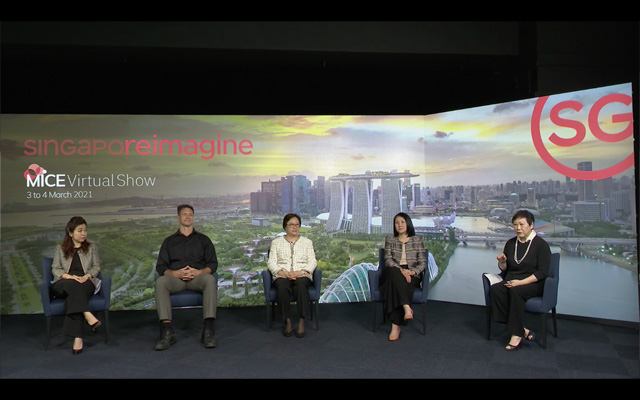
From left: PCMA's Patricia Cheong; Council on Tall Buildings and Urban Habitat's Shonn Mills; Align Technology's Julie Tay; STB's Jeannie Lim; and moderator Janet Tan-Collis from SACEOS speaking at the SingapoReimagine MICE Virtual Show
The events fog is clearing up for Singapore’s events industry, as a promising roster of large-scale conferences is in the works.
Panellists at the SingapoReimagine MICE Virtual Show on March 3 revealed plans to organise physical events in Singapore this year, with attendance possibly running up to 2,000.
From left: PCMA’s Patricia Cheong; Council on Tall Buildings and Urban Habitat’s Shonn Mills; Align Technology’s Julie Tay; STB’s Jeannie Lim; and moderator Janet Tan-Collis from SACEOS speaking at the SingapoReimagine MICE Virtual Show
These include the Invisalign Asia Pacific Summit, which is projected to welcome more than 1,000 healthcare professionals from Asia Pacific, Europe and the US; as well as a gathering of the Council on Tall Buildings and Urban Habitat, comprising 2,000 attendees and an international membership of 75-80 per cent.
These potential events join the anticipated World Economic Forum’s Special Annual Meeting 2021, slated for Aug 17-20, which aims to host some 1,000 delegates.
Shonn Mills, board of trustees member for the Council on Tall Buildings and Urban Habitat, shared: “We picked Singapore for our conference location because it is a beacon for sustainable urbanism, and this has become even more important after Covid-19. Our plan is to have 2,000 members come to Singapore in November. I’m sure it will be hybrid too, but I’m hoping the measures that Singapore Tourism Board (STB) and Ministry of Health put in place, as well as (developments) surrounding vaccination, will allow us to move ahead with a large-scale conference.”
Confidence in Singapore’s safe facilities and events were bolstered by the portfolio of hybrid events that have been piloted under the government’s Safe Business Events framework. Since STB opened up applications for MICE events on October 1, 2020, some 50 events have already been organised.
These include TravelRevive in November 2020, which saw some 1,000 attendees and exhibitors on-site, and the Professional Convention Management Association’s (PCMA) Convening Leaders in January 2021, which welcomed 300 delegates. Measures put in place to ensure safe meetings included daily antigen rapid testing, meeting pods with Plexi-glass and zonal systems to limit intermingling.
“The fact that 300 delegates agreed to join us and take the antigen rapid tests was a strong indication that the industry is ready to meet again in a safe manner,” expressed Patricia Cheong, associate director, development, PCMA.
She continued: “We are still a very long way from figuring out how to network virtually. The serendipitous moments that happen are only possible in physical meetings. I think we will continue to see smaller, regional events coming together first. We can learn, experiment and start building a box of experiences, which can then be used for bigger events.”
As Singapore leads the path towards the resumption of safe business events, various different measures are being trialled. This includes the “stepped-up testing regime” employed at TravelRevive and PCMA Convening Leaders, whereby delegates underwent pre-departure, on-arrival and pre-event testing in place of quarantine.
STB is also working towards international vaccination certification, in hand with ICAO and IATA, in order to “expedite travelling across borders”, described Jeannie Lim, assistant chief executive, STB.
The reimagined event will offer the same networking opportunities
The Business Events Cairns & Great Barrier Reef has transformed the Sell TNQ educational programme for Australian meeting planners, into a new-look event BE Immersed: Cairns & Great Barrier Reef.
Business Events Cairns & Great Barrier Reef’s general manager Rosie Douglas said the Sell TNQ had successfully showcased the region’s business events products and capability for 20 years, and the BE Immersed: Cairns & Great Barrier Reef has been revolutionised to build on the successful components of Sell TNQ programme.
The reimagined event will offer the same networking opportunities
“With meeting planners eager to start work on reactivating the business events industry, it is timely to evolve our key educational programme to meet the needs and expectations of our business events clients’ as well as reflecting our leave greater destination brand promise,” she said.
BE Immersed: Cairns & Great Barrier Reef will be held on May 6-9, and will showcase the region and its natural beauty for post-touring options, Covid-safe practices for meetings, and unique off-site events to stage events in the post-pandemic world.
Registrations to attend BE Immersed: Cairns & Great Barrier Reef are now open.
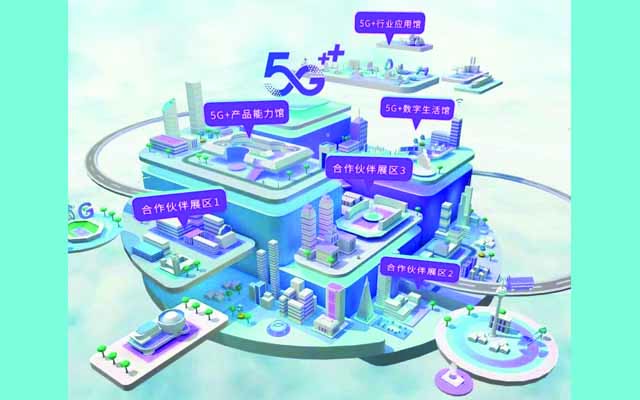
The 360-degree panoramic 3D virtual city that could be viewed from a smartphone
Event brief
The China Mobile Global Partner Conference was transformed into a hybrid event for the first time in 2020, held virtually as well as on the ground in Guangzhou.
The theme was “5G integration into all industries, digital intelligence leading the future”, widely regarded as a starting point for commercialised 5G service construction and development in China.
The event attracted hundreds of senior executives from well-known local and overseas companies as they explored the potential of commercialised 5G service and promoted its construction, application, integration and innovation.
Pico+ was appointed by China Mobile’s Migu to create the event’s H5 webpage, an online virtual city, and multi-themed online virtual exhibition halls with 360-degree panoramic view function to display brand information from nearly 150 companies.
Event highlights
The team used Web3D technology to create a 360-degree panoramic 3D virtual city platform that would provide an optimal mobile phone experience. Users opened the H5 webpage on their phone to interact with the virtual city – rotating, dragging, zooming and panning by touching the screen.
The virtual city’s multi-themed virtual panoramic exhibition halls were equipped with dual interactive technology, allowing content to be displayed either via mobile phone or VR headset. Visitors could also use the automated photo generation function, which enabled them to select their preferred scene, choose the frame colour, portrait location and size, to generate a personalised photo for saving and sharing.
This resulted in a virtual world that delegates could interact with smoothly, and was also eye-catching, which boosted engagement among visitors and achieved a high engagement rate.
Cherry Ye, general manager, business operation of Pico+ China, shared: “Virtual character animation was another online event highlight. The virtual characters guided and interacted with participants through vivid body movements, mimicking the experience of offline events.”
Challenges
Audiences have become fatigued by online events that now seem too predictable and impersonal. Keeping the virtual audiences engaged was a major challenge.
To encourage their virtual audience to connect and stay engaged with the content over the three-day event period, the team turned the whole programme into a game.
Users were given incentive points to interact with the virtual city, and points were given when they did registration and sign-up, logged in daily, checked into virtual scenes, browsed content, and created photos in the exhibition halls. Points could be redeemed for gifts once certain totals had been reached.
Event China Mobile Global Partner Conference 2020 Organiser China Mobile Dates November 19-21, 2020 Attendance During the three-day event, more than 100 million engagements and 50 million unique visitors were recorded on the online platform
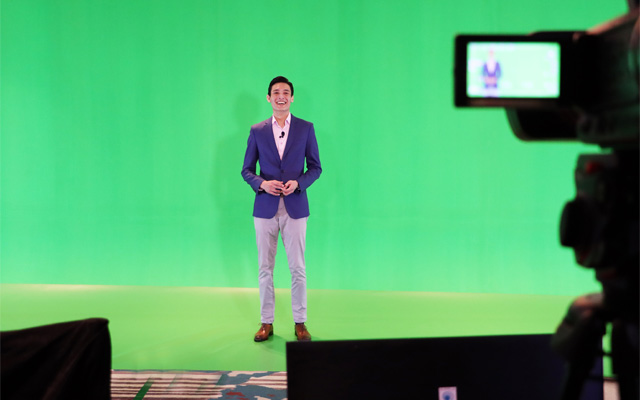
The Westin Singapore has converted one of its function spaces within the hotel to a dedicated Virtual Studio.
The Virtual Studio has been now fitted with a 7.2m x 2.8m green screen that can accommodate up to three presenters on-site with two remote connections; a HD camera system; on-screen personalisation; and on-site technical support.
The green screen in action
A two-hour Virtual Studio rental package starts from S$3,800++ (US$2,824).
In addition, the Virtual Meeting package can be customised based on different event requirements with additional options for live streaming. Hybrid meetings with in-person attendees and concurrent off-site viewers are available as well.
Packages range from 100 to 500 persons; and comprise a single session agenda up to three hours live streaming capacity (excluding China); supports for two onsite speakers and two remote speakers; as well as archival recording for three hours.
Planners can also now have meals delivered to offsite attendees. Lunches start at S$75 per person; a lunch and afternoon tea break at S$90 per person; an evening cocktail package at S$60 per person, or S$45 with every order of lunch or half-day package. Prices are nett and inclusive of delivery to one location per person.
Gearoid Lyons has been appointed general manager of Conrad Bangkok in Bangkok, Thailand.
Lyons brings with him more than 20 years of experience in the hospitality industry. Prior to this, Lyons most recent role was hotel manager at Waldorf Astoria Bangkok.
Joining Hilton in 2010, he has previously held various management roles in full service and luxury hotels across multiple markets including London, Sydney, Perth, Tokyo and Bangkok.
Royal Caribbean International (RCI) will deploy Quantum of the Seas for an additional three months in Singapore from March 22 to June 21, 2021, to cope with demands for the uptake in sail packages following Singapore’s implementation of enhanced safety protocols to support the return for safe cruising since November 2020.
Now available for booking, the 2-, 3- and 4-night Ocean Getaway packages offer up to 50 per cent off, with prices starting from S$199. Seniors enjoy an additional 10 per cent off, and kids under 12 cruise for free, subject to prevailing terms and conditions.
The North Star, offering vantage views at 90m above sea level
Enjoy pioneering entertainment options such as RipCord by iFLY, the first skydiving experience at sea; the North Star, an observation capsule transporting guests to an exhilarating height of 90m above sea level; SeaPlex; the largest seafaring indoor sports and entertainment complex; and Bionic Bar powered by Makr Shakr, the world’s first robotic bartending system.
Guests will also get to enjoy a landscape of 18 restaurant concepts as vast and varied as dining in the world’s most cosmopolitan cities, including specialty restaurants created with partner chefs such as Jamie Oliver.
RCI has in place a comprehensive set of health and safety measures that adhere to the CruiseSafe Certification standards jointly developed by the Singapore Tourism Board (STB) and DNV GL. Click here for a full list of health and safety measures enforced on board.
“Our close partnership with the Singapore Government has played an instrumental role in the success of these pilot cruises, and we remain committed to safeguarding the health and safety of our guests and crew during these additional sailings,” said Angie Stephen, managing director, Asia-Pacific, Royal Caribbean International.
She added, by reducing capacities in communal spaces on board (such as restaurants, theatres and activity areas) to 50 per cent – lower than the national standard of 64 per cent – coupled with no ports of call make it “no less safe” compared to other activities and settings that have already resumed on land.
Guests who book their sail-cation on Quantum of the Seas before April 30, 2021, can be assured of flexibility in their plans with RCI’s Cruise with Confidence programme, which allows for changes and cancellations up to 48 hours before the cruise begins.
For a greater peace of mind, cruise inclusions comprise of Covid-19 protections such as a 100 per cent credit towards a future cruise should a guest of any member of their travel party test positive for Covid-19 during the three weeks prior to their booked cruise; or a full refund if a guest, or any member of their travel party, tests positive during their voyage.
On Covid-19-related expenses, Royal Caribbean will cover onboard medical treatment, cost of any required land-based quarantine, and travel home for the guest, travel party, and any confirmed close contacts.
Contact the corporate sales team for more information:
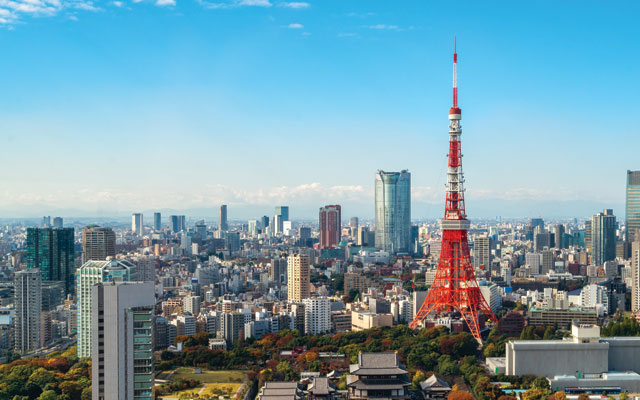
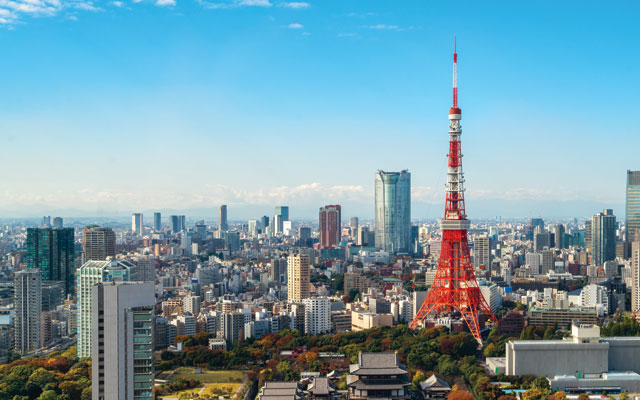
The Japanese business travel market offers vast opportunities to grow; Tokyo pictured
Global convention industry consulting firm, GainingEdge, has released the first annual report on Leveraging Intellectual Capital of convention destinations, based on an analysis of international association leadership.
The research underpinning the report identifies the relative strengths of 350 destinations via the presence of their local intellectual leaders in the governing bodies of international associations that organise large conventions. Intellectual Capital is described as a destination’s strength of representation in international association leadership.
Tokyo is the top city in Asia-Pacific that GainingEdge pegs as a true global knowledge hub with a strong influence in international associations
Key findings of the report include:
A Top 50 ranking of destinations (cities/countries) with the greatest influence in international associations
How well destinations leverage their local leaders by engaging them to bring conventions to the city (their “Harnessing Ratio” – the correlation between number of international association meetings hosted or booked over the last four years and number of local intellectual leaders on boards of international associations)
The key industry sectors and scientific fields where destinations are best represented in international association leadership.
Milos Milovanovic, head of GainingEdge Analysis and Research (GEAR), said: “Our Intellectual Capital research was conducted over the last half of 2020 and included reviewing over 3,500 international associations and their governing bodies, which organise large meetings for over 500 participants. Using the ICCA database, as well as international associations’ web sites, we obtained data for 350 cities and 145 countries around the world.”
This analysis looked at:
Total number of governing bodies of international associations with active presence of local leaders from each destination (city/country).
Total number of presidents/chairpersons of international associations from each destination (city/country).
Total number of large (city-wide) international association meetings organised or booked in the last four years.
Milovanovic continued: “This research enabled us to develop key analysis ratios, such as our Harnessing Ratio and the market intelligence we gained can be applied in any of the 350 destinations.”
The report found a very high level of correlation between GainingEdge’s intellectual capital rankings and their International Convention Destination Competitive Index 2020 global rankings. The top 20 cities in terms of intellectual capital are all among the top 30 most competitive destinations in the Competitiveness Index.
“Our research shows London at the top, followed by Paris, Tokyo, New York and, Beijing, indicating these cities are true global knowledge hubs with strong influence in international associations,” Milovanovic said.
Image 1: Top 50 Cities – Available Intellectual CapitalImage 2: Top 50 Countries – Available Intellectual Capital
The report found that among the top 20 cities, three European destinations had high Harnessing Ratios: Berlin, Barcelona and Vienna. Among destinations with fewer local leaders on international association boards, high Harnessing Ratios are seen with Prague (highest in the world), Dublin, Lisbon and Copenhagen. In the Asia-Pacific region, cities with high Harnessing Ratios are Bangkok and Singapore, while North America has two Canadian cities, Montreal and Vancouver.
Image 3: Top 50 Cities – Harnessing Ratio
The Harnessing Ratio for the top 50 countries shows the UAE have a high level of intellectual capital engagement. Among European countries with a relatively high Harnessing Ratio are Czech Republic, Portugal, Ireland and Spain. Asia-Pacific countries with a high Ratio are Thailand, Malaysia and South Korea. Among the top 10 countries with very high Harnessing Ratios are Canada and the US. The US has the greatest amount of intellectual capital in the world and is clearly benefitting as a result.
Image 4: Top 50 Countries – Harnessing Ratio
Jon Sivertson, GainingEdge’s CEO, said: “We see our Leveraging Intellectual Capital report as the foundation for building advanced convention development programmes for destinations. We can now see the absolute, and relative, strengths of destinations with regards to their harnessing of their resident intellectual capital. Drawing on this analysis, we can now provide a Destination Intellectual Capital Study to convention destinations, eager to improve both their business development as well as destination marketing activities. This service will help them to identify associations where they have influence they may not have known about. It also allows a destination to understand which of its actual key business sectors and scientific fields are best connected in global association leadership, and provides them with a focused, deliverable and measurable, approach to securing large meetings.”
Sivertson continued: “Our GEAR unit continually tracks intellectual capital data to ensure that it’s complete and up to date, and as part of our analysis it can be provided to any destination on demand. This is the first report on Leveraging Intellectual Capital and we will be publishing updated reports annually going forward.”
Strong preference for standalone and multipurpose flexible venues
Small venue providers are revising operations, pricing to woo organisers
Clear understanding of event T&Cs is ever more important
Smaller and more flexible venues are gaining favour among planners
Continued government limitations on in-person business event capacity have triggered a stronger appetite for small, flexible venues in Asian cities where such activities have been allowed to resume.
In destinations such as Hong Kong, Thailand and Singapore, where approved business gatherings can take no more than 20, 100 and 250 people (across five separate zones) respectively, meeting organisers are finding the use of large venues irrelevant.
Sheryn Sethoe, commercial director for client services, 1000Meetings, a venues procurement specialist, said: “The cost of large venues (is) difficult to justify unless there is a requirement for more space to accommodate pre-event tests, such as the Antigen Rapid Tests that are done in Singapore under the business event pilot programmes.”
The use of small venues, which are likely exclusive to the event group, also enables safe distancing from general crowds and passers-by.
Sethoe observed that clients are leaning towards standalone event spaces, with a preference for unique venues within a hotel, raw event spaces or non-hotel venues. Location is no matter, as clients are open to suitable venues in the city or outskirts.
Anticipating an increased demand for small meeting venues due to restrictions on travel, group sizes and safe distancing requirements, CWT Meetings & Events last year launched CWT easy meetings, a direct-booking platform with a listing of over 250,000 meeting rooms in hotels as well as unique venues and event spaces around the world. Through the platform, meeting organisers can also source and book audiovisual equipment and F&B packages while monitoring cost, compliance and employee safety and security.
Petrina Goh, director, Singapore, CWT Meetings & Events, said: “Even as in-person meetings and events gradually resume in Asia, clients are naturally approaching this with a healthy dose of caution. In places like Singapore, organisers are required to have separate zones at events for batch registration, Antigen Rapid Test zones, waiting rooms etc., and so clients are moving away from the ‘bigger is better’ mentality, and are now looking at smaller venues with multiple spaces that they can design their event around.”
Goh finds that convention centres and business hotels remain a popular choice among her clients, as these properties come with multiple small function rooms that are compliant with government regulations.
“While unique, standalone venues remain popular with clients in the fintech industries, we’ve found that many clients are gravitating towards venues that are easily reachable via public transport as accessibility is taking precedence over the uniqueness of a venue,” she added.
Improved client support
Keen to support new meeting needs amid a pandemic, small venue providers have leveraged their agility in making quick decisions to revise their operations and price structure.
Goh said: “While larger hotels and convention venues sometimes struggle with pivoting quickly to meet clients’ needs and the ever-changing regulations, smaller venues with more autonomy in managing their pricing structure and partnership tie-ups have transformed themselves with new go-to-market offerings that are both price competitive and flexible enough to meet client demands.”
Some changes that have come in handy include ready floor plan configurations to guide clients on spacing arrangements, contacts for clinics that provide onsite Covid-19 swab tests and manpower, and new pricing structures in a la carte, add-on and all-inclusive formats.
Goh said these changes make a meeting organiser’s job much easier when considering both budget and logistics before confirming an event.
With the pandemic forcing meeting organisers to get creative with their in-person event delivery, Sethoe said venues that “provide a fresh new look to the workings of small meetings” will stand out.
She observed that venues are making an effort to differentiate their products. A good example, she said, was The Dutch Pavilion at the Shangri-la Hotel Singapore, which is a standalone space with a unique history.
When asked if small venues should go the way of larger competitors that have brought in broadcasting capabilities, so as to compete better for a limited number of business events today, Sethoe said: “Economically speaking, it will be more beneficial for small venues to work with established audiovisual and technology partners to offer more products and services for virtual and hybrid events. Such capabilities require specialised skillsets and operational expertise, and coupled with other associated costs such as storage, it might be better to finance other services such as a robust Wi-Fi network.”
Information clarity is critical
Given that meetings during a pandemic are subject to more considerations and potential disruptions, Sethoe suggested that organisers communicate with venue providers and obtain a good understanding of their cancellation policies, health and safety protocols, F&B arrangements, and existing infrastructure to support safe distancing measures.
“If there is an online component to the meeting, also enquire on network connectivity. There is a tendency to assume that Wi-Fi is never a problem but when it comes to streaming, the load on the network will differ as compared to simple web surfing, for example,” she added.
She recommended detailed pre-event discussions with the operations team to ensure that “everyone is on the same page for the day”.
“A simple case could be coffee and tea arrangements. These were usually self-served pre-Covid-19. Will the venue continue to do so, or will there be a contact-less ordering system in place? If so, how should attendees interact with it? Small as it may seem, such elements are part and parcel of the overall attendee experience,” she explained.
The newly-opened Ritz-Carlton, Bangkok anchors the One Bangkok development with cosmopolitan elegance. Featuring the city's largest ballroom and a spectacular new penthouse suite, it delivers exceptional hardware and deeply authentic, soulful service for business and leisure travellers alike
Behind the imposing, Brutalist concrete that defines Zurich’s Oerlikon district lies a surprising secret. While its exterior honours the neighbourhood’s industrial roots, stepping inside Mama Shelter reveals a vibrant, neon-soaked world that is a far cry from its rigid shell
A polished urban retreat designed for business travellers, Hyatt Regency Kuala Lumpur at KL Midtown combines thoughtful design, seamless service, and exceptional facilities.








 Brought to you by