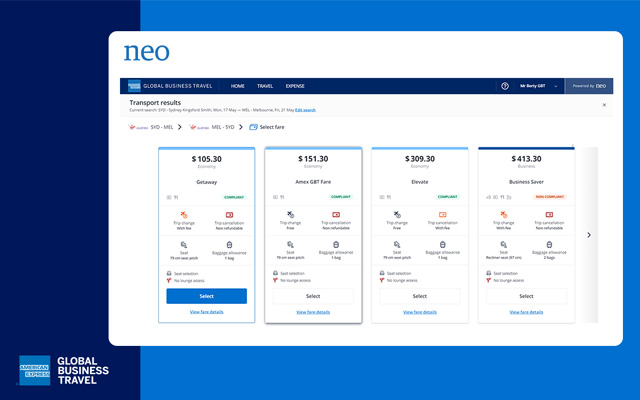
American Express Global Business Travel (GBT) has changed the way it displays airfares – to an easier-to-scan consumer-inspired format – within its corporate travel and expense software, Neo.
Earlier February 9, GBT launched its New Fare Display (NFD) for all clients using Neo to book travel, making it the first TMC in the industry to display a complete set of fare attributes in a corporate booking tool.
The consumer-like interface reflects how travellers prefer to shop for airfares
NFD presents airfares in an easy-to-scan format with a view of all fare bundles offered in side-by-side cards, similar to the way they are presented on airline websites. Each card shows the amenities included within that fare including ticket features. Users can shop a complete set of attributes and see all the value a fare includes such as seat selection, priority check-in and boarding.
This includes the airline’s public offers as well as corporate negotiated, or GBT Preferred Extra air content.
This feature was developed to keep Neo in step with the way travellers prefer to shop for airfares as airline retailing evolves. To drive more adoption, Neo developers took inspiration from popular airline booking tools.
GBT’s strategy is to help travel managers improve compliance through a more consumer-like air booking experiences in Neo. This will also ultimately support all the goals of managed travel programmes, including savings and duty of care.
Currently, the Neo NFD feature includes fares from nearly 30 airlines around the world. More airlines will be added as they adopt the necessary technology standards. A similar feature for hotel content in Neo is in the works.
Anderes Fourdy Events Singapore (AFES), a PCO operating out of Singapore, was established this week in an agreement between The Travellers DMC (TTDMC) in Singapore and Anderes Fourdy Events (AFE) in Malaysia.
“We’ve always been looking at Singapore. It has always been one of the Top 10 BE destinations in the world,” Anderes Fourdy’s co-founder, Fu Kei Cheong, said.
A screenshot from the Anderes Fourdy website
“The Covid-19 pandemic was a catalyst. It jolted us sufficiently to relook at our plans and hasten our resolve”, said Yvonne Low, executive director of TTDMC.
“AFE is well-known in the Asia-Pacific medical and life sciences field as most of the congress they organise are within these sectors. Their client profile is exceptional and they manage a number of regional and national associations as their Association Management Company (AMC),” added Low.
AF has already started to put the Singapore team through the rigours of a very steep learning curve during the pandemic lockdown. Weekly meetings and trainings are filled with SoPs, knowledge, technical know-how and insights.
“AFES is a natural progression to keep the congresses and clients within the AF Group. Working closely with the Singaporean associations and Singapore Convention Bureau, Yvonne and I look forward to bring and deliver our first congress in Singapore very soon,” KC said.
AFE is currently committed to growing its Singapore operations and establishing AFES as a major PCO in Singapore before expanding its operations to other countries.
ICE clients continue to receive high quality event management services and delivery
Australian event and conference management company, Arinex, has joined forces with ICE Australia.
ICE Australia staff transitioned to Arinex in the first week of February 2021, while the full handover of ICE clients happened at the end of February 2021.
ICE clients can be assured of high-quality event management services and delivery from Arinex
ICE Australia’s director, Daryll Dorner, said that this move will “successfully and professionally fulfil the obligations and contractual commitments of ICE to their clients”, while allowing ICE to pursue other business ventures.
Over the last two decades, Arinex has integrated 10 PCO and DMCs.
This partnership will help the business community embrace sustainable changes to its travel model, as we return to in-person relationship building
Travel management data specialist, Travelogix, has partnered with sustainability expert Trees4Travel to provide a long-lasting approach to carbon offsetting.
The first phase of the partnership will go live in March 2021 and will see Travelogix automate the supply of trip data directly to Trees4Travel for subscribed TMCs and their corporate customers.
This partnership will help the business community embrace sustainable changes to its travel model, as we return to in-person relationship building
The data supplied by Travelogix will allow Trees4Travel to determine how many trees need to be planted to offset the carbon emissions related to each trip booked and report those values back to Travelogix for sustainability tracking purposes.
The second phase of the project will allow TMCs and their corporates to visualise the progress of their sustainability programme with Trees4Travel at an agency and client level.
Travelogix will make the Trees4Travel integration available free of charge to all users of the Analytix data management platform.
Nico Nicholas, CEO of Trees4Travel commented: “Our partnership with Travelogix, made possible by early adopter; Sunways Travel, means there is effectively no excuse or justification for any business to not be offsetting their travel carbon from today.
“Travelogix’s adoption of the Trees4Travel system means the calculation, purchase and ongoing monitoring of a company’s carbon footprint is all provided direct to its business travel manager and the corporate clients at the click of a mouse.”
Tanah Gajah, a Resort by Hadiprana, in Bali, Indonesia, has created a stay package to bring corporate groups, who have not seen each other for a long time due to the pandemic, together.
The Art of Reuniting package costs US$7,500++ per night, with a minimum stay of two nights. This price includes the bookout of the entire resort, which is 20 individual villas spread out over six hectares among the rice paddies in Ubud.
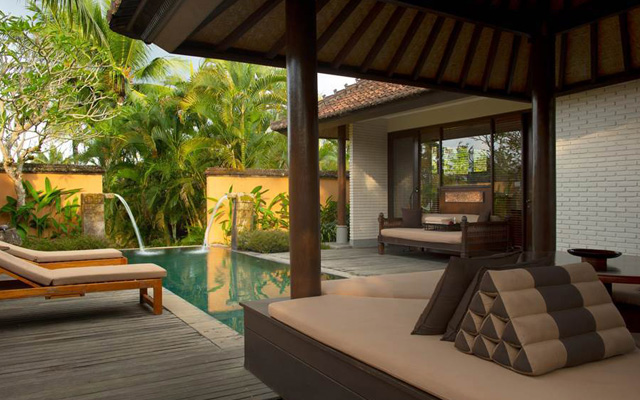
One-bedroom villa at Tanah Gajah
Meeting spaces are available on-site, alongside group activities such as rice paddy trekking, a hot air balloon ride above the resort, and fishing; as well as wellness retreats, with an open-air yoga pavilion and a head chef who can cater to all dietary needs.
Club benefits are included in the package, such as a personal butler service, daily a la carte breakfast, daily seasonal fresh fruits delivered to each villa or suite, daily afternoon tea, daily sunset cocktails, daily laundry, and yoga classes as per the property’s schedule.
The resort has had strict hygiene protocols in place over the course of Covid-19 and was recently given a 100 per cent score for its CHSE (cleanliness, health, safety and environment) certification, from the Indonesian government.
Tanah Gajah has also partnered with Garuda Indonesia on charter flights from around Indonesia and other international destinations the airline frequents. Groups after extra comfort and safety when travelling to the island can now have their own private flight. Rates and availability depend on the departure city and interested parties should contact the resort directly.
The Art of Reuniting is subject to availability and valid for stays booked until March 31, 2022.
The resort’s sister property, Dua Dari, has also launched a buyout package for smaller groups.
Formerly the private residence of Indonesian architect and designer, Hendra Hadiprana, Dua Dari consists of four residences in a valley overlooking the Petanu River.
Guests can take an art tour through the property, relax by the pool, take a picnic afternoon tea, or take the complimentary shuttle into Ubud. Package rates start at US$690++ per night (for the entire property bookout and for a minimum of two nights) including daily breakfast.
Hoshino Resorts has launched a fund and joint venture to help hotels and ryokan in Japan facing financial difficulty due to the novel coronavirus.
A 50-50 partnership by the fourth generation hotel management company and Tokyo investment bank RISA Partners Inc., the Hoshino Resorts Tourism Revitalization Fund will offer an initial 10 billion yen (US$93.4 million), with a maximum of up to 20 billion yen provisionally. It started operations on October 30, 2020, through joint venture H&R Asset Solutions.
Hoshino hopes to prevent as many ryokan closures as possible
According to Hoshino Resorts, the fund will ensure the long-term survival of hotels and ryokans that may be otherwise unable to weather Covid-19-induced financial troubles, particularly if the inbound tourism they rely on is slow to recover.
Japan’s tourism sector has been badly hit by measures to curb the pandemic in the country, which include entry bans on arrivals from more than 150 countries and regions. In January 2021, a four-week stay-home request was placed for residents of Tokyo and its three neighbouring prefectures due to a spike in cases. The detection of a new, more contagious variant of the coronavirus in four travellers who arrived in Japan has added to the concern.
While larger companies have proved better able to withstand cancellations and lost trade, privately-owned and rural accommodation providers are increasingly facing insolvency or long-term financial uncertainty.
As of end-2020, Tokyo Shoko Research reported that there have been 800 bankruptcies in Japan as a result of Covid-19. As of September 30, 2020, the most recent period for detailed data, about eight per cent of bankruptices (600 recorded at the time) were in the lodgings sector.
Hoshino Resorts believes it can prevent further cases and fulfil the needs of accommodation providers.
The idea for the fund came when the company began receiving enquiries from hotel and ryokan owners whose business continuity was at risk. They wanted Hoshino Resorts to step in and run their operations. When Yoshiharu Hoshino, CEO of Hoshino Resorts, considered the facilities, he believed they could be managed as a sub brand of Hoshino Resorts and began discussion with RISA Partners.
Under the fund, Hoshino Resorts will operate the property or aid in its management, dependent on the hotel or ryokan’s circumstances.
“In the short-term, Hoshino Resorts will support the facilities to keep their business,” said Hoshino, adding that in the longer-term, the businesses will be operated as Hoshino Resorts.
“Through the acquisition of property, this fund aims to provide a succession of business, assistance in the transfer of business, and ways of fundraising for hotel and ryokan operators that are facing a serious loss of demand,” he noted.
He added that the fund will also “contribute to the early recovery of the tourism and lodging industry after Covid-19 is brought under control”.
Although Hoshino Resorts has not determined how many properties the fund might be able to help, Hoshino shared “quite a number of facilities that are struggling at the moment” will be able to receive support.
Hoshino Resorts also aims to “cherish the local culture and community” of the properties’ respective areas, to promote the sustainability of tourism in regions across Japan.
Andaz Singapore has welcomed German hotelier Stephan Karl as its newly-appointed general manager.
With a career spanning over 24 years, Karl first started at Hotel Bayerischer Hof in Lindau as an apprentice. Over the next decade, he rose through rooms, F&B and banqueting roles at Carlton Hotel St. Moritz, Sheraton Suites Galleria-Atlanta and Castle Hospitality & Catering in Heidelberg, south-west Germany.
In 2006, his Hyatt journey began at Hyatt Regency Mainz followed by other luxury properties such as Park Hyatt Dubai, Grand Hyatt Beijing and Park Hyatt Sydney. In 2018, he received the Hyatt Leadership Award for Americas as a testament to his broad-based experiences, and for playing a pivotal role in the opening of Andaz Mayakoba Resort Riviera Maya Mexico in 2016.
His tenure in the luxury hotel scene then led him to Vietnam. For close to two years, he was part of the pre-opening team for Hyatt Regency Nha Trang as general manager, before moving on to Andaz Singapore in the same capacity.
Ongoing efforts by the Singapore Association of Conference and Exhibition Organisers and Suppliers (SACEOS) to build resilience in the industry hit by the Covid-19 pandemic, has seen an expansion in the destination’s MICE ecosystem and a rise in membership.
SACEOS’ membership has grown by around 15 to 20 per cent – rising from 110 in late-2018 to 130 since then, and 160 now – when its constitution was amended in 2020 to expand its outreach to include event technology; lifestyle and sports companies, and festival event organisers.
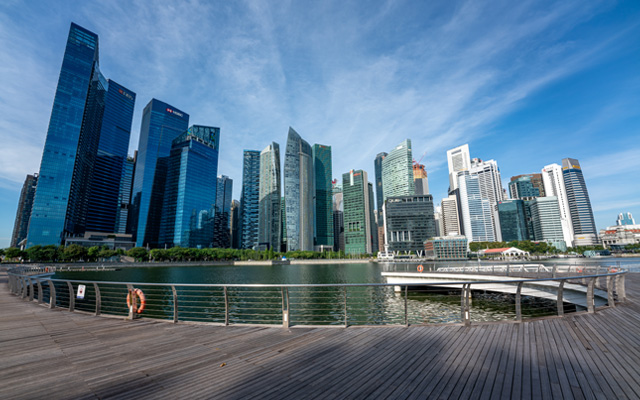
Local MICE players need to look into reconstructing their business model to survive this challenging period; Singapore CBD pictured
New members include interactive, digital and experiential company Trinax; Azeus Convene, whose clients include global universities and colleges for top-level council and campus-wide meetings; and Freeman, which provides event marketing and management services including content development, audiovisual setting and logistics.
According to SACEOS, new members see the “power of voice, community and networking” it provides, in particular for SMEs.
The October 2020 launch of the SACEOS Event Industry Resilience Roadmap (IRR) to guide the safe resumption of business events, supported by the Singapore Tourism Board and Enterprise Singapore, provided guidance on implementing safe business events, solutions for hybrid events and an overview of new capabilities needed to transform the industry.
The IRR, a “living” document that will be updated in line with the evolving pandemic situation and health and safety standards, is being developed into a “technical reference” for Singapore and will be launched soon, according to SACEOS.
Its president Aloysius Arlando, said the emergence of hybrid events is not the end as the impact of the pandemic on the industry is still evolving. “It will be a long journey and a jerky one,” he noted, adding that the effort has to shift “to build back stronger in enterprise development growth and capabilities”.
Arlando, who is chief executive, venues, SingEx-Sphere, said the whole industry had to level up and work closely with the authorities in piloting events; and not only those that have been badly affected.
He continued: “Even with the vaccine rollout, it is very clear it does not mean we will go back to normal. It will not be the pre-Covid-19 normal because the virus is evolving and vaccinations are only part of the arsenal. We still have to brace for pandemic X (should there be one) and the end is not in sight.”
Despite the low number of local daily cases, Arlando also noted Singapore, as of February 19, 2020, has been in DORSCON (Disease Outbreak Response System Condition) Orange, which indicates the virus is severe and spreads easily from person to person, for more than a year.
Describing this “lull period” as a “new model” Arlando said SACEOS had been helping members to change, but “change is tough” as pivoting to digital events is not providing the income players are looking for and there is also additional costs with safe event protocols that need to be put in place.
“The industry is changing, and changing at a different pace. It is important for different enterprises to take the first few baby steps,” the association head pointed out.
“Resources and assistance from various government agencies will help, but industry members must be willing to change, change soon to the new trajectory and learn what clients need and are hungry for.”
Arlando noted that a good number of members are “trying to figure out how to best pivot”, and cited examples of some investing in broadcast studios and green screen technology.
Calling the attempts encouraging, he stressed change has to occur throughout the industry.
“Some players are going to fall. For those who are uncertain, they must ask what they want to be, look at the support and schemes available or move to a new industry. We cannot sugar coat it,” he opined.
On industry-self help attempts, SACEOS executive director, Bita Seow, noted the association “can do with more participants” for its MICE webinars, acknowledging there are many options in the marketplace.
More encouraging, she noted, was the interest in its SG SafeEvent Ambassador programme, in partnership with NTUC (National Trade Union Congress), which has provided training for some 500 “freelancers” in the industry to help them pick up new skills and additional sources of income.
Seow is optimistic a target to double the number before the end of the year is possible.
And during last month’s webinar – Bring Back Events With Ease organised in partnership with Bona Technologies Systems and ADERA Global – SACEOS honorary treasurer, Don Tsai, again urged industry members not to “passively wait for the pandemic to blow over or to continue to expect more support from the government”.
Instead, he advised participants to do more to reconstruct their business models, to reach out to and collaborate with SACEOS, and other partners, to overcome challenges, and to familiarise themselves with the IRR SACEOS has crafted.
offered to work closely with the government in coming up with guidelines that would facilitate the re-opening of business events according to reasonable SOP
The Malaysian government has agreed to allow meetings, incentives, conferences, and exhibitions to take place in Movement Control Order (MCO) areas beginning March 5, but with a 25 per cent limit on the capacity of the premises, up to a maximum of 250 people in very large venues.
The Malaysian Association of Convention and Exhibition Organisers and Suppliers (MACEOS) voiced hope this will be the start of a more substantial recovery for the business events industry.
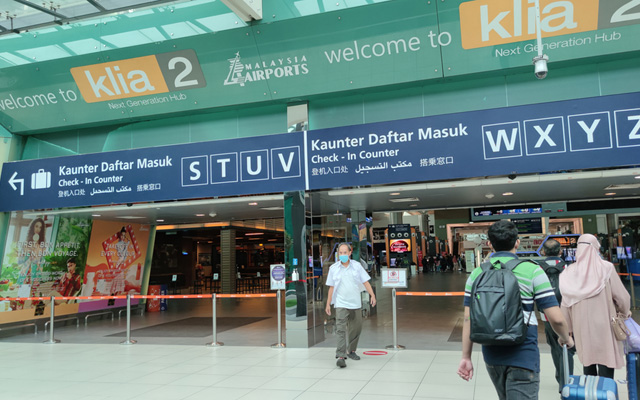
MACEOS wants to work closely with the government to develop guidelines that would facilitate the reopening of business events; passengers at KLIA 2 departure hall pictured
Its president, Francis Teo said: “We want to thank the government for giving us this lifeline. After months of lobbying for the opening of business events, we view this as the start of better things to come.”
The news was timely, he said, citing a recent survey done among members of MACEOS in which almost 64 per cent of respondents shared that they wouldn’t be able to survive another three months if the MCO was not lifted soon and events could not be organised.
However, he noted that the continued restriction on inter-district and inter-state travel since January 13 would limit the success of the reopening of business events.
He said: “As long as this travel restriction is not lifted, then the green light on business events will not be of many benefits to industry players. It is unlikely that events (will be limited to only) participants from only one district.”
He also voiced concern over the recent statement made by the Ministry of Health that travel restrictions would be extended until 70 per cent of the population was vaccinated.
Teo said: “The vaccination programme is only expected to be completed by early next year. If we are to wait until then, that may mean another year or so of the travel ban. The vaccination may save us, but it may be too late as the travel ban will kill us.”
He offered to work closely with industry players and the government to develop guidelines that would facilitate the reopening of business events safely.
One of the solutions Teo brought forth was asking the government to allow event participants to cross districts or state borders with proof of event registration while the travel ban is still in place.
He stressed: “Business events is an industry that supports all other industries in the economy. The re-opening of business events during these difficult times is the surest way to revitalise our local and national economy and lift Malaysia out of this economic slump.”
Dr Low dishes out some advice as to how build a vaccination policy that is within their control, and addresses future business needs
Dr Low dishes out some advice as to how a vaccination policy can be built, while addressing future business needs
With Singapore’s Covid-19 vaccination campaign well underway, many of us have started wondering when we might travel again – for business or leisure.
Real-world data has shown that herd immunity is a distinct possibility in the near future and we may see large-scale events or business trips back on the calendar soon. Governments and authorities worldwide have already started planning for the resumption of travel, with adjustments in quarantine requirements and other border restrictions.
For example, Israel has announced deals with Cyprus and Greece to allow fully vaccinated citizens to travel within these countries without limitations, once flights resume. We are likely to see similar arrangements in Asia soon, which will require organisations to relook their corporate travel policies.
However, there are many steps before we get back to business as usual – and one key factor right now would be achieving herd immunity through vaccine uptake. Organisations can play a critical role in supporting the national immunisation campaign, and accelerating our progress in achieving herd immunity, by developing a corporate vaccination policy that supports employees and communities at large, and builds workforce resilience even beyond this pandemic.
With vaccine rollout plans drastically varying per country, how can organisations build a vaccination policy that is within their control, and addresses future business needs?
Here are four steps to get started on developing a robust and resilient vaccination policy:
1. Define your objective
Each country’s vaccine rollout plan differs and impacts the corporate vaccination policy. For example, in Singapore where the vaccine rollout is largely driven by the public healthcare system – the role of the business would be to support the national agenda and encourage employees to get the vaccine. In other countries, for example in Indonesia, private sector organisations may obtain and administer vaccines for their workforce.
2. Assess the threats
A vaccination policy provides evidence-based guidance to ensure three critical outcomes: consistency, accountability and efficiency. This ensures that the entire workforce is treated fairly, has ready access to vaccines, and takes into account the health, safety and wellbeing of each individual.
To achieve this, organisations need to take a holistic view of their operations and assess the various health and security threats that their workforce is exposed to, This will depend on the nature of your work and daily operations – some industries like aviation and healthcare will have far greater exposure to Covid-19 transmission, and require a more granular approach.
In an ever-evolving pandemic, having access to accurate intelligence is key to ensuring quality and consistency in your vaccination policy. With specific vaccine intelligence interrogated by a medical professional, organisations can uncover threats, risks and trends specific to their business, and make informed decisions on how this affects their policy.
This also ensures that your vaccination policy is based on country-specific information, government regulations and employee population.
3. Communicate openly and regularly
As with all organisational changes, communicate transparently and regularly with your employees. After disseminating the information to your workforce, constantly engage with them to uncover developing challenges, risks and goals which will arise at different stages of the immunisation campaign. It is important to be entirely transparent with your workforce and offer various channels for communication.
Education is also critical for employees to make informed decisions on their health and wellbeing. Proactively conducting educational webinars or engaging with health experts to answer common questions that employees may have will instil confidence and trust so that employees can share their concerns or hesitations, and encourage vaccine uptake. Employers should also be sensitive in delivering these messages, so that employees feel heard and understood.
4. Ready access, reporting and re-evaluating
Where possible, ensure easy access to vaccines through company-wide vaccine drives, or arrangements with healthcare providers can provide the needed push for employees to get vaccinated. In regions where vaccination is predominantly a public health initiative and vaccine supplies are controlled by the government, allocating time off work for vaccination appointments and making financial and leave provisions for possible vaccination-related side effects can go a long way towards resolving logistical and non-medical barriers.
However, companies must be careful to balance between encouraging, and mandating vaccine uptake. Vaccinations are a largely personal issue, and employees may refuse to take the vaccine for medical, religious, or other reasons – and such cases should be treated with empathy and fairness.
As part of the process, companies will need to monitor their vaccination programme’s progress, successes and challenges to make accommodations and changes to overall business operations. Notable challenges can then be proactively managed and brought back on course to ensure that employees remain protected from Covid-19 and other health threats, while organisations can uphold their Duty of Care.
A successful vaccination programme is flexible, and continually evolving to adjust and account for changes in the global situation. Ultimately, companies must ensure a safe and inclusive working environment for all, for long-term workforce and business resilience.
The newly-opened Ritz-Carlton, Bangkok anchors the One Bangkok development with cosmopolitan elegance. Featuring the city's largest ballroom and a spectacular new penthouse suite, it delivers exceptional hardware and deeply authentic, soulful service for business and leisure travellers alike
Behind the imposing, Brutalist concrete that defines Zurich’s Oerlikon district lies a surprising secret. While its exterior honours the neighbourhood’s industrial roots, stepping inside Mama Shelter reveals a vibrant, neon-soaked world that is a far cry from its rigid shell
A polished urban retreat designed for business travellers, Hyatt Regency Kuala Lumpur at KL Midtown combines thoughtful design, seamless service, and exceptional facilities.